Archives for:

"WWAMI"

State Supreme Court affirms Dunleavy decision that drained fund for Alaska college scholarships

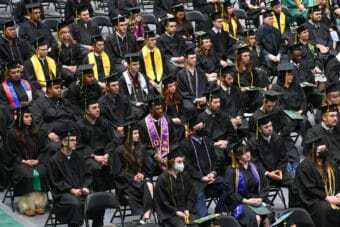
The University of Alaska Anchorage held commencement ceremonies on Sunday, May, 1, 2022. (Photo by Bill Roth/ADN)

The Alaska Supreme Court affirmed Tuesday a lower court decision against a handful of Alaska college students who sued the administration of Gov. Mike Dunleavy, challenging a decision that drained Alaska’s $410 million Higher Education Investment Fund.

The decision means the Alaska Performance Scholarship program and WWAMI, the state’s equivalent of medical school, do not have a dedicated funding source and must compete with other programs in the state’s annual budget process, but a separate effort by the Legislature may reinstate a dedicated account.

“Although the plaintiffs tried to make this case about supposed policy calls made by the executive branch, the Court recognized that the State was just following the Alaska Constitution,” Deputy Attorney General Cori Mills said in a statement released after the court’s ruling.

“No one disputes that the performance scholarships are an important program, which is why Governor Dunleavy included appropriations to pay for the scholarships in his budget. But that does not mean that the Higher Education Investment Fund falls outside of the reach of the constitutionally required sweep into the CBR (constitutional budget reserve),” Mills said.

The scholarship programs remain funded through at least June 30, and the budget making its way through the Legislature has money to fund the programs in the next fiscal year.

The Legislature is separately considering a bill that would remove the fund from the state treasury so that it can’t be emptied by the end-of-session legislative sweep. That measure, House Bill 322, passed the state House on Monday, and is heading to the Senate for consideration.

“We are not giving up,” Pat Pitney, president of the University of Alaska System, said in a statement Tuesday. “We have been simultaneously working to fund HEIF and the programs it supports through legislative action.”

The fund “is too important,” Pitney said. “Our state’s future is inextricably linked to the success of our people and their access to high-quality workforce training and higher education.”

Pitney said the university will dedicate its efforts to “solving this issue by supporting HB322.”

That bill would create separate accounts for higher education scholarships and for the Alaska Marine Highway System.

“Ongoing crucial state services such as the Alaska Marine Highway System should not suffer the destabilizing effects that may result from the sweep of the funds,” said Rep. Dan Ortiz, I-Ketchikan. The bill would create “needed certainty” both for the ferry system and for the higher education investment fund, he said.

The bill originally applied only to the Alaska Marine Highway System fund and was amended to cover the education fund.

“It’s about our workforce. It’s about our future engineers, our future business accountants, our teachers. Many important jobs that need to be filled,” Rep. Andi Story, D-Juneau, said on the House floor, before the House voted 25-15 to pass the bill.

Lawmakers who opposed the measure said that creating separate accounts defied the state’s constitution.

In the Superior Court decision that was affirmed by the Supreme Court, Anchorage Superior Court Judge Adolf Zeman said that Dunleavy’s administration correctly classified the higher-education fund as part of the state’s general fund in 2019. That made it subject to a clause in the Alaska Constitution that requires leftover general fund money to be automatically swept into the Constitutional Budget Reserve, a special savings account.

The Alaska Legislature regularly votes to reverse that sweep, but it failed to do so in 2021 because of opposition by Republican legislators in the state House. That failure, combined with the administration’s classification, drained the fund.

This story was originally published by the Anchorage Daily News and is republished here with permission.

Alaska senators consider bill to protect accounts used for scholarships, ferries

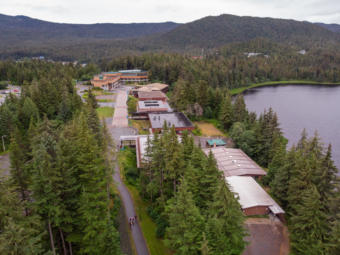
The University of Alaska Southeast campus in Juneau, shown in July 2019. On Tuesday, the Senate Finance Committee discussed a bill that is intended to protect a state account used to pay for university scholarships and grants. (Photo by David Purdy/KTOO)

The Senate Finance Committee is weighing a bill that’s aimed at protecting state accounts used to pay for university scholarships and the ferry system.

The intent of Senate Bill 224 is to keep any money in the accounts from being swept into a state piggy bank, the Constitutional Budget Reserve. 
A Superior Court judge recently ruled against university students who sued to keep more than $400 million in the Higher Education Investment Fund.

It pays for Alaska Performance Scholarships, Alaska Education Grants and the state’s medical education program, WWAMI, named after the initials of the states that participate, Washington, Wyoming, Alaska, Montana and Idaho.

The sweep grew the Constitutional Budget Reserve from roughly $1 billion to $1.5 billion.

Bethel Democratic Sen. Lyman Hoffman said at a committee meeting on Tuesday that Alaskans who rely on the scholarships and the ferries want more certainty. 

“I think these two need to be taken care of as soon as possible, particularly the Alaska Higher Education Fund, because this one has the most funds in it and to put them aside and get them unsweepable, I think, is something that the people of Alaska are looking forward to,” Hoffman said.

Dozens of other accounts wouldn’t be protected through the bill. They range from a fund for tobacco cessation programs to one that pays to maintain the Whittier tunnel. 

Wasilla Republican Sen. David Wilson said he’s concerned about that. 

“I don’t want to pick winners or losers and [be] trying to pick out, you know, this fund versus this fund – I believe we should just take action to either do them all or none,” he said.

Hoffman said he wants to start with the higher education and marine highway accounts so that the bill is less likely to get bogged down in the legislative process. 

The bill would put the accounts in a similar legal position as the Power Cost Equalization Endowment Fund, which pays to reduce the cost of power in high-cost areas. In a separate court case last year, a judge ruled that $1 billion in that fund is not subject to being swept into the Constitutional Budget Reserve. 

The House is considering two bills on related subjects. House Bill 229 focuses on protecting the higher education fund, while House Bill 57 seeks to protect all of the separate accounts.

Even if the Legislature passes any of the bills, it would need to take another step to put the money back into the accounts that’s already been swept out of them. 

It would take three-quarters of both legislative chambers to agree to draw money from the Constitutional Budget Reserve. If that doesn’t happen, the Legislature could put money into the accounts as part of the regular budget bill, but that would leave less money available for other programs.

Anchorage judge to decide fate of $400 million scholarship fund

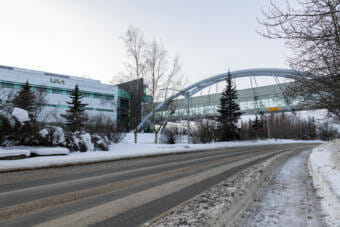
The University of Alaska Anchorage campus on Dec. 30, 2021. On Tuesday, Anchorage Superior Court Judge Adolf Zeman heard oral arguments in a lawsuit by four Alaska university students suing the state to try to keep more than $400 million in the Alaska Higher Education Investment Fund. (Photo by Lyndsey Brollini/KTOO)

An Anchorage judge will decide in the next two weeks whether more than $400 million will remain in a state fund that pays for scholarships and need-based grants for Alaskans to attend college.

Lawyers for four Alaska university students and the state government presented their arguments to Superior Court Judge Adolf Zeman on Tuesday to determine the future of the Alaska Higher Education Investment Fund. The fund was started in 2012 with $400 million. 
But three years ago, Gov. Mike Dunleavy’s administration started sweeping the money into the Constitutional Budget Reserve, a state savings account, unless three-quarters of both the Senate and House of Representatives agreed to keep it in the higher education fund. That failed to happen last year.

So, in January, four students sued to maintain the fund. 

Jahna Lindemuth, the students’ lawyer, argued that the state misapplied a provision of the constitution that determines what money will be swept into the Constitutional Budget Reserve each year. She served as the attorney general in the administration of former Gov. Bill Walker, an independent who is challenging Dunleavy, a Republican, in this year’s election.

Lindemuth said Dunleavy had proposed language in a bill that would have eliminated the fund, which the Legislature failed to pass. She said that it wasn’t until after that happened that the administration reached its conclusion that the higher education fund money was subject to being swept without legislation.

“The governor simply has different legislative priorities than the Legislature,” she said, adding that it was a “money grab that fundamentally violates the Legislature’s rights” under the constitution. 

Assistant Attorney General Margaret Paton-Walsh represents the state in the case. She noted that the state constitution requires that unspent money in the general fund that’s available to be spent in the annual budget — also known as being “appropriated” — be swept in into the Constitutional Budget Reserve. She said that applies to the money in the Alaska Higher Education Investment Fund, which the law defines as being in the general fund.

“The Legislature is quite free to appropriate that money for any purpose that it wants,” she said. “There is no dispute about that fact.”

The judge noted that students rely on scholarships for several years, and asked Paton-Walsh if that makes the higher education fund similar to the state setting aside money for a construction project that lasts several years. 

“How’s that different than a four-year education?” he asked. 

She replied that with the higher education fund, the Legislature has to take two separate actions: putting money into the fund and then spending it on programs like scholarships. 

But with a multi-year construction project, it only appropriates it once. And the Legislature doesn’t appropriate it again for the same construction project in multiple years.

“That money is not available for appropriation because the executive branch can spend it without any further action by the Legislature, ” she said of a multi-year construction project. 

The state now considers the $422.8 million that was in the higher education fund to be part of the Constitutional Budget Reserve, which has another roughly $1 billion.

Dunleavy has proposed funding the Alaska Performance Scholarships, need-based Alaska Education Grants and the state’s medical education program in the budget for the coming fiscal year.

The money for those programs wouldn’t come from the higher education fund, but instead from the general fund, which pays for the rest of the state budget. Without the money in the Alaska Higher Education Investment, the students expressed concern that there wouldn’t be funding for the programs in future budgets. 

Judge Zeman said he would issue a decision by Feb. 22. That could allow time for the case to be appealed to the state Supreme Court and resolved by the time the Legislature finishes its work on the budget. 

Alaska Legislature to support students’ lawsuit to maintain scholarship fund

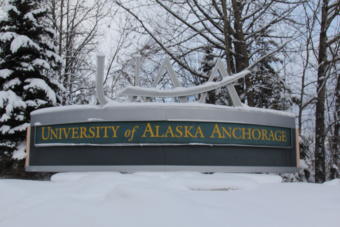
A sign on the campus of the University of Alaska Anchorage. On Monday, the Alaska Legislative Council voted to file a briefing in support of a lawsuits by university students to preserve funding in the Higher Education Investment Fund. (Photo by Tegan Hanlon/Alaska Public Media)

The Alaska Legislature is supporting the lawsuit by university students against Gov. Mike Dunleavy’s administration to protect a fund that pays for scholarships.

A joint council of the House of Representatives and Senate on Monday approved filing a legal brief backing the lawsuit.

The Alaska Higher Education Investment Fund has held more than $400 million. Each year, money from the fund pays for Alaska Performance Scholarships, need-based Alaska Education Grants and the state program for medical students, known as WWAMI.

Dunleavy’s administration has said that the money in the fund must be swept into a state savings account if three-quarters of both legislative chambers don’t vote each year to maintain the funding. That vote failed last year.

Kodiak Republican Sen. Gary Stevens said emptying the fund would leave students uncertain about whether the scholarships would be available.

“The medical students are on a long-term program, and for them not to know from year to year to year how they’re going to be supported would be quite devastating,” he said.

Dunleavy has said that he supports funding the scholarships.

The Legislative Council’s vote to support the filing was 12 to 1.

University of Alaska students sue to protect fund for scholarships, medical education

The University of Alaska Anchorage campus on Dec. 30, 2021. Four students sued on Tuesday, seeking to maintain a fund that pays for scholarships. Two attend the Fairbanks campus, one attends UAA and one is a medical student. (Lyndsey Brollini/KTOO)

Four University of Alaska students are suing the state government in an attempt to maintain a fund that pays for scholarships. 

The Alaska Higher Education Investment Fund has been under threat of being emptied of more than $400 million as a result of legislative budget fights. It pays for Alaska Performance Scholarships, need-based Alaska Education Grants and the state program for medical students, WWAMI.

Riley von Borstel of Seward is one of the students who sued. She’s the student body president at the University of Alaska Fairbanks. She said the scholarships are essential for her and other students. 

“If this funding weren’t available to students anymore, I think the University of Alaska System would see a significant decline in enrollment amongst Alaskan students,” she said. “I think many of them would decide not to attend school in Alaska if this funding weren’t available.”

Students Madilyn Short, Jay-Mark Pascua, Kjrsten Schindler and von Borstel filed the lawsuit on Tuesday against Gov. Mike Dunleavy, the Office of Management and Budget and the Department of Administration.

According to the Dunleavy administration, the money in the fund must be swept into state savings account if three-quarters of each legislative chamber doesn’t vote each year to maintain the funding. And this vote failed last year. 

Another lawsuit, filed by the Alaska Federation of Natives and 17 other plaintiffs, successfully protected the Power Cost Equalization Endowment Fund, which also has been threatened by the legislative disputes. That fund pays to lower the cost of electricity in high-cost rural areas. 

In the new lawsuit, lawyers for both sides jointly asked that a judge hear arguments in the case quickly and issue a ruling by Feb. 22, leaving time for an appeal and for the Legislature to take the ruling into account in the budget. 

Dunleavy said in a statement that he supports funding the scholarships. 

University of Alaska Interim President Pat Pitney wrote in a letter to students that the university supports the lawsuit. 


An Anchorage man took in 1 Afghan who needed help. Now he’s trying to rescue 17

Bill Barnes outside his house in Anchorage. Barnes took in Romal Safi, a student from Afghanistan, years ago. Now, they are working to bring 17 members of Safi’s family to Alaska. (Bill Barnes)

Even before Taliban rule returned to Afghanistan this summer, one Anchorage medical student was scurrying to get 17 family members out. He’s had steadfast support from Anchorage resident Bill Barnes.

Barnes, who is “semi-retired” from the IT business, has invested his heart, soul and savings account to get Romal Safi’s family to the U.S. on a temporary legal status known as humanitarian parole.

Barnes first met Safi in 2009, when Safi was an East High exchange student and Barnes was hosting a different exchange student. Safi went back to Afghanistan, so Barnes told Alaska Public Media’s Liz Ruskin he was surprised to run into him in downtown Anchorage one day in 2011.

Listen to this story:

The following transcript has been lightly edited for clarity.

Bill Barnes: I was kind of smart alecky. I said, “So what are you doing, running from the Taliban?” And he said, “Well, that’s exactly right.”

So he studied at the University of Alaska. And, you know, when he ran out of money and was in danger of getting deported, I offered him a place to stay and helped him out with his tuition. And he graduated with a degree in biology about five years ago, six years ago now.

We applied for political asylum for him, and he’s now a green card holder. He’s on his way to becoming a U.S. citizen. And he’s always wanted to be a doctor, and he got into the WWAMI program here in Anchorage and he’s a first-year medical student now.

Liz Ruskin: And now he’s trying to get his family to Alaska?

Bill Barnes: Yes. In the spring, his dad started getting visits from Taliban agents at his dental surgery, which is just north of Bagram Air Base. And I think it was pretty alarming.

We hired — Romal hired — Margaret Stock of Cascadia Cross-Border Law, who has an office here in town. Margaret suggested that we apply for humanitarian parole for his families. She said, “Well, it’s a long shot. But, you know, that’s the only thing I can think of.” And she suggested, well, you can try five of them. It’s kind of expensive — $575 apiece to apply for parole.

It took Romal and I, you know, about less than a minute to decide we would just apply for all 17.

Romal Safi is a medical student who lives in Anchorage. (Bill Barnes)

Liz Ruskin: How would you choose?

Bill Barnes: Yeah, you can’t. It’s kind of like Sophie’s Choice. Like, what are we going to do? I’m choosing them all. So we chose them all. And lo and behold, the Humanitarian Affairs Branch of the USCIS granted all 17 of them paroles.

Liz Ruskin: Seventeen members of his family — are they all immediate family members?

Bill Barnes: Pretty much. It’s a mom, dad, sisters, brothers and in-laws, and three grandkids.

But the paroles came through about the 24th of August. So it was about 10 days after the Taliban had rolled into Kabul, and the U.S. Embassy had shut down.

The parole document stated: The embassy in Kabul is closed. So if you can make your way to a third country, let us know and we’ll conduct the interviews in this third country. And in this case, it’s Pakistan.

And so they managed cross into Pakistan through the normal road checkpoints about six weeks ago, something like that. But they’ve been unable to get interviews at the U.S. Embassy in Islamabad. And it’s been really, really difficult to find out why that is, whether they’re just overloaded and understaffed. And trying to talk to the USCIS or the U.S. State Department, it’s like talking to a wall.

Liz Ruskin: Where are they living now?

Bill Barnes: They are near Peshawar. They found a place out of town to rent. The good thing about them being in Pakistan is we can send them money. Whereas once the Taliban took over Kabul, you couldn’t send two nickels into Afghanistan.

In Pakistan, we’re able to send money. So they, basically, we think, are in a safe place. Now, we would just like the U.S. government to come through with what they said they would do — interview them so they can get their boarding documents, and I’ve got enough money to get them all here.

Liz Ruskin: It sounds like you’ve really put yourself out for Romal. It sounds like you’ve funded some of these efforts yourself. Why do you feel compelled to help Romal and now his family?

Bill Barnes: You know, I asked my dad one time, you know, why he joined the Marine Corps in World War II. And he said, “My country needed me. I was in a position to help and so I did.” And that’s about it.

It just seems like I can help. I want to help. I’m getting old enough. I know I can’t take it all with me. So why not?

Barnes said others have also stepped up to help Romal‘s family. He said Thursday that they finally heard back from the Humanitarian Branch of U.S. Citizenship and Immigration Service. The agency requested updated contact information.

Site notifications
Update notification options
Subscribe to notifications