Alaska Beacon

Alaska Beacon is part of States Newsroom, a network of news bureaus supported by grants and a coalition of donors as a 501c(3) public charity. Alaska Beacon maintains editorial independence. Contact Editor Claire Stremple for questions: info@alaskabeacon.com. Follow Alaska Beacon on Facebook, Bluesky and Twitter.
Judge rejects bid to put Tara Sweeney on US House special election ballot

Tara Sweeney speaks on April 7 at a session during the 2022 Arctic Encounter Symposium in Anchorage. (Photo by Yereth Rosen/Alaska Beacon)

An Anchorage Superior Court judge ruled Friday that the Alaska Division of Elections acted correctly when it declined to replace independent candidate Al Gross with Republican candidate Tara Sweeney on the ballot for Alaska’s Aug. 16 special U.S. House election.

The decision was immediately appealed to the Alaska Supreme Court, but unless the justices overturn Friday’s decision, it means only three candidates will participate in Alaska’s first ranked-choice election.

Gross announced this week that he would withdraw from the House race despite finishing third in the state primary, whose results will be certified on Saturday. 

Under ordinary circumstances, Gross’ withdrawal would have allowed Sweeney, who finished fifth, to advance to the general election in his place.

Alaska’s new election system, installed by a ballot measure in 2020, allows four candidates to advance to the general election. The winner of the general election is chosen by ranked-choice voting.

Among the laws accompanying the new elections system is a clause that states a withdrawn candidate can only be replaced if his or her withdrawal takes place at least 64 days before the general election. 

Gross’ announcement came 57 days before the special general election, which is operating on a compressed timetable when compared to a regular election.

Alaska has been without representation in the U.S. House of Representatives since the March death of Congressman Don Young, and the special elections are intended to fill the seat until the winner of the November general election takes office in January.

Based on the timeline set by the Alaska Division of Elections, Gross would have had to withdraw from the race by June 13 — two days after the primary election day and before many votes were counted — in order for Sweeney to replace him.

Three voters filed suit on Thursday, and their attorneys argued in court and in writing to Superior Court Judge William Morse that the timeline was unrealistic and that failing to replace Gross would disenfranchise voters and allow future governors and election officials to manipulate results in future special elections.

Without a change, the attorneys wrote, “a candidate in a special election is deprived of the rights afforded candidates in a general election and voters are deprived of a substantive component of the ranked-choice voting system.”

Attorneys from the Alaska Department of Law, defending the Division of Elections, said they have no alternative, based on the plain language of the law installed by voters in 2020.

They were aided by attorneys representing Republican candidate Nick Begich, the second-place finisher in the primary. 

Polling has indicated that Republican candidate Sarah Palin, the first-place finisher, is unpopular with many Alaskans. If Sweeney were eligible for election, Begich and she would be in competition for the votes of Alaskans who both dislike Palin and are unwilling to support the Democratic candidate, Mary Peltola. 

Begich’s attorneys noted that although Alaska’s primary elections are designed to send four candidates to the general election, they can (and do) send fewer if fewer are available.

In many of this year’s legislative elections, there are fewer than four candidates running for office.

Morse ultimately sided with the state.

“That two-day window could hardly be briefer. Nonetheless, that is the period set by statute and the one the division must apply,” Morse wrote. 

“The Division of Elections need not replace Al Gross with the fifth-place vote-getter on the special general election ballot,” he said.

Election officials have said the general election ballot must be finalized by June 28 in order to meet federally imposed deadlines for sending ballots to voters overseas.

The Alaska Supreme Court said it would accept supplemental briefings until 3:30 p.m. Friday, a sign it intends to act quickly.

University of Alaska faculty rally at the Capitol as administration and union continue mediation

A woman speaks into a megaphone on the steps of the Alaska state capitol while others around her hold signs in support of university faculty
Associate Professor of Chemistry at University of Alaska Southeast Lisa Hoferkamp looks at colleague Jill Dumesnil, professor of mathematics, as she talks during a United Academics rally June 22, 2022, in front of the Alaska State Capitol. (Photo by Lisa Phu/Alaska Beacon)

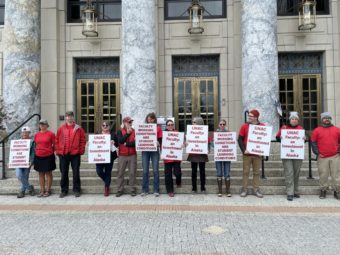
In between two scheduled mediation sessions this week, University of Alaska faculty members and supporters rallied at the Alaska State Capitol on Wednesday, calling for a fair and competitive negotiated contract.

“We deserve a fair contract and I think that the administration is stalling,” Lisa Hoferkamp said. Hoferkamp is an associate professor of chemistry at the University of Alaska Southeast and has been with the university for 22 years.

“We worked very hard, especially during the pandemic. We’ve made a lot of sacrifices in an effort to keep the University of Alaska together. And now, when it finally comes time to reciprocate or to show something, the administration refuses to negotiate fairly.”

Hoferkamp was one of about 15 university faculty joined by a dozen supporters from other unions representing state workers and supervisors, as well as school employees, rallying in front of the Capitol.

The University of Alaska administration and faculty union United Academics have been negotiating the terms of the collective bargaining agreement since late August 2021. The two parties started federal mediation in May and had three sessions that month. There was a fourth session this past Monday and another one scheduled Thursday. The rally at the Capitol Wednesday was United Academics’ third public event this summer to show solidarity.

“Faculty are tired. They have worked tirelessly through very difficult and extraordinary times. We’ve received one single 1% raise in six years and have lost approximately 20% of our purchasing power during that time. And so, we’re feeling a little pinched. Faculty, in general, are feeling a little pinched,” said Jill Dumesnil, professor of mathematics at the University of Alaska Southeast. Dumesnil is also organizational vice president of the union for the Juneau campus and sits on the union negotiating team.

In April, the administration offered what it called its “best and final offer.” In the midst of the federal mediation process, the board of regents in May approved implementing the offer, a contract the faculty union didn’t agree with, that had raises of 3%, 2.5% and 2% over three years. The move was an attempt to get the increases in the state budget before the Legislature adjourned. It failed though; the budget that passed did not include any increases for full-time faculty.

The faculty union has proposed faculty increases of 5%, between 3% and 7%, and between 3% and 6% over the next three years, with the latter two years’ increases determined by the consumer price index. The union wants the university to provide real cost of living adjustments that match inflation.

“Differing views”

In a June 16 email update to the UA community, UA President Pat Pitney described the June mediation sessions as a “resumption of negotiations” with United Academics. Last month, when the administration unilaterally implemented the contract, Pitney said an impasse had been established in negotiations. The claim has been disputed by the union.

“Resumption of negotiations after implementation of the Best and Final Offer does not mean that the university is reverting to the expired [collective bargaining agreement]. That would serve no one well and would only create confusion,” the email said. Pitney wrote the administration has been and will continue to operate under the implemented terms of the best and final offer.

“I have every expectation that we ultimately will reach an amicable and comprehensive agreement” to replace the terms of the best and final offer, Pitney wrote.

Pitney wrote the administration would request a supplemental appropriation for the provisions of an agreement that require spending when the Legislature reconvenes in January 2023.

Pitney also warned, “UA will only agree to terms that can be supported by the Board of Regents and the Department of Administration, be funded with a Legislative appropriation, and that will avoid a gubernatorial veto. A package that is too rich might not get appropriated, or worse, might get appropriated without additional funds to pay for the increases.”

Dumesnil with the faculty union said “the university administration and United Academics have differing views” on the status of the collective bargaining.

“My view is mediation has been ongoing,” she said in response to Pitney’s characterization that negotiations are resuming. “We’ve had ongoing negotiation. We’ve had mediation scheduled. We have a mediation session scheduled for tomorrow.”

A June 17 United Academics update to its more than 1,000 members said the length of time between mediation sessions was due to summer scheduling conflicts.

“The bargaining units have not reached agreement, and we have not agreed that we are at impasse, nor has our state labor agency confirmed that we are at impasse, as required by state law. The monetary terms, or any terms, of a CBA cannot be unilaterally implemented by an employer,” the update said, citing Alaska statute.

Union membership wants a new collective bargaining agreement that members can ratify, the regents can approve, and the Legislature can appropriate.

“That’s our ideal situation,” Dumesnil said. Regarding an ideal timeline, she said, “We do have a mediation session scheduled for tomorrow. So now is ideal.”

In Alaska’s first statewide by-mail vote, turnout was highest for a primary since 2014

A pair of hands guiding ballots into a beige scanner
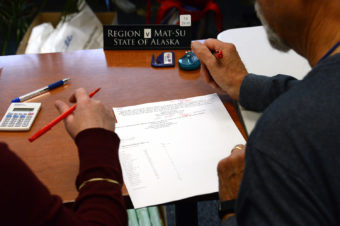
Laraine Derr feeds ballots through a scanner on Wednesday, June 15, 2022 at the Division 1 office of the Alaska Division of Elections in Juneau, Alaska. Derr was among elections workers counting ballots in Alaska’s special U.S. House primary election. (Photo by James Brooks/Alaska Beacon)

Final preliminary results posted Tuesday night by the Alaska Division of Elections show 161,614 people voted in the special election for U.S. House, Alaska’s first statewide election by mail. With 27.5% of registered voters participating, it’s the highest turnout in a primary since 2014 and the sixth-highest in the past 20 years.

Forty-eight candidates entered the race, and ordinarily, the top four finishers would advance to the Aug. 16 special general election, but the third-place finisher, Al Gross, said he will withdraw from the race.

Elections officials said that will leave only three finalists, but that decision is expected to be challenged in court by the fifth-place finisher, Tara Sweeney, who could replace Gross.

Finishing first in the preliminary results is Republican candidate Sarah Palin, with 27% of the vote. Second is Republican Nick Begich with 19.1%.

Gross, a nonpartisan candidate, is third at 12.6%, followed by Democratic candidate Mary Peltola with 10.1% of the vote.

Sweeney, a Republican, is fifth with 5.9%. Undeclared candidate Santa Claus, who has referred to himself as a Bernie Sanders-style progressive, is in sixth with 4.7% of the vote.

Democratic candidate Chris Constant is seventh (3.9%), followed by nonpartisan Jeff Lowenfels (3.7%), Republican John Coghill (2.4%) and Republican Josh Revak (2.4%).

No candidate outside the top 10 had more than 2% of the vote.

Election workers are expected to certify the results by Saturday after checking some votes by hand and conducting further review as required by state law.

At least 7,426 of the received ballots were disqualified and not counted for any candidate, based on a preliminary tally published Monday.

The rejection rate was running above 17% in one Southwest Alaska state House district and above 14% in a House district along the Bering Strait.

Turnout increased in 35 of the 40 state House districts compared with the 2020 primary. The only districts with fewer ballots cast were the four districts in Northern and Western Alaska, and the district that includes most of Joint Base Elmendorf-Richardson.

After certification, the Division of Elections will publish a report identifying the reasons for rejection and will notify voters whose ballot was cast but not counted for any candidate.

COVID-19 vaccines for kids under 5 are rolling out in Alaska

""
A firefighter prepares pediatric doses of the Pfizer-BioNtech COVID-19 vaccine on November 3, 2021, in Shoreline, Washington. On Monday, providers in Alaska began administering the vaccine to children under 5. (Photo by David Ryder/Getty Images)

Kids as young as 6 months old were able to get a COVID-19 vaccine from at least one vaccine clinic in Alaska on Monday, just two days after the Centers for Disease Control and Prevention signed off on the vaccine. Support service company Fairweather LLC is holding vaccine clinics in two different locations in Anchorage every day for the rest of the month, offering both the Pfizer-BioNTech and Moderna vaccines for kids under age 5.

Kelsey Pistotnik took her 3-year-old daughter Vivienne to get the Moderna vaccine at the Fairweather clinic in Tikahtnu Commons late afternoon on Monday. The Anchorage mom, who’s also part of Alaska’s COVID-19 Vaccine Task Force, said she felt a wave of relief as the vaccine was administered.

A woman holes a child on her knee
Kelsey Pistotnik’s 3-year-old daughter Vivienne Pistotnik gets a COVID-19 vaccine on June 20, 2022, in Anchorage. (Photo provided by Kelsey Pistotnik)

“I would make this decision 10 times over. I am just so relieved to finally have that protection for the most vulnerable in my family,” Pistotnik said.

For other providers around the state, access to the vaccine may take a little longer, according to Dr. Lisa Rabinowitz, staff physician at the Alaska Department of Health and Social Services.

“It will take several days for all the vaccine providers who preordered vaccine to receive it, but parents can check with their pediatrician or local pharmacy to see if they will be offering the vaccine and to make an appointment,” Rabinowitz said.

For public health centers, COVID-19 vaccines for the youngest age group will be available at some but not all, so it’s also wise to check in with your local public health center for more information.

All children, including children who have already had COVID-19, should get vaccinated, according to the CDC. Children under age 5 can be vaccinated with the Pfizer-BioNTech or Moderna vaccines to help protect them from COVID-19. Each is administered with its own timeline. DHSS is not recommending one over the other.

Pfizer-BioNTech is a three-dose series with three weeks between dose 1 and 2, and two months between dose 2 and 3. It’ll take 13 weeks for a kid to complete their primary series.

Moderna is a two-dose series with four weeks between Dose 1 and 2, which means it’ll take six weeks for a kid to complete their primary series.

The clinical trials and studies have shown the benefits of getting vaccinated outweigh the risks, which is why the decisions to authorize these vaccines were unanimous from the U.S. Food and Drug Administration and CDC, said Rabinowitz.

“We’re very encouraged that the vaccines are safe and effective,” she said. “We recommend that Alaska parents talk to their health care provider or pharmacist if they have questions or concerns.”

The Alaska Department of Health and Social Services is also hosting a public webinar for parents to learn more about the pediatric vaccines on Tuesday, June 28, from 7 to 8 p.m. The webinar link will be available to the public prior to the event.

How COVID has impacted children in Alaska

Children under 10 years old account for 2% of the total hospitalizations from COVID-19 among Alaska residents. DHSS does not split that data to account for children under 5. There have been two deaths in Alaska in children under 10 years old from COVID-19. Nationally, children ages 0 to 4 account for around 3.3% of total cases and .1% of total deaths. That’s according to CDC’s COVID data tracker.

“Even with these low percentages of total deaths, it should be noted that COVID-19 is the fourth-leading cause of death in children under 1 year old, and fifth-leading cause in those 1 to 4 years old,” Rabinowitz said, citing national data. “Over half of the children who were hospitalized had no underlying condition.”

In addition, a reported 23 children have been hospitalized with multisystem inflammatory syndrome in children, or MIS-C, Rabinowitz said. “It’s a severe inflammatory condition that kids, especially in that age group, will get after a COVID infection,” she said. “Most of those kids get pretty ill and end up in the ICU.”

Possible side effects of COVID-19 vaccine for babies and toddlers

Rabinowitz said possible side effects of the vaccine are similar to the 5-11 age group.

“Some fatigue and headache were the most common in 2- to 5-year-olds. You can see some irritability and sleepiness, and then the one thing that’s slightly higher in this age group is that fevers were a bit more common,” she said.

Fevers could last up to a couple of days and “treated easily with over-the-counter fever medications,” Rabinowitz said.

Mom Kelsey Pistotnik said her daughter Vivienne hasn’t experienced any side effects so far.

“She seemed just like her normal 3-year-old self, yesterday and today.”

Yukon-Kuskokwim Delta wildfires, part of a new pattern, push Alaska to early season milestone

An aerial photo of smoking tundra
The Apoon Pass fire, seen from the air on June 11, is the second-largest tundra fire on record in the Yukon-Kuskokwim Delta. Vegetation changes driven by climate warming have made the tundra more flammable, experts say. (Photo by Ryan McPherson/BLM Alaska Fire Service)

Alaska wildfires have already burned 1 million acres, crossing that threshold earlier in the summer than in any summer in recent decades.

The milestone was driven by large and plentiful fires in a region of the state that, until recently, had only modest burning – the tundra-rich delta in southwestern Alaska that lies between the lower Yukon River and the Kuskokwim River.

Already, the 163,533-acre East Fork Fire near the Yup’ik village of St. Mary’s, sparked by lightning on May 31, is among the biggest tundra fires on record in Alaska. And the nearly Apoon Pass Fire, reported at 72,499 acres Monday, now ranks as the Yukon-Kuskokwim Delta’s second-largest tundra fire on record, said Rick Thoman, a climate specialist with the Alaska Center for Climate Assessment and Policy at the University of Alaska Fairbanks.

The 1 million-acre mark, reported on Saturday morning by the Alaska Interagency Coordination Center, is clearly earlier in the summer than at any time since daily records began in 1993 – and most likely earlier than in any year since 24 years before that, said Thoman, who combed through news accounts from big fire years.

“I’m pretty confident that this is the earliest since at least 1969,” he said. That was a particularly hot year, with temperatures as high as 98 degrees, he said, and it turned out to be the fifth-biggest wildfire year, with 4.23 million acres burned.

Wildfire activity and acreage increased dramatically starting in 2015 in southwestern Alaska’s Yukon-Kuskokwim Delta. (Graph provided by Rick Thoman/ACCAP)

This year’s early burning is notable for its location, said Thoman and other experts who pointed to the large number and size of Yukon-Kuskokwim Delta fires.

“Something’s different in the Yukon Delta. That is a fact,” he said.

“Something obviously different is happening,” echoed Nancy Fresco, a research professor with UAF’s Scenarios Network for Alaska and Arctic Planning.

There were wildfires there in the Yukon-Kuskokwim Delta in the past, she said, but there has been a jump since 2015, statistics show. “It is burning becoming much more frequent, now with larger areas burned, very recently,” she said.

This year’s fires are the product of a combination of long-term climate change and short-term ignition forces, Fresco said.

Climate change has loaded more burnable fuel — shrubs and trees — onto what used to be sparse tundra vegetation, she said. “The vegetation is changing. And that vegetation change is being driven by climate change,” he said.

Short-term forces included a lot of lightning that sparked fires in tundra areas where snow vanished early in the spring, she said.

It’s too early to conclude that the Yukon-Kuskokwim Delta has crossed a tipping point, said Brian Brettschneider, a National Weather Service research scientist. Nonetheless, short-term conditions this spring and early summer were a perfect setup for fires, he said

A record-cold November there was followed by a relatively mild winter and spring melt-off of snow, Brettschneider said. There are extremely dry conditions that stretch from southwestern Alaska to the eastern part of the state, with some areas experiencing drought, according to the U.S. Drought Monitor. Then lightning adds the spark, he said.

“Early snowmelt and occasional lightning strikes and we’re off to the races,” he said.

Even short-term factors, however, can carry a climate-change fingerprint, Fresco said.

The East Fork Fire burns about 5 miles outside of the Yup’ik village of St. Mary’s on June 10. Sparked by lightning on May 31, it is the largest Yukon-Kuskokwim Delta tundra fire on record. (Photo by Ryan McPherson/BLM Alaska Fire Service)

When the climate is warming over the long term, there is more likelihood of early snowmelt out and heat that dries out the ground surface, she said. Additionally, the growth of vegetation has a drying effect because the bigger and more plentiful plants draw in more moisture, leaving the ground drier.

“The entire ecological regime of the region is changing, and this is being driven by climate change,” she said.

Statewide, Thoman said, chances of an extremely big fire season have increased.

Reaching the 1 million-acre threshold in early summer is not necessarily a predictor of a lot of late-summer burning, he said. However, Interior Alaska — the usual center for Alaska wildfires — is now primed for big burns, with its extreme dryness, flurry of lightning strikes and heat forecasted for coming days, he said.

As of Monday morning, 289 fires had burned 1.04 million acres statewide, with recorded fires this year stretching from Adak in the Aleutians to spots above the Arctic Circle in northeastern Alaska, according to the Alaska Interagency Coordination Center.

Alaska’s biggest wildfire season on record was in 2004, when over 6.5 million acres burned.

Alaska’s majority-Native districts had uneven voter turnout in 2020, analysis finds

Campaign signs in Nome, seen on Oct. 2, 2020, urge votes for a slate of Democratic candidates. The Nome Census Area had a 50% turnout in the 2020 election, close to average for majority-Native districts around the nation but lagging the overall U.S. turnout of 67 percent, according to an analysis by the National Congress of American Indians’ Policy Research Center. (Photo by Yereth Rosen/Alaska Beacon)

Among all the nation’s majority-Native voting districts, one in Alaska had the highest turnout in the last presidential election, while others in Alaska had some of the lowest turnouts, according to an analysis by the National Congress of American Indians Policy Research Center.

The majority Yup’ik Yukon-Kuskokwim Census Area of southwestern Alaska posted a 75% turnout rate in 2020, topping those of all county or county equivalents where Indigenous residents comprise at least half of the voting-age population, according to the analysis.

In contrast, the Northwest Arctic Borough, where 83.8% of voting-age residents are Indigenous, had a turnout of only 38% in the 2020 election, near the bottom among the nation’s majority-Native counties or county equivalents. The Lake and Peninsula Borough, with 43% turnout, and Kusilvak Census Area, with 44% turnout, were also near the bottom.

The average voter turnout for the 28 analyzed majority-Native regions across the nation was 53%, according to the Policy Research Center’s findings, which were presented at the NCAI midyear convention held this week in Anchorage.

That average lagged the 67% national voter turnout, the analysis noted. The majority-Native region with the second-highest 2020 voter turnout was Arizona’s Apache County, at 72%, according to the analysis, while the lowest voter turnout was in South Dakota’s Oglala Lakota County, at 37%

The percentages are only estimates that rely on multiple sources of data, as states and local governments “do not collect voter data by race and ethnicity,” the analysis cautioned. Still, “these rates may better inform voter mobilization rates in these regions of the country, as well as provide evidence to continues barriers to voting on reservations and in locations with high numbers of AI/ANs,” it said, referring to American Indians and Alaska Natives.

To Mike Williams Sr., chief of the Akiak Native Community and a longtime Yup’ik leader, the biggest impediment to boosting voting in Alaska’s rural, majority-Native areas is skepticism about whether those votes matter since “urban centers are where the most people are.”

“I think the major issue that I notice is, ‘Does my vote count? Because urban areas have the biggest population, why should I vote?’” he said Thursday, at the close of the National Congress of American Indians midyear conference in Anchorage.

Another issue is ensuring that voting information and instructions are readily accessible to rural voters, including those for whom Yup’ik is the primary language. “I think we need to continuously educate the poll workers,” he said.

The advancement of Yup’ik candidate Mary Peltola as one of the top candidates in Alaska’s ranked-choice U.S. House election, Williams said, should stimulate more Native voting interest. Peltola, a former state legislator, has valuable political experience, he said. “I think she knows how to do the campaigns and how to get the votes,” he said.

Nationally, increased Native voting participation is a priority of the Biden administration, Interior Secretary Deb Haaland said in her address to the conference.

“This administration believes that voting is the most fundamental American right, and we are doing everything in our power to ensure that every American, whether you agree with us or disagree with us, who wants to vote is able to vote,” Haaland said Wednesday by teleconference.

Site notifications
Update notification options
Subscribe to notifications