Alaska Beacon is part of States Newsroom, a network of news bureaus supported by grants and a coalition of donors as a 501c(3) public charity. Alaska Beacon maintains editorial independence. Contact Editor Claire Stremple for questions: info@alaskabeacon.com. Follow Alaska Beacon on Facebook, Bluesky and Twitter.
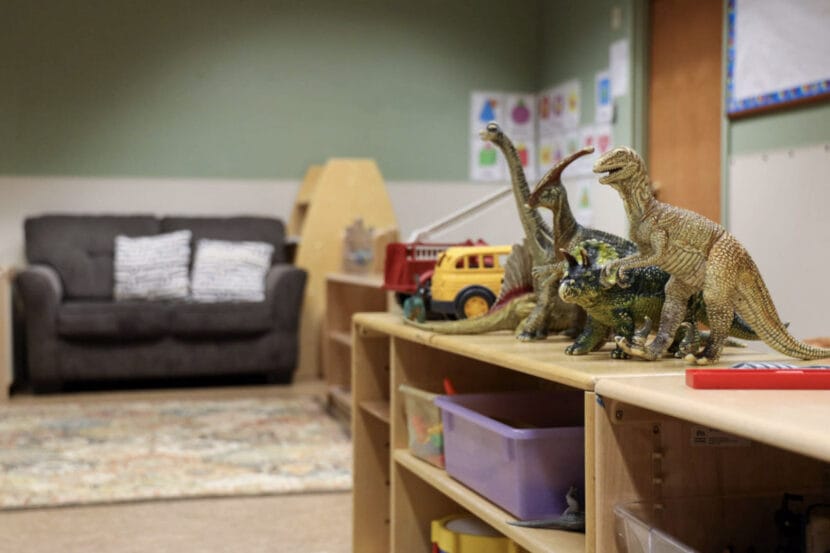
Gold Creek Child Development Center in Juneau in January, 2023. (Photo by Clarise Larson/KTOO)
Alaska school districts that offer early childhood learning programs for children ages 4 and 5, such as programs to help children be ready for kindergarten, could see a state funding boost under new legislation currently being considered by the Alaska Senate.
Senate Bill 93 would boost funding for school districts that are currently enrolled in early education programs under the Alaska Reads Act. The bill would increase per-student funding from half funding to the full amount for other students within the state’s public education funding formula.
The Alaska Reads Act program supports early literacy for pre-K through grade 3 with the aim of improving reading.
“The concept isn’t new,” said Sen. Löki Tobin, D-Anchorage, the bill’s sponsor, citing a body of research supporting improved lifelong learning outcomes following pre-K programs. “For every dollar we invest in high quality early learning, we see a $32 return on investment in increased earning potential, higher graduation rates, higher engagement and post-secondary opportunities.”
She explained with the outmigration of families and children from Alaska, funding early learning programs would encourage young student enrollment. “Last year, the Legislative Finance Division indicated about 3,700 kids left our public education system in total,” she said. “So what our hope is, is not only to provide districts with full funding to maintain their pre-elementary programs, but also to help balance out that outmigration with incoming students.”
School districts can choose to offer prekindergarten in Alaska, and districts’ enrollment in early learning programs under the Alaska Reads Act is also voluntary. Currently the participating districts are Anchorage, Skagway and Valdez.
The Department of Education estimates the funding increase would cost roughly $7.6 million, already requested in Gov. Mike Dunleavy’s budget proposal for next year, going towards funding the Alaska Reads Act, according to a fiscal note to the bill.
State Education Commissioner Deena Bishop said that the governor’s budget includes roughly $4.7 million to sustain funding for existing early education programs and $3 million to expand the number of districts with these programs. The Alaska Reads Act planned for annual increases in funding and programs, Bishop said in a text statement through a spokesperson.
“We look forward to all Alaska school districts who desire to serve their communities with pre-schools, can do so,” she said. “The Alaska Reads Act was a transformational piece of legislation. The present bill builds on its success.”
Tobin said the increased funding could also help alleviate child care costs for families. “We know those pre-K kids are in their communities, their parents might be struggling to braid together support for child care, or for babysitting,” she said. “And by not only providing stability for districts to offer these programs, we also are helping them in stabilizing their school population, and also helping families that are looking for child care options that are high quality and available.”
The bill now is set to be heard in the Senate Finance Committee, where Tobin hopes lawmakers support the education investment. “We know it’s not going to have an impact on our budget. And we do know the fiscal notes of the Alaska Reads Act were adopted when the bill was passed in 2022, so it’s not going to have a discernible impact on our current budget projections.”
Correction: The ages affected by the legislation were incorrect in the headline and first paragraph in the initial version of this article. The legislation would affect 4- and 5-year-olds, but not 3-year-olds.
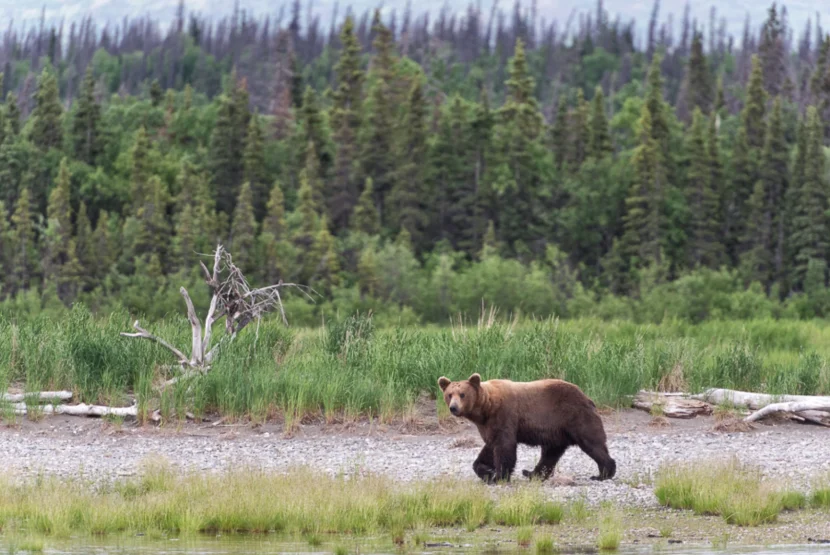
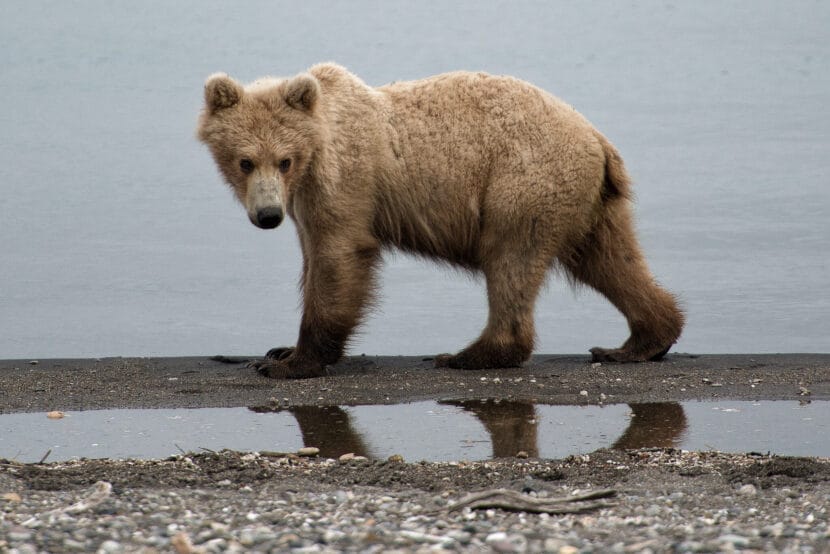
A young adult brown bear walks in front of a forested area in Katmai National Park and Preserve on June 16, 2018. (R. Taylor/National Park Service)
The Alaska Board of Game on Thursday approved state officials’ request to continue a controversial predator control program in Western Alaska, even though a judge ruled two weeks ago that the bear-killing program violated the state constitution.
The board granted an Alaska Department of Fish and Game petition for emergency action to carry out a third season of shooting bears and wolves to keep them from preying on the ailing Mulchatna Caribou Herd. In the past two years, the predator control program — carried out in late spring and early summer within the herd’s range — killed 175 brown bears, five black bears and 19 wolves, according to the department.
The emergency finding is warranted to help a herd that fell from a peak of about 200,000 in the late 1990s to about 13,000 now, too low to allow any hunting, board members said on the final day of a weeklong meeting in Anchorage.
“Right now, we have a herd that has shut down where a large number of people in Western Alaska can’t put caribou in their freezer right now. And it’s not going to grow if they don’t have calf survival,” said Stosh Hoffman, a board member from Bethel.
People in the region need to be able to hunt caribou because other food sources are uncertain, Hoffman said.
“We’re in tough times out here. A lot of things are changing. The salmon is in big decline. Our moose population, everyone knows it’s going to tip over real soon, like new moose populations tend to do. When they crash, they crash hard,” he said. He noted that the Alaska Federation of Natives, at its last convention, unanimously supported a resolution in favor of Mulchatna predator control.
But Nicole Schmitt, executive director of the Alaska Wildlife Alliance, said she was “shocked” at what the department and the board did.
“We just think it was a complete betrayal of the public process,” Schmitt said. Emergency regulations in the past have closed hunting, not opened or reopened predator control, she said. “This says to me if the board wants something done, they will manufacture an emergency to that end.”
The Alaska Wildlife Alliance is considering how to respond, she said. We’re looking at something that includes a legal response, as well as other options,” she said.
The Department of Fish and Game submitted the petition for emergency action last Friday, on the first day of the regularly scheduled Anchorage meeting.
While department officials say the predator removals done to date have resulted in increased calf births that help the herd, opponents say factors like habitat change rather than predation are behind the herd’s population decline.
Opponents also say that the program threatens populations of bears, including those that frequent the well-known bear-viewing areas in Katmai National Park and Preserve.
The Alaska Wildlife Alliance filed a lawsuit in 2023 that resulted in the ruling against the program.
Superior Court Judge Andrew Guidi ruled on March 14 that it was carried out in violation of public-notice and public-comment requirements and that it violated the state constitution’s sustained-yield mandate by failing to adequately evaluate impacts to bear populations.
At the Board of Game meeting, there was debate among members about whether adequate public notice and opportunities for public comment had been given this time. Some members argued for a separate meeting. But the majority, by a 5-2 vote, decided to deal with the matter Thursday, the last day of the weeklong meeting.
The vote to authorize the program’s resumption passed by a 6-1 margin. Member John Wood, who agreed with others that the matter qualified as an emergency but had expressed some concerns about proper public notice, was the lone dissenter.
Ryan Scott, director of the department’s Division of Wildlife, said the program can start imminently. To be effective, it has to be carried out in the late spring and early summer, during the calving season, he said.
The department is poised to start its third season of the Mulchatna predator control, he told Board of Game members.
“It’s not about beginning to gear up. We are full tilt. We have contracts in place, we got fuel moving,” he told the board. Though the court ruling has implications for proper processes to follow, the department is treating the matter as having some urgency, he said. “I mean, 30 days from now, we’ll probably be putting people in the field,” he said.
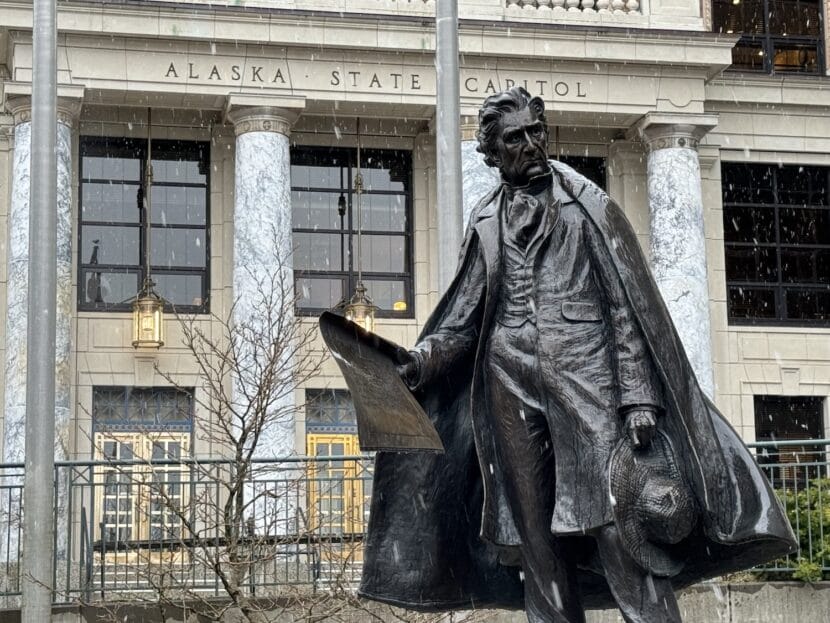
Snow falls on the Alaska Capitol and the statue of William Henry Seward on Monday, April 1, 2024. (Photo by James Brooks/Alaska Beacon)
Members of the Alaska Legislature said this week that they’re likely to use the state’s Constitutional Budget Reserve to fix a roughly $173 million budget deficit for the 12 months that end June 30.
Lawmakers are confronting another, larger deficit as they craft the budget for the fiscal year that begins July 1, but it remains possible that some tax increases — on oil, business income and online sales — could offset the need to spend from savings for that year.
When it comes to the current fiscal year, things are more certain. Passing new taxes and implementing them would take time, and the state’s budget needs to be balanced by June 30.
While members of the Senate’s bipartisan coalition majority previously rejected the idea of spending from savings, they admitted this week that there is no other option.
“Times change, things change, and sometimes you have to eat crow up here,” said Senate President Gary Stevens, R-Kodiak, during a news conference with reporters.
Spending from the state’s $2.8 billion Constitutional Budget Reserve will require the approval of three-quarters of the state Senate, plus three-quarters of the state House.
Reaching those thresholds will require the support of the Republican minority caucuses in both the Senate and the House. It isn’t clear what political horse-trading — if any — will be required to get the needed Republican support.
About half of the deficit in this year’s budget is attributable to lower-than-expected oil revenue. The other half is due to budget changes proposed by Gov. Mike Dunleavy, whom the Republican minority caucuses generally support.
Among the budget additions: $10 million for the Alaska Seafood Marketing Institute, millions for wildfire firefighting, and $2.7 million to cover missed payments by the state to employees’ retirement accounts.
As of Wednesday afternoon, members of the House Finance Committee were debating the use of the budget reserve for the upcoming fiscal year as well as the current one, but those debates had yet to reach a resolution.
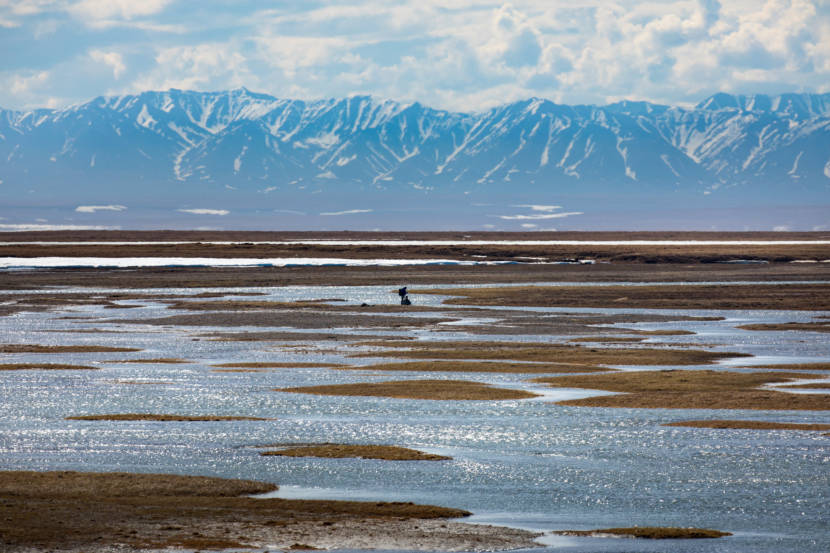
Research biologists pause among the wetlands of the coastal plain, with the Brooks Range in the background. (Lisa Hupp/USFWS)
A federal judge in Anchorage has ruled in favor of Alaska’s state-owned investment bank in a lawsuit that could clear the way for oil drilling in the Arctic National Wildlife Refuge.
In an order published Tuesday, Judge Sharon Gleason wrote that the U.S. Department of the Interior acted illegally when it canceled oil and gas leases held by the Alaska Industrial Development and Export Authority on land within the refuge.
“Having reviewed the parties’ arguments, the court concludes that DOI was required to obtain a court order before canceling AIDEA’s leases,” Gleason said in her 22-page decision.
AIDEA did not immediately respond to a request for comment, but Cori Mills, Alaska’s deputy attorney general, called the decision a victory.
“The state looks forward to working with the current federal administration on fully realizing the vast potential of ANWR to grow Alaska’s economy and help America’s energy independence,” she said by email. “It is unfortunate we have lost a significant amount of time litigating, instead of moving forward with field studies and development. We will continue to review the decision in more detail but it’s definitely a victory.”
Tuesday’s order was the result of a lawsuit filed by AIDEA against the federal government last year, when the Biden administration canceled oil and gas leases that AIDEA won in a January 2021 sale.
Two other companies also won leases during the sale but later surrendered them to the federal government, leaving AIDEA as the only company holding leases within the refuge’s coastal plain, which is believed to hold significant oil and gas reserves, just as nearby state land does.
The Biden administration claimed that the sale — conducted under the auspices of the first Trump administration — was flawed and thus illegal.
It first suspended, then canceled the leases, prompting AIDEA to sue in 2024.
Gleason had upheld the Biden administration’s suspension order, but when it came to the cancellation, she ruled in AIDEA’s favor, citing a provision of the 2017 Tax Cuts and Jobs Act that enabled the ANWR leases.
That act said in part that the Interior Department “shall manage the oil and gas program on the Coastal Plain in a manner similar to the administration of lease sales under the Naval Petroleum Reserves Production Act of 1976.”
Gleason wrote: “Among the NPRPA’s implementing regulations is a regulation that provides that ‘(p)roducing leases or leases known to contain valuable deposits of oil or gas may be canceled only by court order.’”
But the Interior Department didn’t obtain a court order, Gleason noted.
“Accordingly, federal defendants’ cancellation of AIDEA’s leases was not in accordance with law because it failed to seek a court order,” she wrote.
Several environmental and tribal groups sided with the federal government during the course of the lawsuit and had requested the ability to offer alternative solutions if Gleason ruled in favor of AIDEA.
She turned them down, writing, “DOI’s error is serious: DOI cancelled AIDEA’s leases without following the congressionally mandated procedure for doing so.”
In light of that finding, she vacated the department’s lease cancellation decision, saying the department — now back in the hands of the Trump administration — may decide what to do next.
In a statement released last week, Interior Secretary Doug Burgum said he intends to open the refuge’s entire 1.56 million-acre coastal plain to development, indicating that AIDEA will be given a free hand on its leases.
For its part, AIDEA has said in multiple court filings that if allowed to proceed, it will conduct seismic testing and other preliminary work necessary to determine how much oil and gas lies within its leases.
Among the various environmental and tribal groups that stood with the federal government in opposition to AIDEA was the Gwich’in Steering Committee, represented by attorneys from Trustees for Alaska.
“This disappointing ruling ignores the destruction oil drilling will do to our communities and only deepens our resolve in fiercely defending the coastal plain from oil and gas extraction,” said Kristen Moreland, executive director of the Gwich’in Steering Committee. “We will always protect the caribou, our way of life, and future generations.”
The Native Village of Venetie Tribal Government, Arctic Village Council, and Venetie Village Council, represented by the Native American Rights Fund, said in a statement that they will continue to oppose drilling in ANWR and that “multiple legal and administrative pathways remain to ensure proper environmental review before any ground-disturbing activities could occur.”
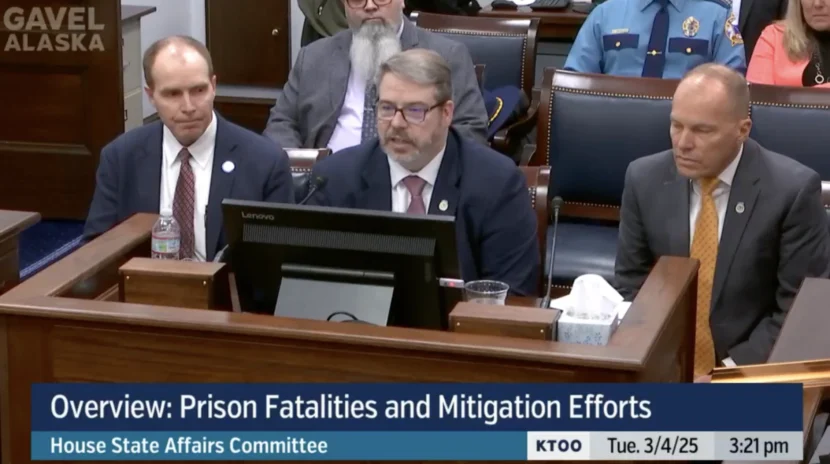
Dr Robert Lawrence, Alaska chief medical officer (left), Travis Welch, director of corrections health and rehabilitation services (center), and Dr Tim Ballard, DOC chief medical officer (right) present before the House State Affairs Committee on March 4, 2025. (Gavel Alaska)
The Alaska Department of Corrections has had at least 67 people die in-custody of state prisons and jails since 2020, with at least 17 deaths reported as suicides, according to the department.
There were at least 14 deaths last year. Two deaths were reported so far this year, with one investigated by the Alaska State Troopers and reported as a suicide.
On average, 4,500 people are incarcerated each year in Alaska’s 13 facilities, which includes individuals under arrest and awaiting trial or sentencing, known as pretrial, and those who are serving sentences. Of those in custody, an estimated 42% of men and 60% of women are pretrial, according to state data.
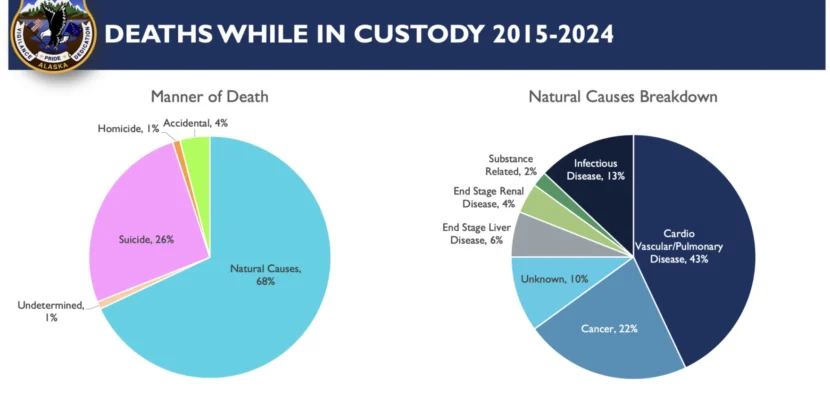
Alaska state medical and corrections officials pointed to “natural causes,” including acute and chronic disease and illnesses, as the leading cause of in-custody deaths – or 68% of reported deaths since 2015.
State officials gave a presentation to lawmakers with the House State Affairs Committee on March 4, describing causes of death from 2015 to 2024, as well as demographics and mitigation efforts.
“We do see a higher number of people who may have never seen a doctor,” said Travis Welch, director of the Division of Health and Rehabilitation Services for the Department of Corrections.
As a result of mental illness or substance use disorder, they may “lack the ability to make a doctor’s appointment and go in and see a doctor or a dentist. So the population that we’re serving is acute, and probably one of the more acute populations within the state of Alaska,” Welch said.
Causes of Alaska in-custody deaths, 2015 – 2024 (Screenshot of Alaska Department of Corrections presentation)
Officials presented data on the causes of in-custody deaths. Of the 68% of in-custody deaths reported as natural causes, 43% were reportedly from heart or lung diseases, 22% cancer, 13% infectious disease, 10% unknown, 6% liver disease, 4% kidney disease, and 2% substance related.
The health issues within state prisons mirror Alaska’s health trends, Welch said. “When we have high rates of heart disease, for example, in the state of Alaska, we’re going to see a concentrated amount of heart disease within our facilities and those we’re caring for,” he said.
Rep. Kevin McCabe, R-Big Lake, asked about expedited release processes for those who are sick or nearing end of life, like medical parole. Welch said that is ultimately up to the courts.
“We always try to house people in the least restrictive environment,” Welch said. “And when people are towards the end of their life, statute does allow for people to be released if they meet certain statutory requirements… we’re the information providers to the courts, and then the courts actually make the decision on people being released.”
There have been at least 114 deaths from 2015 to 2024, according to department data. According to the department, 78 were due natural causes, 30 were suicides, four due to accidental causes, two were homicides, and one cause of death from 2024 is still pending.
Of those, DOC reports 102 men, and 12 women died in custody, reflecting the larger statewide prison demographics. According to department data, 47% were white, 37% Alaska Native, 7% Black, 4% Native American, 2% Hispanic and 2% Asian.
“Every year, there are anywhere from four deaths up to 18 deaths,” said Dr. Robert Lawrence, Alaska’s state chief medical officer, who was the former chief medical officer for the Department of Corrections. “There’s somewhere between 11 and 12 individuals who will die during the period that they are in custody. That average has not changed. What has changed over time are the causes of death.”
Lawrence said that prior to 2015, about a quarter of deaths were due to overdose or related to symptoms of substance withdrawal. He said after the department deployed new screening and withdrawal treatment protocols, those deaths decreased substantially. “From 2017, for the next five years, there were zero deaths in that early withdrawal period,” Lawrence said. “Because of identifying the problem, coming up with a mitigation strategy, and then training staff to address that.”
He said fentanyl is still a problem in the prison system, “but even still, those numbers (of deaths) remain quite low.”
Rep. Ashley Carrick, D-Fairbanks and state affairs committee chair, asked whether the department sees suicide rates also increasing.
Dr. Tim Ballard, current chief medical officer for DOC, said the suicide rate has been going down “slightly,” and that staff training and awareness for suicide prevention is ongoing.
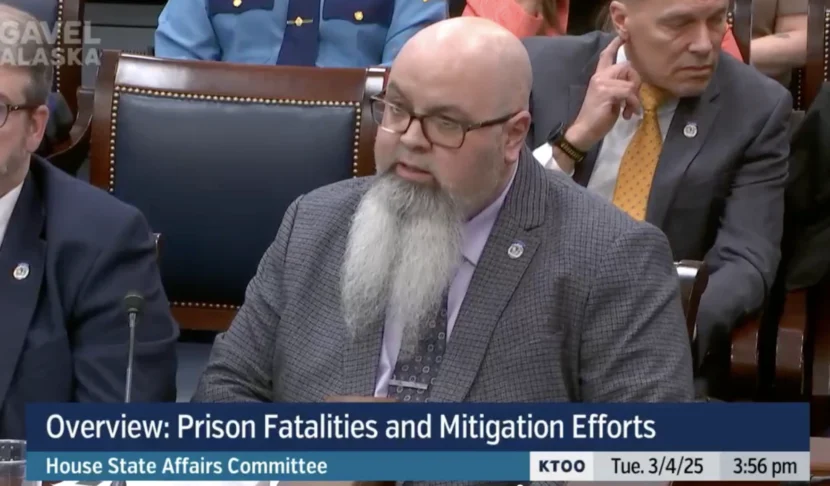
Adam Rutherford, deputy director for health and rehabilitation services with the Department of Corrections testifies on mitigation efforts to prevent in custody deaths on March 4, 2025. (Gavel Alaska)
“One of the key things that we looked at was training, and what can we do to better prepare our staff to identify folks that may be at risk, and how to respond and do appropriate referrals,” said Adam Rutherford, deputy director for health and rehabilitation services. “We also increased scenario-based training within our facilities as well. We use tools to replicate suicide attempts and how to respond appropriately from both the security side of the house and medical side of the house as well.”
Rutherford listed mitigation efforts, including adding medical bags and more cameras across facilities; installing jump barriers; and implementing larger windows for “segregation” units or solitary confinement, for suicide watch.
“So we want to be able to see folks. We want visibility. We want folks to be able to see out. We don’t want them to feel like they’re enclosed,” he said.
Rutherford said aging prison facilities are also an issue. “Our facilities are old, and let’s face it, corrections (facilities) nationally weren’t built to be behavioral health treatment facilities, and that’s really what our systems have become,” he said.
In the presentation, officials reported that 65% of the prison population are living with a mental illness, and 80% have a substance use disorder.
Rutherford said the department reviews each in-custody incident, either suicide attempt or death, in order to make improvements. “And it really is a process of looking at that continuous quality improvement, what changes can we make, and encouraging our staff to have that input and that feedback. And that’s had a significant impact,” he said.
Carrick asked about the protocol for notifying loved ones of those who have died, citing complaints from bereaved family members. “A lot of times people feel like it was a void,” she said. “They didn’t know what was going on. They didn’t know there was a problem, and then all of a sudden, their loved one is gone.”
“Full transparency, we often struggle because we often don’t necessarily have a point of contact,” Rutherford said, and that the department has to adhere to the federal Health Insurance Portability and Accountability Act privacy laws.
“It’s very difficult to make sure that we can navigate through what we’re legally allowed to disclose and what we can’t,” Lawrence added.
Rep. Andi Story, D-Juneau, emphasized it would be good practice for the department to have contact information for family members and release of information agreements in place. “If that is not a standard practice, can that be a standard practice?” she asked.
Lawmakers had more questions around suicide watch, solitary confinement, detoxification protocols, and other issues as the hourlong hearing time ended, and planned to submit those questions to the department.
“It is a very sensitive subject, and very, very close to home for a lot of Alaskans,” said Carrick in a phone interview after the hearing. “And I was grateful we were able to talk about it respectfully, and to have the Department of Corrections in front of us.”
Carrick said she sees deferred maintenance and facilities upgrades as a priority for improving prison conditions, safety and mental health services.
“Inmates have access to certain mental health services, and they have rights for health care while they’re in custody,” Carrick said. “However, that pretrial population doesn’t necessarily have any established, ongoing, mitigating mental health care.
“It’s unclear to me how accessible to the sentenced population, even long-term ongoing mental health services are,” she said. “I think the department is trying to offer what services it can, but I do think that our budget’s not reflective of the number of staff we need” to provide needed services.
Carrick said she’s concerned about the high number of suicides, and support services available.
“I don’t think any person in state custody should ever be dying of suicide,” she said.
Carrick noted that Department of Corrections health care costs are expensive, and she wants to see better management of those services to meet prison population needs.
“I think the public should be aware of what the real costs are for incarceration,” she said. “And at the same time, I’m someone who firmly believes that taking care of every individual that is in state custody is the state’s responsibility, and we should not have lacking medical or mental health care for these individuals while they are incarcerated.”
The hearing took place one day after another in custody death was reported on March 3: 42-year-old Reginald Childers Jr. of Kodiak was found dead in his cell at the Anchorage Correctional Complex. The Alaska State Troopers announced the death was a suicide.
State officials did not address any individual death incidents, investigations or outstanding lawsuits against the department at the hearing.
Carrick said she plans to hold more hearings with corrections officials on in-custody deaths, and contributing issues across the state’s prison system, like prison wages, living conditions, “access to meaningful activities or employment while in corrections, access to other services, like class services, visitation services,” she said. “A lot of these are major challenges in an understaffed and overcrowded prison system.”
Carrick said there are clear improvements to be made across facilities, and the department.
“I want folks that are incarcerated to actually come out of that experience with the tools and the skills needed to productively reenter society,” she said. “We’re not really setting any trends for extraordinary success right now, and I’d really like to see us, even potentially in the future, be a leader in what successful rehabilitation and reentry can look like.”
A subadult brown bear stands on June 8, 2018, on the shore of Naknek Lake in Katmai National Park and Preserve. A state program that is killing bears in an effort to boost an ailing caribou herd was found last week to be unconstitutional, but the Department of Fish and Game is now seeking emergency authority to continue the program. Opponents say the predator-control program will not help the caribou but could put Katmai bears at risk. (Photo by Russ Taylor/National Park Service)
Alaska officials are seeking emergency authorization to keep killing bears and wolves in a region in the western part of the state even though a judge ruled a week ago that the state predator control program there was unconstitutional.
The Alaska Department of Fish and Game on Friday petitioned the state Board of Game for an emergency regulation allowing the “intensive management” program to continue for a third year in the range of the ailing Mulchatna Caribou Herd.
The proposal came on the first day of an eight-day Board of Game meeting in Anchorage. The board sets hunting rules that are carried out by the department.
The Mulchatna herd, in Western Alaska, peaked at 200,000 animals in 1997, but it is now down to about 13,000 animals. Hunting has been closed for several years. Department officials argue that removal of bears and wolves is needed to help the herd population grow back. Residents of dozens of rural communities in the region have traditionally depended on the herd for food, and increased caribou numbers would allow their hunts to start again, department officials argue.
So far, the state program that started in 2023 has killed nearly 200 bears and 19 wolves through the program, according to the department.
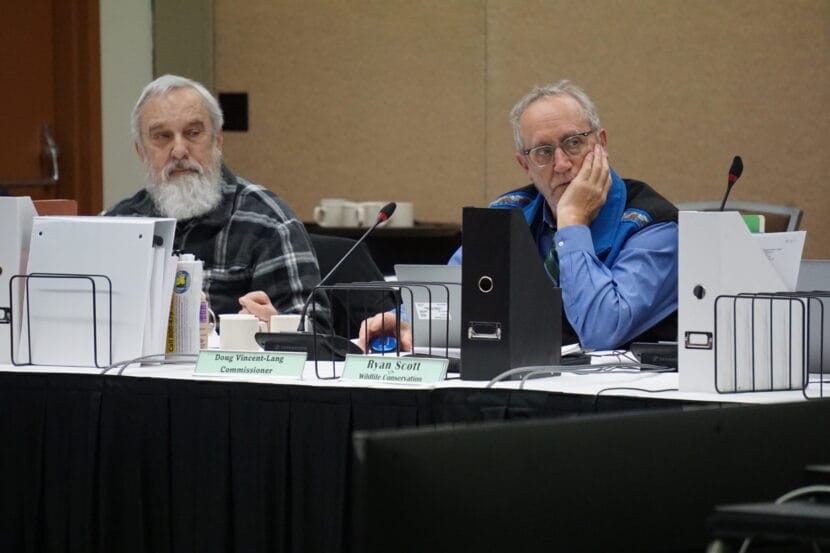
Alaska Board of Game member John Wood and Alaska Department of Fish and Game Commissioner Doug Vincent-Lang listen on Friday to public testimony at the first day of an eight-day Board of Game meeting in Anchorage. The board is now considering an emergency petition to continue a predator-control program that was ruled unconstitutional last week. (Photo by Yereth Rosen/Alaska Beacon)
That has already benefited the herd, as seen in the increase in the number of calves born, the department’s proposal said. Continuing the program is “critical” to the goal of getting the herd large enough to allow resumed hunting, it said.
“Not being able to conduct control efforts in the third year is detrimental to the program and will result in a loss of the improvements in calf recruitment and survival that have been realized since the department treatment began in 2023,” the department’s proposal said.
The Alaska Wildlife Alliance, the plaintiff in the case that resulted in last week’s ruling, said the Department of Fish and Game is attempting to circumvent the law.
“We’re just kind of stunned right now,” Nicole Schmitt, the alliance’s executive director, said during a break in the Board of Game’s meeting on Friday.
The late proposal, released just that morning, was also rushed without proper public notice or opportunity for public comment, just as the earlier predator-control authorization had been, Schmitt said.
“The state is trying to push through an emergency regulation, in the hopes that it is not stopped before they are done killing bears, lawfully or otherwise,” she said.
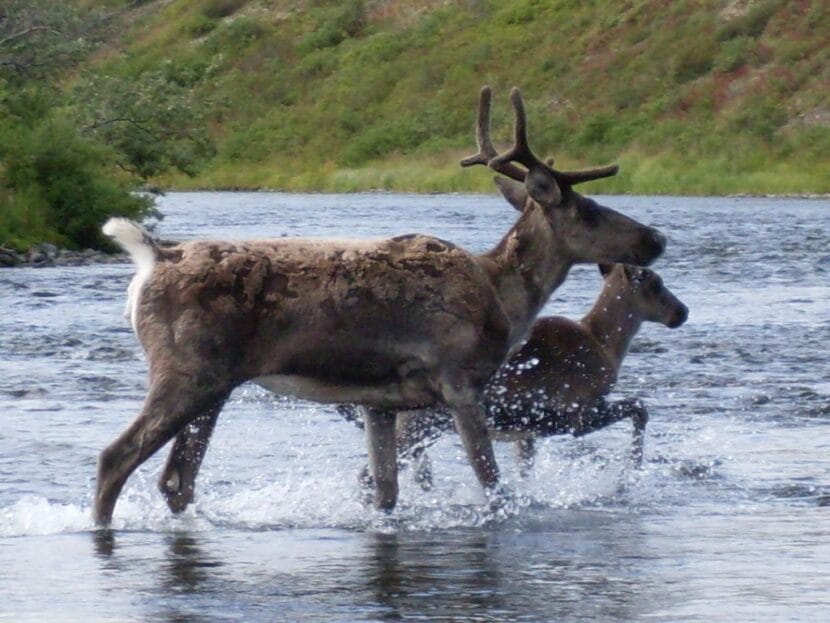
Caribou cross the Kanektok River in the Togiak National Wildlife Refuge on Aug. 25, 2009. The Mulchatna caribou herd, which ranges in the refuge, has declined sharply since the late1990s. The Alaska Department of Fish and Game argues that removal of bears and wolves will help the herd recover. (Photo by Allen Miller/U.S. Fish and Wildlife Service)
Superior Court Judge Andrew Guidi, in his March 14 ruling, found that the Board of Game’s action in 2022 that authorized the predator control program violated constitutional standards for public notice and public comment. The Alaska Wildlife Alliance and Michelle Bittner, an Anchorage attorney who filed a separate lawsuit challenging the predator-culling program, argued that the board rushed its approval through improper and secretive means.
Guidi also found that the board’s approval of bear kills in the Mulchatna caribou range failed to properly consider impacts to the bear population, in violation of constitutional mandates for sustainable management.
Supporters and opponents of the Mulchatna predator control program disagree about the causes of the caribou herd’s decline.
While department officials point to bears and wolves as limiting recovery, opponents of the bear- and wolf-killing program say other factors caused the caribou decline. Those include some sweeping habitat changes, with a warming climate allowing woody bushes and trees to spread into tundra territory. Caribou from herds like the Mulchatna depend on tundra plants for food, but the proliferation of woody plants has made the area more favorable for moose.
Disease is another factor cited as a reason for the caribou population decline.
The Board of Game has identified a goal of getting the population back up to between 30,000 and 80,000 animals, enough to support hunts of 2,400 to 8,000 caribou a year, according to the Department of Fish and Game.
Close
Update notification options
Subscribe to notifications
Subscribe
Get notifications about news related to the topics you care about. You can unsubscribe anytime.