Alaska Beacon is part of States Newsroom, a network of news bureaus supported by grants and a coalition of donors as a 501c(3) public charity. Alaska Beacon maintains editorial independence. Contact Editor Claire Stremple for questions: info@alaskabeacon.com. Follow Alaska Beacon on Facebook, Bluesky and Twitter.
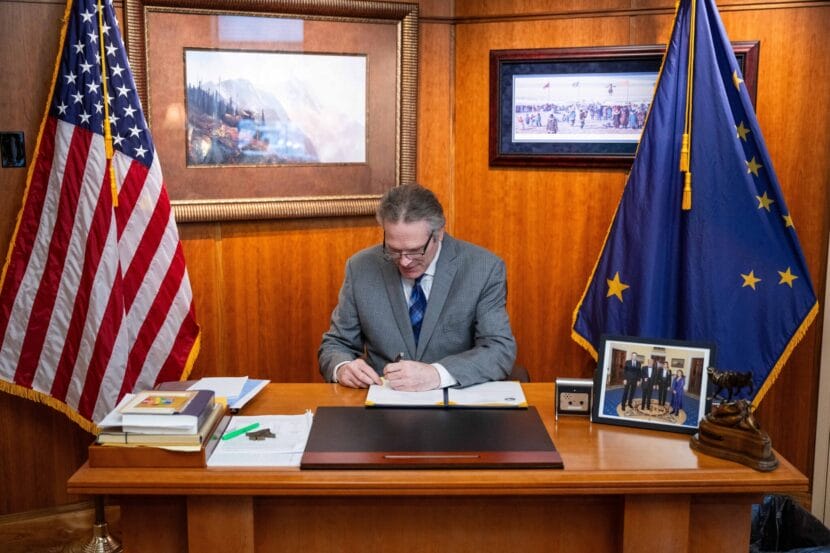
Gov. Mike Dunleavy signs Senate Bill 43, declaring March to Women’s History Month in Alaska, on April 3, 2025, in his office in the Alaska State Capitol. (Photo provided by the Office of the Governor)
A bill that would increase Alaska’s K-12 education funding formula by $253 million per year is on the desk of Gov. Mike Dunleavy after both the House and Senate passed it.
On Monday, a spokesperson for the governor said Dunleavy intends to veto it, confirming prior posts on social media.
The Alaska Legislature transmitted House Bill 69, containing the formula funding increase, to the governor on Saturday. Under the Alaska Constitution, the governor has until April 30 to sign it, veto it or allow it to become law without his signature.
If the governor vetoes the bill, lawmakers must meet “immediately” in joint session to vote and either confirm the governor’s veto or override it.
Overriding a veto on HB 69 would require 40 of the Legislature’s 60 members. Lawmakers for and against HB 69 have said they doubt there are enough votes to override a Dunleavy veto on the issue.
And even if the bill became law, actually funding the formula would require action in a separate budget appropriation bill. Overriding a budget veto would require 45 of 60 legislators.
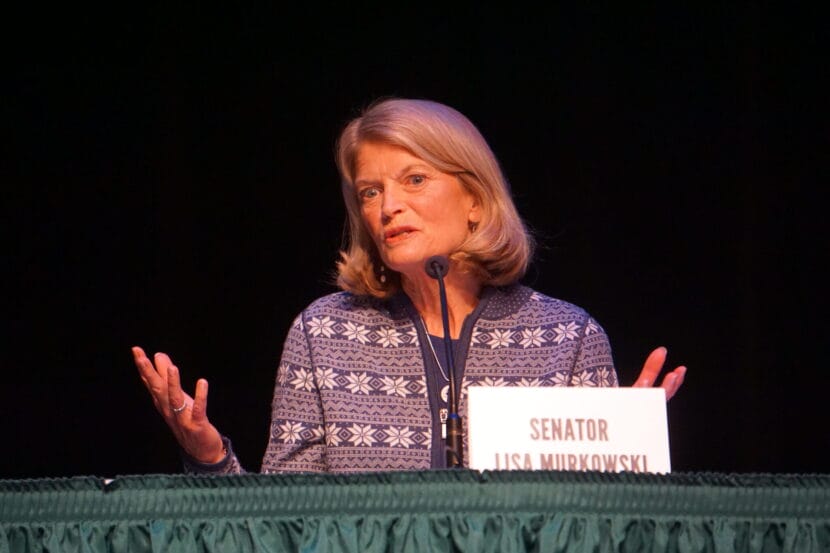
Sen. Lisa Murkowski, R-Alaska, speaks at a fisheries forum on Oct. 4, 2022. (Photo by Yereth Rosen/Alaska Beacon)
U.S. Sen. Lisa Murkowski, R-Alaska, is calling on the U.S. Department of Homeland Security to allow Ukrainians with temporary protected status to remain in the country, following reports people had received an email that their status was revoked and they had seven days to leave the U.S.
The agency has said the April 3 notice was issued by mistake, and the Ukrainians’ designation under what’s known as “humanitarian parole status” has not been terminated. They had been granted the status under the “Uniting for Ukraine” program.
But Murkowski penned a strongly worded letter on Sunday, with U.S. Sen. Jeanne Shaheen, D-New Hampshire, ranking Democrat on the U.S. Senate Foreign Relations Committee, to Homeland Security Secretary Kristi Noem condemning the move, even if it was “apparently an error.”
“Even if this message was sent in error, threatening the abrupt termination of humanitarian parole for Ukrainians is alarming and adverse to the U.S. national interest,” they wrote.
Humanitarian parole is a temporary immigration status granted to those fleeing humanitarian crises, and can be revoked at any time. There were 651,000 Ukrainians granted humanitarian parole in the United States last year. An estimated 6.9 million Ukrainians have been displaced since Russia invaded Ukraine in 2022.
“Ukrainians who have participated in the Uniting for Ukraine program have entered the U.S. lawfully, passed rigorous screening and vetting requirements,” the senators wrote. “These are individuals, including children, who have fled a war zone and followed a lawful process. Many are working in our states, paying taxes and contributing to local communities.”
Murkowski and Shaheen also requested a briefing on any future plans regarding the Ukrainians’ status.
“We urge the agency to provide immediate clarification to Ukrainians in the United States that their humanitarian parole has not been terminated, and that there are no plans to terminate the program while Ukraine is still under active attack by Russia,” they said.
The agency’s notice to those with humanitarian parole began: “It is time for you to leave the United States,” and the recipient’s parole would be terminated in seven days. “If you do not depart the United States immediately you will be subject to potential law enforcement actions that will result in your removal from the United States — unless you have otherwise obtained a lawful basis to remain here.”
Ukrainians have been the largest group of refugees arriving in Alaska over the last three years, according to Issa Spatrisano, the Alaska state refugee coordinator with Catholic Social Services Alaska, a resettlement agency.
Spatrisano said she has received several reports of people in Alaska receiving the DHS termination notice, and the news spread secondhand very quickly. She said the effect was chilling.
“The email was very scary for Ukrainians living in Alaska and across the country,” she said. “Because they really are at the whims of at any point an announcement coming from DHS, and when that announcement is made, they’ll have to respond accordingly to what the announcement is.”
An estimated 1,500 Ukrainians have arrived since 2022, about 500 people per year, Spatrisano said. Many joined family members, communities, and the workforce, “really much needed jobs throughout the state,” she said. But the uncertainty takes a toll.
“A mental health toll,” she said. “It takes a serious toll on people’s well being, and that impacts on our state. There are Ukrainian families who are in the process of buying homes here in Alaska, you know, in the process of laying down roots, in the process of getting job training programs to advance in jobs that the state frankly needs really badly. And those are all investments in time and in energy and in resources that families are now wondering if they should do.”
Murkowski and Shaheen have asked for “an immediate explanation as to how these emails were sent in error” and “that there are no plans to terminate the program while Ukraine is still under active attack by Russia.”
Correction: This article has been updated to reflect thatIssa Spatrisano is with Catholic Social Services Alaska, not Catholic Relief Services.
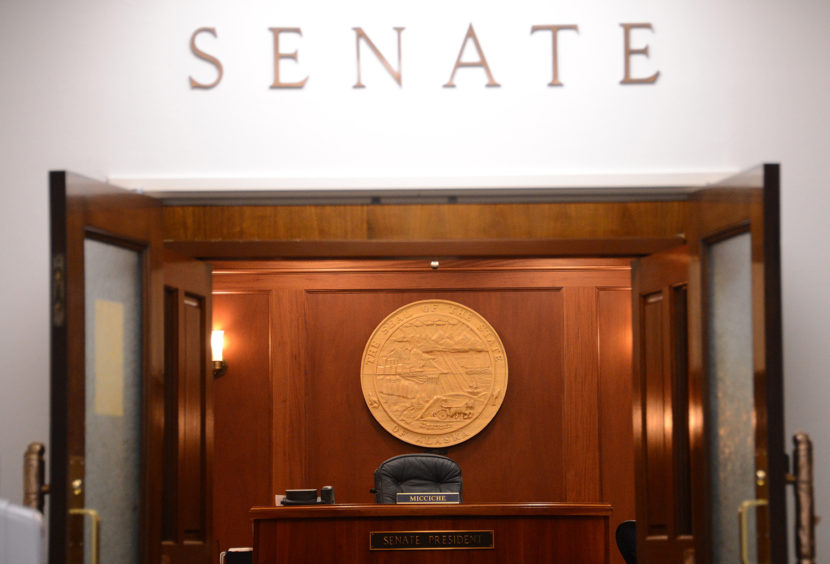
The Senate chambers are seen at the Alaska State Capitol on Friday, May 13, 2022 in Juneau, Alaska. (Photo by James Brooks/Alaska Beacon)
The Alaska Senate will vote as soon as Friday on legislation that seeks to permanently increase K-12 public school funding, but Gov. Mike Dunleavy has vowed to veto the bill if it passes as currently written.
On Thursday morning, the Senate Finance Committee approved a modified version of House Bill 69, which would increase the base student allocation — the core of the state’s per-student public school funding formula — by $1,000 per student.
School districts and public school advocates have testified for years that state funding, which has been kept flat amid rising inflation, is inadequate and has caused extensive cuts that hurt student performance.
The bill is a top priority for the multipartisan majorities in both the House and Senate.
If the new formula is fully funded by legislators and the governor, the effect would be an additional $253 million per year for public education.
The state House has already approved a version of the bill, meaning that if the Senate approves it, members of the House would be asked to approve the Senate’s version or send the bill to a conference committee to negotiate a compromise.
In a statement posted on social media, Dunleavy called the bill’s present form “a joke,” adding, “Unless it is amended to address needed policies, if this lands on my desk, it’ll be vetoed immediately.”
If the governor vetoes the bill as promised, it would take 40 of 60 legislators, meeting in joint session, to override him. Multiple legislators said that as of Thursday, the necessary votes were not present.
“I do not believe in its current form, it will get through the process,” said Sen. Shelley Hughes, R-Palmer.
Some legislators, including Senate Minority Leader Mike Shower, R-Wasilla, suggested that a smaller increase, on the order of $680 per student, might find success if coupled with policy changes.
The bill advancing toward a Senate vote was introduced at the start of the legislative session by Rep. Rebecca Himschoot, I-Sitka, after Dunleavy vetoed a different bill, with a smaller funding increase, last year. Lawmakers failed to override the governor’s veto by a single vote.
Himschoot’s bill was repeatedly modified, and lawmakers held closed-door negotiating sessions with a representative of the Dunleavy administration in an effort to find a compromise between legislators’ preferences and the governor’s.
Most legislators have supported an unrestricted funding boost, which would allow school districts to choose how to spend the new money. The governor has introduced bills that place more emphasis on policy and would empower charter schools, homeschool parents, and alternatives to traditional schools.
The closed-door negotiations ended without success, and the House passed a bill focused on new funding. The Senate Education Committee amended that proposal to include policy items, a step toward the governor’s preferences, but in a statement, the governor said that version of the bill “does not pass muster.”
Rather than try further modifications, the Senate Finance Committee acted Thursday to strip all policy measures from the bill and leave just the funding increase.
“There’s a lot of discussion on what level of funding the BSA should have,” said Sen. Lyman Hoffman, D-Bethel and co-chair of the finance committee.
“We’re putting this forward to see what support there is on this funding level in this building and on the third floor,” he said, referring to the Capitol floor occupied by the governor’s office.
Sen. James Kaufman, R-Anchorage, objected to that line of thinking, saying that the bill must have more support than its failed predecessor from last year, Senate Bill 140.
“I just want to say on the record that if we’re going to get something done, it’s going to have to be a thoughtful compromise that is durable, that hopefully the governor and the (House) will accept to the degree that it has as many — I’ll say friends, supporters — plus one more — at least — than we had with SB 140, which unfortunately failed,” Kaufman said.
“And so I’m afraid we’re going down the path to failure.”
Students swing on a playground at Meadow Lakes Head Start in Wasilla, Alaska. It closed in 2024 due to funding and staffing challenges. (Image by Lela Seiler, courtesy of CCS Early Learning)
Alaska Head Start programs are reeling after the regional federal office was suddenly closed last week, leaving programs uncertain about grant administration and future funding.
Trump-appointed U.S. Department of Health and Human Services Secretary Robert F. Kennedy Jr. ordered the closure of five of the nation’s 12 regional offices, as part of an agency-wide consolidation that included cutting 10,000 employees. That included closing the Seattle-based Region 10 office serving Alaska, Washington, Idaho, and Oregon.
The office was a critical resource for Alaska Head Start programs, for grant administration and compliance, said Katrina Ahlfield, executive director for Kids’ Corps Inc., an Anchorage Head Start program. She also serves on the board of the Alaska Head Start Association.
“Thousands of children and families potentially are impacted in the longer term,” she said of the closures nationwide. “If this creates a delay in grant processing, or programs receiving the immediate support that they might need.”
The federal department did not respond to a request for comment on Tuesday.
Head Start provides early learning programs through schools and nonprofits that serve children from low-income families, from supporting pregnant mothers up to age 5. Foster youth, families who receive supplemental assistance like food benefits, and those who are experiencing homelessness are automatically eligible.
“We’re looking at some of the most vulnerable children and families in Alaska,” Ahlfield said.
Ahlfield said Kids’ Corps Inc. is one of four Head Start programs impacted directly, currently serving 1,076 children.
Ahlfield said the Alaska Head Start Association heard the news of the regional office closure on March 31 second-hand, and had no direct notice or further direction from federal officials.
That day, federal staff arrived to work in Seattle and were locked out, according to news reports, and staff were placed on immediate administrative leave until June, without warning.
With that office closed, Ahlfield said there’s a loss in administrative and technical support.
“They were your experts really on the Head Start performance standards and all of the compliance requirements that come along with operating any federal program,” she said. “So they were kind of your go-to as a director, or go-to for technical assistance and questions. They also help to process your grant applications.”
While there are no immediate cuts or closures, she said the loss of administrative support impacts her organization, as well as and also CCS Early Learning in the Matanuska-Susitna Valley, Thrivalaska in Fairbanks, and the Rural Alaska Community Program, or RuralCap, which serves children and families throughout Alaska.
Ahlfield said regional administrators would answer questions, or give advice related to health and safety requirements.
“These people had worked there for, you know, over 10 years, and really knew our programs well, and knew Alaska well,” she said.
“So right now, we don’t have anyone to contact about any of those kinds of questions or needs,” she added.
Kids Corps Inc. serves 189 children in the Anchorage area, and Ahlfield said she’s most concerned about their pending grant funding, which she expects to cover costs for the next six months.
“My most urgent concern is, is this going to create a delay in programs receiving grant approvals and funding on time in order to be able to continue providing services without a temporary, you know, delay and or needing to temporarily close?” she said.
She said there have not been Head Start funding delays reported in Alaska yet. But the uncertainty is difficult; any program cuts or closures would hit families and staff hard.
“We have an early-childhood and an educator crisis, where we don’t have enough people in the field already,” she said. “And so it just makes the situation worse for people. It definitely has the potential to create hard times.”
Alaska Head Start receives $68 million in federal funding each year, she said, with a 20% match totaling $13 million provided by the state through the Alaska Department of Early Education and Childhood Development. DEED provides state grants to 17 Head Start programs across the state, in classroom and home-based settings.
DEED did not respond to requests for comment on Monday.
Ahlfield said Head Start administrators and communities are calling on the Alaska congressional delegation to urge the Trump administration to reverse the cuts, or provide a clear plan.
“If it’s not possible to reinstate our regional office, and that would be our first preference, … then we really need and want a well communicated, coordinated plan on how this is going to work, so that it doesn’t impact these vital services,” she said.
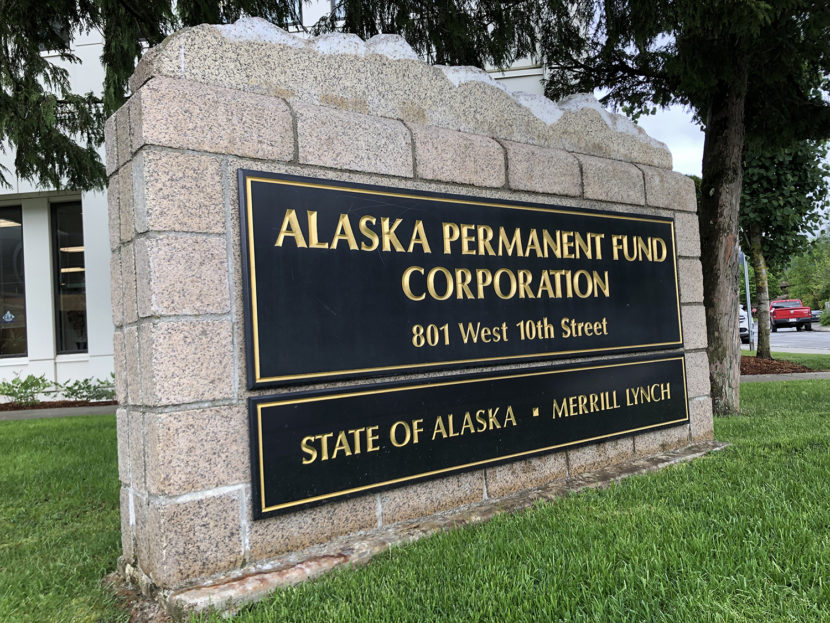
The offices of the Alaska Permanent Fund Corp. are seen Monday, June 6, 2022 in Juneau, Alaska. (Photo by James Brooks/Alaska Beacon)
The Alaska Permanent Fund, the No. 1 source of general-purpose revenue for state services and the Permanent Fund dividend, suffered a multibillion-dollar loss during last week’s stock market crash.
According to preliminary figures published by the Alaska Permanent Fund Corp., which manages the fund, the fund’s assets declined from $81.7 billion on Tuesday to $79.7 billion at the end of the day on Friday. Figures for Monday were not immediately available.
From Wednesday through Friday, the S&P 500, a leading American stock market, declined 10.5% as markets reacted to President Donald Trump’s imposition of tariffs on most imported goods.
Paulyn Swanson, a spokesperson for the Alaska Permanent Fund Corp., said the Permanent Fund’s value declined by 2.7% during the same period.
Speaking last Thursday, APFC executive director Deven Mitchell noted that the fund is invested in a variety of assets, including real estate, bonds, private equity and gold, as well as publicly traded stocks.
That means the Permanent Fund hasn’t performed as well as the S&P 500 in recent years, but during a downturn, it doesn’t suffer as much.
“In our public equity portfolio, we’ve had a tilt away from growth stocks and the S&P 500, which we’ve suffered under over the last two years, but now we’re benefiting from that tilt towards value. So in some ways … we’ll be making up ground relative to our benchmark,” he said, referring to a mix of investments that the corporation measures its performance against.
Since 2018, an annual transfer from the Permanent Fund to the state treasury has been largest source of general-purpose revenue for services and the dividend.
In the fiscal year that starts July 1, that transfer will be worth $3.9 billion. All of the state’s oil revenue combined is expected to be worth less than half that — $1.6 billion.
For the moment, money for the transfer is kept in the earnings reserve, a spendable account within the fund. As of Feb. 28, Swanson said, the earnings reserve contained $9.8 billion — enough for the upcoming transfer, an inflation-proofing payment, and part of the upcoming fiscal year 2027.
At that time, the earnings reserve also held $1.8 billion in unrealized gains — much of which may have been lost in the market slide.
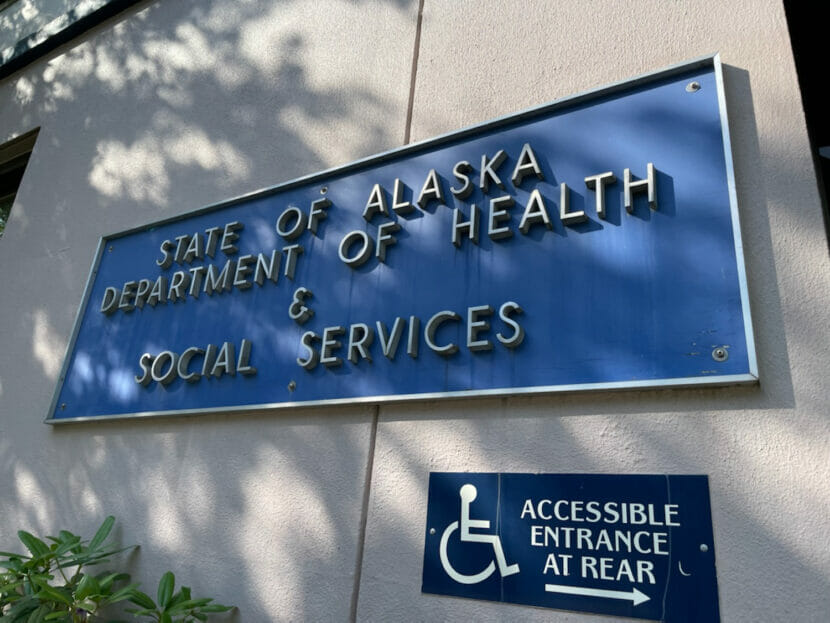
The offices of the Alaska Department of Health and Social Services are seen in Juneau on Friday, July 1, 2022. The department is being split into two separate agencies. (Photo by Lisa Phu/Alaska Beacon)
“Their last day of employment is today, and they found out — I believe — earlier this week. So it is very abrupt,” said Heidi Drygas, director of the Alaska State Employees Association, the union that represents 22 of the 30 laid-off employees.
The layoffs are believed to be the first round of significant Alaska state-government job losses caused by President Donald Trump and the arm of the White House named the “Department of Government Efficiency,” coordinated by Elon Musk.
Trump-ordered cuts have already had significant effects on federal government programs and nongovernmental organizations that rely on federal grants, but until now, state-government jobs had been relatively protected.
“I fear that there are more (layoffs) coming,” Drygas said. “I’m worried that this is the tip of the iceberg, and this rapidly evolving news story … is causing a lot of anxiety for our members, many of whom work under federal grants, or they work on a daily basis with their federal counterparts. It’s hugely disruptive.”
Alex Huseman, a spokesperson for the Alaska Department of Health, said the federal government brought an early end to two major COVID-19 response grants.
Those grants had been expected to expire no later than 2027. The state’s current operating budget and Gov. Mike Dunleavy’s proposal for the coming year list millions of dollars in expected grant spending.
“The amended notice of awards for the impacted grants now reflect an end date of March 24, 2025,” Huseman wrote by email. “The reductions in federal funding had an impact on 30 employees. The DOH is working with the Division of Personnel and the Rapid Response Team from the Department of Labor and Workforce Development, in accordance with the respective union contracts and regulations, to assist affected employees.”
Drygas said the affected positions are spread across the state, and that as with any job losses, these cuts will have ripple effects in the local communities, since state salaries lead to local spending.
“In some of these smaller communities, there’s not that many jobs, and so it could have a huge impact, or a disproportionate impact,” she said.
Close
Update notification options
Subscribe to notifications
Subscribe
Get notifications about news related to the topics you care about. You can unsubscribe anytime.