Alaska Beacon

Alaska Beacon is part of States Newsroom, a network of news bureaus supported by grants and a coalition of donors as a 501c(3) public charity. Alaska Beacon maintains editorial independence. Contact Editor Claire Stremple for questions: info@alaskabeacon.com. Follow Alaska Beacon on Facebook, Bluesky and Twitter.

Sen. Sullivan supports Trump, downplays federal budget chaos, in speech to Alaska Legislature

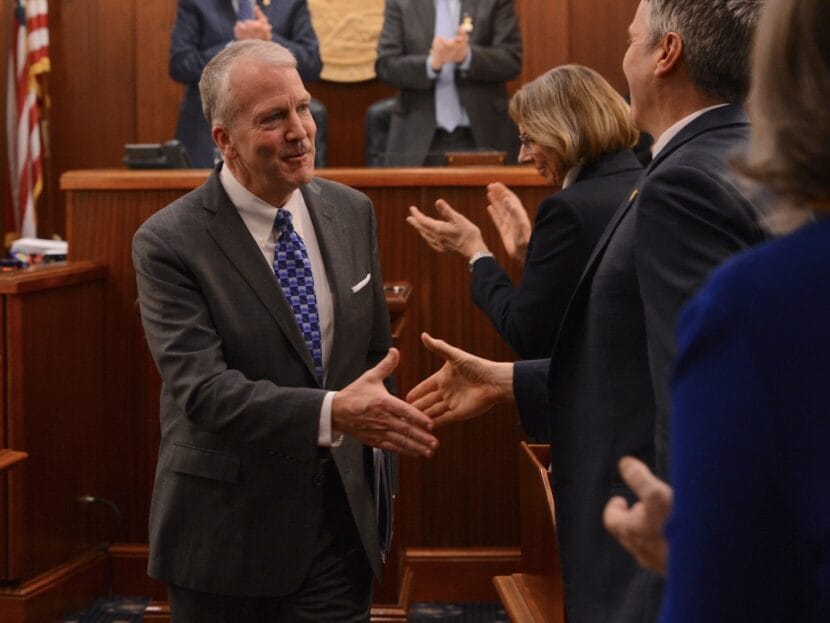
U.S. Sen. Dan Sullivan, R-Alaska, prepares to shake hands with one of his critics, state Rep. Andrew Gray, D-Anchorage, after the conclusion of his speech to the Alaska Legislature on Thursday, March 20, 2025. (Photo by James Brooks/Alaska Beacon)

In remarks to the Alaska Legislature on Thursday, U.S. Sen. Dan Sullivan praised the work of President Donald Trump, saying the new president’s promining and prodrilling views are “great for those of us in Alaska.”

Sullivan, who walked through a crowd of anti-Trump and prodemocracy protesters en route to the speech, downplayed the chaos caused in Alaska by the Trump-empowered “Department of Government Efficiency,” which has orchestrated the firing of hundreds of Alaskan workers and halted millions in federal spending within the state.

“Our national debt of over $36 trillion has reached dangerous, unsustainable levels,” Sullivan said, adding that DOGE is “making some noble progress” in reducing the debt.

Sullivan said he doesn’t like every decision DOGE has made, and that job cuts “need to be done humanely and not randomly, but is the end goal of a smaller, more efficient federal government that lives within its means necessary at this point in time? Yes.”

Sullivan’s speech came two days after one by fellow Republican Sen. Lisa Murkowski to the Legislature. Murkowski was willingly critical of some Trump actions but said that Americans chose him as their president, and she must be willing to work with him.

During his time in office, Sullivan has endorsed mining, drilling, logging and other forms of natural resource development as the best way to grow Alaska’s economy and boost the well-being of its residents.

Trump’s support of Alaska development is a huge opportunity for the state, Sullivan said.

“We’re pushing on an open door, because this president and this administration — and you can see it almost daily — they want to help us,” he said.

Hours before the speech, the Interior Department confirmed plans for widespread oil and gas leasing on the North Slope, including in the Arctic National Wildlife Refuge.

The agency also said it would transfer land to the state for the Ambler Road and portions of the proposed trans-Alaska natural gas pipeline.

That pipeline, Sullivan said, offers “transformative possibilities” for the state’s economy, and while the effort to advance it has felt like “smashing into a wall,” Sullivan said it has been worthwhile.

On Thursday, Taiwan’s state energy company signed an agreement to buy liquefied natural gas from the AKLNG project and invest in the pipeline’s development. The terms of the agreement were not disclosed.

“The project is still not right around the corner, but the corner is in sight,” Sullivan said.

Sullivan said the U.S. Navy has begun investigating the possibility of reopening its base at Adak, and touched on a variety of other topics during his prepared remarks, including the need to restrict the drug fentanyl, improve aviation safety, and grow a national missile defense system.

After more than 45 minutes of prepared remarks, Sullivan faced questions from members of the Legislature, some of whom were prepared to interrogate him on key issues.

State Sen. Forrest Dunbar, D-Anchorage, asked whether Sullivan would oppose cuts to Medicaid, Medicare and Social Security, and asked the senator to answer “yes or no.”

Sullivan refused, but his answer implied that he’s open to cuts.

“Almost one-third of Alaskans … are on the rolls of Medicaid now. We, I think, accept that. Some see it as a good. I don’t see it as a good. I think our goal should be to increase our private-sector economy and increase the opportunities for people to move off Medicaid and get private-sector insurance,” Sullivan said.

The share of uninsured Alaskans fell over the past decade, after Medicaid eligibility was expanded, from 14.5% in 2015 to 10.5% in 2023.

Sullivan, formerly a vocal defender of American military aid to Ukraine, has grown quiet on the subject since Trump entered office. The Trump administration has repeatedly wavered on support for Ukraine and has acted more in line with Russia than the country it invaded.

Rep. Andrew Gray, D-Anchorage, asked how Sullivan is pushing back on the White House’s “whiplash-inducing change in foreign policy,” including its attitude toward Canada.

Sullivan said he considers Russia’s leader to be “brutal and expansionist” but said he believes “what the president and his team are doing right now — and they’re putting an enormous amount of effort into it — is trying to bring both sides together to stop the war and stop the killing.”

He did not address the administration’s attitude toward Canada.

Responding to a question about fired federal employees from Rep. Sara Hannan, D-Juneau, Sullivan said affected Alaskans should fill out a form about their situation and send it into his office so he can make the case for the relevant DOGE cuts to be reversed.

That form was originally written for Alaskans to complain about DOGE program cuts, Sullivan’s office said, but it can also be used for feedback on job cuts.

Responding to questions from reporters, Sullivan said he does not think the Trump administration’s actions on deportation flights represent a constitutional crisis. Murkowski, who spoke earlier in the week, offered a similar view.

Also Thursday, Trump signed an executive order with the intent to begin the process of eliminating the federal Department of Education. The department oversees federal aid for school lunches, special education, low-income schools and college grants and loans, among other programs.

Asked whether he supports Trump’s effort, Sullivan was noncommittal, saying he had not yet seen the order.

“The key question to me is, are they just dismantling everything, or is the vision to dismantle and then get the money to the Alaska State Legislature and local communities, who — mind you — have a way better sense, especially for Alaska, on how to spend the money and how to prioritize the money.”
Alaska legislators seek to ease planning for new housing projects

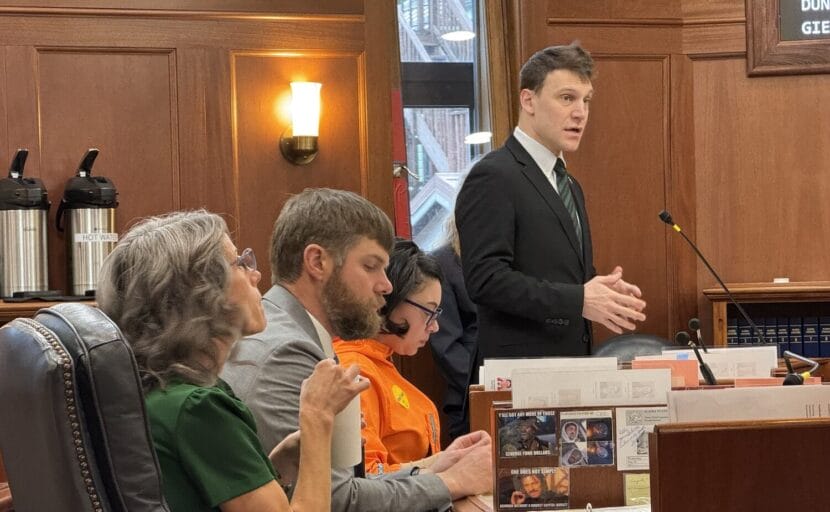
Sen. Forrest Dunbar, D-Anchorage, speaks Monday, March 17, 2025, in favor of Senate Bill 50. (Photo by James Brooks/Alaska Beacon)

Alaska’s organized borough governments would be encouraged to make long-term plans for housing projects under a bill passed Monday by the Alaska Senate.

Senate Bill 50, from Sen. Forrest Dunbar, D-Anchorage, would change state law to say that boroughs’ comprehensive plans — long-term planning documents — may include a housing development plan.

The bill passed the Senate 17-0 with three excused absences and advances to the House for further consideration.

Alaska housing prices have risen by nearly 50% over the past 10 years. The National Association of Realtors estimates that Anchorage and the Matanuska-Susitna Borough alone have a shortage of 5,066 homes.

Speaking on the Senate floor, Dunbar said the bill is part of a larger effort to encourage new housing construction.

The bill doesn’t require boroughs to create new comprehensive plans for their land, and it doesn’t require them to include housing as part of those plans, but it does encourage them, he said.

“In the process, boroughs will assess how their regulations impact housing supply, engage and inform the public, and recommend reforms,” Dunbar said.

Fired federal workers in Alaska, nationally are ‘reinstated’ after order, but are not back at work

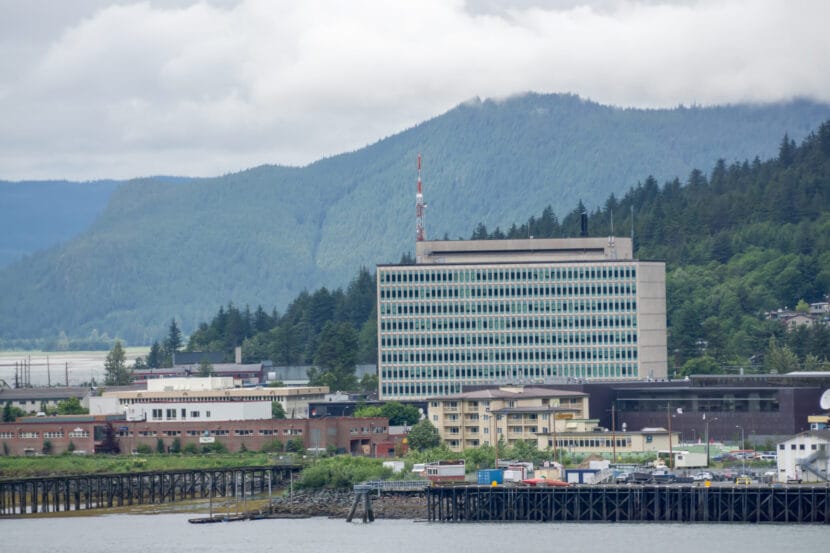
The Hurff A. Saunders Federal Building is pictured in Juneau in an undated photo. (iStock/Getty Images Plus)

Some fired federal employees received letters on Monday notifying them they were “reinstated” according to a federal court order, but on “paid, non-duty” status, a type of administrative leave.

The U.S. Department of Commerce issued a letter to fired employees, including those formerly with the National Oceanic and Atmospheric Administration, or NOAA, who shared a copy with the Alaska Beacon.

“When I first heard the decision, I was super excited,” said one former employee with NOAA, who spoke on condition of anonymity to avoid potential retaliation, as they hope to get their job back. “But as the weekend went on, I basically started to think that we’d probably be put on admin (administrative) leave and that it would be challenged, and I slowly lost confidence.”

While some reinstated employees have received letters, not all have. U.S. Sen. Lisa Murkowski, R-Alaska, told reporters on Tuesday that she’s heard from employees who’ve received backpay, but no letter describing their employment status. “Basically it had been a direct deposit to their account, but with nothing further,” she said. “No notice that they were placed on administrative leave, no notice about going back to work … So there’s a lot of uncertainty, I think, about those that are being brought back on by order of the court.”

For those who did receive this notice, the letter states that employees are “reinstated to their position” retroactive to their date of firing, and placed on “paid, non-duty status until such a time as the litigation is resolved.”

“It’s nice to get a little more pay, but what we want is to have our jobs back,” said the former employee, who said the entire ordeal driven by the Trump administration’s cost-cutting efforts through the “Department of Government Efficiency” is anything but money saving.

“The whole process is inefficient. They’re spending money to terminate us all through HR, and then rehire us all and then, of course, now paying us not to do work,” they said. “The whole thing is incredibly inefficient.”

The letter came following a March 13 court decision in the U.S. District Court for the District of Maryland, which ordered the Trump administration to temporarily reinstate all fired probationary employees with 18 federal agencies, after finding those agencies acted unlawfully in carrying out the firings.

U.S. District Court Judge James Bredar, appointed in 2010 by Barack Obama, granted a temporary restraining order and a 14-day stay on the federal firings, after a case was brought by state attorneys general from 19 states and the District of Colombia.

The states argued the Trump administration ignored laws in carrying out the mass firings, with no advanced warning, and caused harm including to state programs that rely on federal workers, loss of tax revenue and harms to unemployment benefit systems with no advance notice.

At least 24,000 probationary federal employees have been fired since Trump took office, according to the lawsuit. In Alaska, the total number of probationary employees is estimated at 1,378, but the current number of fired federal employees is unknown.

The judge agreed with the plaintiffs that the process of mass firings, as well as citing probationary employees’ “performance,” was unlawful. “There were no individualized assessments of employees. They were all just fired. Collectively,” Bredar wrote in the court order.

The ruling orders all affected probationary employees to be reinstated with the defendant agencies, including the Departments of Commerce, Education, Health and Human Services, Interior Veterans Affairs, Treasury and others.

The Trump administration has appealed the ruling, arguing the federal government’s right supersedes the states, and the administration is targeting “waste, fraud and abuse.”

The letter from the U.S. Department of Commerce is signed by the Department Acting General Counsel John K. Guenther. It continues that if the court order is invalidated by a higher court and the department “prevails in this litigation matter,” the employees would be terminated again and they would “waive any indebtedness to the federal government,” meaning they would not be owed the back pay.

“The government is doing the absolute minimum to comply with the court order while still maintaining the stance that what they did was fine, and that’s disappointing,” said another former NOAA employee, in a phone interview on Monday, who also spoke anonymously to avoid potential repercussions.

“It’s great to get paid for that time, and it really helps considering how emotionally draining this whole process is,” they said. “But it’s not what I’m really after. I’m really after getting my job back. I want to go back to work. I’ve got stuff I’d like to go do.”

On Monday, a federal appeals court also denied a Trump administration’s request to overrule a Northern California district court’s order, and block the reinstatement of thousands of fired probationary employees.

The case was brought by the federal union, American Federation of Government Employees, arguing federal employees were fired illegally from six federal agencies, including Agriculture, Defense, Energy, Interior, Treasury and Veterans Affairs.

The Trump administration had appealed the ruling of U.S. Judge William Alsup, who ordered the reinstatement of federal employees. Alsup’s order is in place indefinitely, while Bredar’s is for 14 days, though it could be extended.

The White House has criticized the court rulings as “unconstitutional” and interfering with executive actions.

“A single judge is attempting to unconstitutionally seize the power of hiring and firing from the Executive Branch,” White House press secretary Karoline Leavitt said in a statement on social media on March 13, following the ruling. “The President has the authority to exercise the power of the entire executive branch – singular district court judges cannot abuse the power of the entire judiciary to thwart the President’s agenda. If a federal district court judge would like executive powers, they can try and run for President themselves.”

Anchorage judge rules state’s brown-bear killings are unconstitutional

Katmai bears fish at Brooks Falls. (Photo courtesy National Park Service)

The Alaska Department of Fish and Game’s decision to kill almost 200 brown bears in order to boost a struggling caribou herd violated due process and was unconstitutional, an Anchorage Superior Court judge ruled Friday.

Judge Andrew Guidi’s 10-page decision means at least a temporary end to the state’s controversial bear-killing program, which was intended to aid the struggling Mulchatna caribou herd.

“Unless they want to seek a stay of this decision, they’ve got to stop killing bears,” said attorney Joe Geldhof, who represented the Alaska Wildlife Alliance in a lawsuit that prompted Friday’s decision.

The Alliance sued the state in 2023 to challenge the application of Alaska’s “intensive management” project in Southwest Alaska.

Originally designed to kill wolves in order to boost the populations of prey species that hunters pursue, the program was expanded in 2022 to cover bears that have been preying on the Mulchatna caribou herd.

That herd, which contained 200,000 animals at its peak in 1997, has declined to about 13,000 animals and is closed to hunting.

Anchorage attorney Michelle Bittner filed a separate lawsuit, also challenging the state’s bear-killing program.

Both lawsuits argued that the state’s Board of Game failed to follow adequate due process standards before beginning the program.

Before a judge could consider the merits of either case, state attorneys argued that Bittner did not have the standing to bring a lawsuit on the issue. That argument went all the way to the Alaska Supreme Court, which ruled in February that Bittner could bring her case.

That cleared the way for the Alaska Wildlife Alliance’s lawsuit to advance as well, with oral arguments taking place in March.

Ruling Friday on the merits, Guidi concluded that the Board of Game violated due process and did not provide adequate public notice when it began its bear-killing program.

“The notice provided by the BOG contemplating extension of an existing wolf control program to lands managed by the federal government that was altered to include a bear removal program on state lands substantially changed the subject matter of the proposal,” Guidi wrote. “These changes went far beyond varying, clarifying or altering the specific matter of the proposal addressed in the original notice. As a result, the BOG failed to adhere to mandatory due process standards.”

Guidi also found that the Board of Game violated the Alaska Constitution’s principle of sustained yield because it valued the sustainability of caribou herds but didn’t adequately study what would happen to bear populations.

“The issue of the bear population and distribution is an obvious salient issue touching on sustainability,” he wrote. “Addressing the sustainability of a constitutionally protected resource like bears almost certainly requires the BOG to engage in more than a rudimentary discussion about a bear population or engage in conclusionary opinions when considering a proposal to initiate a program calling for the unrestricted killing of bears.”

A spokesperson for the Alaska Department of Law, which represented the Board of Game in the lawsuit, said the state is reviewing the order and considering its options for how to proceed.

British Columbia introduces toll measure to counter tariffs; Sullivan suggests acting against BC

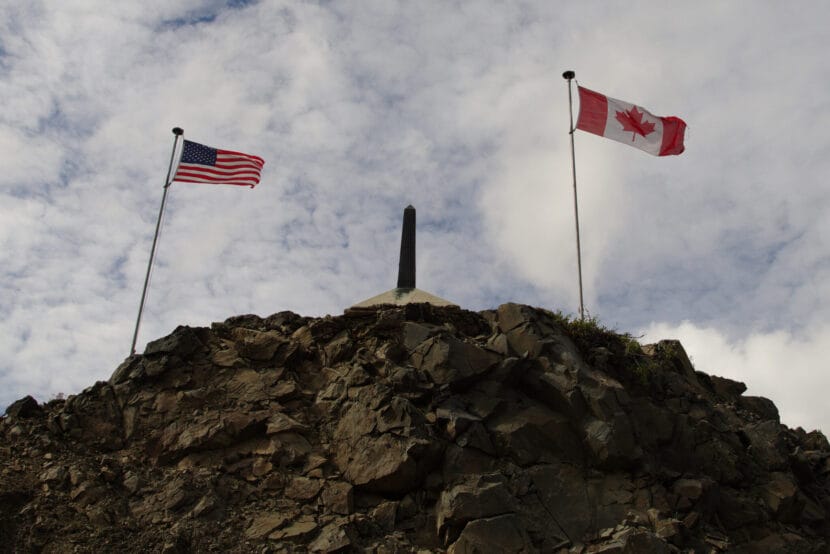
Marker for the U.S.-Canadian border between Skagway, Alaska, and Stikine Region, British Columbia. (Photo by Philip Yabut/Getty Images)

The government of British Columbia filed legislation Thursday that would permit the province to levy tolls on vehicles between the Lower 48 and Alaska.

The bill, known formally as the Economic Stabilization (Tariff Response) Act, had been expected since BC Premier David Eby announced his intentions last week.

Introducing the bill at the British Columbia Legislative Assembly in Victoria, Deputy Premier Niki Sharma said the bill “provides a range of authorities to enable the government to quickly respond to the recent unprecedented threats to our province from the United States.”

The bill does not automatically impose fees on vehicles traveling to and from Alaska, but it “just gives BC the tools to do so down the road if Trump continues to escalate his threats towards BC and Canada,” according to a statement from the provincial Ministry of Transportation and Transit.

“This is not something British Columbia wants to do, but we need to have this tool if the U.S. does not back away from their unjust tariffs,” the ministry said.

In addition to threatening tariffs on trade with Canada, President Donald Trump has threatened military action against the country and has said that it should be annexed to the United States in order to avoid economic consequences.

Sharma, speaking to the Legislative Assembly, said that if enacted, the bill would “allow government to impose a system of tolls, fees or other charges on vehicles using certain BC infrastructure, such as highways and coastal ferries. It will provide a broad, flexible power to government to address challenges to BC arising from the actions of a foreign jurisdiction to support inter-provincial cooperation.”

According to the text of the bill, the amount of the tolls and their application would be decided by governmental officials.

The legislation would expire May 28, 2027, Sharma said.

“We did not ask for this trade war, but we will fight for BC’s economy, we will fight for BC’s workers, and we will fight for this province with every tool that we have. We will take a ‘Team Canada’ approach in our response, and I hope that every member of this House supports this bill,” she said.

The bill is expected to advance in the legislative process no sooner than March 31, after the Legislative Assembly returns from a weeklong spring recess.

Meanwhile, in Alaska, Republican U.S. Sen. Dan Sullivan has threatened to take economic action against British Columbia.

In a talk radio interview on Tuesday, Sullivan said he would seek to waive a federal law that requires foreign-registered cruise ships to stop in Canada when sailing between Washington state and Alaska.

All but a handful of the megaships that carry tourists to Alaska in the summer are registered to foreign countries, and the United States has already waived the law once before — in 2021, amid the COVID-19 pandemic emergency.

“You know, Canada, you don’t want to mess with Alaska,” Sullivan said in the radio interview. “If you do, we’re going to work hard on having our cruise ships bypass your ports, and that’ll help our economy tremendously, it’ll help our tourism industry tremendously, and it’ll really hurt their tourism.”

The British Columbia transport ministry said the cruise ship industry “employs thousands of people and supports hundreds of BC businesses who benefit from the arrival of ships.”

“We know that people want to experience British Columbia cities as part of their cruise experience,” the ministry said.

New Alaska revenue forecast worsens state’s big projected budget deficits

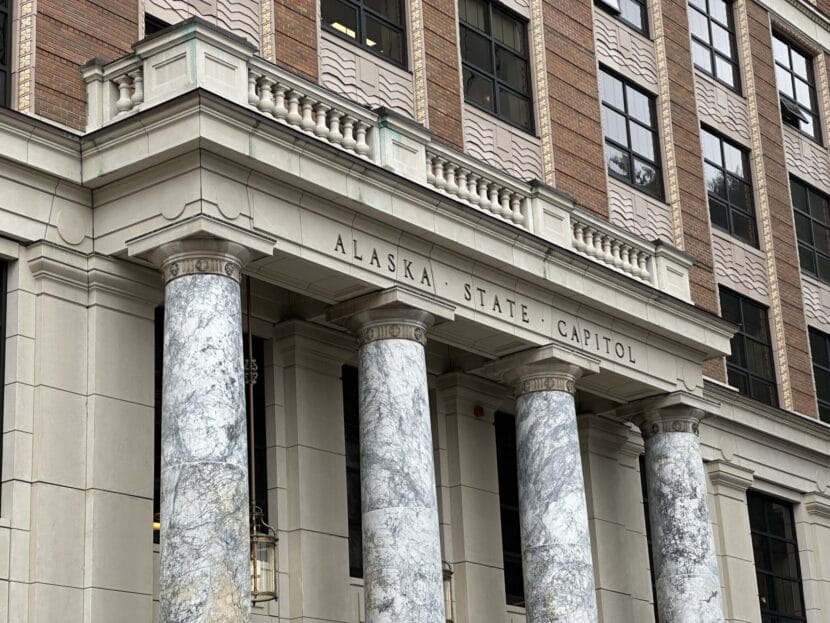
The Alaska State Capitol on March 25, 2024. (Eric Stone/Alaska Public Media)

The state of Alaska is still facing a significant budget deficit despite a revised state revenue forecast published Wednesday by the Alaska Department of Revenue.

Oil revenue makes up about 40% of Alaska’s general-purpose revenue, leaving state finances unstable and dependent upon estimated oil prices. The Department of Revenue updates its outlook twice per year, and its changes can radically alter the state’s budget process.

For the 2025 fiscal year, which ends June 30, the department is estimating $6.23 billion in general-purpose revenue, formally known as “undesignated general funds.”

This amount doesn’t include federal funding and revenue designated for specific purposes, like university tuition.

The undesignated general fund estimate is about $30 million less than a prior forecast from the fall, and as a result, the state is looking at a $200 million deficit in the current fiscal year under spending previously proposed by Gov. Mike Dunleavy.

Lawmakers are expected to edit the governor’s spending plan before adjourning the current legislative session, but it isn’t clear how that deficit will be resolved.

For the 2026 fiscal year, which begins July 1, the Department of Revenue is expecting $6.13 billion in general-purpose revenue. That’s down $70 million from the $6.2 billion forecast in the fall.

Under Dunleavy’s proposed FY26 budget, the new forecast results in a $1.64 billion deficit.

Legislators are examining alternatives to the governor’s budget, with multiple different scenarios floated in recent weeks.

On Wednesday, the Alaska House voted in favor of a $275 million public school funding increase. In a budget scenario with that increase and an estimated $1,420 Permanent Fund dividend per recipient, the FY26 deficit is near $532 million.

Erasing that deficit through Permanent Fund dividend cuts alone would reduce the dividend to about $600 per recipient, a step that no legislator has proposed.

One potential source for closing short-term deficits is to draw from a state savings account, the Constitutional Budget Reserve, which held $2.82 billion on Jan. 31. But drawing from the CBR requires three-quarters of both the Senate and House to agree, and the leaders of the Alaska Senate have said they will not vote to spend from the CBR.

Legislative hearings on the revised forecast are scheduled for Thursday in both the House Finance Committee and the Senate Finance Committee.

Site notifications
Update notification options
Subscribe to notifications