Alaska Public Media is one of our partner stations in Anchorage. KTOO collaborates with partners across the state to cover important news and to share stories with our audiences.
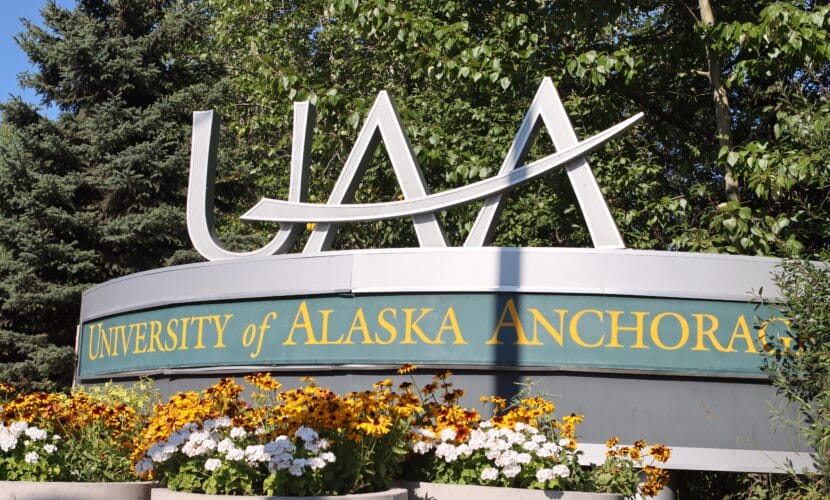
The University of Alaska Anchorage sign. Photographed on Friday, Aug. 21, 2020. (Tegan Hanlon/Alaska Public Media)
The Trump administration has changed course and is reversing the termination of international student records, which had put thousands of students across the country at risk for deportation.
University of Alaska officials confirmed Monday that the four impacted UA students now have restored status in the federal Student and Exchange Visitor Information System, or SEVIS.
Immigration lawyer Margaret Stock represented one of the students. She said the actions of the Trump administration were illegal, and she thinks the administration buckled under the pressure of dozens of lawsuits filed in response.
“They were playing some kind of game where they figured people would self-deport or they just wouldn’t react fast enough,” Stock said. “But the legal community rallied pretty quickly, and it was so blatantly illegal that it was easy to win a lawsuit. So people were just filing lawsuit after lawsuit after lawsuit and getting temporary restraining orders immediately.”
The move from the federal government comes amid a crackdown from President Trump on immigration.
Jean Kashikov, a recent University of Alaska Anchorage graduate, was among many students who sued the government and argued that it terminated their SEVIS records without due process, in violation of the Fifth Amendment to the U.S. Constitution.
Kashikov is from Kazakhstan and studied aviation and mathematics in Anchorage. He received his termination notice as he was doing his optional practical training, which allows foreign students to work in the country for up to a year, if they are working in their field of study. He was self-employed as a flight instructor in Wasilla.
Cindy Woods, an attorney with the American Civil Liberties Union of Alaska, represented Kashikov. She said she was notified that Kashikov’s record was restored Monday morning.
“He has status again to be here in the United States and to continue with his optional practical training period,” Woods said. “So he can get back to flight instructing and continuing to earn the hours he needs to launch his career as a pilot.”
In announcing the reversal Friday, attorneys with the Justice Department said the federal government is working on a framework to legally terminate SEVIS records.
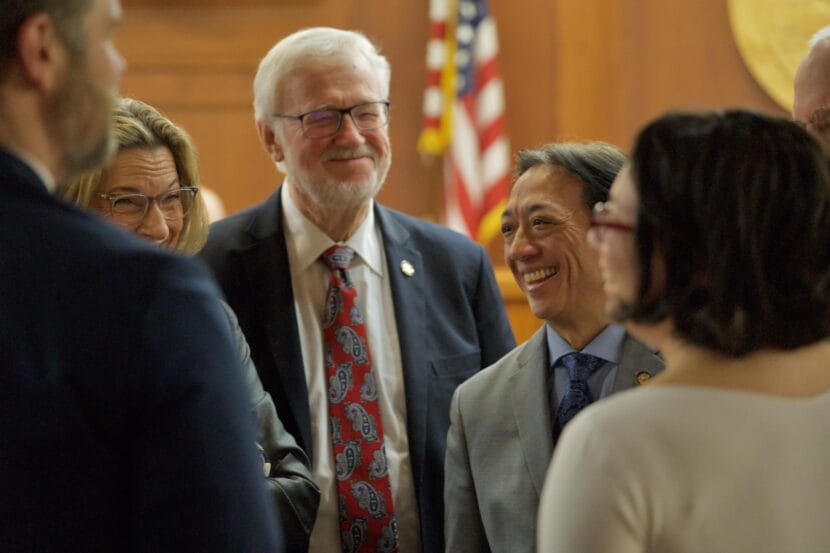
Senators smile ahead of a final vote on House Bill 57 on Monday, April 28, 2025. (Eric Stone/Alaska Public Media)
The Alaska Senate passed a second attempt at an education funding bill on Monday, setting up an up-or-down vote in the House that could send the bill to Gov. Mike Dunleavy.
House Bill 57 would boost the basic input into the state’s public school funding formula, the base student allocation, by $700. It comes less than a week after lawmakers failed to override Dunleavy’s veto of a $1,000 boost to basic funding. The bill passed 19-1 with five members of the all-Republican minority caucus crossing over in support. Sen. Robb Myers, R-Fairbanks, was the only no vote.
School administrators, parents, businesspeople and community leaders have pleaded with lawmakers to boost education funding for years, and there’s broad agreement that the state’s public schools are underfunded. But lawmakers have failed to come to terms with each other and the governor on a long-term increase, instead offering one-time cash infusions the last two years.
“While the bill before you isn’t the final answer to adequately funding our schools, it will get the much-needed financial resources our schools desperately need to retain high quality educators, reduce class sizes, keep beloved extracurricular activities and support our struggling students,” Senate Education Committee Chair Löki Tobin, D-Anchorage, said.
It’s an attempt at compromise. Dunleavy has called for any school funding boosts to be tied to policy items that he says would boost student performance. Those include changes to state law aimed at boosting charter schools and correspondence homeschool, along with grants supporting literacy in elementary schools.
Tobin, who negotiated in closed-door meetings with the governor’s staff on a prior attempt to find common ground on an education funding bill, said the final bill did not represent a deal with the governor.
“I am working with my colleagues here in the Senate and also in the House to ensure that we have a veto-proof majority supporting this legislation,” Tobin said in an interview after the vote. “I’ve been working my ass off, so I’m hopeful.”
The bill that arrived in the Senate Monday morning would, in addition to boosting overall school funding, provide a 10% boost in student transportation funding, require school districts to regulate student cellphone use and simplify the process of creating a new charter school or renewing its contract. It would also set up a task force to study education funding.
After the bill advanced out of committee last week, Dunleavy said he would sign the bill if lawmakers made “a few key edits.” Those included additional provisions aimed at boosting charter schools, an additional funding boost for correspondence homeschool, and an incentive program aimed at improving reading scores for young students.
Senators modified the bill in some important ways during debate on the floor, adding some but not all of the policies Dunleavy requested.
“We believe we’ve struck the most reasonable compromise we’re going to find this year,” Senate Minority Leader Mike Shower, R-Wasilla, said.
One amendment, which passed with unanimous support, added a literacy incentive program proposed by Dunleavy to the bill. The program would pay school districts $450 for each student in kindergarten through sixth grade who reads at grade level or demonstrates improvement.
But, as the state faces a dire budget picture, senators tied the literacy program to passage of a Senate-approved bill that would boost state revenue. Senate Bill 113 would require companies who do business in the state via the internet to pay Alaska state income taxes. Senators have described the tax bill as a “unicorn” and said it would not increase taxes on Alaskans or companies based within the state. Revenues from the tax change would be allocated to the literacy program, with any money in excess of the cost of the reading program going towards career and technical education.
“I’m just trying to find a way to get what I believe is the most important part of all this to the finish line,” said Sen. Robert Yundt, R-Wasilla and a member of the all-Republican minority caucus who sponsored the amendment alongside Democratic colleagues.
Some other Senate-approved changes to the bill relate to charter schools. If a school district decides to terminate a charter school contract, the bill would require them to show cause and give the charter school a chance to address the issue. It would also speed the timeline for the state school board to act on charter schools’ appeal of local board decisions.
Another amendment to the bill would require school districts to set nonbinding target class sizes, with maximum targets set in state law: 23 for elementary schools and 30 for middle and high schools at 30. Districts would be tasked with tracking actual average class sizes and reporting them to the state. Tobin said the amendment, which passed unanimously, would help lawmakers “figure out the best way to support our local school districts and get them the resources they need.”
The newly amended bill would also ban student cellphone use during school hours, including lunch, unless a school board sets out a policy allowing it.
Sen. Shelley Hughes, R-Palmer, said the cellphone policy, in addition to the reading-focused incentive grants, “would be a game-changer.”
The Senate also approved an amendment that would require lawmakers to study, but not necessarily implement, an open enrollment system that would allow families living in one school district to enroll their children in another.
Senators rejected a number of other changes to the bill, including proposals to reduce the number of years that the state tracks student outcomes, require districts to report the results of staff exit interviews and add an incentive to the state school funding formula that the sponsor said would “encourage” correspondence students to take standardized tests.
Dunleavy’s proposal to increase correspondence homeschool funding did not come up for a vote. Hughes said lawmakers were looking to keep the overall cost of the bill manageable given the state’s budget constraints, and that the benefits of a homeschool funding boost would not necessarily flow to students.
“It was not going to change, for instance, the allotment that a parent would get per child,” Hughes said. “It would have provided more for the district.”
Senate approval of the bill sets the stage for a fast-track vote in the House.
Because an earlier version of the bill already passed the House, though at that time it included only a requirement to regulate student cellphone use, Senate passage sets up a yes-or-no concurrence vote in the House. If the House votes to accept the Senate’s changes, it would be sent to the governor’s desk.
A spokesperson for Dunleavy declined say whether the governor supported the new bill ahead of the final House vote. But Hughes, a close ally of the governor, said she had been in touch with Dunleavy, asking him to accept the compromise.
“I can almost guarantee you that the governor is not a happy camper right now,” Hughes said. “But I will tell you, I had a conversation with him over the weekend, and I talked about pride and ego and really implored him to look at the big picture”
Several Republican senators — Sens. Mike Cronk, R-Tok, Robert Yundt, R-Wasilla, and James Kaufman, R-Anchorage — said they would support an override if Dunleavy ultimately vetoes the bill. Several said they were glad to support a compromise.
“We’re not a Republican in Idaho, and we’re not a Democrat in California,” Yundt said. “This is a state where everybody has to give.”
Hughes and Shower said their support for an override would depend on whether the tax bill that would fund the reading program passes.
Though the House initially planned to vote on the final bill Monday, lawmakers sent the bill back to the Senate for a re-vote after discovering an error in the bill’s language. A final vote is expected Wednesday.
Correction: An earlier version of this story said the vote came less than a week after the governor’s veto. It comes less than a week after a failed override vote.
Pipelines stretch toward the horizon in the National Petroleum Reserve-Alaska. (Photo by Elizabeth Harball/Alaska’s Energy Desk)
The Trump administration’s National Energy Dominance Council is planning an Alaska summit with leaders from Japan and South Korea in early June to discuss the Alaska LNG project.
That’s according to reports from the New York Times and Reuters citing unnamed sources familiar with the matter. The White House, the Energy Department and the Interior Department all declined to confirm the summit reportedly scheduled for June 2 in emails to Alaska Public Media.
The White House and the Energy Department each emailed identical statements touting the potential benefits of the project and saying the administration was “committed” to supporting the Alaska LNG project.
“Unlike the previous administration which openly discouraged investment in American LNG, President Trump and (Energy) Secretary (Chris) Wright are committed to expanding American energy infrastructure, including by supporting the Alaska LNG Project,” White House and Energy Department spokespeople said.
The $44 billion, 800-mile Arctic gasline project would connect North Slope natural gas fields with a liquefaction facility and export terminal in Southcentral Alaska. But for decades, the Alaska LNG project has failed to attract enough investors to make the complex and expensive project a reality, leaving trillions of cubic feet of natural gas stranded without a market.
Since returning to office, Trump has repeatedly said the gasline project is a priority for his administration. The state agency working towards the gasline project signed an agreement last month with developer Glenfarne to bring the project towards a final investment decision. That’s expected late this year.
Gov. Mike Dunleavy traveled to Asia earlier this year to seek foreign investors for the gasline. He returned with a nonbinding letter of intent saying Taiwanese state energy company CPC Corp. would purchase gas from the project. But the governor did not return with commitments from enough partners to allow the project to move forward.
The reports from the Times and Reuters say federal officials hope to use the summit to announce commitments from Japan and South Korea to purchase gas from the project. Trade talks with Japan and South Korea are underway, and Japan has floated increasing LNG imports as an element of a potential trade deal. But the Korean industry minister told Reuters he was not aware of any plans to announce a commitment from South Korea.
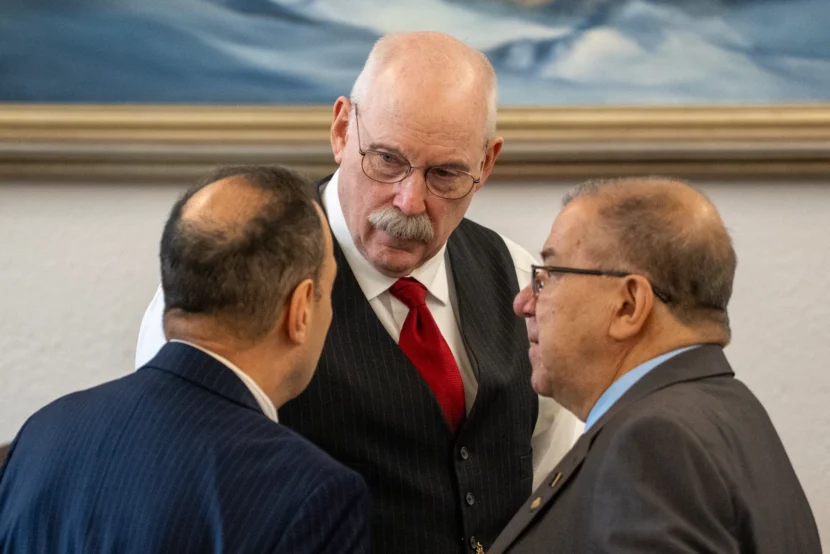
Sen. Bert Stedman, R-Sitka, center, huddles with fellow co-chairs of the Senate Finance Committee — Sen. Donny Olson, D-Golovin, left, and Sen. Lyman Hoffman, D-Bethel — during a committee meeting on April 24, 2025. (Eric Stone/Alaska Public Media)
The Alaska Senate is planning to vote Monday on a new education funding bill, even as Gov. Dunleavy is calling for changes. That’s after a state Senate committee approved a new version of a bill calling on school districts to regulate student cellphone use.
The new version of House Bill 57 from the Senate Finance Committee includes a $700 boost to the base student allocation, the basic input into the state’s public school funding formula. It also includes a 10% boost to student transportation funding, a longtime priority for school districts facing rising costs.
School leaders, community members and others have said for years the state’s schools are underfunded, and school boards have been forced to slash staff and programs as lawmakers and the governor have struggled to come to terms on a long-term boost to education funding.
The revised bill comes a week after Gov. Mike Dunleavy vetoed a prior bill adding $1,000 to the base student allocation and two days after an override vote failed. Dunleavy has said for years he’d veto any school funding bills that don’t include his preferred policy priorities and twice made good on that threat.
Sen. Bert Stedman, R-Sitka, who caucuses with the largely Democratic bipartisan Senate majority, says the new bill is an attempt to compromise.
“We talked about some of the policies that were in play, and there’s quite a few of them, which ones seemed to be most universally acceptable, and threw them together,” Stedman said of the new bill.
Some of the policy items included in the bill would ease the process of creating and renewing charter schools.
Sen. Löki Tobin, D-Anchorage, said the bill “strikes a balance between having public policies that have been well-vetted and that will actually improve education outcomes in our public schools, and also provid(es) the desperately needed resources to stabilize our public school system and keep our class sizes limited.”
There are, however, some significant differences between lawmakers’ approach and a bill Dunleavy introduced after vetoing lawmakers’ last attempt.
The Senate version of the bill does not, for instance, limit the reasons school districts can terminate charter schools’ contracts, nor does it prescribe a new appeal process for charter schools that face termination. Those, along with a provision that would create a statewide open enrollment system that allows students living in one district to go to school in another, have faced opposition from Senate leadership.
The new bill also omits a funding increase for correspondence homeschool and $450-per-student incentive payments to school districts whose elementary-age kids read at grade level.
In a social media post Thursday, Gov. Dunleavy called on lawmakers to add those items.
“Let me be clear. If legislators make a few key edits, including restoring the reading grants, adding open enrollment, ensuring full funding for correspondence students, and including the four charter school reforms, I will sign this bill,” he said.
The bill is scheduled for amendments on the Senate floor on Friday.
If Dunleavy ultimately vetoes the bill, the predominantly Democratic coalitions who control the House and Senate could not override him without help from minority Republicans.
Rep. Will Stapp, R-Fairbanks, who objected to the prior bill’s large price tag, said the new bill looks more affordable.
“It doesn’t appear to me to be the kind of the clear things that the executive (Dunleavy) is asking for, but it’s certainly closer,” he said. “Hopefully, we’ll get there. It doesn’t feel like we’re that far apart here in the building.”
Stapp said he’d like to see the governor’s open enrollment and correspondence school provisions added to the bill.
“We’ll just have to see what the final bill ends up looking like,” he said.
The bill is expected to move quickly through the Senate and onto the House. Because the bill already passed the House — though at that point, it only included a requirement that schools regulate cellphone use — approval in the Senate would set up a single up-or-down vote in the House on concurring with the upper chamber’s changes.
Jean Kashikov, a recent University of Alaska graduate, poses for a photo on April 13, 2025. Kashikov is one of four UAA international students whose visa has been revoked by the Trump administration. (Wesley Early/Alaska Public Media)
A recent University of Alaska graduate is suing the federal government after his foreign student status was revoked by the Trump administration.
Jean Kashikov is one of four UA students, and hundreds nationwide, who recently had their status terminated in the federal Student and Exchange Visitor Information System, or SEVIS. His student visa was also revoked.
A spokesperson for the university said Thursday that, to their knowledge, there have been no additional UA students or recent graduates to have their status terminated or student visas revoked since Kashikov and the others in mid-April.
In a lawsuit filed Wednesday in federal court, Kashikov’s attorneys say the Department of Homeland Security did not give Kashikov proper notice of the termination of his student status, and they say the revocation of his student status puts him at risk of being detained by Immigration & Customs Enforcement officials.
Cindy Woods with the American Civil Liberties Union of Alaska is one of the attorneys representing Kashikov. She pointed to the Fifth Amendment to the U.S. Constitution, as well as the federal Administrative Procedure Act.
“We do think that there has been clearly unlawful activity here,” Woods said. “A violation of Mr. Kashikov’s Fifth Amendment rights and his right to due process, and also a violation of the APA because this was a final agency action that he has not been given the opportunity to contest.”
Kashikov graduated from the University of Alaska Anchorage in 2024, earning a bachelor’s degree in mathematics in May and an associate’s degree in piloting in December. He had worked as a self-employed flight instructor since March as part of his optional practical training, a defined time period that allows foreign students to work in the country for up to a year, if they are working in their field of study.
In an email, UAA notified Kashikov on April 10 that his SEVIS record had been terminated. The federal government’s stated reason for the termination was “other,” and the email noted that his record was terminated following a criminal records check.
Kashikov told Alaska Public Media earlier this month that he’d been arrested in Arizona in 2022 after he blocked a public bus he says refused to pick him up, but the charges were dropped. He also had a speeding ticket in Georgia, but those charges were also dismissed.
Nicolas Olano, a lawyer with Nations Law Group also representing Kashikov, said he shouldn’t have lost his SEVIS status as a result.
“That is not sufficient to revoke your status in the United States,” Olano said. “It’s a different standard to revoke your visa. Okay, they might have been right or could be right. That doesn’t matter at this point. What matters really is, what is his status.”
In the lawsuit, the attorneys say they are not contesting the revocation of his student visa, which allowed him to enter the country, and are instead suing over the termination of his student status.
Kashikov’s attorneys are asking a federal judge to issue a temporary restraining order that would prevent federal officials from detaining Kashikov as a result of his student status being revoked.
But Woods said she believes the loss of Kashikov’s SEVIS status has caused irreparable harm.
“We’re hopeful that the judge sees that as well and can issue a temporary restraining order and then move forward with a permanent injunction, so that while this is all ongoing, Mr. Kashkoff can continue to fly and to instruct and reap the benefits of the education that he received here in Alaska.”
Homeland Security Secretary Kristi Noem and acting ICE director Todd Lyons are named as defendants in the suit.
“Due to privacy concerns and visa confidentiality, the Department of Homeland Security (DHS) generally does not comment on specific cases or actions taken under the ICE Homeland Security Investigations (HSI) Student and Exchange Visitor Program (SEVP),” a senior DHS official said in an email.
In a statement, an ICE spokesperson said the department does not comment on pending litigation.
This story has been updated with more information.
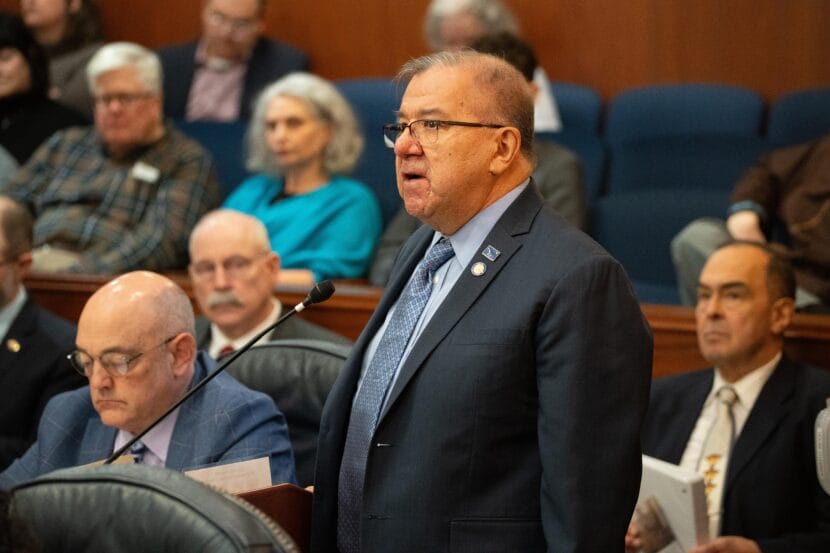
Sen. Lyman Hoffman, D-Bethel, speaks on April 22, 2025 against the override of Gov. Mike Dunleavy’s veto of House Bill 69. (Eric Stone/Alaska Public Media)
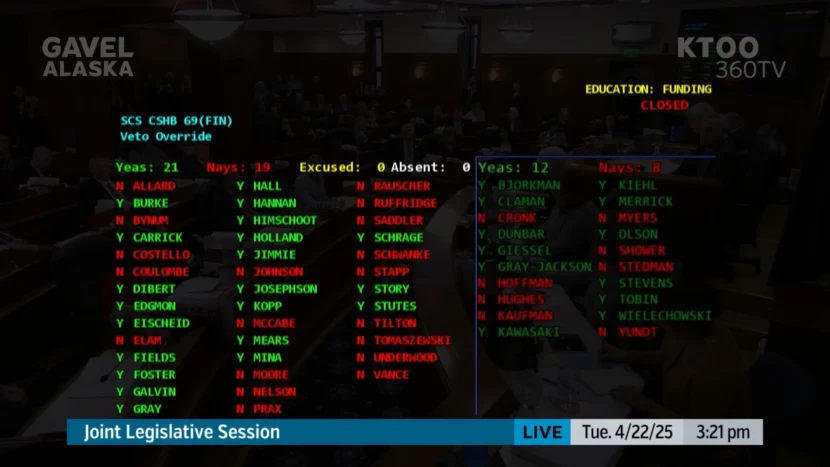
Alaska lawmakers on Tuesday failed to override Gov. Mike Dunleavy’s veto of a bill that would have provided a $1,000 boost to basic per-student funding for public schools.
The combined House and Senate vote was 33-27, well short of the 40 votes needed to override Dunleavy’s veto. All but two members of the House and Senate’s Democrat-heavy bipartisan majority caucuses voted for the bill; all 25 members of the all-Republican minorities voted to sustain the veto.
Dunleavy vetoed the bill on Thursday, saying it didn’t include his preferred policy changes and that the bill’s $250 million price tag was too steep.
On that second point, chief Senate budgeter Sen. Lyman Hoffman, D-Bethel, said he reluctantly agreed, voting against an override. Hoffman acknowledged the need to boost funding for the state’s schools. Superintendents, parents, principals and business leaders have said for years that inadequate state funding has forced them to increase class sizes, slash beloved programs like sports and electives, and lay off staff.
But Hoffman said the state can’t afford a $1,000 increase right now given the worsening fiscal picture, driven in part by low oil prices.
“We need to take our heads out of the sand, look at the fiscal realities that we live in today and do what the people have sent us down here to do, to balance this budget,” Hoffman said.
Hoffman repeated a call for lawmakers to pass a series of revenue measures that he said would allow the state to fund schools appropriately. The largely Democratic Senate majority has backed three bills that would roll back oil and gas tax credits and expand corporate income taxes.
The head budgeter in the House, Rep. Andy Josephson, D-Anchorage, took issue with Hoffman’s view.
“I can’t go to my constituents and say this is just unaffordable, because it’s not. It’s just a question of will, that’s all,” he said.
Josephson said the $1,000 boost would cost just $77 million more than the state approved for public schools last year on a one-time basis. That’s a small fraction of the nearly $3 billion that the state has in savings.
Lawmakers fell seven votes short of overriding Dunleavy’s veto. (Gavel Alaska)
Status quo spending would leave the state hundreds of millions of dollars in deficit, and it’s unclear how lawmakers will resolve the shortfall. The state Constitution requires lawmakers to pass a balanced budget every year.
Senate Finance Committee co-chair Bert Stedman, R-Sitka, said before voting against the override that drawing from the state’s primary rainy-day fund, the Constitutional Budget Reserve, was not prudent with oil prices and financial markets in turmoil.
Stedman said he didn’t want to risk being forced to reduce school funding next year.
“The headwinds coming at the state over the next year or so look significant, more significant than they have ever looked in my 20 years here,” he said. “We are very concerned over the next year that we may have demands on our treasury that we have not foreseen.”
The top three sources of state revenue are investment earnings, oil taxes and the federal government, all of which are under pressure.
Stedman said lawmakers should focus on passing a minimum $680 boost in long-term funding, matching the one-time funding schools got last year. He said lawmakers should consider an additional “incremental” boost next year.
Minority Republicans were largely silent on the floor but echoed Stedman’s budget concerns in a news conference after the vote.
The veto — and the failed override — were expected. The Senate Finance Committee stripped out policy measures aimed at finding common ground with Dunleavy and avoiding a repeat of last year’s veto. The governor took to social media to call the new funding-only bill a “joke” and pledged to veto it. It passed with a one-vote majority in each chamber, and Dunleavy made good on his veto threat days later.
Sen. Bill Wielechowski, D-Anchorage, said Tuesday that senators thought at the time that the bill had a realistic chance of passing despite a veto from the governor.
“Before Gov. Dunleavy came out and called it a joke, we thought there were 40 votes there,” Wielechowski said, though it’s not clear where those votes would have come from.
Dunleavy applauded the failed override on social media Tuesday.
Lawmakers say they’ll keep trying
Gov. Mike Dunleavy proposed a $560 boost to basic education funding, the base student allocation, in a bill he announced alongside his veto. The bill also includes additional funding aimed at boosting correspondence homeschool and an incentive program that would reward school districts with large numbers of young students who read at grade level or demonstrate improvement.
Dunleavy’s bill also includes provisions that would change the appeal process for charter schools terminated by a local school board and an open enrollment policy that would allow parents to enroll their students in brick-and-mortar schools outside their home district.
Those provisions are already causing some heartburn from Senate leadership. Senate President Gary Stevens, R-Kodiak, said he worried they would take power from locally elected school boards.
“There are some things that we’re very concerned about,” he said, adding that he hoped to continue discussions aimed at finding common ground. He said he had not yet discussed Dunleavy’s new bill with the governor.
Lawmakers on all sides said they hoped to come to a compromise in the month left in the legislative session.
“It does feel like the wind has come out of the sails a little bit after this, after this override session, but we’ve still got time,” Wielechowski said. “Our schools are counting on us.”
Rep. Mia Costello, R-Anchorage and the House minority leader, said she looked forward to digging into the governor’s proposal to find a way forward.
“We just have to work through the process and I think work together in the last weeks of session in order to get the governor’s bill across the finish line,” she said.
Rep. Rebecca Himschoot, I-Sitka, the primary sponsor of the bill Dunleavy vetoed, said she thought the veto and failed override were “somewhat predictable, but that doesn’t make it any less disappointing.”
“I know that right now in every school district, personnel are being laid off, programs are being cut, families are asking themselves, ‘Is this what I signed up for when I decided I was going to raise my kids here in this state?'” she said. “So we have some work to do.”
Close
Update notification options
Subscribe to notifications
Subscribe
Get notifications about news related to the topics you care about. You can unsubscribe anytime.