Alaska Public Media is one of our partner stations in Anchorage. KTOO collaborates with partners across the state to cover important news and to share stories with our audiences.
Alaska State Refugee Coordinator Issa Spatrisano at the Catholic Social Services office. (Wesley Early/Alaska Public Media)
Alaska officials who help resettle immigrants say they’re facing a lot of uncertainty amid the Trump administration’s crackdown on legal and illegal immigration.
Issa Spatrisano is the refugee program coordinator for Catholic Social Services. During an appearance on Talk of Alaska on Tuesday, she said a large group of immigrants in the state come from Ukraine, and are classified as having humanitarian parole. However, she said a pause on certain federal programs has prevented those people from keeping their paperwork up-to-date.
“I don’t know how many Ukrainians I’ve spoken to that we serve who have bought land and are ready to buy houses, who were enrolled at UAA and questioning if they should go,” Spatrisano said. “I mean, people are at a loss of what to do.”
Spatrisano said the Trump administration has rolled back a number of Biden-era refugee policies that have left people who entered the country legally now told that they need to leave the country.
For asylum seekers, immigrants and other noncitizens currently in the country, immigration attorneys have been working to clarify what rights people have. Nicolas Olano is an attorney with Nations Law Group. He said some of that outreach involves telling people that they have a right to an attorney and that there’s a difference between the kinds of orders that law enforcement might issue to them.
“The judicial and administrative warrants that we’re talking about permit you to do different things,” Olano said. “The administrative warrant that ICE issues does not let you go into a house, for example, versus the judicial warrant that would allow the officers to go into the house and search for either people or certain specific things that they’re looking for.”
Cindy Woods, a senior immigration law and policy fellow for the American Civil Liberties Union of Alaska, said her organization has been hosting Know Your Rights presentations to combat rumors and misinformation around deportations, and she encourages noncitizens to reach out if they are concerned about their immigration status.
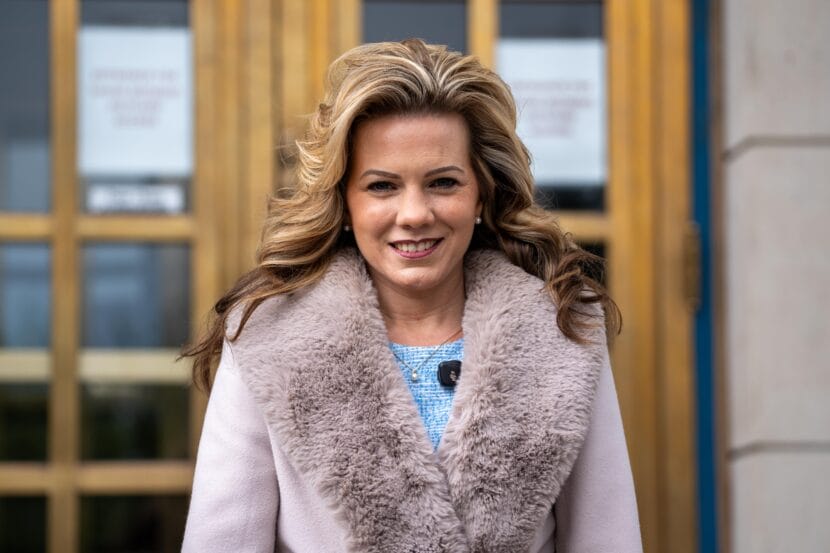
Bernadette Wilson, an entrepreneur and conservative activist, poses for a photo in front of the Alaska State Capitol after announcing a run for governor on May 13, 2025.
Conservative activist Bernadette Wilson announced on the steps of the Alaska State Capitol in Juneau on Tuesday that she’s entering the race for governor.
Wilson, a business owner who has also led conservative policy groups, pitched herself as a political outsider in an interview.
“I think it’s time that we take someone with a business background and entrepreneurial spirit, someone that hasn’t been jaded, you know, within the halls of this building, and we get infrastructure done,” she said. “We’ve got to sit down and have a serious conversation about how we’re going to get education in this state. There’s no reason Alaska shouldn’t be No. 1.”
Wilson says she has deep roots in the state as the great-niece of former Alaska Gov. Wally Hickel and a member of the Naknek Native Village Council. She is the majority owner of the nine-year-old Anchorage garbage company Denali Disposal, according to state records.
Wilson has also been active in conservative politics. She’s a sponsor of the latest ballot initiative seeking to ask voters in 2026 to repeal Alaska’s open primaries and ranked choice voting. Until recently, she was the interim executive director of the Alaska Policy Forum, a conservative think tank. Prior to that, she was the state director for the Alaska arm of Americans for Prosperity, a conservative advocacy group affiliated with brothers Charles and David Koch. Wilson was the top choice in a straw poll of readers conducted by the conservative site Must Read Alaska.
“Current leaders like President Donald Trump and Congressman Nick Begich, previous leaders like Governor Hickel have all gone and done wonderful things for our state and for our country, but they all have one thing in common,” she said. “None of them had a government bureaucrat background when they started. Indeed, even when President Ronald Reagan first ran for governor of California, he had not been in government.”
Wilson also lamented the state’s failure to pay Permanent Fund dividends in line with a formula in state law that lawmakers have essentially ignored since the mid-2010s, when oil prices crashed and the state started relying on an annual draw from the Permanent Fund to pay for state services. The Permanent Fund draw has replaced oil revenue as the top source of the state’s unrestricted cash, which pays for everything from state troopers and schools to roads, bridges and ferries.
As oil prices drop on weakening global demand and growing supply from abroad, the state faces a grim fiscal future. Senators recently approved an austere budget while warning of even tougher times to come. Legislators in the predominantly Democratic bipartisan coalition in the Senate have pushed to expand taxes on out-of-state corporations and oil and gas companies to help close the gap, but they have run into resistance from Gov. Mike Dunleavy and the narrowly divided House.
Asked how she would address the state’s looming budget crunch, Wilson said she would reduce the state workforce.
“We have one of the highest rates of public employees, government employees per capita than any other state,” she said. “It’s time for us to look at the bloat. Is it going to be painful? Absolutely, it is. But we need to take a strong look at that budget and figure out, what are we going to do?
Though she holds a number of traditionally conservative positions on resource extraction and development, Wilson breaks from Gov. Mike Dunleavy on one key issue: She said she would like to see a significant increase in education funding in an effort to improve student performance.
“I am tired of hearing an arbitrary number on education continually get thrown out, whether it’s $1,000, $1,200, $700. I want to support a (basic school funding) increase that’s the number that the education bureaucrats can look at me and say, Bernadette, that’s the number that’s going to make us number one in the country,” she said. “That’s the number that I want to know. That’s the number that we should be supporting.”
Dunleavy has repeatedly said funding alone would not improve the state’s school system. Education advocates have pushed for a more than $1,800 increase in basic funding to restore schools’ buying power to what it was in 2011, though lawmakers and the governor have said the decline in oil prices has made such a move unaffordable. A bipartisan bill that would, among other reforms, boost basic per-student funding by $700 is pending on Dunleavy’s desk, and he told superintendents on Thursday he plans to veto it unless lawmakers pass additional education policy changes.
But Wilson shares some positions with Dunleavy and other conservative Republicans on public education, including support for so-called education savings accounts, a voucher-like system that allows students to use government funds to attend private schools.
That’s an issue in a high-profile constitutional case working its way through Alaska’s court system challenging the use of state homeschool funds on private school tuition. The Alaska Constitution prohibits the use of public funds “for the direct benefit of any religious or other private educational institution.”
Wilson lives in Anchorage, but she said she kicked off her campaign in Juneau to illustrate her willingness to go “right into the belly of the beast.”
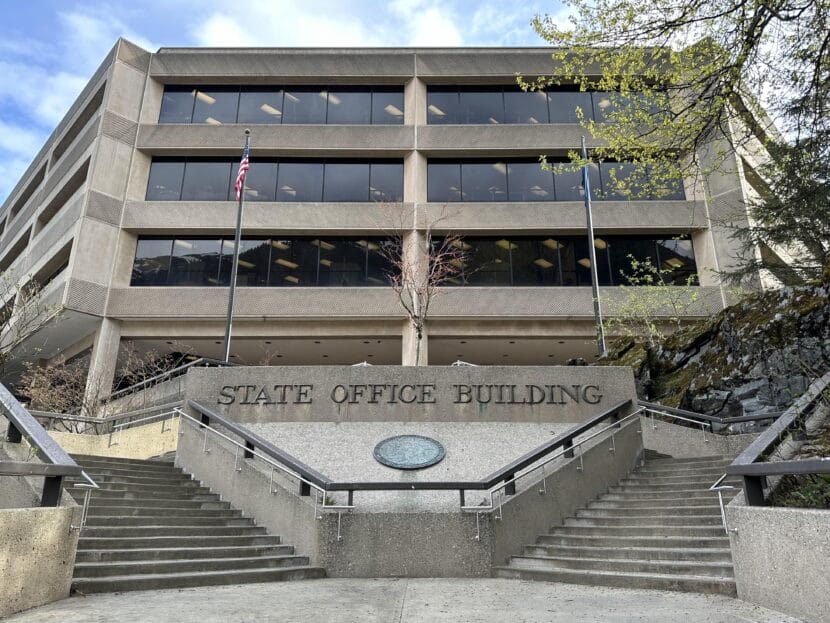
The State Office Building in Juneau, Alaska is seen on April 30, 2024.
Gov. Mike Dunleavy on Friday ordered a freeze on most state hiring, out-of-state travel and new regulations as oil prices tumble. Dunleavy outlined the freeze in an administrative order released Friday afternoon.
Oil production in Alaska is expected to increase in the coming years as new projects like Pikka come online. But, at the same time, the price of a barrel of North Slope crude fell more than $10 in April, and federal forecasters say they expect oil prices to fall further in the coming months. Oil no longer provides a majority of the state’s revenue. But it’s still a significant factor, and an especially volatile one.
Dunleavy’s office declined an interview request Monday. In a statement, Dunleavy said falling prices meant the state had no choice but to institute the freezes.
“This is the right thing to do,” Dunleavy said. “Alaskans expect us to manage their resources wisely. With oil prices dropping and our savings accounts unable to carry us through even one year of full state operations, we have no choice but to act now. ”
Rep. DeLena Johnson, R-Palmer, said the freezes were a fast-acting mechanism to address the drop in state revenues.
“He’s just looking to make some cuts wherever he can, and that’s probably the quickest and fastest way he can do it,” she said.
But some lawmakers say they’re concerned about the impact of the hiring, travel and regulation freeze on the operations of state government. Rep. Will Stapp, R-Fairbanks, said he largely agreed with Dunleavy’s decision to impose the freezes, but he said he was wary of the consequences.
“I think some of those things are probably in order if you look at the oil price and where we’re at in the budget,” he said. “I would certainly like to see the implications. I think, probably, the hiring freeze should probably be on a case-by-case basis.”
Some agencies, especially those dealing with public safety, are exempt from the freeze. The Division of Public Assistance, which administers aid programs like Medicaid and SNAP, is also exempt. The exempt positions include Alaska State Troopers, correctional and probation officers, airport police and fire officials, and “employees that provide patient, resident, or food services at 24-hour institutions.”
The out-of-state travel freeze applies regardless of funding source, meaning state employees can’t travel outside Alaska even if a third party pays for it. In-state travel is restricted to essential business.
State agencies can apply for waivers of the hiring and travel freezes.
“The freeze is aimed at limiting non-essential travel. The Governor will continue to travel when needed to directly support Alaska’s core interests,” Dunleavy spokesperson Jeff Turner said in an email. “Additionally, waivers can be requested by a state agency for travel related to protecting the safety of the public or meet essential State needs.”
House Speaker Bryce Edgmon, I-Dillingham, said he finds it hard to square the cost-control measures with the fact that Dunleavy’s first-draft budget came with a $1.5 billion deficit.
“It doesn’t make sense to me,” he said.
Edgmon said he hoped the freeze would not prevent administration officials from working with legislators in the final days of the legislative session. Dunleavy has already warned administration staff to stay away from the Capitol in the session’s closing days ahead of May 21.
Sen. Bert Stedman, R-Sitka, said lawmakers were able to come up with a balanced budget without a hiring freeze, and he said he’s worried about the impact of a freeze on state services.
“There’s a lot of vacancies in the state, and those positions are funded,” he said.
Roughly one in six state jobs were vacant at the beginning of this year. Stedman said he was especially concerned about the Alaska Marine Highway System, where about half the jobs were vacant at the beginning of the year.
“You can’t run the Marine Highway without licensed staff, a licensed crew, and you don’t get licensed crew unless you hire them,” he said.
The head of the largest union for state employees, Alaska State Employees Association Executive Director Heidi Drygas, said she worried that the hiring freeze could burn out an already stressed state workforce.
“I worry they are more of a face-saving measure than actually saving state funds,” she said. “I say that because it could actually cost more. Right now we are paying state employees huge amounts of overtime because the work has to be done.”
Drygas said it’s long past time for lawmakers and the governor to come together on a long-term plan for the state’s fiscal future.
In that letter, Dunleavy said he “cannot support standalone tax measures.” The House and Senate recently approved a tax bill that aims to bring in more tax revenue from out-of-state corporations. The bill is awaiting the governor’s signature or veto.
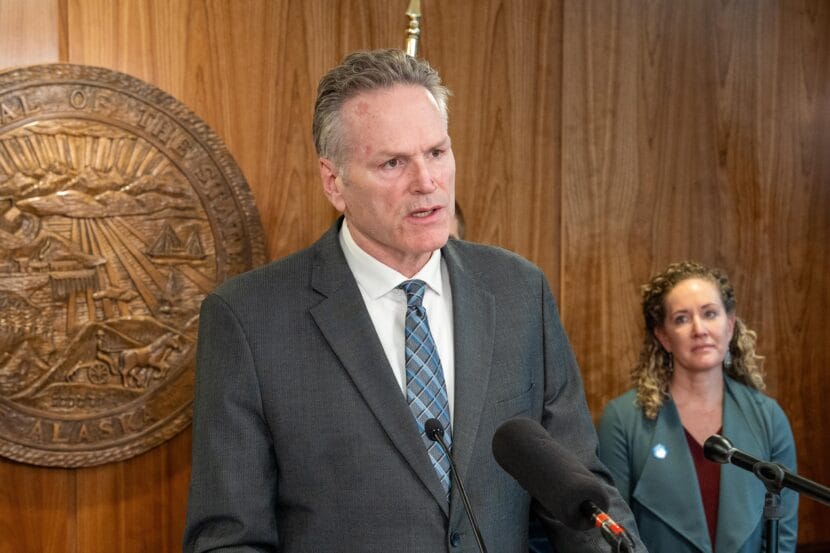
Gov. Mike Dunleavy, R-Alaska, speaks during a press conference introducing his budget for the next fiscal year on Dec. 12, 2024. (Eric Stone/Alaska Public Media)
Gov. Mike Dunleavy is once again threatening to veto a compromise bill legislators hammered out to boost funding for the state’s public schools and make a variety of policy changes.
Dunleavy has yet to make the threat publicly. But Clayton Holland, the superintendent of the Kenai Peninsula Borough School District, said in an interview that the governor made his intentions clear in a teleconference with school district leaders from across the state.
“Really, what it ended up boiling down to is that he does plan to veto (House Bill 57),” Holland said.
It’s the first time the governor has indicated whether he’ll sign or veto the high-profile bill, which passed the Legislature by a combined vote of 48 to 11. Lawmakers in the bipartisan, Democrat-heavy majority caucuses have said boosting education funding is their top priority for this year’s legislative session, which is now entering its final weeks.
Asked about the meeting, the governor’s press office pointed to a midday statement on the governor’s social media accounts, which did not say explicitly whether Dunleavy planned to veto the bill.
“We need a system that delivers results, not just more spending,” part of the statement said.
House Bill 57 would boost long-term public school funding by increasing basic per-student funding by $700. In an effort to compromise with Republicans in the House and Senate’s minorities and the governor, lawmakers added a variety of education policy changes to the bill. Those range from a ban on student cellphone use to incentive grants aimed at boosting reading performance and an increase in career and technical education funding.
But Dunleavy wants more, Holland said. The governor told superintendents to lobby their local legislators to pass several additional policy items.
Dunleavy told superintendents to advocate for a statewide open enrollment system, which would allow students living in one district to enroll in another. He also asked for additional changes to state laws around charter schools, and for lawmakers to fund a reading incentive grant program included in House Bill 57 without expanding corporate income taxes on out-of-state companies as lawmakers have proposed, Holland said.
School districts, community members, business leaders and local elected officials have pleaded with lawmakers for years to increase formula funding for schools by raising the base student allocation. Leaders say they’ve been forced to close schools, increase class sizes and slash electives and career and technical education programs as the formula has remained largely unchanged since 2017.
Though lawmakers have provided one-time funding for public schools in recent years, district leaders say a boost to the funding formula is essential to stopping a cycle of cuts that have dramatically reduced their offerings.
“It feels like all of the students, even the students that are most in need, are being held as bargaining chips,” said Madeline Aguillard, the head of the Kuspuk School District, who also attended the meeting and confirmed the veto threat.
‘We have nothing left to cut’
Aguillard’s district, with nine schools in seven remote communities along the Kuskokwim River in Western Alaska, is already operating with bare-minimum staff and will face a 10% budget shortfall without additional funding, she said. Even the $700 increase lawmakers approved would leave her district wanting, she said.
“We have nothing left to cut,” she said.
A report from KYUK and ProPublica this year found that the state had so badly underfunded rural schools, including those in Aguillard’s district, that many are crumbling and pose health and safety hazards for students and staff alike.
Already, seven of the district’s schools are forced to rely on offsite teachers, she said, because the district is unable to afford in-person certified teachers. One school in the district has no certified teachers in it at all, she said. In others, students must rely on online learning for core subjects.
“A group of them, it’s, it’s full-blown math class. A group of them, it’s for electives,” she said. “There’s always been online programs, and supplemental (instruction), and things like that. But this isn’t supplemental anymore.”
Without a boost in funding, the few remaining cultural activities for the district’s students, which are more than 95% Alaska Native, would be among the programs on the chopping block.
“Eventually, you get to the point where you can’t cut because you literally don’t have the capacity, the staff, the resources to even open the doors,” she said. “It really feels like we’re being strangled out.”
Aguillard said she was worried the worsening offerings of the local school district would lead village residents to move their families elsewhere, forcing school closures. The Kuspuk School District’s enrollment has dropped roughly 20% since 2019, according to state data.
The threat is existential for the Alaska Native communities her district serves, she said.
“It will kill the village if the school is closed. We’ve had that happen in Kuspuk before,” she said. “We have previously closed a village school, and there are now between one and four residents in that village.”
The outlook is similarly dire for the relatively urban Kenai Peninsula school district, Holland said. The local board voted Monday to close one school, and Holland said that without additional funding, local officials would likely be forced to close at least eight more.
“We have expansive cuts happening already,” he said.
Districts around the state are in crisis, said Holland, who is also the president of the Alaska Superintendents Association.
“There’s not a district in Alaska that is not in this situation,” he said. “This isn’t a superintendent problem. This isn’t a school board problem. When the whole state is in the same boat, it’s a bigger problem, right? It lands back in the executive office and with the legislators.”
The meeting with Dunleavy and Education Commissioner Deena Bishop left Holland disappointed, frustrated and desperate, he said.
“We’ve asked about compromise all year, that’s been our theme,” he said. “And I believe the legislators did that, right? They came up with a bill that no one really got everything they wanted out of it, which I think is … a good thing.”
Even a veto override may not provide relief
Lawmakers have said they’re confident they have the requisite 40 votes to override a veto of House Bill 57. At least six minority Republicans, one more than would be necessary, told Alaska Public Media they’d vote to override the governor.
But that may not be enough to actually boost education funding next school year.
The Alaska Constitution allows Dunleavy to issue line-item vetoes that reduce or eliminate spending, even if it’s required by state law. Holland said Dunleavy had threatened to issue a line-item veto reducing school funding if lawmakers don’t pass the additional policy items he demanded.
It would take 45 of 60 legislators to override a line-item veto, and it’s not clear that enough lawmakers would vote to do so.
It’s thus possible lawmakers could succeed in changing the formula dictating how much school districts should get from the state, but fail to force the governor to actually fund the full amount specified by law.
If Dunleavy were to veto the funding, said Rep. Jeremy Bynum, R-Ketchikan, that would clash with his approach to the Permanent Fund dividend. Dunleavy has consistently proposed budgets with a dividend in line with the amount laid out in statute — even this year, when doing so would have required draining half the state’s savings.
“That’s what he has done this whole time that I’m aware that he’s been putting these budgets out, is that he’s trying to follow what’s in statute,” Bynum said. “I think it’d be a departure from that practice to go in and then veto funding out from a statutory formula.”
Put another way, vetoing the school funding “would effectively be breaking the law,” said Rep. Rebecca Himschoot, I-Sitka.
Even so, overriding a budget veto is difficult — not only because of the three-quarters majority required, but also because it would require lawmakers to gather in a somewhat rare special session. Line-item vetoes are typically announced in mid-to-late June, long after the May 21 deadline for the regular session to conclude.
“I think that veto would be sustained,” said Rep. Andy Josephson, D-Anchorage. “I mean, I can only base it on the experience I’ve had.”
This marks the second year in a row Dunleavy has threatened to veto a school funding bill unless lawmakers pass his preferred policies. Last year, he followed through on that threat, and the Legislature fell one vote short of overriding him.
The Senate minority leader, Sen. Mike Shower, R-Wasilla, said he was optimistic lawmakers and the governor could come to an agreement.
“The daylight between what the governor is asking for and what is left is very small,” he said.
But Himschoot said she remained skeptical of key elements of the governor’s request, especially his call for open enrollment. Lawmakers have previously said the system Dunleavy requested could prevent military families from enrolling in their local school after they’re transferred from elsewhere.
“So many things that work or work differently somewhere else have a different impact in Alaska, and I’m not willing to take risks like that with our system,” Himschoot said.
Josephson said he was frustrated with the governor’s veto threat and the prospect that schools could go another year without a long-term boost in funding.
“I think at some point, supporters of our public schools need to sue,” he said. “I don’t know what else to tell them.”
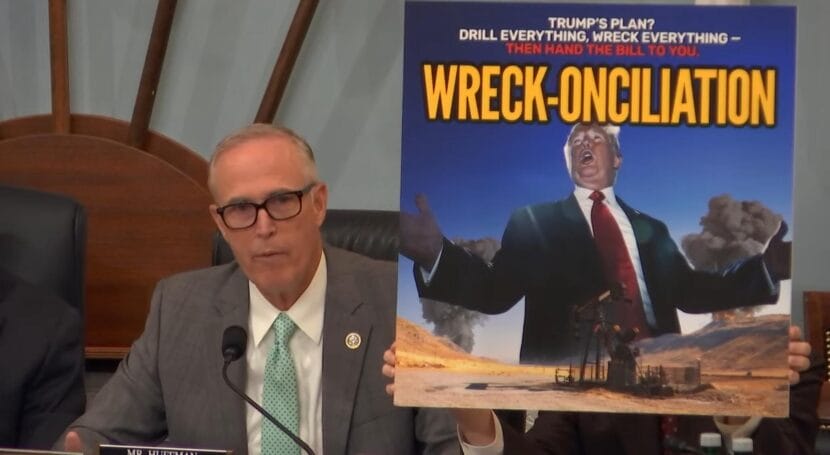
Rep. Jared Huffman, D-Calif., employed puns and posters denounce the GOP reconciliation bill when the U.S. House Natural Resources Committee marked up the bill on May 6, 2025. (Screenshot/U.S. House Video)
WASHINGTON — In an unusually quiet session, the U.S. House Natural Resources Committee passed a bill to mandate new oil lease sales in the Arctic National Wildlife Refuge and allow construction of the Ambler Road, crossing protected federal land in Northwest Alaska.
Lawmakers approved those items early Wednesday, as part of a budget reconciliation bill, with barely a peep from the Republican side of the room.
Democrats taunted. They fired off passionate assertions that usually get a rise out of the other side. They cajoled. They pleaded. Nothing they did could get Republicans on the committee to debate them.
Alaska Congressman Nick Begich III, like other Republicans, sat calmly scrolling on his phone or leafing through papers.
Republicans had a strategy, and they stuck with it.
Democrats tried to defeat portions of the bill with more than a hundred amendments. The first one would’ve removed the requirement to hold oil lease sales in the Arctic Refuge and killed any chance of ever drilling there.
“The Trump administration’s reckless and thoughtless push to sell off the refuge isn’t about lowering energy costs. It’s about sacrificing your public lands for his billionaire buddies, and that’s why I urge support for this amendment,” said Rep. Jared Huffman, D-Calif. “We should be voting to permanently protect this special place rather than auctioning it off to the highest bidder.”
In response, Republicans said nothing. Although, as soon as Huffman yielded the mic, Committee Chairman Bruce Westerman, R-Ark., made an announcement: Sandwiches were enroute.
“Soon we’ll have lunch in the back,” Westerman said. “We’re not going to recess for lunch, but if you want to go have lunch, you can go in the back room and have lunch.”
That’s how it went, through more than a hundred amendments, for hours at a time.
Democrats said Republicans wanted to avoid debating policy so that the bill wouldn’t get derailed in the Senate. A reconciliation bill is special because Senators can’t filibuster it, but to qualify, all the components have to be about revenue and spending.
The silent treatment had another benefit: The proceedings moved along faster. Still, it was after midnight when the committee passed the bill, by a vote of 26-17. One Democrat voted for it.
Alaska Congressman Nick Begich did not respond to an interview request but he claimed the win.
“This is a major victory for Alaska and for American energy independence,” he said in a statement emailed from his office.
At the U.S. Capitol, opponents of drilling in the refuge often cite the Gwich’in people, whose traditional culture depends on the caribou that give birth in the refuge. But oil development is more popular on the North Slope, in and near the refuge.
The bill “will advance Iñupiaq self-determination on our homelands and support economic development opportunities in our region that are crucial to sustaining our Indigenous culture,” said Nagruk Harcharek, president of a well-funded advocacy group called Voice of Arctic Iñupiat, by email.
Athan Manuel, the Sierra Club’s director of public land protection, has watched the House Resources Committee hold countless Arctic Refuge debates, many of them fiery, since 1998.
“This one feels weirder and worse,” he said.
Years ago, there were Republicans and Democrats on both sides of the debate. The Arctic Refuge fight didn’t entirely align with party labels.
Now, Manuel said, there’s less independent thought in Congress and more partisan dictates.
It was clear from the start, Manuel said, that all the Democratic amendments would fail. And they did.
In addition to the Arctic Refuge provisions, the bill mandates lease sales in the National Petroleum Reserve and Cook Inlet.
The reconciliation bill is controversial for other reasons, and GOP unity might not hold in Congress. Some Republicans say they’ll vote no because the bill adds trillions to the deficit.
Sen. Lyman Hoffman, D-Bethel, the Senate’s chief budgeter, speaks on the floor of the Alaska Senate on Wednesday, May 7, 2025. (Eric Stone/Alaska Public Media)
The Alaska Senate approved its version of the state budget Wednesday, including a $1,000 Permanent Fund dividend and, for now, a $150 million surplus. But senators say they expect that surplus to evaporate in the year to come, and they’re warning of rough seas ahead.
“It’s clear to me that the decisions next year will be even more difficult than the decisions that we have made today,” said Sen. Lyman Hoffman, D-Bethel, the Senate Finance Committee co-chair responsible for the operating budget.
In an effort to avoid using the state’s $2.8 billion savings account, the Constitutional Budget Reserve, senators stripped out nearly every budget increase requested by the governor and those approved by the House in its version of the budget last month.
In total, the Senate’s version of the budget is $350 million less than was approved by the House, and $1.7 billion less than Gov. Mike Dunleavy proposed, according to the Legislature’s nonpartisan budget analysts.
“Now is the time to preserve our rainy-day fund for the coming storm,” Hoffman said.
Winds from that coming storm are already buffeting the current year’s budget.
One particularly stiff headwind is the worsening outlook for oil prices. As of Monday, a barrel of Alaska North Slope crude went for $65.63, according to the state Department of Revenue, below the $68 figure state forecasters said they expected in their March revenue forecast.
And it’s not looking like that headwind will let up anytime soon. The federal Energy Information Administration, in a forecast released Monday, said it expected oil prices to fall further due in part to slowing global economic growth fueled by President Donald Trump’s tariffs. A boost in OPEC production is expected to push prices down further. And though Trump has sought to expand oil production in Alaska, that’s not likely to provide relief in the short term, since drillers’ capital investments count against their tax bills.
State officials warned Hoffman and other legislative budgeters that prices could average as low as $64 a barrel in the coming fiscal year, he said.
Another headwind Hoffman identified is federal spending. The federal government is the biggest single source of state revenue.
“The state’s budget has over $6 billion in federal revenues that help pay for many services, from Medicaid and heating assistance to fish and game research and K 12 education,” Hoffman said.
Even a 5% cut to federal spending would leave the budget reeling, he said.
“Time will sort out what funds are cut in Washington,” Hoffman said. “If only 5% of the federal revenues are cut to the $6 billion that we receive, that would leave an impact of over $300 million to our budget.”
On the Senate floor Wednesday, there was, as there has been for roughly the past decade, debate over how big the Permanent Fund dividend should be. The planned $1,000 figure would be the lowest inflation-adjusted dividend in state history. Even Hoffman said it would be too little.
But the debate was, at times, halfhearted. There were familiar attempts to raise the dividend to the amount set out in state law — nearly $3,900 this year — and the amount specified by a 50-50 formula Dunleavy proposed in 2021. Senate Minority Leader Mike Shower, R-Wasilla, put forward and quickly withdrew amendments that would raise the dividend to those amounts.
He did it largely for the Alaskans watching the proceedings at home, he said, simultaneously acknowledging the lean times now and to come made it unrealistic.
“This is not forgotten,” he said. “The headwinds of the fiscal situation and other things are changing that dynamic at the moment.”
The one dividend amendment that did come to a vote — a Shower proposal to boost it to $1,500, a move that would require exceeding the government’s 5% annual drawdown from the Permanent Fund set out in state law — failed with the bipartisan, Democrat-heavy majority caucus in opposition.
There was also plenty of debate about how the state should fix its structural budget issues. There were calls from, among others, Sen. Bill Wielechowski, D-Anchorage, to expand state revenue.
“We are not following our constitutional obligation to get the maximum value for our resources,” he said. “You want a full PFD, you want a half PFD, a 50-50, PFD, you’ve got to fix oil taxes.”
The Legislature has passed one bill that would raise state revenue, a corporate income tax change aimed at bringing in more money from out-of-state companies, but has failed to come to terms on other proposals that would expand taxes on oil-producing businesses.
And there were calls from others, including Shower, to return to negotiations on a long-term fiscal plan — including an expansion of taxes and ways to keep government spending in check, like a spending cap and a periodic review of state programs.
“Part of why we are here is because we haven’t enacted enough of that yet,” he said.
There was even a rebuke of the governor’s budget proposal from Republican Sen. Rob Yundt, R-Wasilla. Dunleavy’s budget, released in December, proposed drawing $1.5 billion from the $2.8 billion rainy-day fund.
“I cannot wrap my mind around walking into my house and dropping a budget on my wife’s desk that’s a billion and a half dollars upside down on Day One,” Yundt said. “It shouldn’t even be legal.”
Hoffman said it was a herculean task to construct a balanced budget given all of the state’s headwinds, and he said he’s not happy with the budget’s cuts to key programs, from child care to corrections.
“We all wish we could provide all the services that every Alaskan desires. But that is not reality,” he said. “The bottom line is, our constituents want and deserve more.”
At the end of it, though, he said lawmakers had no choice.
The budget passed 16-4, with votes from all of the bipartisan majority caucus and two minority Republicans, Sens. Mike Cronk, R-Tok, and James Kaufman, R-Anchorage, who said they were glad their voices were heard in the Finance Committee.
The budget now goes back to the House, which is likely to reject the Senate’s changes in a simple up-or-down vote, setting up a conference committee to hammer out a final budget proposal. Senators said they expected the conference committee to convene early next week.
The House and Senate have until midnight May 21, the constitutional end of the legislative session, to approve a final budget.
Close
Update notification options
Subscribe to notifications
Subscribe
Get notifications about news related to the topics you care about. You can unsubscribe anytime.