Alaska Public Media

Alaska Public Media is one of our partner stations in Anchorage. KTOO collaborates with partners across the state to cover important news and to share stories with our audiences.

Anchorage woman faces 73 counts of animal neglect involving dozens of dogs

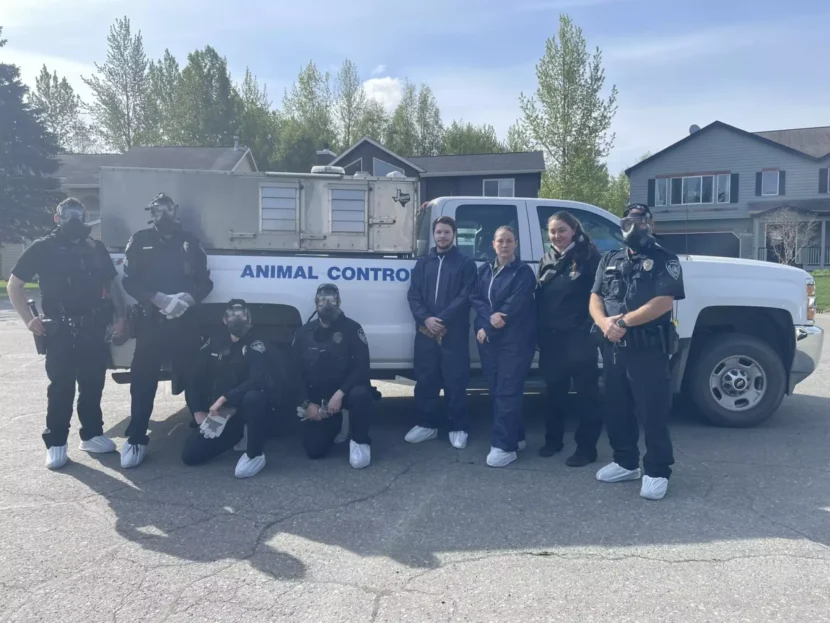
Anchorage police donned gas masks as they joined Animal Care and Control officers to remove 71 dogs and two birds from the Abbott Loop home of Monika Marshall, 47, on May 22, 2025. Marshall faces 73 misdemeanor counts of animal neglect. (Photo from the Anchorage Police Department)

An Anchorage woman has been charged with neglecting more than 70 dogs, in a case that strained local animal-care resources and prompted a massive outpouring of community support to adopt the animals.

Court records show Monika Marshall, 47, charged with 73 misdemeanor counts of animal neglect. Anchorage police described the situation on Facebook as “one of the most severe neglect cases we’ve encountered.” It involved a total of 71 dogs and two birds.

Marshall could not be reached for comment Tuesday.

But a charging document against her lays out what authorities say happened. According to the charges, police and Anchorage Animal Care and Control officers visited her Abbott Loop home on May 22 in response to a report of animal neglect. They reported a “strong smell of urine emanating from the house.”

“Upon entering the residence the smell of urine and feces greatly intensified, and officers observed urine and feces present on every wall, and were forced to return to the residence with gas masks due to the overwhelming odor,” prosecutors said in the charges.

Inside, officers reported finding “a large number of dogs roaming freely,” which made moving through the home’s first floor difficult due to their sheer numbers.

“Officers observed even more surging out of cramped and unsanitary spaces,” prosecutors said.

All 73 dogs and birds were removed from the home, according to the charges, and Marshall was briefly arrested.

Animal Care and Control described it as a “hoarding case” on Facebook. A day after the dogs were seized, police posted a plea for help online.

“The animals were found in unimaginable conditions,” police said. “While neglect charges are pending, the immediate crisis is this: AACC is now operating at nearly three times its standard capacity. They need our help, and they need it now.”

Residents responded to that request for aid, the shelter said on Facebook, adopting more than two dozen dogs on May 24 alone.

By Thursday, a week after the seizure, less than half of the original 71 dogs remained at the shelter. Animal Care and Control said staff did not have to euthanize any of the animals thanks to an “amazing effort by everyone in our Alaskan community.”

“In just 7 days we have had 70 dogs adopted, 11 dogs go out to foster care, 5 dogs transferred to other shelters from around the state, and 2 birds picked up by a rescue,” shelter staff said. “On top of this the amount of donations that have been coming in is simply incredible; we have bags of pet food stacked as high as possible, bins filled with new toys, and enough treats to spoil every animal in our care.”

Animal Care and Control’s shelter manager, Melissa Summerfield, said by email on Tuesday that just 29 of the seized dogs remained at the shelter, in good condition.

“These dogs are doing well,” Summerfield said. “They are not socialized, and some are taking a little bit longer to warm up to the new environment and new people. There may be a few that need to be placed in foster care for a few weeks to be socialized prior to adoption but we are hopeful that all 71 dogs will be able to be placed successfully.”

The rapid pace of adoptions played a key role in clearing the shelter to work with the new animals, according to Summerfield.

“Just 3 days after the seizure we were back down to a normal operating level thanks to the 60 dogs adopted in just one weekend!” Summerfield said. “We have received over 100 applications for volunteers, fosters, and our Tails on Trails program so we are asking the public to be patient as we process these.”

Court records show that Marshall was released from jail on May 23 with her next court appearance scheduled for July 23.


Trio of Trump officials tour Alaska under promise of ‘unleashing’ state’s resource potential

Interior Secretary Doug Burgum, Energy Secretary Chris Wright and EPA administrator Lee Zeldin participate in a roundtable with Alaska energy stakeholders at the Captain Cook Hotel in Anchorage on June 1, 2025. (Wesley Early/Alaska Public Media)

Three high-level Trump administration officials are touring Alaska this week, to make good on a day one promise from the president: unleashing Alaska’s resource potential.

Interior Secretary Doug Burgum, Energy Secretary Chris Wright and EPA administrator Lee Zeldin are part of a group that will travel to the North Slope on Monday and later participate in Governor Mike Dunleavy’s sustainable energy conference in Anchorage.

After a roundtable with energy stakeholders Sunday morning, Zeldin said the administration wants to balance protecting the environment with growing the nation’s economy.

“We don’t have to pick one or the other. We choose both,” Zeldin said. “It is my three favorite words — they were spoken about in different ways over the course of this morning’s roundtable — approved, primacy and durability.”

Zeldin’s tenure as EPA administrator began with what he described as “the largest deregulatory announcement in history,” rolling back a couple dozen environmental regulations.

Interior Secretary Burgum’s department oversees more than half the land in Alaska, and he says that land is roughly half the land his department is in charge of.

“When you take a look at the water, the mineral resources, all those things here, this is a huge thing,” Burgum said. “You know, the Secretary of Interior should be here all the time, every day, because it’s such a big part of the portfolio.”

All three described the state as key to the nation’s ability to produce energy and provide it to international partners. They say the roundtable was a way to learn what stands in the way of producing energy in the state from stakeholders.

Monday’s visit to Prudhoe Bay will include a tour of a pump station along the Trans-Alaska Pipeline and meetings with Alyeska Pipeline officials.

The governor’s energy conference runs from Tuesday through Thursday in Anchorage.

After Anchorage man’s ICE detention, his wife wants answers

Immigration and Customs Enforcement officers detained Cristian Ibanez Velasquez — pictured here with his cat, Cosmo — on Friday, May 23, 2025, according to his wife, Paola Jimenez. (Photo by Paola Jimenez)

Immigration officials detained an Anchorage man originally from Peru on Friday, according to his wife, who says she’s been left in the dark about what will happen to him next.

Cristian Ibanez Velasquez, 32, had dropped his wife at work Friday morning and returned home when Immigration and Customs Enforcement officers approached him in the couple’s driveway.

He’s been in jail ever since, said his wife, Paola Jimenez, in an interview Thursday, nearly a week later. Jimenez said she just wants to know if he’s safe.

“I just want to know when my husband’s gonna get out, when he’s gonna be safe and sound at home, because I don’t know how it is inside,” she said. “I don’t know if he’s safe in there.”

As ICE was detaining him, Ibanez Velasquez called Jimenez. He only speaks Spanish, she said, and the officers detaining him didn’t have an interpreter.

The officers told Jimenez that her husband had been marked for deportation, she said. They said they were taking him to the Anchorage Correctional Complex and that he would eventually be sent an immigration facility in Tacoma, Washington.

Ibanez Velasquez entered the United States illegally in 2022, the couple married in Alaska in 2024, and while they had intended to pursue citizenship for him, they never did, Jimenez said.

While in jail, Ibanez Velasquez has been able to make sporadic phone calls and Jimenez has been able to visit him, but visitation was canceled at least once. And her husband said he was not getting a medication he’s supposed to take for heartburn, which Jimenez attributed to a language barrier.

“He said that the nurse told him that he needs to ask that in writing and give it to the guard,” Jimenez said. “But my husband doesn’t know how to read, how to say or do anything in English.”

Jimenez is adamant that her husband has no criminal record and, though he was caught entering the United States illegally in 2022, had been in regular contact with ICE about his whereabouts and immigration case. That involved using an app on his phone to snap photos of himself every Sunday and occasional in-person check-ins, she said.

“The same officer that was doing his check-ins for him was the same officer that detained him that day,” Jimenez said. “Nobody told him there was something else going wrong.”

Ibanez Velasquez was a mechanic in Peru and had been following a dream, along with his cousin, to come to the U.S., first to Chicago, Jimenez said. When that didn’t work out, he came to Alaska in 2023, when the couple met, and they married in October of 2024, Jimenez said.

They got two cats together – Cosmo and Tac – and after the wedding had planned to apply to get citizenship for Ibanez Valasquez, she said.

“The whole process is expensive to start. A, B and C, there was always something in the middle,” Jimenez said. “It was hard to be able to pay for everything for us, and then start the process. So we just never got around to it, unfortunately. And then this happened, and it just changed everything completely.”

As immigration enforcement ramped up under President Donald Trump’s administration, the couple saw news stories about ICE rounding up immigrants for deportation, Jimenez said.

“But that was more in the Lower 48,” she said. “Obviously, it was in the back of our heads, you know, like, ‘We still got to be careful.’ But then I think it was probably a month before this happened to my husband, that three are also picked up here, I believe. Well, then it happened to him.”

A Seattle-based spokesperson for ICE sent a general written statement in response to a request for comment on Ibanez Velasquez’s case.

“U.S. Immigration and Customs Enforcement does not indiscriminately conduct enforcement actions on random people,” ICE public affairs officer David Yost wrote. “All aliens in violation of U.S. immigration law may be subject to arrest, detention and if found removable by final order, removal from the United States, regardless of nationality.”

Activists plan to protest Ibanez Velasquez’s detention in a rally set for 5:30 p.m. Thursday in front of the Department of Homeland Security offices in downtown Anchorage.

Alaska ferry engineers say they are critically short-staffed, with no easy answers

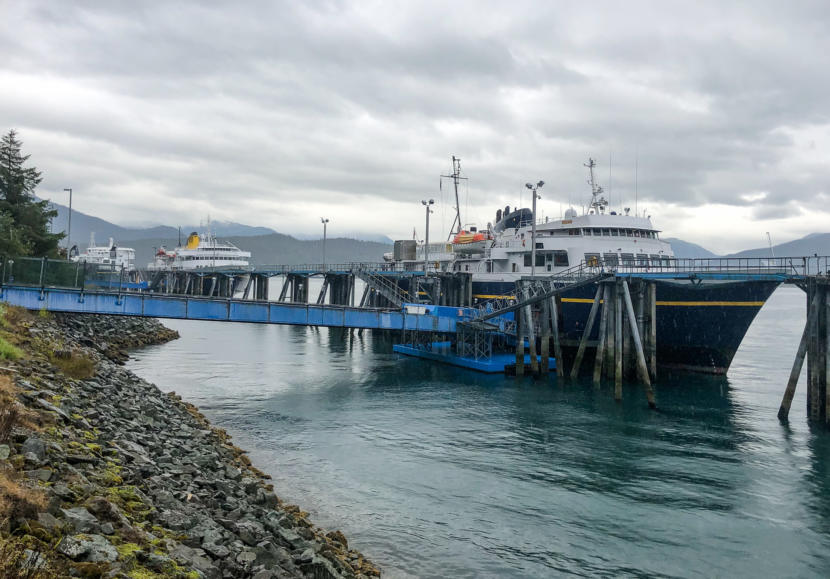
The Tazlina, Malaspina and LeConte moored in Juneau during a strike by the Inlandboatmen’s Union of the Pacific on July 25, 2019 (Photo by David Purdy/KTOO)

Meagan Nye doesn’t always know when or if her workweek will end. She’s an engineer on the Alaska Marine Highway System ferry Columbia. She is supposed to work two-week shifts at sea. But more and more often, those two weeks will turn into six.

“I love my job, but I don’t want to be there all the time, and I want to have a schedule so I can plan my off time and know if I’m going to be able to go home,” Nye said over the phone.

Nye is a second engineer. She works in the Columbia’s bowels, maintaining the ferry’s three boilers, fuel, HVAC, refrigeration, basically every complicated, whirring thing. She and five other engineers work in split twelve hour shifts so the engine room is manned 24 hours a day.

“We’re short staffed. We don’t pay what everyone else pays but we are under a contract. You can’t just leave, right? You could be subject to disciplinary action. You could be fired if you just leave. You cannot do that,” Nye said.

Many communities along Alaska’s southern coast are dependent on state ferries to get around and to fuel their economies. But those ferries move thanks to teams of on-board engineers, who say they are critically understaffed and the only solution is more state funding or fewer sailings.

The M/V Columbia – the largest ferry in the state’s arsenal – is meant to rotate two six-person teams of engineers every two weeks, meaning that the vessel has a total 12 engineer postings.

If that metal box in the bottom of the ship isn’t properly manned, then the ship doesn’t sail. Nye said it comes down to safety; there is a minimum number of staff needed to keep the vessel and its passengers safe.

“That’s our nightmare – having to cancel a sailing,” Nye said. “I feel personal responsibility if there’s any cancellation. That’s terrible.”

According to her, there are two ways to become a ferry engineer. You can do four years at a maritime academy or you can be what they call a “hawsepiper.” Hawsepipers essentially apprentice on the ferries as an “oiler” or unlicensed engine room staff for five or so years at sea, then study independently to take five licensing tests. Historically, many Alaskans have come through the hawsepipe to become ferry engineers. That’s what Nye did. But she said hawsepiping is more difficult now.

“We have a lot less people coming up the hawsepipe, because they have families, the cost, and they can’t just leave for that time and not be working. It’s just a lot more difficult now,” Nye said, adding that the regulations have tightened and brought more classes and more costs. “So we don’t have that source of engineers with the Alaska Marine Highway anymore.”

Staffing shortages aren’t exclusive to below deck crew. About three years ago, 60% of the ferry system’s jobs were vacant. They’ve been slowly closing that gap but AMHS Marine Director Craig Tornga said the ferry system is 10% short of the fleet’s minimum number of masters and bridge crew. The Marine Engineers’ Beneficial Association, the union representing Alaska’s state ferry engineers, said their vacancy rate is nearly 20%.

The ferry engineers’ union distributed a public petition entitled “The Alaska Marine Highway System is Sinking” that urged Gov. Mike Dunleavy to prioritize higher wages for ferry employees. The petition read that engineer shortages were making state ferry service unreliable and impacting the health of ferry-dependent communities.

Josh Chevalier, the chief engineer on the Columbia, said staffing is a problem for all ferry jobs but because engineers are behind the scenes, they are often forgotten by the public and lawmakers.

“When people are stressed out and unhappy, I have to balance the needs of the vessel with the needs of people’s lives,” Chevalier said.

Chevalier has worked in the ferry system for over twenty years. He noticed the problem with filling jobs beginning about a decade ago when wages for engineers went up on container ships and ferry systems in other states, while state funding for AMHS declined.

For Chevalier, the ferry system’s funding woes go back to a larger problem he sees in the state: the state’s major population centers like Anchorage have far more sway in the legislature and for voters on the road system and northern lawmakers, infrastructure like the ferries and the engineers down in their bellies are out of sight, out of mind.

“We haul a tremendous amount of traffic that never stops in Southeast. They drive up to Southcentral and stay in hotels and buy fuel and groceries, stay in Airbnbs, and so it’s a very valuable economic engine for the entire state, but I believe it’s viewed as a sort of welfare for Southeast Alaska,” said Chevalier.

The union for ferry system engineers brokered their current agreement with the state back in 2022. That agreement governs everything from what engineers wear to when they can get off the ship. It expires next month.

The state ferry engineers’ union has been bargaining with the state. They recently reached a tentative new three-year agreement. Union representatives declined to comment on the terms of the new agreement until it is made official. Union ferry engineers are currently voting on if they will accept the state’s terms. A spokesperson said the details of the new agreement will be released in early June.

Engineers like Nye said that agreement could essentially determine the ferry system’s future.

“I mean, the number one thing that will fix the problem is money, right? It’s the pay. It’s a pay issue, trying to attract people from the academies. It’s just not enough to attract people when they can make so much more money elsewhere,” she said.

The state recently reached an agreement with a different, bigger union of state government employees. That agreement included more healthcare coverage and an 11% pay increase.

According to Chevalier, a hiring push for engineers is a race against time. 30% of the ferry system’s engineers are approaching retirement age and he said in five years, busted boilers or a faulty refrigerator could be a much bigger problem.

Alaska’s Drue Pearce and Kara Moriarity join Interior to work on ‘unleashing’ state’s energy

Kara Moriarity, left, and Drue Pearce have taken new Alaska-focused jobs at the U.S. Interior Department. (Photo by Liz Ruskin/Alaska Public Media)

WASHINGTON — Drue Pearce, a former president of the Alaska Senate, has taken a new job in the U.S. Interior Department.

I’m counselor to the assistant secretary in the Land and Minerals hallway,” she said in an interview from her new office.

“Hallway” is not actually part of her title, but it does describe how the Interior Department’s D.C. headquarters is organized. The assistant secretary Pearce will work under is charged with implementing the Trump administration’s orders to unleash Alaska’s energy potential.

Pearce has worked for decades in this arena, as a federal appointee during the George W. Bush administration and the first Trump presidency, and most recently as a consultant and lobbyist at the firm Holland & Hart.

She calls some issues she’ll be working on, like opening the Arctic National Wildlife Refuge to oil development, old friends.

“I think I had my first ANWR briefing when I was first elected, but not yet sworn in, all the way back in 1984,” she said. “And we’re still at it.”

The Interior Department has also hired Kara Moriarity, president of the Alaska Oil and Gas Association. Her exact title hasn’t been announced, and she didn’t respond to an interview request Friday. Moriarity has worked for the industry trade association for 20 years.

News that Moriarty will have an important role in managing federal land in Alaska sparked criticism from the Sierra Club. The environmental group issued a statement saying an oil and gas lobbyist should not be in charge of treasured landscapes.

The Interior Department manages more than 200 million acres in Alaska, some of it in national parks and wildlife refuges.

Begich says GOP bill is ‘great’ for Alaska, despite cuts to Medicaid and SNAP

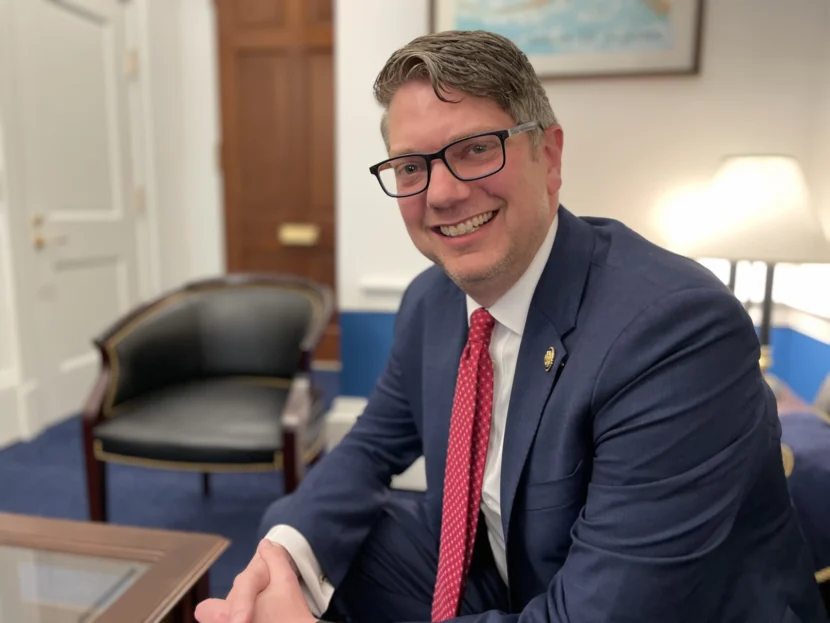
Congressman Nick Begich in his Washington, D.C. office, a few hours after the House passed the budget reconciliation bill. (Photo by LIz Ruskin/Alaska Public Media)

WASHINGTON — Without a single vote to spare, the U.S. House passed a mega-bill early Thursday that’s chock-full of Republican priorities.

Alaska Congressman Nick Begich, like nearly all Republicans, voted for it.

“This is a great bill for Alaska,” he said in his Washington, D.C. office, a few hours after the vote. “It preserves the 2017 Tax Cuts and Jobs Act, so it keeps taxes low for working Americans, working Alaskans. It also drives some accountability in some of the government programs that are safety-net programs.”

As he spoke, protesters in Alaska were preparing to bring a hospital bed covered in funeral flowers to his Anchorage office as a “symbol of public grief.” They and other critics say the bill is devastating for the social safety net.

Nationally, the bill cuts almost $100 billion a year from Medicaid, a public health insurance program, and SNAP, sometimes called food stamps. Instead, it shifts some of the costs to the states.

If it becomes law, the reconciliation bill would, for the first time, require states to pay a percentage of SNAP benefits, based on each state’s rate of payment error.

That would hit particularly hard in Alaska, which has the highest error rate in the country, stemming from a huge backlog in cases it struggled to clear. Alaska could be on the hook for 25% of SNAP benefits, or $63 million. Also, the bill would cut in half the amount the federal government pays the states to administer SNAP, a loss of nearly $6 million for Alaska.

“We’re struggling right now, and this would just be a bigger hit,” said Rep. Genevieve Mina, D-Anchorage, who chairs the state House Committee on Health and Social Services. “I still receive constituent emails, and emails from people in other districts, that they’ve been waiting months for their Medicaid and for their SNAP. So it’s this cascading impact.”

About one in 10 Alaskans receive SNAP benefits to help them buy food. The program injects some $250 million a year into Alaska’s economy, through grocery purchases.

Begich said he supports measures to ensure Alaska and other states abide by the rules of the safety-net program. Alaska’s cost share of SNAP could drop from 25% to 5% if it improves its error rate, he said, and it has a year to work on that.

“A number of other states have gotten it right, and I think that we need to look to other states for how we go about ensuring that the people that are receiving the benefit are properly vetted,” he said.

State House Rep. Zack Fields, D-Anchorage, said there’s no quick way to fix the trouble Alaska has had administering the federal programs, which he attributes to job vacancies, low salaries and benefits.

“This is such a profound challenge,” Fields said. “It’s absolutely not something we can solve by the time these proposed mandates and the budget reconciliation proposals would come down on us.”

The bill adds work requirements to Medicaid. Health researchers say requiring beneficiaries to document they work at least 80 hours a month could cause as many as 14,000 Alaskans to lose their health care coverage, even though many work already or would be exempt.

The bill includes a huge array of Republican priorities, such as more domestic energy production.

Begich lauded a section promoting oil development in the Arctic National Wildlife Refuge, including a provision that says 90% of the revenue would go to the State of Alaska, starting in 2035. In addition to requiring more lease sales, Begich said it would provide regulatory certainty.

“We worked with many of the folks who would likely be bidders to ensure that they believe that they could bid high and robustly on these lease sales, so that we can get some production in these areas,” he said.

In last-minute changes, House leaders removed two sections of the bill aimed at encouraging development in the National Petroleum Reserve-Alaska and construction of the Ambler road to aid mining.

The reconciliation bill goes next to the Senate, where it can pass with just Republican votes. But several Republicans have said they don’t like it

Sen. Lisa Murkowski has said she won’t vote for a bill that would make big cuts to health care coverage. She said a bill that does that indirectly, by requiring states to contribute more than they can, isn’t good either.

“If you shift these costs, and they are substantial enough, you will possibly, quite possibly, have the state in the position of then just dropping those individuals from the rolls,” she said.

She said she was still studying the bill to see if Alaska can administer the safety-net programs with the new requirements.

Site notifications
Update notification options
Subscribe to notifications