Alaska Public Media

Alaska Public Media is one of our partner stations in Anchorage. KTOO collaborates with partners across the state to cover important news and to share stories with our audiences.

To fund education programs, Alaska lawmakers look to tax Netflix and Amazon

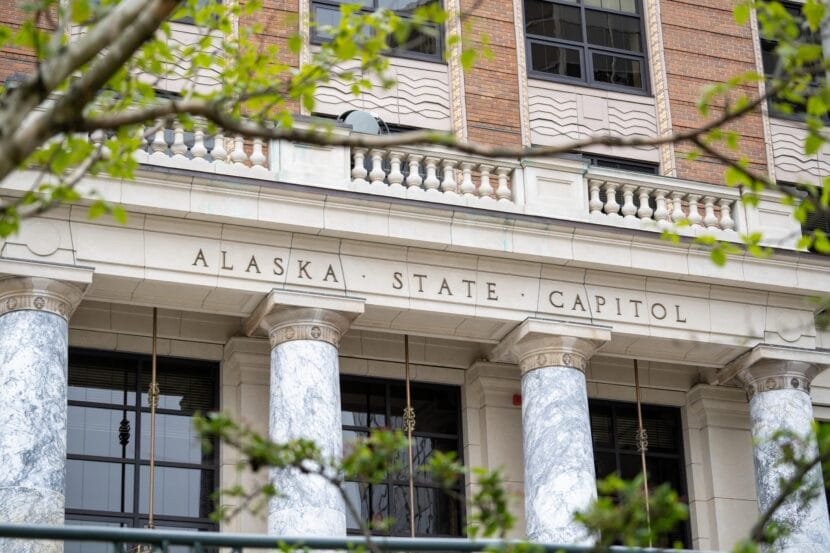
The facade of the Alaska State Capitol in Juneau on May 22, 2024.

The Alaska House is scheduled to vote Wednesday on a change to corporate income taxes that could raise millions of dollars as the state faces deficits and an uncertain financial future.

It’s also tied to funding for two key elements of an education bill pending on the governor’s desk.

Senate Bill 113 would change the way many companies calculate their state corporate income taxes. Backers are pitching it as a tax on large, out-of-state businesses. Sen. Bill Wielechowski, D-Anchorage, told the House Finance Committee on Friday that the bill would change the state’s corporate income tax system to require businesses to pay taxes on the money they bring in from Alaska customers.

“If you buy a Netflix subscription, instead of Netflix claiming the sale occurred at its headquarters in Los Gatos, California, or at its server farm in Texas, the sale is deemed to have occurred where the service is delivered — under this bill, in Alaska,” Wielechowski said.

In a related change, for companies who do a majority of their Alaska business over the internet, the bill would change the corporate income tax formula to look primarily at sales.

The corporate income tax formula currently takes companies’ Alaska payroll and property into account, which means lower taxes for corporations that don’t have much of a physical presence in the state. That means those companies aren’t paying their fair share for state infrastructure like roads, bridges and ports, Wielechowski said.

“Guess who’s picking up the tab for that? Alaskan consumers, Alaskan businesses. That is not fair to our brick and mortar companies,” Wielechowski said. “In fact, I would argue that’s taking Alaskans’ Permanent Fund dividend checks. That’s taking money out of Alaskans’ pockets, because these out-of-state corporations are not paying what they should be paying.”

The bill enjoyed broad support in the Senate, where it passed 16-4 with crossover votes from two Republicans in the minority caucus. The bill would only apply to so-called C corporations, which are typically large businesses, and would not change corporate income tax rates or brackets.

Rep. Jamie Allard, R-Eagle River, said she was concerned the bill could result in higher prices for Alaska consumers.

“I think it’s going to impact people greatly,” she said. “I feel like this is a hidden cost to Alaskans.”

At least 36 other states, from Alabama to Hawaii, have made similar changes to their tax codes. Wielechowski said he didn’t think Alaska was a large enough market to make a substantial difference on prices. Across the U.S., he said, no matter a state’s corporate income taxes, a Netflix subscription is the same price.

At least two House minority Republicans on the House Finance Committee agreed. Rep. Jeremy Bynum, R-Ketchikan, said he doesn’t expect the bill to result in across-the-board price increases.

“Whether it’s Netflix or some other digital company, when they’re paying taxes, they build that into their taxing or into their pricing structure overall,” Bynum said. “Could it cause prices to go up? Maybe. Maybe, in the big scheme of things. … But will they have an Alaska tax? I don’t believe so.”

Another minority Republican, Rep. Will Stapp, R-Fairbanks, said he thought taxing out-of-state businesses would level the playing field for Alaska businesses looking to compete with them.

“Where I live, in Fairbanks, everyone has seen these small businesses go out of business and be replaced by big, national chains,” he said. “Perhaps if we didn’t tax our local businesses unfavorably compared to the ones who don’t live here, fewer of them would go out of business.”

The state’s tax division says the bill could raise $25 to $65 million. If House lawmakers greenlight the bill, it would be the first significant revenue bill to pass this year as lawmakers reckon with large deficits.

Money from the bill would go toward incentive grants for school districts rewarding student reading performance and bolster career and technical education. Lawmakers tied the two programs to the tax bill because of the looming deficits.

If lawmakers in the House approve it, it will go to Gov. Mike Dunleavy. It’s not clear whether he’d sign it. His press office said by email that Dunleavy will make a decision if the bill reaches his desk.
Whittier case poses a larger question: Why can’t these Americans vote?

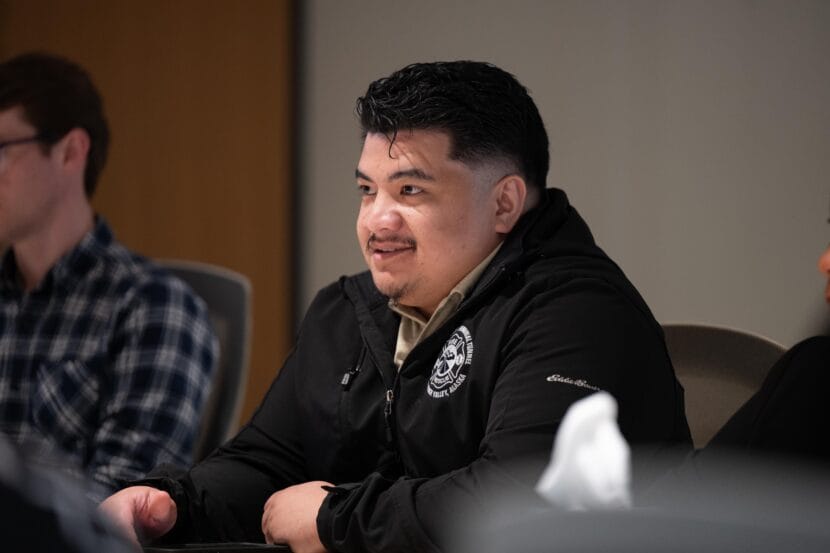
A man in a black coat speaks at a conference.
Michael Pese was among 10 Whittier residents charged in April, 2025 with illegal voting. He was born in American Samoa, so he’s a U.S. national but not a citizen. He spoke at at a May 2, 2025 press briefing in Anchorage. (Matt Faubion/Alaska Public Media)

Ten people from Whittier charged with illegal voting made initial court appearances Friday — a routine procedure in a case that has the potential to be anything but.

The 10 were born in American Samoa. That gives them the unique status of being U.S. nationals, born on American soil and holders of U.S. passports, but not citizens. A group called Right to Democracy is championing their case.

“If they had been born instead in another U.S. territory — like Guam or the Virgin Islands or the District of Columbia — or Alaska, they would not be in this situation, facing criminal legal peril today,” said Neil Weare, co-founder of the group.

Right to Democracy advocates for people born in U.S. territories and is part of the legal team representing a previous Whittier defendant: Tupe Smith. She was arrested in 2023 and charged with illegal voting and related felonies after she won election to her local school board. Her challenge is before the state Court of Appeals.

Meanwhile, last fall Alaska State Troopers investigated Smith’s husband and other members of their extended family in Whittier. The state brought fraud and perjury charges against the 10 defendants last month.

Some, according to the charging documents, told officers they thought they could vote in state and local elections but not for president.

The case could draw a national spotlight for reasons that go beyond election outcomes in Whittier.

It is already wrapped up in a larger constitutional question about whether people born in U.S. territories have a birthright to citizenship. Weare sees that as a central issue in the Whittier cases and said it may be part of the defense.

“It is the state’s burden to prove every element of the alleged offense, and one of those elements is that they’re not a citizen of the United States,” he said. “We don’t believe they’ll be able to prove that under the Constitution.”

The case has a different import for right-wing bloggers. That’s because, despite a lack of proof, it’s a widely held belief among supporters of President Donald Trump that non-citizens voted in massive numbers in 2020.

The Whittier case doesn’t fit the stolen-election narrative well. Many of the defendants didn’t vote in presidential election years. And Trump swept tiny Whittier in 2020, winning 74 votes — more than double the vote total of Joe Biden. At least one of the Whittier defendants is an ardent Trump fan, to judge by his Facebook posts.

Michael Pese is Tupe Smith’s husband and accused of voting in 2022 and 2023. He said he loved the town of Whittier and loved serving as a volunteer firefighter there. But, he said, the charges have changed his feelings.

“After everything is done, I don’t know if I want to stay back in Whittier, because I feel unwelcome,” he said.

Prosecutors say the state built the case against Pese and the other defendants after receiving an anonymous tip that non-citizens were voting in Whittier.

Trump has buoyed hopes for an Alaska gasline. Is it enough to get it built?

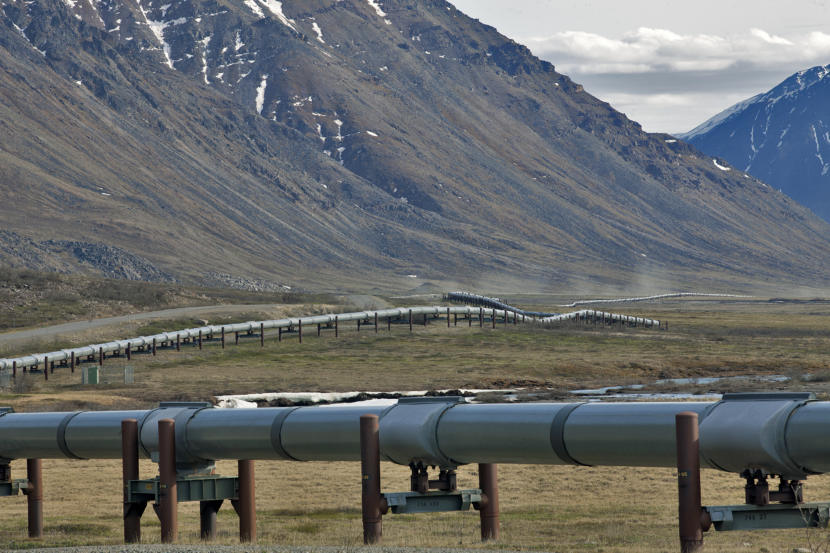
An above-ground section of the Trans-Alaska Pipeline System near the Toolik Lake Research Station in the North Slope Borough. (Photo by Rashah McChesney/Alaska's Energy Desk)
An above-ground section of the Trans-Alaska Pipeline System near the Toolik Field Station in the North Slope Borough. (Photo by Rashah McChesney/Alaska’s Energy Desk)

Donald Trump’s return to the presidency has buoyed hopes for the 800-mile, $44 billion Alaska LNG pipeline project. And the project has taken some important steps forward in recent months.

But you’d be forgiven for being skeptical. Alaskans have dreamed for decades of a line that would bring the North Slope’s immense gas reserves south for export.

But there’s a reason it hasn’t happened: Nobody has wanted to pay for it.

So, is a gasline more likely than ever? Or is this déjà vu all over again?

‘It’s closer than ever to becoming a reality’

Suffice it to say that Gov. Mike Dunleavy was encouraged when he heard Trump call out the gasline project: “My administration is also working on a gigantic natural gas pipeline in Alaska,” the president said in a speech to Congress back in March.

“Yes!” Dunleavy said in response, in a video his office posted to social media.

The video shows the governor watching Trump on a smartphone, offering color commentary and raising his fist in agreement. There’s some cheery acoustic guitar music in the background, a take on The Beatles’ “Here Comes The Sun.”

There is plenty to be excited about.

The state agency shepherding the gasline project has signed an agreement handing it off to a private developer for some final engineering design work. They’re hoping to get to an investment decision around the end of the year.

Dunleavy, after a trip to Asia earlier this year, came home with a nonbinding letter saying a Taiwanese state energy company is interested in buying gas from the project.

And, of course, the president has said it’s a priority — so much so that his administration is planning an Alaska summit with Asian leaders — potential gas-buyers — in early June.

So a lot of folks are saying things like this, from House Minority Leader Mia Costello, R-Anchorage, at a House Resources Committee meeting on April 30.

“After years of uncertainty, planning and perseverance, the AK LNG project is no longer just a vision,” she said. “It’s closer than ever to becoming a reality, thanks to significant progress in permitting, global interest and most importantly, renewed momentum from the federal government.”

‘I don’t think it’s extremely likely’

The project, though, faces a lot of the same barriers it’s always faced. It’s hard to build a pipeline from the Arctic, never mind an 800-mile one. You have to have enough customers for the gas lined up for anyone to throw down the billions and billions of dollars it’ll take to get it built. The cost was last estimated at $43.8 billion in 2023, according to the Alaska Gasline Development Corp., the agency behind the project.

So Rep. Zack Fields, D- Anchorage, doesn’t want Alaskans to get ahead of themselves. There is one potential buyer who’s put pen to paper. Others haven’t signed on quite yet.

“I just don’t want people to be misled that this is about to happen,” Fields said. “I don’t think it’s extremely likely.”

The project faces opposition from conservation groups, who say extracting more fossil fuels would worsen climate change. But, like a lot of folks in this oil-and-gas-friendly state, Fields said it would be great if the pipeline is eventually built. It could provide some state revenue — though exactly how much isn’t clear — and perhaps lower energy prices for a significant fraction of the state’s residents.

For now, though, Fields said he’s not counting his methane molecules before they come south.

“I think it would be awesome if one of those buyers materializes and buys the gas,” he said. “But that hasn’t happened yet, and until it does, we’re not really in any different situation than we have been for the last 50 years.”

‘It remains to be seen’

Though there’s still a long road ahead for the pipeline — even in a best-case scenario, gas wouldn’t start flowing until the early 2030s — one has to admit, it’s been a heck of a turnaround.

It was just a year ago that the future of the pipeline project was on the ropes. Lawmakers were frustrated at the gasline agency’s slow progress. They floated cutting its funding and mothballing the project.

One of those frustrated lawmakers was Sen. Bert Stedman, R-Sitka, a co-chair of the powerful Senate Finance Committee. These days, however, he’s more optimistic.

“It was, in my opinion, highly unlikely we’d get a gasline until the Trump administration came in,” he said.

That’s due in part to Trump’s hardball strategy on tariffs and international trade, Stedman said. Japan — one of the places Alaska’s LNG could go — has discussed increasing natural gas imports as a way to shink the country’s trade deficit with the U.S.

But whether that strategy will work, Stedman said, is uncertain.

“It remains to be seen if jawboning Japan and Korea will work to get them to write a check,” he said.

If it doesn’t work, though, Stedman has another idea for how the federal government could help get the pipeline built.

“A big equity infusion,” he said. “You put in $20 billion or $30 billion, or some significant number, to get in and get it built and de-risk it. And then, just sell it once it’s up and built and running and profitable.”

The investment, Stedman said, could even make the taxpayer some money.

Lingít artist Reine Pavlik melds beading and skin sewing with contemporary styles

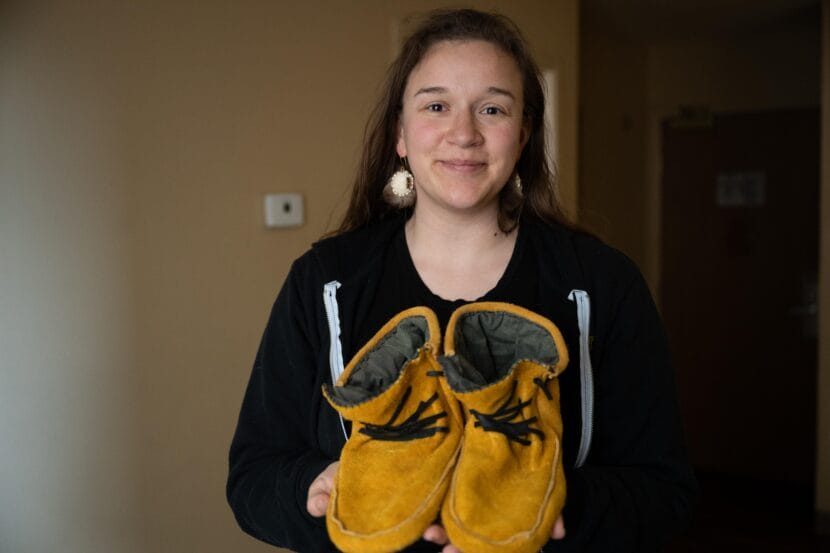
a woman holds moccasins
Reine Pavlik holds hand-sewn moccasins in April 2025. (Matt Faubion/Alaska Public Media)

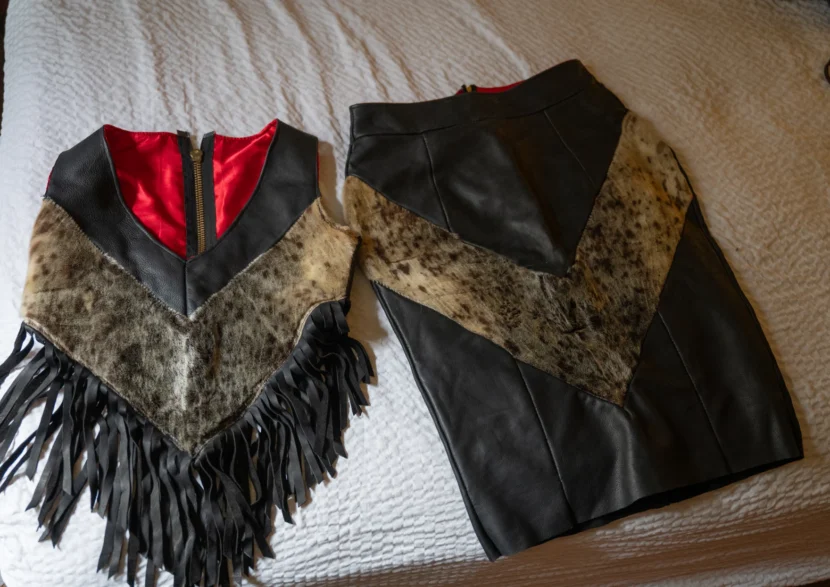
Reine Pavlik sorted through a large collection of her latest work. She pointed to a pair of jeans with seal skin flare, a women’s suit made of deer skin and seal hide and several more hand-made pieces of clothing. Many of the pieces had ornate beading.

“Sometimes I feel like beading a straight line is really hard,” she said, holding up a pair of hand-sewn moccasins. “This pair of moccasins is made with deer and moose skin.”

Skin sewing, or hide sewing, and bead work are vital art forms in Southeast Alaska’s Lingít culture. Pavlik, who is from Yakutat, is blending those art forms with contemporary style.

She turned over the hand-sewn moccasins, revealing beadwork on the back.

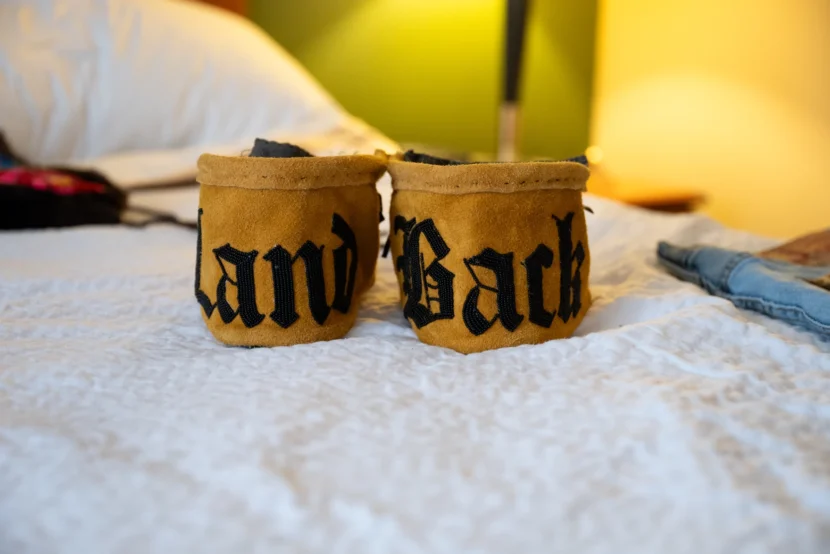
“I feel like I can see my progress in my beadwork,” she said. The beaded letters read “Land Back” in an Old English typeface. “Behind these moccasins is ‘Land Back,’ which is a message for the world we live in today to hopefully give Indigenous peoples their land and sovereignty and right to stewardship.”

a pair of moccasins that say "land back" on them
In beadwork, Reine Pavlik spells out “Land Back” on a pair of moccasins. (Matt Faubion/Alaska Public Media)

Pavlik said she grew up surrounded by artists.

“That was just always part of our lives is just doing art. It was just part of the activities that we did,” she said.

She first learned from her mother how to sew items like pillowcases and, for a while, she said that was all she knew how to sew. Few members of her family practiced skin sewing on animal hides like sea otter and moose.

But eventually, Pavlik learned skin sewing from her aunt, Jennie Wheeler. Wheeler is a Lingít artist who creates skin-sewing pieces, beadwork and spruce root weavings.

Wheeler taught Pavlik to make moccasins.

“Making moccasins really was a way to connect to my family and my ancestors,” she said. “I feel like it’s so ingrained in our family stories.”

Now Pavlik’s community knows her for her beadwork and skin-sewn garments. She said her art weaves together tradition with modernity, and is inspired by her Lingít heritage. That blending of old materials with new designs gives her work meaning and momentum, she said, describing the process as almost spiritual.

“Using the traditional materials and using it in a modern way feels like I’m honoring my ancestors but I’m also modernizing some of the ideas that people have attached to traditional materials,” she said.

A woman's suit made from deer skin and seal hide
Reine Pavlik designed and created this women’s suit made of deer skin and seal hide. (Matt Faubion/Alaska Public Media)

Sustainability is another way she connects to the traditional and she tries to only use materials from donations or thrift stores. She said she’s aware of the damage fashion causes to the environment and hopes people think twice before buying for convenience.

“I also kind of felt like it’s something that our ancestors would do is they’d use what is near us and make things out of what is close by,” she said. “So I felt like that was a good way to honor them.”

But keeping culture alive while making room for personal expression isn’t always easy, and Pavlik acknowledged the pressures facing Indigenous artists today. She said there is a push for Indigenous artists to modernize and step away from tradition. But, she said she is committed to exploring her own voice within the context of Lingít art.

“It just feels like something I’m supposed to do,” she said.

Pavlik said her art practice connects her to ancestral knowledge and traditions. It’s something her father noticed when she started skin sewing.

“There was sort of an excitement there for my dad to see that, like something that his mom knew how to do his daughter knows now how to do as well,” she said.

Pavlik said she wants to explore new ways to pass on her skills to the next generation by teaching others her crafts.

Bipartisan vote sends $700 school funding boost to Gov. Dunleavy’s desk

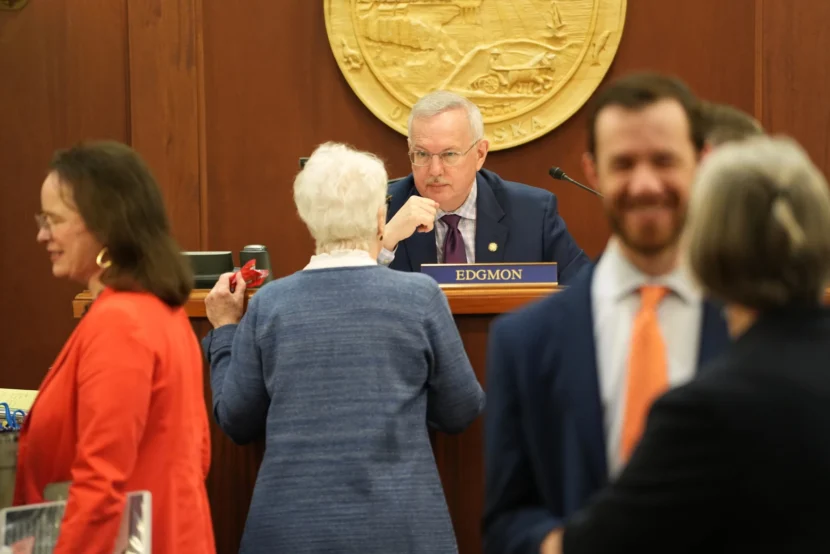
House Speaker Bryce Edgmon, I-Dillingham, confers with House Rules Committee Chair Louise Stutes, R-Kodiak, on the House floor on April 30, 2025. (Eric Stone/Alaska Public Media)

Alaska’s public schools may get a long-sought increase in state funding this year. A bill that would boost state education funding and make changes to state education policy passed the state House and Senate Wednesday and will soon head to Gov. Mike Dunleavy’s desk.

House Bill 57 would provide a $700 increase to basic per-student state education funding, the base student allocation, a longtime priority for the bipartisan coalitions who control the House and Senate.

Billed as a compromise, the package would also limit student cellphone use during school hours, make a number of changes to the laws governing charter schools, and — if lawmakers pass an otherwise unrelated tax bill — create a new incentive program that would provide school districts with $450 for each young student who reads at grade level or demonstrates improvement.

Any leftover revenue brought in by the tax bill, which would expand corporate income taxes to include non-Alaska companies who do business in the state over the internet, would be put toward career and technical education.

“This bill supports all public schools: brick-and-mortar, charter, homeschool, correspondence and residential,” said minority Sen. Mike Cronk, R-Tok.

Senators voting against the bill said they were worried the tax bill may not pass into law. Though Senate Minority Leader Mike Shower, R-Wasilla, said he would advocate for the tax expansion, he said the uncertainty led him to oppose the bill.

“I want to know that I’m voting for something that is going to do what I think it’s going to do, and I can’t guarantee that as I stand here today,” Shower said.

Wednesday’s vote started with a redo: senators approved a very similar bill on Monday, but discovered what Senate President Gary Stevens, R-Kodiak, called a “drafting error” before the House could vote on the measure. Senators deleted the errant amendment and approved a very similar replacement to it before approving the bill 17-3 Wednesday afternoon. Shortly afterward, the House passed the bill 31-8.

The votes in the House and Senate crossed caucus lines, with 3 minority Republican senators and 10 Republican House members joining all members of the bipartisan coalitions who control both chambers.

It’s unclear whether Gov. Mike Dunleavy will sign or veto the bill. Dunleavy’s education commissioner, Deena Bishop, emailed superintendents on Monday and asked them to urge their legislators to modify the bill to align with Dunleavy’s priorities. Though lawmakers added several policy initiatives proposed by Dunleavy to the bill that passed, they declined to add additional funding for correspondence schools or implement a statewide open enrollment policy.

“If these critical reforms are not included, we risk repeating the challenges of previous years when the education bill — and its funding components — were vetoed,” Bishop wrote.

Bishop’s email was first reported by the Anchorage Daily News and confirmed by Alaska Public Media.

Bishop also raised the possibility that Dunleavy could use his line-item veto power to delete funding from the state budget that would allow for the $700 funding increase. Dunleavy used a veto to reduce one-time funding lawmakers approved for schools in 2023, but he has not vetoed the long-term funding specified by the base student allocation.

Dunleavy’s office declined to say whether the governor will sign the bill. His communications director, Jeff Turner, instead pointed to a nearly week-old social media post discussing a prior version of the bill that called for lawmakers to make “a few key edits.” Lawmakers have since amended the bill to address some, but not all, of his priorities.

“The governor’s last statement on the bill … still stands,” Turner wrote.

Lawmakers may not need Dunleavy’s consent for the bill to become law. It takes a two-thirds majority to override a veto, a total of 40 votes across the House and Senate. If all 48 legislators who voted for the bill support an override, they would have enough votes, even at a higher three-quarters threshold that would be necessary if Dunleavy vetoes funding for the bill.

“I am confident that we’re going to get this bill past the finish line,” Sen. Löki Tobin, D-Anchorage, said in an interview after the vote.

Several minority lawmakers, including some conservative Republicans, said they would vote to override a veto from the governor if it became necessary, including Sens. Robert Yundt, R-Wasilla, Mike Cronk, R-Tok, and James Kaufman, R-Anchorage, and Reps. Justin Ruffridge, R-Soldotna, and Sarah Vance, R-Homer.

Vance said she planned to ask Dunleavy not to veto the bill, saying she thought the reforms included in House Bill 57 would benefit the state’s struggling schools. But she said she would support an override if it came to that.

“I don’t want to, but I’m willing if necessary,” Vance said.

Some other lawmakers who voted for the bill, including House Minority Leader Mia Costello, R-Anchorage, declined to say whether they’d vote to override the governor.

“We don’t know what’s going to happen,” she said. “I mean, this is the process, and I would rather not comment on that at this time.”

Once the bill is transmitted to his office, the state Constitution provides him 15 days, excluding Sundays, to sign or veto it. Otherwise, it becomes law automatically.

House Speaker Bryce Edgmon, I-Dillingham, said he expected the bill to go to the governor in short order. He said he was confident the bill would become law one way or another.

“We are going to get something through this year, and we will override the governor if he chooses, at this time to, on a second occasion, veto the bill,” Edgmon said. “I would hope … that the governor respectfully takes heed of the broad support behind the measure that just passed both bodies, and if he doesn’t, there will be a veto override vote.”

But a veto could scramble the dynamics. Last year, after lawmakers approved Senate Bill 140, a similar education funding and policy package, on a 56-3 vote, they fell one vote short of overriding Gov. Mike Dunleavy’s veto.

“I really hope we learned our lesson from that,” said Ruffridge, who voted to override last year’s veto. “It’s good for us to make sure that we don’t vote yes on this if you don’t plan on voting yes again.”

Federal job losses hit home in Alaska. How hard? We don’t know yet.

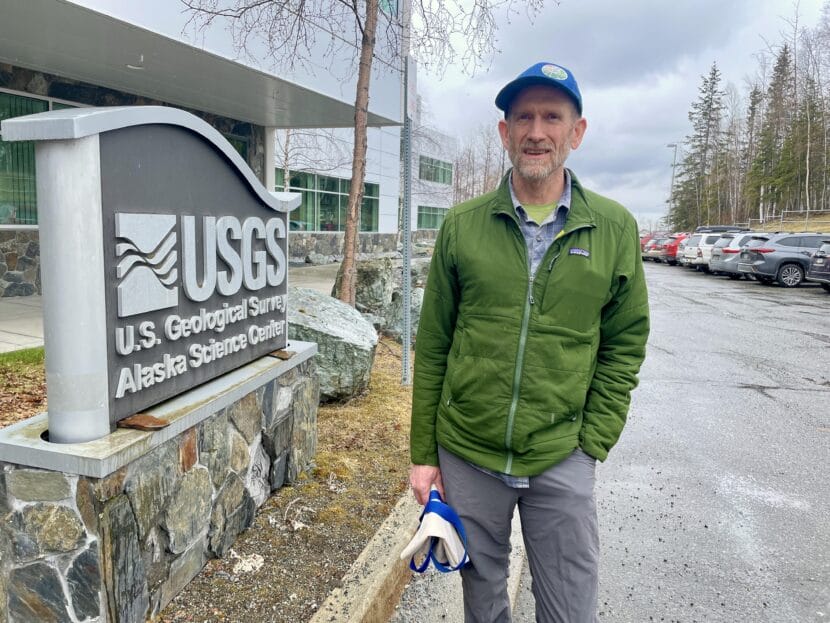
Man in green jacket in front of a USGS sign
Research biologist Dan Ruthrauff took an early retirement from the U.S. Geological Survey in Anchorage. He wasn’t ready to end his career. (Liz Ruskin/Alaska Public Media)

Last July, Dan Ruthrauff was on the North Slope with colleagues, outfitting black brant with metal leg bands. It was the sort of thing he did year after year as a federal research biologist.

He wishes he was still working as a federal scientist, adding to the knowledge of Alaska shorebirds, migration patterns and reproductive ecology.

But Ruthrauff is now listed as a former employee of the U.S. Geological Survey’s Alaska Science Center. His last official day at the office was in mid-April. It’s not how Ruthrauff wanted to end his 24-year career.

“I had a lot of irons in the fire, and many projects that I was still working on,” he said. “And I, you know, am lamenting the fact that those aren’t going to be able to happen.”

He’s among about 10 colleagues who quit in mid-April, out of 62 people who worked in his USGS ecosystems unit.

Across Alaska, hundreds of federal employees are losing their jobs. Diminishing the federal workforce is a central goal of President Trump’s, and a hallmark of the first 100 days of Trump’s second term. Alaska is especially reliant on federal jobs. While the loss is hitting home for some Alaskans now, it’ll be months before we can quantify that impact.

Ruthrauff considers himself lucky, compared to some of his colleagues. With the so-called “Fork in the Road” incentives, he could retire early without penalty. He feels for the co-workers who had to leave under less favorable terms. And he’s sad for the science that won’t be completed.

“We believe in what we do, and we believe in the value that we bring to the public,” he said. “So when that started being denigrated and undervalued, it became really difficult, and it’s been a lot of anxiety at work as we started to recognize that lack of appreciation for this very basic research.”

USGS is part of the Department of Interior, which is one of the largest components of Alaska’s federal workforce. In total, about 15,000 Alaskans worked for the federal government when Trump took office this year. No one can yet say how many have since been fired, or took incentives to quit or retire.

“That has been a big question, a gaping question,” said Brock Wilson, assistant professor of economics at the Institute of Social and Economic Research, part of the University of Alaska Anchorage.

“What everyone wants to know is the magnitude” of the job losses, he said. “And that has been really challenging to make any firm conclusion about.”

The state of Alaska says more than 230 federal workers have filed unemployment claims. Those might be some of the 1,400 probationary workers in Alaska. Probationary workers were among the first targeted for firing.

But Wilson cautions that the number of unemployment claims aren’t all that telling, since some of the probationary workers were rehired, some fired a second time, and some continued to receive pay for a time despite getting emails saying they’d been fired. Wilson says that’s just one moving piece that confuses the federal employment picture. Another, he says, is that people who took the Fork in the Road incentives are on different path.

“In fact, they may have gotten another job elsewhere, and so you wouldn’t see that movement in unemployment,” he said.

The best indicator, Wilson said, will be payroll data – how many Alaskans receive federal paychecks now compared to a year prior. The government releases those figures about half a year after the fact, so it will be a few months before we know how much the Trump administration has shrunk Alaska’s federal workforce.

As for the remaining researchers at the Alaska Science Center, more job losses are likely. The journal Science reports that the White House is expected to ask Congress to defund the entire biological research program at the U.S. Geological Survey. The Project 2025 blueprint, which the Trump administration is largely following, calls for abolishing it and obtaining “necessary scientific research about species of concern” from universities by competitive bid.

Ruthrauff, the biologist studying birds, said he’s pretty sure the agency will discontinue his work.

“In the short term, for sure it’s just not going to happen. We don’t have the bodies to do it,” he said. “And if the 2026 budget is any indication, there literally won’t be the organization to do it.”

Some of his colleagues work on species with obvious economic value to Alaska, like salmon, and Ruthrauff said bird-watching and hunting add to Alaska’s economy. Beyond that, he said, “birds bring all of us joy.”

The data he’s collected over his career is archived. He hopes future scientists will one day use it to help maintain healthy bird populations.

Site notifications
Update notification options
Subscribe to notifications