Alaska Public Media

Alaska Public Media is one of our partner stations in Anchorage. KTOO collaborates with partners across the state to cover important news and to share stories with our audiences.

Education bill veto leaves Alaska school leaders disappointed, frustrated and confused

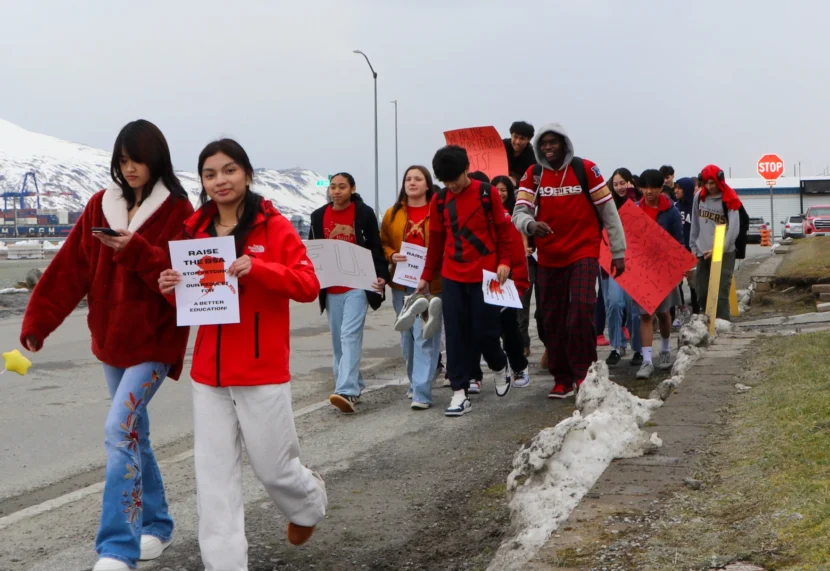
More than 30 Unalaska students march from the Unalaska City High School toward City Hall in support of a boost to education funding on April 11, 2025. (Lucy Bagley/KUCB)

Gov. Mike Dunleavy vetoed an increase to school funding on Thursday, saying the bill was too expensive and didn’t include policies that he said would bolster school choice and improve student performance.

Instead, he proposed a smaller funding and policy package for schools.

It’s the latest development in a yearslong saga. Lawmakers and Dunleavy for years have struggled to come to terms on the state’s first substantial boost to long-term funding in nearly a decade.

Alaska Public Media spoke with school leaders from Ketchikan to Kotzebue on Friday to hear their thoughts on the news. Here’s what they had to say.

‘It’s our students that are going to lose out’

There were some themes.

“My reaction was, once again, disappointment,” Unalaska City School District Superintendent Kim Hansich said.

“I think frustration is the word I’m going to choose here,” said Ketchikan High School principal Rick Dormer.

“Frustrating and a little bit confusing,” said the president of the Anchorage School District board, Andy Holleman.

“It’s our students that are going to lose out,” Northwest Arctic Borough School District Superintendent Terri Walker said.

Walker leads a district based in Kotzebue with 12 schools spread out over a land area about the size of Virginia. Each of those schools, she said in a phone interview, is the center of a community.

“Everything happens in that building, weddings and funerals and meetings, because it’s the … largest place for gathering for the whole community,” she said.

They’re also a haven for often under-resourced communities in times of crisis, she said.

“Oftentimes, many of the villages have catastrophes. Floods, the electricity goes out, their housing freezes up,” she said. “And the school is a safe place to go.”

The veto of House Bill 69 — and the ongoing uncertainty around funding for schools across the state — means her schools’ ability to continue to serve as community hubs is at risk.

Schools in Walker’s district keep their lights on from the early morning late into the evening in recognition of their roles as community gathering places, she said. But costs have skyrocketed. At least 38% of her district’s budget goes to utilities, she said.

“The cost of buying fuel, the electricity bill, water and sewer, it’s gone way up in the last few years,” she said.

Schools have gotten infusions of one-time funding in recent years. But lawmakers and the governor failed to come to terms on a long-term funding boost.

That means Walker is looking at deep cuts to core programs, student activities and even second helpings at meals for hungry students.

“We are really cut to the bare bones right now,” she said. “Chipping at the bones, actually.”

Walker said she’s disappointed that the governor vetoed a bill that would boost basic per-student funding, the base student allocation, by $1,000. She said the $560 increase Dunleavy proposes in a new bill he announced Friday — less general-purpose funding than lawmakers approved in one-time funding last year — won’t stop the bleeding.

“That does not cover half of the deficit that we are looking at,” she said.

In Fairbanks, Superintendent Luke Meinert said that even with status quo funding, equivalent to a $680 increase this year in the base student allocation, his district is bracing for deep cuts. Three elementary schools and 160 staff members are on the chopping block, he said.

“That is on top of devastating cuts that Fairbanks has had to work through in the last several years,” including the closure of seven schools last year, Meinert said.

Jomo Stewart, the president of the Fairbanks Economic Development Corp., said the community’s struggling education system is putting the future of its economy at risk.

“If you have the choice of living in a place (or) staying in a place that has a high quality, well-funded, well-supported educational system, and one that either doesn’t or looks suspect, you will choose the better one,” he said. “So making the proper investments in our educational system, and I mean from pre-K through university, is important.”

According to a report from Stewart’s organization, though the community’s population grew by 0.7% from 2019 to 2023, that’s due largely to an influx of seniors.

The number of elders grew 23% over that period. Meanwhile, school enrollment dropped 6% and the number of working-age adults and school-age children dropped by 2%.

‘We don’t actually understand what the strategy is’

In the state’s largest school system, the Anchorage School District, school board President Andy Holleman said leaders are waiting anxiously to see where school funding lands. He said Anchorage, like districts around the state, is also steeling itself for cutbacks.

“We’re starving a little bit, and there’s not much food on the table to begin with,” he said.

The veto was not unexpected. Lawmakers had been working with the governor on a compromise before negotiations appeared to fall apart.

Though lawmakers in the Democrat-dominated caucuses in control of the House and Senate say they’d like to increase funding with a standalone bill, Dunleavy has said again and again that any funding increases should be tied to policy measures that improve the state’s school system.

Senators stripped out policy measures aimed at avoiding a repeat of last year’s education bill veto shortly before the House and Senate approved the bill. The governor called it a “joke” and pledged to veto the bill before the final version even passed. The co-chairs of the Senate Finance Committee, which stripped out the policy provisions earlier this month, voted against the bill’s passage, saying it was too expensive.

Holleman’s not expecting any surprises in an upcoming veto override vote. The bill passed with a one-vote majority in each chamber. It takes two thirds to override. Even supporters say they’re pessimistic about the override’s chances.

Holleman said he’s just fed up with the politics of it all.

“We don’t actually understand what the strategy is,” he said.

He said he’s also not sure whether the governor’s new proposals — which include easing the process of creating and maintaining charter schools, allowing parents to enroll students outside their home district and requiring districts, and placing a new emphasis on growth-based testing — will truly improve student achievement.

There’s also what’s not in the bill. Dunleavy took issue with a provision inserted into a prior version of the bill that would have required correspondence homeschool students to take state assessments to access public funding.

“What they’re calling accountability is confusing to me,” he said.

Holleman stressed that he was speaking on his own behalf, not for the board. But he’s not the only Anchorage School District board member concerned.

Another one, Kelly Lessens, emailed a chart: with the governor’s proposed increase in basic funding, the Anchorage School District is going to need to find more than $31.2 million in cuts from a $71 million budget amendment identifying programs and staff that would be restored with a $1,000 increase in basic per-student funding.

Ketchikan High School Principal Rick Dormer said he was also dismayed by the back-and-forth that culminated in Thursday’s veto.

“A lot of us were kind of holding our breath,” he said. “And then the governor steps in as one person, … and just says, ‘No, I have a different plan. We’re going to do less funding, and what we’re going to do is a lot of my own personal ideas.’ That’s hard to stomach.”

‘I want them to explain why this is an OK business model’

Dunleavy isn’t just proposing $560 in basic funding. He’s also proposing $35 million in what he calls “targeted” funding — an increase in formula funding for correspondence homeschool, plus an incentive program that would provide a boost for each young student who performs well on literacy assessments. Dunleavy is pitching the total package as equivalent to a $700 base student allocation increase.

But school leaders like Deidre Jenson, the superintendent in Sitka, say that leaves them with a lot of questions.

“Does that mean that we’re going to get it beforehand because we’ve had good scores, because we’ve shown growth? Well, what does it mean for the ones that have been doing all these cuts and they’re not making as good growth?” she said.
“Like, it’s just, what does it mean?”

The one-time funding boosts lawmakers have approved in recent years have not come until the end of the legislative session in late May, weeks or months after school districts have built their budgets.

That leaves districts flying blind, uncertain how much money they’ll receive in the next year, school leaders said. Instead, school boards take guesses on where they think the political football will land.

Some are planning around no increase in long-term funding. Others are budgeting for a $680 boost to the base student allocation, equal to the funding lawmakers approved on a one-time basis last year.

“They want change and incentives to make growth better. You need to give us the money, and then maybe we can do our job,” Jenson said. “Right now, we can’t do the job, because we’re just trying to figure out our budgets and who to cut and where to cut and what not to cut.”

Dormer, the Ketchikan High School principal, said he’s frustrated at the uncertainty over education funding. He recalled his time working in the private sector, including for businesses like Hewlett-Packard and Nike.

“None of them run a business like this. And they make shoes!” he said. “We’re working with people’s children. I have children in Alaska’s schools today. Like, I want them to explain why this is an OK business model and a funding model for people’s children.”

Dormer, echoing other school leaders interviewed for this story, said he wants lawmakers and the governor to work together to figure out a way forward in the 30 or so days left in the legislative session.

“We have leaky roofs and broken boilers. I mean, it’s just degrading,” he said. “I know that’s not what Alaska’s people want.”

Dunleavy vetoes education bill, announces competing bill

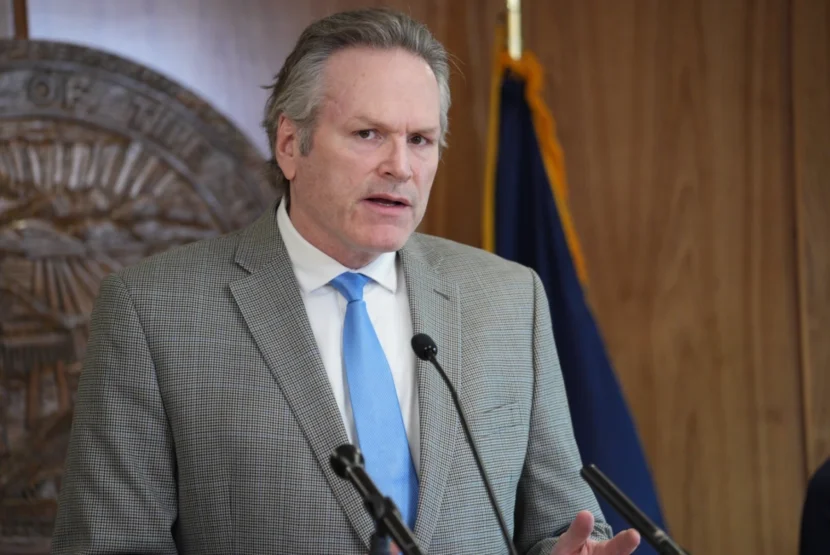
Gov. Mike Dunleavy speaks to reporters during a news conference on April 17, 2025. (Eric Stone/Alaska Public Media)

Gov. Mike Dunleavy on Thursday announced he had vetoed a bill that would have boosted the basic per-student funding amount for public schools, the base student allocation, by $1,000. Instead, Dunleavy said he would introduce a $560 BSA increase, along with $35 million in targeted education funding, attached to a set of policies in a bill that he said he would introduce Friday.

“There were really two reasons for the veto,” he said at a news conference. “One of the reasons is that the revenue situation has deteriorated a lot since we submitted the bills and worked off a budget in December, and the second reason for the veto is there’s no policy in the bill.”

The veto was widely expected. Dunleavy called the bill the House and Senate sent to his desk “a joke” after senators stripped out a variety of policy provisions that lawmakers previously included in the bill as an effort to seek compromise. Some policy measures — including an expansion of intra-district open enrollment and a ban on cellphones in schools — were items the governor favored.

Others stripped out by the Senate Finance Committee were items Dunleavy opposed, including a requirement that homeschooled students take a standardized test or alternative assessment to access state funding known as correspondence school allotments.

The leaders of the House and Senate say they plan to meet in joint session to attempt to override the veto on Tuesday afternoon.

“Our schools are in desperate need of this additional funding,” said Sen. Bill Wielechowski, D-Anchorage.

Given that the bill passed with a one-vote majority in each chamber, though, minority Rep. Will Stapp, R-Fairbanks, said he didn’t believe lawmakers would come close to the two-thirds majority necessary to override the governor’s veto.

“It would be very strange for me to see people who voted no on a bill to vote yes on an override of the bill,” he said.

Senate President Gary Stevens, R-Kodiak, said he, too, was skeptical the override would succeed.

“That’s not going to happen,” he said.

Lawmakers failed by one vote to override the governor’s veto of a compromise education bill last year that would have included a $680 boost to basic per-student funding while making numerous policy changes.

New bill would boost education funding — but there’s a catch

Dunleavy’s new bill, according to a draft provided to reporters, would provide $35 million in education funding in addition to the $560 base student allocation increase, including an increase in funding for homeschool students in correspondence schools and incentive payments to school districts tied to student performance on literacy assessments. The governor said that’s “equivalent” to a $700 increase in basic funding.

“The schools need more money. We had a huge spike in inflation just a couple years ago,” he said.

That’s been a chorus repeated by school districts, parents, community leaders and businesspeople for years, though lawmakers and the governor have failed to agree on a substantial boost to education funding since Dunleavy took office in 2018.

Debates over education funding, responding to those calls from Alaskans across the state, have dominated the last two legislative sessions. Dunleavy said Thursday that he was open to removing education funding as a perennial item of legislative debate.

“We should have a discussion about inflation-proofing education funding going forward, to be perfectly honest with you, and I would have that conversation,” Dunleavy said.

But it’s unclear whether the governor’s bill, if passed as is, would actually boost funding for schools across the state.

Schools this fiscal year got the equivalent of a $680 increase in basic funding on a one-time basis. It was entirely tied to total school district enrollment, rather than the approach the governor’s bill takes, tying some of the funding to reading performance and homeschool enrollment.

That means it’s possible the bill could result in some school districts — especially those with few homeschool students and poor scores in reading, or few young students — receiving less money next year than they did this year.

The new bill would also make a variety of changes to state law around charter schools and require school districts to “regulate” the use of cellphones in schools.

Lawmakers open to further negotiation with governor — if he’s willing

Key lawmakers say they’re open to continuing to work with Dunleavy on a compromise.

“There’s a lot of ‘Yes, and…’ in what I heard today,” said House Education Committee Co-Chair Rebecca Himschoot, I-Sitka, who sponsored the bill the governor vetoed.

She said the governor’s new proposal was an improvement over the last education bill Dunleavy introduced, which did not include an increase in the base student allocation. Himschoot said she was especially encouraged by the governor’s apparent willingness to tie school funding to inflation. The original version of the education funding bill she filed would have tied school funding to the Consumer Price Index.

But Himschoot took issue with the fact that the governor’s bill provides less general-purpose funding than schools received last year.

“None of us is willing to go there,” she said.

Minority House Republicans said the governor’s bill provided a foundation to build upon.

“The bill looks like a pretty reasonable bill to me, with the permanent increase in education funding,” said Rep. Will Stapp, R-Fairbanks, a member of the all-Republican House minority. “If he says he’s going to sign in, I don’t see a reason why we wouldn’t pass the bill at this moment.”

But key members of the Senate said they had reservations about some of the governor’s new proposals. Wielechowski, who chairs the powerful Senate Rules Committee, said he’s not sure the governor’s proposed policies will actually improve student performance.

“They really don’t do anything at all to advance education,” Wielechowski said.

The governor’s office estimates the cost of the bill to be $179 million. Status quo funding for schools and other state services — slightly less than the funding Dunleavy proposes — would leave the state budget hundreds of millions of dollars in deficit.

Dunleavy suggested filling the gap with the state’s roughly $3 billion in savings, a prospect that has been dismissed by Senate leadership.

Wielechowski and Himschoot said they were frustrated by their experience negotiating with the governor’s staff, both this year and last. Himschoot, the primary sponsor of the bill the governor vetoed, said negotiations over the bill, the Legislature’s No. 1 priority, had run through the governor’s staff rather than Dunleavy himself.

“I’ve had no meetings with the governor,” she said.

Wielechowski said he hoped Dunleavy would be open to a little give-and-take.

“We worked last year and we thought we had a compromise. (We) gave the governor, quite frankly, 95% of what he asked for, and it still wasn’t enough,” Wielechowski said. “If he’s coming into this with the perspective of, ‘Give me everything, or we don’t have a deal,’ that’s probably not going to happen. I guarantee that’s not going to happen.

“But if he’s coming into this in a manner where he genuinely wants to compromise, then sure, absolutely we can find a deal,” he said.

KMXT’s Brian Venua contributed reporting.

University of Alaska says 4 international students have had visas revoked amid national immigration crackdown

Jean Kashikov, a recent University of Alaska graduate, poses for a photo on April 13, 2025. Kashikov is one of four UAA international students whose visa has been revoked by the Trump administration. (Wesley Early/Alaska Public Media)

At least four international students in Alaska have had their student visas revoked, as the Trump administration’s immigration crackdown continues.

They are among hundreds across the country facing removal after losing their student visas.

One of them is recent University of Alaska Anchorage graduate Jean Kashikov.

Kashikov first visited Alaska in 2017 as a tourist from his home country of Kazakhstan.

“We took a cruise out of Whittier, and we did a bunch of regular tourist stuff,” he said in an interview Sunday. “And I felt like it’s a really nice place with really nice people.”

Kashikov decided to apply to UAA and began taking courses in 2019. He graduated last May with a bachelor’s degree in math, followed by an associate’s degree in aviation in December. Now 24 years old, he began working as a self-employed flight instructor in Wasilla in March.

“In the last four to five weeks that I’ve been doing this, I had a bunch of one-time customers where I gave them, you know, biennial flight reviews, which is something that every pilot needs every two years, no matter how small,” Kashikov said.

Kashikov is able to work in the U.S. under an optional practical training period. It allows international students to remain in the country for one year after graduating, so long as they’re working in the field they studied. The federal government tracks and documents the students’ activities with what’s called a Student and Exchange Visitor Information System, or SEVIS, record.

Kashikov’s training period wasn’t set to end until January of 2026. But on April 10, as he was eating breakfast at the Denali Family Restaurant, he received an email from UAA that his SEVIS record had been terminated.

“That basically means that starting this day, you are unlawfully present in the country,” Kashikov said.

In a statement, University of Alaska officials say a total of four UAA students, including one currently enrolled, received a similar revocation, without any prior notice. They added that no students from the Fairbanks or Southeast campuses have been impacted, so far.

“Our international students and scholars are vital members of our community, and we remain fully committed to supporting their success,” UA President Pat Pitney said in the statement.

Kashikov said he believes the U.S. isn’t following its own procedures and laws. At least one experienced immigration lawyer agrees.

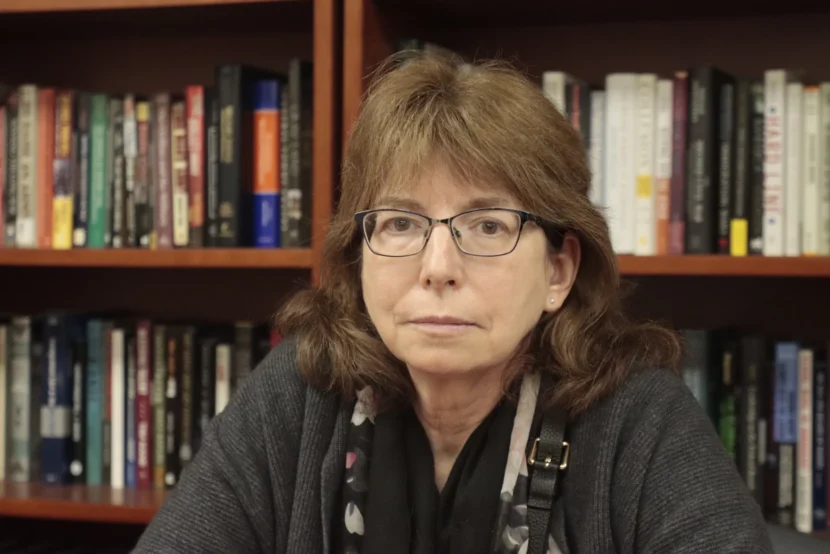
Margaret Stock is an Anchorage-based attorney who is recognized for her expertise in immigration law. (Wesley Early/Alaska Public Media)

“This is, like, totally illegal,” said Margaret Stock, an Anchorage-based attorney and internationally recognized expert on immigration law. “Everybody, they know it’s illegal, but they’re figuring people aren’t gonna be able to fight it.”

Stock cited research from the National Association of International Educators, which found that more than 800 international students nationwide saw their visas revoked or their SEVIS records terminated in recent weeks.

“The president apparently set a goal internally at the White House of deporting 1 million people, and they haven’t been able to find enough people who are actually deportable in order to do that,” Stock said.

Instead, the administration is trying to get people to deport themselves by revoking their visas or telling them directly to leave the country, Stock said. There hasn’t been a consistent reason given to students for the termination of their visas, but officials have made vague references to criminal records checks, she said.

“So it sounds like they apparently went into some system and found the person had a ticket of some kind, or they got arrested for something, even if no charges were brought against them,” Stock said.

Kashikov admitted that he had been arrested before. It was three years ago, in Arizona, when he was arrested for blocking a public bus he says refused to pick him up, he said. He had no alcohol or drugs in his system, didn’t act violently, and the charges were dropped. He also has a pending speeding ticket in Georgia from August.

Neither incident is grounds to deport someone, but many people don’t have the resources to take on the federal government in court, Stock said

“Their strategy is to do things that are illegal,” she said, “because they think people are going to have to go into court, and they won’t be able to afford a lawyer, and they won’t be able to fight the government, because it costs a lot of money to sue people in federal court.”

Kashikov consulted with immigration attorneys who’ve basically given him three options, he said. One is to simply leave the country. Another is to try to get his SEVIS record reinstated, though Stock said the Trump administration is not approving reinstatements right now. A third option is to sue the federal government. Stock pointed to a ruling in Wisconsin from Monday, where a judge granted a temporary restraining order for a student, blocking the termination of their SEVIS record. The order allowed the student to stay in the country and continue to work as their federal lawsuit goes through the courts.

Kashikov said he’ll most likely just leave.

“They can technically come grab me at any time,” he said. “So I’m not willing to test them. I want to leave if I can’t find a better solution. And now there is no better solution on the horizon as of right now.”

Kashikov said he’s going to miss Alaska, and at least one of his flight instruction clients said they’re going to miss him, too.

Kenneth Groat lives in Palmer and said he looked for a flight instructor for more than a year to help him get his sport license, before he found Kashikov.

“He’s a good pilot to start out with, but a good instructor as well,” Groat said. “You know, he did maneuvers that I hadn’t done in a while, and it just worked out good having a good guy in the cockpit with me.”

Kashikov leaving throws a wrench in his plans, Groat said, but it also means the state will be losing a talented worker.

“It just seems like it’s hard to find young people to work these days,” Groat said. “And Jean just seemed, for his age, he seemed super motivated, you know, and headed in the right direction. I really wanted him to succeed.”

Though his future in Alaska seems to be coming to a close, Kashikov said he wanted others to learn from his experience.

“I want the voting public to know that, you know, six months later, or a year later, or whenever, when they come out on the news and say, ‘We deported, removed, etc, so many thousands of violent criminals and whatnot,’ they’re gonna claim that that’s what they’ve done,” Kashkov said. “And I just want people to know that that’s literally not what’s happening.”

Kashikov received an official notice from the State Department that his visa was revoked on Monday night. As of Tuesday afternoon, he remained in the country.

Officials with the State Department and the Kazakhstan embassy, which told Kashikov his visa was revoked, did not immediately respond to a request for comment.

Protesting the Trump administration? Murkowski says keep at it.

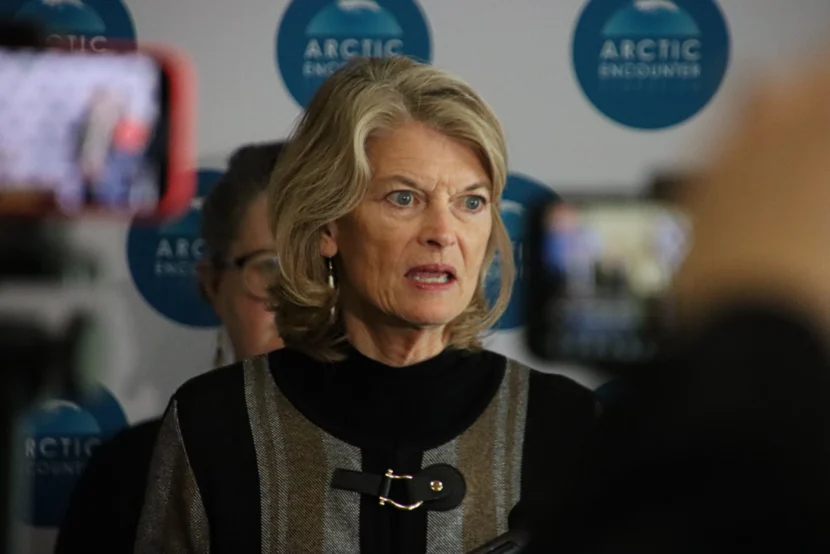
Lisa Murkowski at a 2022 conference in Anchorage. (Lex Treinen/Alaska Public Media)

Sen. Lisa Murkowski is urging Alaskans to speak out against changes the Trump administration is bringing to their lives and the government they’ve relied on.

“Keep calling. Keep the emails. Keep the social media going,” she told a conference of 500 nonprofit leaders in Anchorage Monday.

The event was organized by the Foraker Group, which advocates for nonprofits, a sector that in Alaska provides everything from water and electricity to human services. Some are trade associations, supporting the state’s largest industries.

Foraker President Laurie Wolf said nonprofit executives are unsure whether they can commit to their projects by purchasing equipment or hiring personnel, because even if they have funding now, they might lose it later.

And, Wolf said, some Alaskans don’t feel safe speaking out.

“What do you have to say to people who are afraid, or who represent people who are afraid?” she asked Murkowski on the conference stage.

“We are all afraid. Okay?” Murkowski said.

She paused for a full six seconds to let it sink in.

“It’s quite a statement,” she said.

Murkowski is one of the most outspoken Republicans in Congress against many of the Trump administration’s actions. Like Sen. Dan Sullivan and Alaska Congressman Nick Begich, Murkowski said she’s reaching out to the Trump administration behind the scenes to try to lessen the impact on Alaskans. But Murkowski is also openly critical of the administration.

“I’m oftentimes very anxious myself, about using my voice,” she said, “because retaliation is real.”

Among the programs and policies she’s worried about, she cited Medicaid, possible deportation of refugees, energy and housing programs and food assistance. As she described it, even things that sound like unfounded administrative horror stories can come true.

“I am operating off of rumors a lot of times,” she said. “And then you see some things that are just unnerving in their scope, and you realize, well, that rumor was actually real.”

Murkowski said Alaskans have come to her at airports and shed tears, over losing their jobs or fears for their safety net. She said she’s worried the chaos will cause her constituents to retreat.

“It’s important that the concerns continue to be raised, rather than allow the fatigue of the chaos grind you down,” she said. “Don’t let it grind you down.”

She said protestors should keep their statements “affirmative,” by saying why they want to keep government programs and services. For those who are protesting at her offices every week, she asked that they keep at it.

“It’s going to sound crazy coming from an elected official, but I’m going to continue to urge you to raise your voices,” she said.

Salary study shows large segment of Alaska state workforce is underpaid

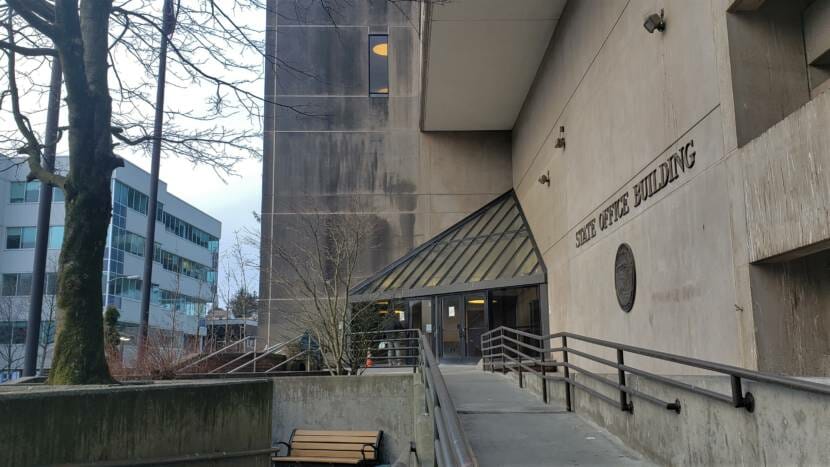
State Office Building Willoughby Avenue entrance 2021 01 22
The State Office Building’s Willoughby Avenue entrance in Juneau was open on Jan. 22, 2021, though the offices inside were all closed to the public. (Photo by Jeremy Hsieh/KTOO)

Gov. Mike Dunleavy’s administration released a long-delayed study on state worker salaries on Wednesday. The study shows that more a quarter of the jobs surveyed, 28%, pay less than the median market wage, and 43% pay less than a key benchmark the state has used for decades.

“The report found several areas where the State is doing well and very competitive, as well as several areas that need improvement,” Department of Administration spokesperson Forrest Wolfe said via email after declining an interview request.

Nearly 3,000 state jobs were vacant at the beginning of this year. Alaska State Employees Association head Heidi Drygas, whose union represents a majority of the state’s rank-and-file workers, said in an interview that the salary report offers some insight on that problem.

“It’s no wonder why they’re having a difficult time attracting applicants to apply for these jobs, because they simply will make more money in the private sector or in public employment in other states,” she said.

A few job classes stand out as especially underpaid, according to the study. State biologists, physical scientists, wildland firefighters and economists all earn far less than the market rate. Law enforcement officials tend to earn above the market rate.

The salary study looked at more than 400 benchmark job classes, covering about half of the state’s more than 15,000 employees. It compared the salaries for those jobs to similar roles in other governments and the private sector.

State agencies have traditionally sought to align their pay with the 65th percentile- essentially paying employees a bit better than average. Compared to that benchmark, more than 40% of the surveyed jobs are underpaid. Drygas says the state’s decision to look at the median salary obscures how much the state underpays its employees.

“I think the state has done its level best to … look at it through rose-colored glasses, but when you look at the details, it’s abysmal,” she said. “State salaries have fallen miserably behind.”

The Department of Administration says it asked for both figures in line with past practice.

“For a large employer and complex employer, such as the State of Alaska, market studies often use more than one market competitive point. This allows consideration of different market competitive frameworks,” Wolfe said.

Wolfe said state officials will review the findings of the study to determine whether salaries need to be adjusted, starting with those that are 10% or more below the market rate.

Drygas said she hopes the study spurs the state to offer more competitive wages. She said the union plans to continue a lawsuit seeking to obtain earlier drafts of the study, which the state says were not used in decision-making and are thus not public records.

Whether a ‘pickle’ or a ‘crisis,’ the Alaska House is struggling with a deficit budget

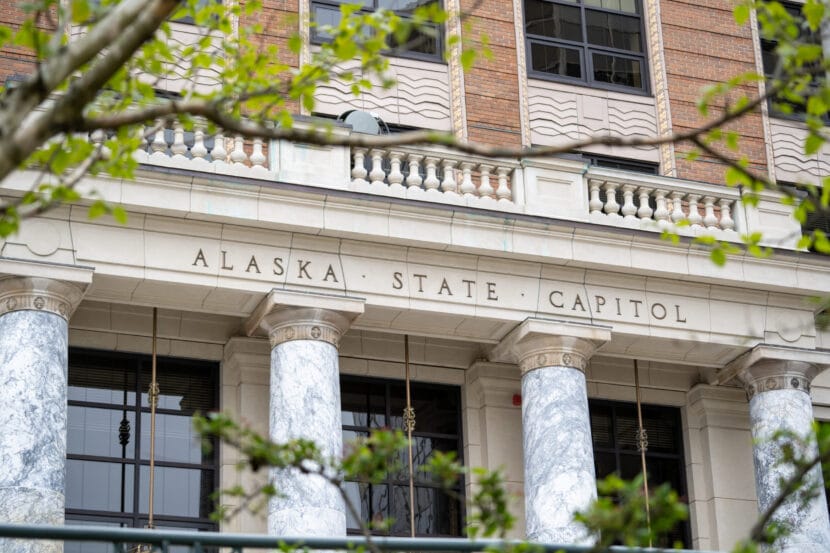
The facade of the Alaska State Capitol in Juneau on May 22, 2024. (Eric Stone/Alaska Public Media)

The Alaska Legislature’s quest to pass a viable state budget before the end of the legislative session in mid-May isn’t getting any easier.

“Ladies and gentlemen, we’re all in a pickle,” House Speaker Bryce Edgmon, I-Dillingham, told reporters on Tuesday.

At this point in a normal year, Edgmon said, House lawmakers would be on the verge of passing their version of the state’s operating budget, marking the lower chamber’s preferred level of spending on state agencies, public schools and the Permanent Fund dividend. Last year’s budget passed the House on April 11.

But this is not a normal year. Low oil prices are fueling large deficits, meaning tough budget decisions are ahead. With a razor-thin 21-19 majority for the chamber’s Democrat-heavy bipartisan coalition, House lawmakers are struggling to come to an agreement that meets their constitutional obligation to pass a balanced budget.

Nowhere is that struggle clearer than in the state operating budget, which House Finance Committee members voted out of committee last week. The $13.5 billion appropriations bill contains $2.5 billion for dividends, enough for a roughly $3,800 PFD, in line with Gov. Mike Dunleavy’s budget proposal and a formula in state law that has not been used since the mid-2010s. The budget also includes a so-called “unallocated cut” of nearly $80 million, an unusual step that would give the governor the freedom to make substantial cuts on his own. Legislative attorneys warn the step could be unconstitutional.

Altogether, it adds up to a $1.9 billion deficit. And that’s before accounting for recent volatility in the markets for crude oil, equities and bonds, which further threatens the state’s financial stability.

“It is a crisis. We cannot pay an unsustainable dividend,” said Chuck Kopp, R-Anchorage, the House majority leader.

The state has approximately $2.8 billion in its main rainy-day fund, the Constitutional Budget Reserve.

Large dividend figure is largely a mirage — but a persistent one

Members of both the coalition majority and Republican minority have called the $3,800 figure unrealistic in a year when roughly status quo spending would leave a $677 million deficit between the current fiscal year ending in June and the next year beginning in July. That figure, spotlighted by Senate budgeters, includes a roughly $1,400 dividend and a long-term extension of this year’s $175 million boost to education funding.

But House lawmakers have so far failed to come to an agreement on a more realistic dividend.

Majority lawmakers, including members of House leadership, have called repeatedly for reducing the PFD to $1,000 in an effort to balance the budget while boosting funding for public schools. But so far, they haven’t mustered the votes to pass, or even advance, a budget that reflects that stated preference.

During the marathon budget-writing process, two majority-aligned members of the House Finance Committee — Rep. Neal Foster, D-Nome, and Rep. Nellie Unangiq Jimmie, D-Toksook Bay — voted with all of the House Finance Committee’s minority Republicans to reject a proposal that would have reduced the PFD to $1,000.

Foster and Jimmie were not available for interviews Wednesday afternoon, but Foster has in the past said PFD reductions amount to a tax that falls disproportionately on the poorest Alaskans.

The House’s chief budgeter, House Finance Committee Co-Chair Andy Josephson, D-Anchorage, said he’s sympathetic, but the dire fiscal picture is forcing lawmakers’ hands.

“We don’t yet live in a world where the Alaska people, writ large — although we heard different messages in Anchorage — are ready for themselves to invest in their state government, so here we are,” he said. “I’m not saying that people who want the PFD in its entirety aren’t speaking to a set of values. We just have a significant math problem.”

House leaders turn to minority and governor for help

With members of his own caucus apparently unconvinced, Edgmon on Tuesday pleaded with his Republican counterparts for help.

“We need the help of the minority caucus. We also need the help of the governor to come forward and to put all these pieces together,” Edgmon said.

Reducing the PFD would only go so far when it comes to balancing the budget, though. Even with a $1,000 PFD, the nonpartisan Legislative Finance Division estimates a $169 million deficit for the next fiscal year — if a House-passed $1,000-per-student funding boost, a key campaign issue for the Democrat-dominated majority, is included.

“That’s just not possible,” said Rep. DeLena Johnson, R-Palmer and the senior Republican on the Finance Committee, said.

House minority Republicans say they’d like to see some additions to the governor’s budget rolled back, though those would not close the gap. Johnson said she anticipated cuts to both the PFD and the House’s $275 million education bill that’s now in the hands of the Senate.

“We’re looking at really having to cut things back, and [that’s] probably going to include having to discuss both of those two very, very, very difficult things,” Johnson said.

‘Maybe we can get to yes’ on Senate tax bills

Even reducing the education funding boost to a status quo level, $175 million, same as schools got this fiscal year in one-time funding, would not close the remaining gap.

Another option for balancing the budget is raising state revenue. Members of the bipartisan Senate majority have suggested expansions of corporate income taxes and reductions to oil and gas tax credits.

“I hope they pass,” said Senate President Gary Stevens, R-Kodiak. “I’d like to see us have reasonable education funding and a reasonable dividend, and not have to slash everything, as we would if we don’t have those revenues.”

Stevens also suggested that the Legislature may not have a choice when it comes to determining the appropriate school funding level.

“I suspect that the legislature may pass a $1,000 [school funding increase],” he said. “I have no doubts, from having spoken to the governor, that he will veto that.”

Stevens said he expected efforts to overcome a veto with a two-thirds majority vote would be “dead on arrival.”

Josephson, the Finance Committee co-chair, suggested the House may agree to Senate-proposed reforms that would capture corporate income taxes for large S corporations in the oil and gas industry — namely, BP successor Hilcorp, which is not subject to typical state corporate income taxes — and companies that do business in the state via the internet.

“Maybe we can get to yes,” Josephson said.

But the House majority’s one-vote margin may make that difficult. Kopp, the majority leader, said he opposes the Senate’s revenue measures.

“Not this year,” he said last month.

Stevens, though, reiterated Wednesday that he continues to oppose spending from savings for the coming year’s budget, despite recently acknowledging a withdrawal will likely be necessary to close the budget gap in what remains of the current fiscal year.

If the House fails to pass a budget, the Senate could push forward with its own budget bill, cramming the Legislature’s typically separate operating, capital and supplemental spending bills into a single budget document colloquially referred to as a “turducken.”

Despite the political headwinds and mounting time pressure, Edgmon says he remains optimistic lawmakers will settle on a budget before the constitutional end of the legislative session on May 21. Edgmon estimated that the House would have to pass a budget next week to remain on track.

“We still have time,” he said. “We don’t have a lot of time.”

Site notifications
Update notification options
Subscribe to notifications