Alaska Public Media

Alaska Public Media is one of our partner stations in Anchorage. KTOO collaborates with partners across the state to cover important news and to share stories with our audiences.

At Senate confirmation hearings, Sullivan asks to make a point

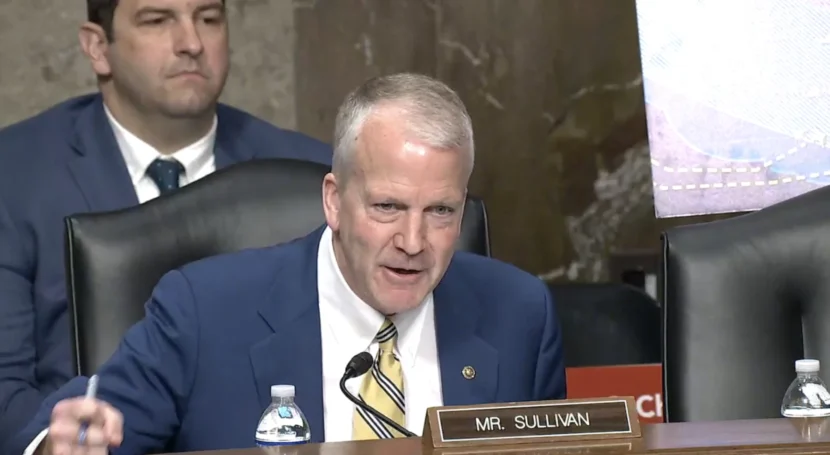
Sen. Dan Sullivan questions a nominee at the Senate Armed Services Committee, April 1, 2025. (Screenshot from U.S. Senate Video)

President Trump’s nominee to be chairman of the joint chiefs of staff, Gen. Dan Caine, faced the Senate Armed Services Committee Tuesday. That gave Alaska U.S. Sen. Dan Sullivan five minutes to ask, in public, anything of the man likely to soon be the nation’s most senior military officer.

Sullivan called out what he sees as the liberal agenda of the Biden administration’s appointees.

“I think the military was politicized in a huge way, particularly from the civilian leaders who were pushing left-wing theories on the military, pushing climate change over ship-building,” Sullivan said. “The undersecretary for policy came before this committee and told us that our military is, quote, systemically racist. It’s ridiculous, right? Do you believe our military is systemically racist?”

Sullivan often disparages the idea that the military is imbued with institutional discrimination. He spent some time on it at Caine’s hearing. The nominee had only to provide the briefest response:

“No, senator.”

Confirmation hearings can reveal a lot, and not just about the nominees. They are ostensibly a chance for senators to ask nominees about their background, policy views and how they intend to fulfill the duties of the position. That does happen. But senators often use these proceedings not to extract information but to deliver it — to the nominee, to other senators and to the C-SPAN-viewing public. Sullivan sticks mostly to the second mode.

At this hearing, Sullivan’s point about liberal agendas served as a bit of counterprogramming, since it was interspersed between Democratic senators asking Caine what he’d do if Trump tried to use the military against civilians or to carry out domestic political goals.

Sullivan quickly moved on to a topic any regular observer of these proceedings knew was coming.

“I’m not going to let this hearing go by without a famous quote from the father of the U.S. Air Force, Billy Mitchell, who was talking about a certain place in the world,” Sullivan said, leading Caine down a rhetorical path that he’s taken with many prior nominees. “He said, Whoever controls this place, controls the world. It is the most strategic place in the world. What place was Billy Mitchell talking about, General?”

Caine knew the answer: Alaska

“You agree with Billy Mitchell’s incredibly insightful analysis?” Sullivan continued.

“Mitchell was a brilliant air power …,” Caine started to say, but Sullivan wanted to hear just one word.

“That’s a yes, I assume you’re saying?” he pressed.

Caine took the hint: “Yes, sir.”

Sullivan raises Billy Mitchell to argue for more military assets in Alaska. He spoke at the hearing of repeated Russian and Chinese incursions in the North Pacific, near Alaska. He talked about the value of re-opening the military base at Adak. He also made a plug for 8(a) contracting. The 8(a) program allows the federal government to sign sole-source contracts with certain types of businesses, and some Alaska Native Corporations have done well with it.

When Sullivan’s five minutes in the Armed Services Committee were up he moved on to another confirmation hearing, in the Veterans Affairs Committee. There he raised another issue he’s passionate about — capping attorneys’ fees for law firms representing Marines exposed to toxic drinking water at Camp Lejeune. Sullivan grew frustrated as the nominee to be general counsel for the V.A., James Baehr, equivocated.

“I think the issue of representation and making sure that folks have aggressive representation, helping them …” Baehr began.

“You’re getting ready to lose my vote here,” Sullivan interjected. “That’s the wrong answer.”

Sen. Angus King’s turn came next. King, I-Maine, said the discussion about fine points of veterans policy seemed like playing music on the deck of the Titanic, given that the Trump administration has fired thousands of employees at the VA and intends to fire tens of thousands more.

“And we’ve got the (VA) secretary telling us that this is going to produce better service,” King said. “I don’t think that passes the straight-face test.”

He said the committee should quit considering nominees until they get answers from the department about how the firings and cancelled government contracts are going to impact service to veterans.

But, for the most part, nominees before the Armed Services and the Veterans committees did not face stiff opposition, so confirmation is likely.
Bill would protect foster kids from unnecessary stays in psychiatric wards in Alaska

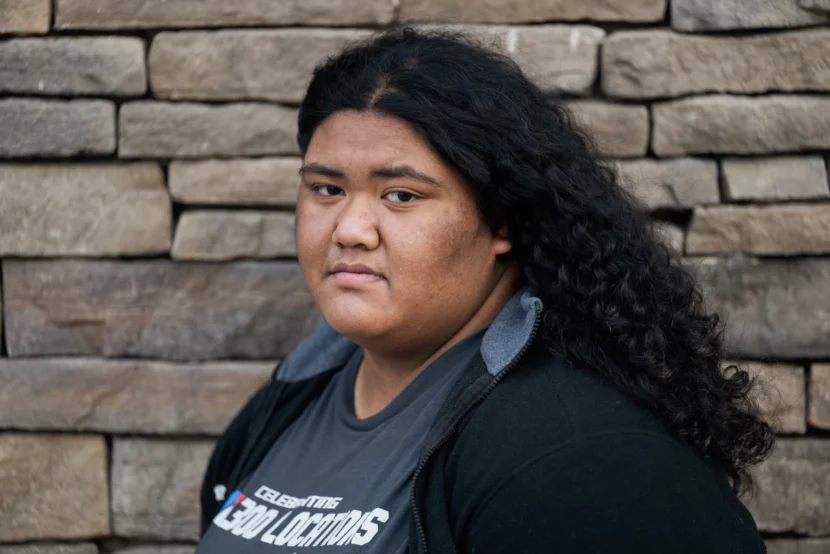
Tali Stone stands in the parking lot at the Hyatt Hotel in Anchorage on Monday, March 31, 2025. (Matt Faubion/Alaska Public Media)

Tali Stone was nine years old when her foster mother brought her to North Star, an acute psychiatric facility in Anchorage. Stone said she had been refusing to go to bed and got in a fight with her foster mom. She said her foster mom had talked about North Star before, as leverage sometimes if one of her nine foster kids wasn’t behaving.

“She always described it to me as a prison,” Stone said. “She said that they’ll lock you up. She said that it was moldy inside the building, like an actual prison.”

But this time it wasn’t an empty threat. Typically, to be admitted to a psychiatric facility someone needs to be at risk of suicide or violence, experiencing psychosis, or unable to care for themselves. Stone said during the intake, her foster mom exaggerated her behavior and lied that she was seeing ghosts.

“Even the staff said, themselves, ‘I’m not sure why you’re here,’” Stone said. “And I was like, ‘I’m not sure either.’”

Stone was at North Star for four weeks, according to her psychiatric records. And over the next two years, she was admitted to North Star a total of four times, each stay several weeks at a time.

Stone was one of the thousands of kids under the care of the Office of Children’s Services in Alaska, or OCS, who have spent time, sometimes unnecessarily, in acute psychiatric facilities. OCS is under-resourced, with a high staff turnover rate, and a serious shortage of foster families. The Department of Justice reprimanded the state in 2022 for overreliance on psychiatric hospitals and residential treatment, and the office has made improvements since then.

OCS officials did not agree to an interview for this story, but commissioner Kim Kovol from the department that oversees OCS, wrote over email that there is a lack of appropriate placements nationwide for youth with serious behavioral and emotional challenges. She wrote that they will continue to use “all existing services to the greatest extent possible,” and work towards the least restrictive care settings.

But Amanda Metivier, who runs the nonprofit Facing Foster Care, said that lack of placements means foster kids stay in psychiatric facilities for too long.

“They do an intake at a hospital, they get a diagnosis, and then they linger there,” Metivier said. “[It] used to be for months on end, but because of court cases, it’s now weeks.”

Right now kids have the right to a court hearing within 30 days of admittance, but the bill passed by the state House March 26 would reduce that timeline to seven days. That’s still much longer than many states, which require a hearing within 72 hours.

Timeliness is important because kids say these facilities are traumatic.

“What happens in these facilities?” Metivier said. “Children are physically restrained, chemically restrained, put in quiet rooms or in seclusion.”

She said even if kids in facilities don’t experience those directly, just witnessing them can be traumatic.

If the bill passes, when a child does get a court hearing, all people invested in the child’s care would have to be there: birth parents, foster families, tribes, behavioral health care providers and OCS. Every kid over ten would also have their own lawyer who could advocate for them being in the least restrictive setting appropriate.

State Representative Andrew Gray, who sponsored the bill, said there’s a lot at stake.

“The absolute human rights violation of having your freedoms completely taken away and no one coming to help you, that alone is enough that we have to fix it,” Gray said. “But, if you want to just look at it from a fiscal perspective, we’re wasting tons of money on keeping a child in the most expensive possible placement.”

He said inpatient care can cost more than a thousand dollars a night per child, a cost that is usually shared by the state and federal government.

The legislation didn’t pass last session when it included a shorter 72-hour time period before a required hearing, but Gray is optimistic it will pass this year. He said it’s important kids don’t get stuck in these places.

Metivier worked with kids in foster care to help draft the bill, and said it would add a sense of urgency to the process of assessing the care.

“We need to act quickly on either identifying a higher level of care or different therapeutic intervention, or releasing them,” she said.

Tali Stone, who entered North Star at age nine, didn’t get that kind of grace. She said she never got a hearing at all to assess whether she should be there. And she said her experience at North Star, totaling about four months, changed her from an outgoing kid to one who was reserved and numb.

“I didn’t have anyone else to tell me that you’re just a kid,” she said. “You’re just dealing with stuff that’s natural, if you’re going through this situation, telling me that I’m not a bad kid, that I’m loved, stuff like that.”

Stone said now, at age 19, about nine years after her last stay, she still feels the effects. She struggles with self esteem and self hatred.

But she recently got a job she loves, she said, with a coworker she admires.

“Every day, he’s just being himself, and I look up to him,” Stone said. “I want to know how that feels one day.”

She said she really hopes this bill passes. It now heads to the state Senate. She wants foster kids in institutions to know they’re not forgotten, and there are people out here looking out for them.

Alaska’s public health programs lose millions in federal grant funding

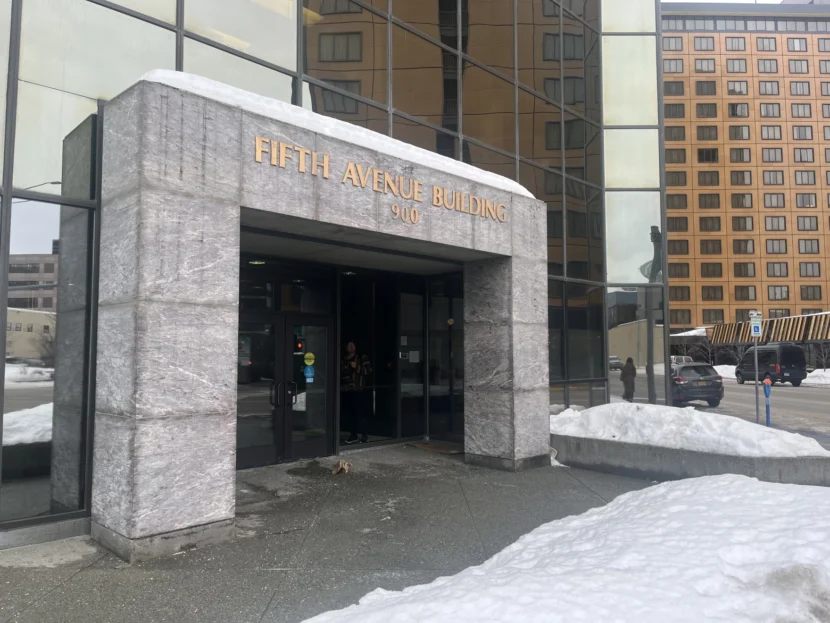
The frontier building in Anchorage houses the state’s division of public health. (Rachel Cassandra/Alaska Public Media)

The federal government notified the state that Alaska’s division of public health won’t receive millions of dollars in public health grants it was expecting over the next two years.

The state department of health, which oversees the division, did not agree to an interview for this story, but spokesperson Alex Huseman said by email that the grants were terminated March 24.

“The funds were meant to address the continued impact of COVID-19 on the economy, public health, state and local governments, individuals, and businesses,” Huseman said. “The Department is actively assessing potential impacts and next steps for our staff, programs, and activities.”

Dr. Anne Zink, who led the state’s response to the COVID 19 pandemic as chief medical officer, said the money was also intended to reduce the impact of future disease outbreaks and pandemics.

“I worry that without letting [the projects] finish, we will be set back tremendously again,” Zink said. “It’s hard to know for sure, but it feels like decades of lessons learned are going backwards if we lose this.”

In a meeting last week, leaders in the division of public health announced the federal government had cut the funds because the COVID pandemic is over, according to a source who works in the division. The source, who did not want to be identified because they’re not authorized to speak to the media, said a major aim of the funding was to protect the state against future pandemics or public health emergencies.

The state did not give an estimate of the total amount of funding lost, but the source provided documents showing the grants amounted to $25 million in funds already allocated by Congress. An additional $18 million has already been awarded to state organizations and contractors, they say, and the future of those funds is uncertain and complicated legally.

Zink said stopping the funding partway through projects is a waste of money and effort.

“The money that was already spent may not be realized in its benefit to Alaskans, because we may not be able to finish the project, or we started something and can’t get it done,” Zink said.

One of the state projects that is losing funding is an electronic records sharing system, which is partially finished.

Zink said the system would allow for data sharing between public health and the broader healthcare system to help them communicate and work better together.

The division source said the COVID-era funding was also focused on reducing health disparities across the state, especially in rural Alaska, and such major cuts will have a devastating ripple effect throughout all Alaska public health programs.

“Everybody is going to feel this,” they said. “People who are trying to quit smoking, they are potentially going to call for that resource and it’s not going to be there anymore. People who are seeking to have extra Narcan doses through Project Hope might find that they can’t get the doses they need.”

Project Hope is an organization that distributes free opioid reversal treatments like Narcan.

The source said about fifty people, ten percent of the division’s staff, are employed fully with funds from the eliminated grants. They said the state aims to cover some of the missing grants with other federal funding sources.

The source said the division directs these grants to organizations working in communities, and on projects communities identify as important for public health reasons.

A majority of the funding, they said, has gone toward expanding rural health access, but the Anchorage Health Department has also received a big chunk of funding to reduce disparities in urban areas.

Michelle Fehribach, a spokesperson for the Anchorage Health Department, said they “don’t currently have enough information to ascertain how the [municipality of Anchorage] may be impacted by this decision.”

Zink said the grants were aimed at the biggest public health concerns in Alaska.

“These dollars were very tailored to what Alaskans need and want, and these were not federal dollars telling us how to practice or what to do,” Zink said. “Alaska got the opportunity to decide if we were going to apply for them or not, and apply for them, in ways that met the department’s goal of the health well being and self-sufficiency of Alaskans. And to have those dollars cut, which are Alaskan taxpayer dollars, is going to hurt Alaskans, and that is hard for me to watch.”

It’s unclear whether the state will be able to pay the contracts that have already been promised to organizations and communities across the state.

Editors note: Anne Zink is a host of the program Line One: Your Health Connection on Alaska Public Media.

Monday is the final day to apply for a 2025 Alaska Permanent Fund Dividend

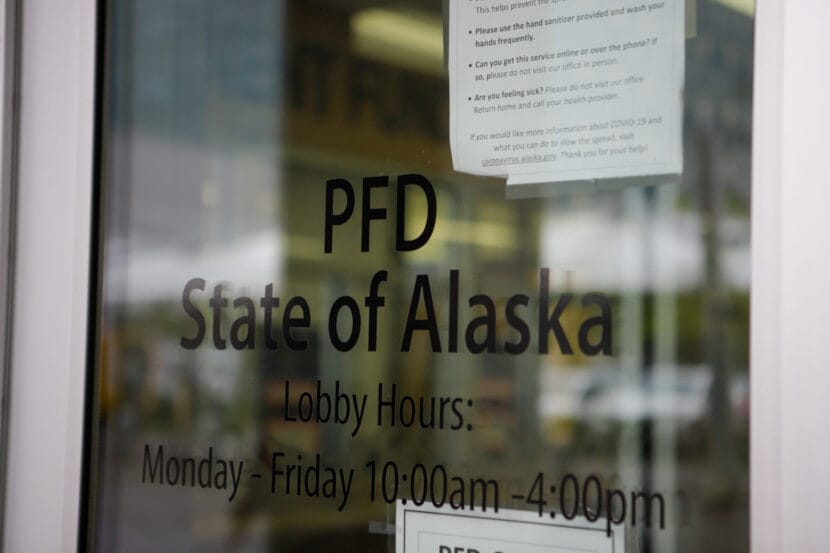
The State of Alaska’s PFD and Child Affairs Office is located in downtown Anchorage and pictured here on August 31, 2022. (Valerie Kern/ Alaska Public Media)

Monday, March 31, marks Alaskans’ final opportunity to apply for a 2025 Alaska Permanent Fund Dividend check.

If you’re filing online, you have until 11:59 p.m. Monday. Mailed applications must be postmarked March 31 to be processed.

If you want to apply in-person, lobbies at Alaska PFD Division offices in Anchorage and Fairbanks will be open to receive applications from 9 a.m. to 4 p.m. Monday, which is also Seward’s Day. Juneau’s division office is closed for the day, but PFD applications can be dropped off on the eighth floor of the State Office Building near its security desk.

No phone support is available due to the holiday.

According to the division’s website, about 600,000 of Alaska’s roughly 740,000 people have applied for dividends as of Monday morning.

The amount of this year’s dividend has yet to be finalized during the legislative session, with Gov. Mike Dunleavy proposing about $3,900 – an amount unlikely to be approved by lawmakers. If they again use an informal formula that has calculated previous dividends, checks would be about $1,400.

Last year’s dividend, including a one-time energy relief payment, was about $1,702.

DMV urges Alaskans to get a Real ID by May deadline

An application for a Real ID at the Alaska Division of Motor Vehicles in Anchorage on Thursday, March 27, 2025. (Matt Faubion/Alaska Public Media)

Starting on May 7, every air traveler age 18 and older will need a REAL ID to board a flight within the United States.

Lauren Whiteside, division operations manager for the Alaska Division of Motor Vehicles, said her agency is ready to help any residents who still need to upgrade their IDs.

“We are ready and willing to issue to anyone and everyone who doesn’t have one that wants one,” she said.

The Real ID deadline was delayed many times, but the Transportation Security Administration says this upcoming deadline is for real.

Whiteside urged travelers who plan to fly on or after May 7 to ensure they have a REAL ID. Without one, people may face delays or be denied entry at TSA security checkpoints, preventing them from boarding their flights. Military bases will also require REAL IDs for entry starting May 7.

Whiteside said the DMV has already issued REAL IDs to many Alaskans.

“DMV’s been issuing REAL IDs for over six years now,” she said. “We’ve issued a little over 350,000 unique REAL ID credentials since January of 2019.”

Whiteside said her agency has used mobile units and outreach programs to reach Alaskans in more remote parts of the state.

“DMV does have a mobile DMV unit that does travel to rural Alaska.” she said. “We have traveled to several communities over the last few years issuing REAL IDs.”

If you’re unsure if your driver’s license is a REAL ID, check the top right-hand corner, it will have a star symbol to indicate compliance.

To obtain a REAL ID, visit your local DMV or motor vehicle agency. Here is a checklist for what you will need to bring. For more information, visit the Alaska DMV website.

Alaska lawmakers pass bill designating March as Women’s History Month

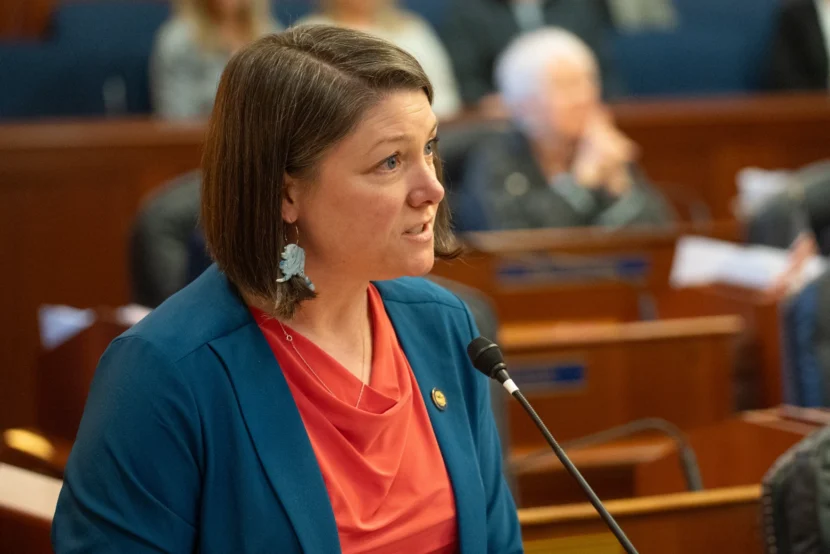
Rep. Carolyn Hall, D-Anchorage, speaks in support of a bill designating March as Women’s History Month in state law on March 28, 2025. (Eric Stone/Alaska Public Media)

The Alaska Legislature passed a bill Friday that would, if signed by the governor, designate March as Women’s History Month in state law.

Backers say it’s an effort to recognize the important contributions women have made to Alaska and the nation as a whole.

The main sponsor in the House, Rep. Carolyn Hall, D-Anchorage, introduced the bill by reading the names of more than 50 notable Alaska women, starting with Gail PhillipsVera AlexanderCarol BeeryEllen PaneokNellie CashmanElizabeth Peratrovich and Tina DeLapp.

“How many names mentioned have everyday Alaskans heard of before? How many of us know their accomplishments, their leadership, or their fortitude?” she said.

Establishing a particular month in state law to honor their contributions would help Alaskans better appreciate the female leaders who came before them, she said.

“This is why it’s so important for Alaska to honor and preserve Women’s History Month,” she said. “The purpose is to lift up, recognize and integrate women’s experiences into our state’s narrative.”

This year, for the first time, women outnumber men in the Alaska House of Representatives, a fact Hall noted in her speech supporting the bill.

Sen. Elvi Gray-Jackson, an Anchorage Democrat, wrote the bill and carried it through the Senate.

“Alaska is a land of resilience, where survival depends on strength, adaptability and community, and for generations, women have been at the heart of it all — leaders, trailblazers and defenders of culture and justice,” Gray-Jackson said during debate on the bill on March 3. “Too often, their contributions have been overlooked.”

Gray-Jackson said she hoped the observance would help inspire the next generation of female leaders.

The bill passed 19-0 in the Senate and 33-2 in the House with broad, bipartisan support in both chambers.

Republican Reps. Julie Coulombe of Anchorage and Mike Prax of North Pole were the only lawmakers voting no. Prax and Coulombe said after the vote they thought women should be recognized for their accomplishments rather than their gender. Coulombe said designating a month for women’s history wouldn’t make a meaningful difference in women’s lives.

“This isn’t going to help women. I want policies that actually help women, and us just passing resolutions and days doesn’t do anything,” she said. “We keep hearing that we have a majority of women in the Legislature, and I take offense that I’m a ‘woman legislator.’ I’m just a legislator.”

Gov. Mike Dunleavy’s communications director, Jeff Turner, declined to say whether the governor would sign the bill.

Site notifications
Update notification options
Subscribe to notifications