Alaska Public Media

Alaska Public Media is one of our partner stations in Anchorage. KTOO collaborates with partners across the state to cover important news and to share stories with our audiences.

NTSB says plane to Nome that crashed, killing 10, was overweight

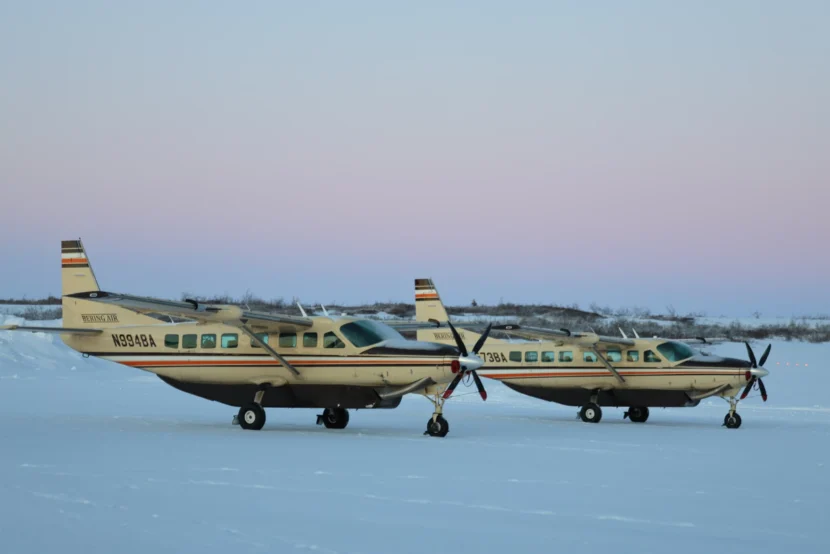
The Cessna Caravan is a mainstay in Bering Air’s fleets. Caravans were parked at the Nome Airport on Friday, Feb. 7, 2025, as a massive search was ongoing for the plane that went missing the day before on its way from Unalakleet. (Ben Townsend/KNOM)

The passenger plane that crashed near Nome last month, killing all 10 people on board, was hundreds of pounds overweight according to a preliminary report from the National Transportation Safety Board.

The NTSB released its first report Wednesday on the crash of Bering Air Flight 445. The Cessna Caravan was en route from Unalakleet to Nome. A massive search extending into the next day found the plane on an ice floe, which had been moving up to 10 miles per day, at a location 34 miles southeast of Nome.

The dead include:

34-year-old Chad Antill of Nome (pilot)
52-year-old Liane Ryan of Wasilla
58-year-old Donnell Erickson of Nome
30-year-old Andrew Gonzalez of Wasilla
41-year-old Kameron Hartvigson of Anchorage
46-year-old Rhone Baumgartner of Anchorage
52-year-old Jadee Moncur of Eagle River
45-year-old Ian Hofmann of Anchorage
34-year-old Talaluk Katchatag of Unalakleet
48-year-old Carol Mooers of Unalakleet

At the request of U.S. Sen. Dan Sullivan, NTSB Chair Jennifer Homendy visited Nome soon after the crash, one of the deadliest in recent Alaska history. Residents of the region came together to support families of the victims as well as Bering Air, which has flown in Northwest Alaska for 45 years.

‘A tremendous amount of information’

Clint Johnson, the NTSB’s Alaska chief, said Wednesday that investigators haven’t yet determined why the plane was overweight.

“There’s no way around that. Unfortunately, our estimations are that the airplane was about 1,000 pounds over gross (weight),” Johnson said.

Still, Johnson said, it isn’t yet clear what specific role the weight might have played in the plane’s crash and whether other factors were involved.

Johnson noted that investigators have recovered several avionics components from the plane, with data from them still being assessed.

“That has given us a tremendous amount of information,” he said. “We’re still poring over that information at this point.”

According to the report, the flight originated in Nome and headed to St. Michael and Unalakleet, before taking off on a return leg to Nome at 2:37 p.m. on Feb. 6. It headed to Nome at a cruising altitude of 8,000 feet, under instrument-only flight rules for a time, then began a planned descent to 6,000 feet just before 3 p.m.

At about 3:15 p.m., an air traffic controller informed the Caravan that the Nome airport’s runway was closed for about 10 to 15 minutes due to deicing.

“The controller added that if the pilot wanted to ‘slow down a little bit’ to prevent the flight from arriving before the runway reopened, that would be fine, and the pilot acknowledged,” investigators wrote.

A minute later, the controller asked the plane to descend to 4,000 feet, which the pilot acknowledged.

In about 15 minutes, between 3 p.m. and 3:15 p.m., the plane’s airspeed gradually fell from a peak of about 160 knots to 112 knots and continued to decrease. It had also turned from a westerly heading to a southerly one.

“At (3:19 p.m.), the autopilot disengaged,” investigators wrote. “At that time, the airplane’s airspeed was 99 knots. About 19 seconds later, the airspeed had decreased to about 70 knots, and the altitude was about 3,100 (feet above sea level) which was the end of the data available from the onboard avionics.”

A final data point from the plane’s avionics, at 3:20 p.m., showed it 32 miles east of Nome and 12 miles offshore over Norton Sound. Third-party satellite data eight seconds later showed it at an altitude of 200 feet.

“(One second later), the controller transmitted a low altitude alert to the pilot,” investigators said. “The controller’s efforts to contact the pilot were not successful, and no further communications were received.”

Plane was 969 pounds overweight, NTSB says

Antill’s pilot records showed that he had about 2,500 hours of flight time, including just over 1,000 hours in Cessna Caravans. He had flown with Bering Air since 2022, completing a Cessna cold-weather operations course in October and recurrent ground training in January.

The crashed Caravan was fitted with a TKS ice protection system, which Johnson called a “weeping wing” designed to dispense deicing fluid from wing and tail surfaces’ leading edges in flight. That system was mechanically functional based on examination of the wreckage, he said.

The plane was also fitted with a fuselage cargo pod, according to the NTSB. Preliminary calculations found that the plane’s gross takeoff weight was about 9,776 pounds.

“This was about 969 (pounds) over the maximum takeoff gross weight for flight into known or forecast icing conditions under the TKS system supplement,” investigators wrote. “It was also about 714 (pounds) over the maximum gross takeoff weight for any flight operation under (a) flight manual supplement.”

The report says Bering Air’s load manifest estimated that the plane was carrying about 709 pounds of baggage and cargo. A post-accident examination found that approximately 798 pounds was aboard at the time of the accident.

A weather report from the Nome airport at 3:45 p.m. noted light snow for about 10 minutes shortly after 3 p.m., as well as “trace precipitation” and “trace icing” just before 3 p.m.

Searchers had said no emergency locator transmitter signal was detected from the plane, which investigators at the crash site initially confirmed.

“However, the on-scene examination determined that the ELT had become disconnected from the antenna likely during the impact sequence,” investigators said. “When a portable ELT antenna was installed, a strong signal was heard from a handheld receiver.”

Bering Air crash was ‘eerily similar’ to 2021 incident

Johnson said the flight data, and the sequence of events it depicted, has led investigators to revisit a 2021 incident near Fairbanks in which a Wright Air Service Caravan suddenly dropped thousands of feet. Nobody was injured in that incident, but a final NTSB report found that the plane was overweight when it encountered icing and suffered an abrupt loss in airspeed, with its autopilot subsequently disengaging.

Johnson called the events of the 2021 altitude drop “eerily similar” to the Bering Air crash, although the Wright Air Service plane was fitted with a less-powerful engine. Autopilot procedures often call for them to be checked during flight in icing conditions, but what happened during last month’s Bering Air crash is still not clear, Johnson said.

“We are in the process of looking to see what the sequence of events were, as far as the airspeed drop, the disconnection (of) the autopilot,” he said. “Was that pilot-induced? Was that automatically done? We don’t know, but we are drilling down into that information as we speak right now to see if we can get a little bit better of an idea and understand the final moments of this flight.”

Johnson said Wednesday that a total of 15 to 20 people are involved in the crash investigation, including NTSB officials and expert sources whom they are consulting. A final investigation report is expected in 12 to 18 months.

Murkowski says Trump is ‘testing’ the institutions of democracy

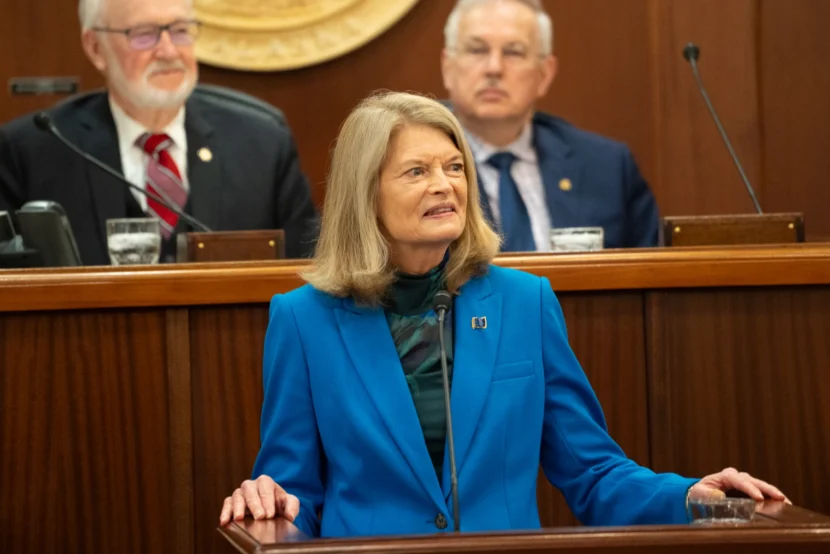
Sen. Lisa Murkowski, R-Alaska, speaks to the state Legislature on Tuesday, March 18, 2025. (Eric Stone/Alaska Public Media)

Sen. Lisa Murkowski says President Trump is testing the limits of his power.

In a speech to the Legislature Tuesday, Alaska’s senior senator, a Republican, said the president has gone too far during his first two months back in office.

Trump has frozen funding that Congress approved. He’s moved to shutter agencies created by law. He’s fired thousands of federal workers across dozens of government offices, from the Department of Veterans Affairs and the Department of Energy to the U.S. Forest Service and the National Weather Service.

Murkowski said she’s “disturbed” by the cuts to the federal workforce.

“These terminations are indiscriminate, and many we’re now learning are unlawful. And they’re being made regardless of performance, and with little understanding of the function and the value of each position,” she said. “At any human level, they’re traumatizing people, and they’re leaving holes in our communities.”

Federal courts have reversed many of Trump’s moves, though it’s not always clear how faithfully the administration abides by those court orders.

Just this weekend, Trump administration officials refused to stop a flight deporting alleged members of a Venezuelan gang without an opportunity to present their case to a court. Trump officials argue the judge’s order came too late, though flight records reviewed by news organizations indicate that’s not true.

Murkowski told state lawmakers that legislators have a duty to assert their and the courts’ authority under the Constitution. And she said there are plenty of reasons to deport gang members — but she said the government still has to give the accused due process guaranteed to everyone in the United States, citizen or not, by the Constitution.

“We’ve got to stand up, and we have to make sure that it is understood that we are all separate but equal branches of government. When the court’s orders are defied, that weakens our courts,” she said. “When the people no longer believe that the system of justice is there for them, what do we have in this country?”

Some commentators have described the administration’s apparent defiance of a federal court order as a constitutional crisis.

Murkowski said that’s not how she sees it. In her speech, she said the Trump administration was “testing the court to see how far they might be able to go.”

“No, we’re not in a constitutional crisis,” she said in an interview after the speech.

Murkowski said there’s “a lot of debate” over the timing of the order and whether the administration intentionally ignored it. But she said she’s “worried” the country could approach a crisis “if we don’t work to maintain and enforce the rule of law that we, as Americans, have come to expect and to rely on.”

“But then the real question is, so, what do we do about it? What do we in Congress do about it?” she said. “I would suggest to you that if we fail to do anything, if we say it’s all OK, because I happen to like what the President was moving towards … but yet we allow our preference for that policy to override our own respect for the institutions of democracy, that’s when you may get closer to a constitutional crisis.”

Murkowski said she’s worried her Republican colleagues in Congress, who lead both the House and Senate, might not stand up even if Trump openly and clearly ignores a court order.

Rep. Dan Saddler, R-Eagle River, asked Murkowski during a question-and-answer session after her speech if there was any prospect that Congress might modify laws giving the president broad authority to use emergency powers.

Trump has used such powers to justify tariffs on imports and invoked an 18th century wartime law never before used in peacetime to speed deportations.

Murkowski said she’s not holding her breath.

“Is it possible for the legislative branch to act on this? Yes. Do I see that happening with the current construct? No,” she said.

She said at a news conference after the speech that she’s been criticized harshly for standing up to the president, who has vowed retribution against his enemies — and that’s why others in her party are staying silent.

Alaska Senate bill would lower age of consent for therapy to 16

The Alaska State Capitol on March 25, 2024. (Eric Stone/Alaska Public Media)

Alaskans ages 16 and 17 would be able to consent to talk therapy under a bill introduced in the state Senate in February that would lower the age of consent from 18.

A parent or guardian would still need to consent to any medications.

Anchorage Republican Sen. Cathy Giessel, an advanced practice registered nurse, sponsored Senate Bill 90. She screens Anchorage children and teens for mental health issues and said only a third of parents typically consent when their kid requests therapy.

“I believe that students have a real understanding of their need for assistance, their need for counseling, their desire to talk to someone about the struggles they’re having,” Giessel said.

Typically, she said, major mental health challenges start around age 14, and when kids are struggling, they sometimes turn to harmful coping strategies like using nicotine, alcohol or drugs.

“By helping them early, we can head off more advanced issues later in their teen years, or even adult years,” Giessel said.

Most states allow minors to consent to mental health care. Several allow kids to consent at age 14, and two states at age 12.

Critics of the bill worry that therapists working with younger children will encourage them to identify as transgender, without parental knowledge. But peer-reviewed research has shown that kids do not identify as transgender because of so-called “social contagion.”

Meanwhile, experts say the United States is in the midst of a youth mental health crisis. Giessel said she sees that in her work, especially after the COVID-19 pandemic.

“Prior to COVID, I rarely had a student share significant anxiety, depression or even suicidal ideation,” she said. “During and after COVID, it has increased significantly more, and I think it’s a reflection, really, of what’s going on in our society. But I also think that parents are becoming less and less engaged with their kids.”

Parents and guardians are still the best people to talk to their kids about mental health struggles, and the bill is designed to include them, Giessel said. As written in the bill, therapists would be required to notify parents and guardians of the therapy after five sessions, unless the therapist and youth decide it’s unsafe or will threaten their care.

The bill is expected to head to the Senate Health and Social Services Committee within the next two weeks, where there will be an opportunity for public comment, Giessel said.

AIDEA, Vigor announce talks to resolve dispute over future of Ketchikan Shipyard

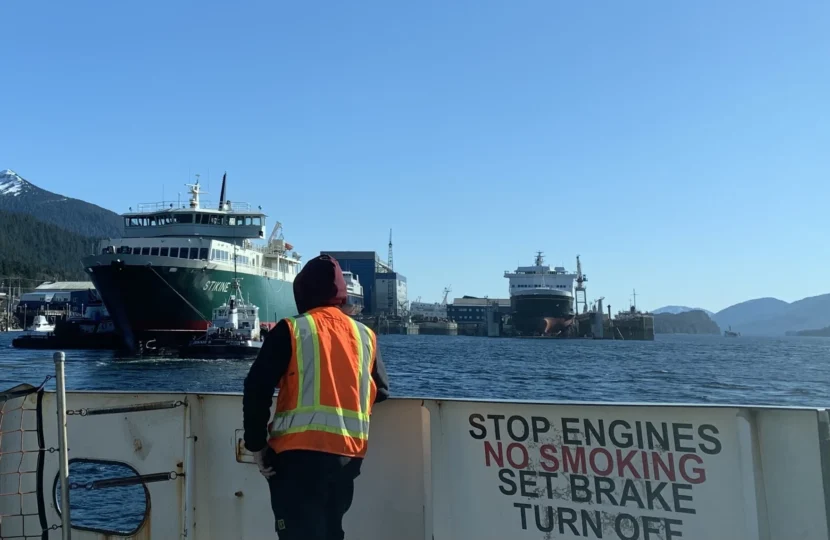
A deckhand aboard Ketchikan’s airport ferry watches as tugs maneuver the Inter-Island Ferry Authority’s M/V Stikine outside the Ketchikan Shipyard on March 8, 2022. (Eric Stone/KRBD)

Alaska’s state development agency says it’s in talks with the operator of the Ketchikan Shipyard to resolve a dispute that threatens the future of the key local employer.

The announcement comes about two weeks after the Alaska Industrial Development and Export Authority told shipyard operator Vigor it would not renew its contract to run the multimillion-dollar state facility. AIDEA said Vigor had not supported enough jobs, made enough money for the state or adequately contributed to repairs and maintenance. The agency said the operator’s time at the yard would end Nov. 30.

Now, though, tensions appear to be easing. A joint statement from AIDEA and Vigor dated March 13 commends the operator’s “stewardship” of the Ketchikan Shipyard.

“AIDEA and Vigor are united in their commitment to preserving this essential shipyard as a cornerstone of opportunity for the community and the state,” the statement said. “Both organizations are working together on potential opportunities to extend our working relationship by exploring new opportunities and partnerships to improve the shipyard’s ability to serve Alaska’s maritime needs.”

Neither side offered any details on what had changed in the meantime.

Previously, AIDEA said it was willing to discuss extending the end of the contract to March of next year. But there’s no mention of the March deadline in Thursday’s statement, indicating the pair may be negotiating a longer-term deal.

“Looking ahead, AIDEA and Vigor remain optimistic about the Ketchikan Shipyard’s future and its enduring role in the region,” Vigor and AIDEA said. “Further updates will be provided as negotiations advance, and we anticipate sharing additional developments in the near future.”

Vigor is a significant employer in Ketchikan, with roughly nearly 100 direct employees and dozens of additional contractors. It’s also the only major shipyard in Southeast Alaska, and it’s where many of the state’s Marine Highway System ferries, among other government vessels, go for maintenance and overhaul work.

Leaders from Alaska’s St. Lawrence Island take contamination claims to U.N.

Sandra Gologergen from Savoonga has lost many members of her immediate family to cancer. She believes military contamination on St. Lawrence Island is a cause. (Liz Ruskin/Alaska Public Media)

The tribal governments of Alaska’s St. Lawrence Island in the Bering Sea say they’re living with the toxic legacy of Cold War military installations on their land, and this week they took their complaint to the United Nations special rapporteur on toxics and human rights.

About 4,000 miles from home, at a press conference Wednesday in Washington, D.C., tribal leaders spoke about troubling health problems on the island.

Vi Waghiyi works with the Alaska Community Action on Toxics. She said her family lived at the most contaminated location on St. Lawrence, the Northeast Cape, for five years when she was growing up.

“I’m a cancer survivor. I’ve had three miscarriages. I’m 66,” she said. “My mother had a … stillborn child after me. Heart disease, strokes, diabetes and cancer. Her name was Della Waghiyi. I want to say their name.”

Sandra Gologergen from Savoonga said her father and his brother salvaged materials from the military buildings at the Northeast Cape, and, unaware of any contamination risk, built a cabin.

“We stayed there every summer, not knowing,” she said. “My father and his brother always worked and camped together. And then they both died of cancer, three months apart.”

The Yup’ik people of St. Lawrence Island have PCB levels in their blood 4.5 to 9 times higher than the average in Lower 48 communities, according to the Alaska Community Action on Toxics. ACAT recognizes that much of that is not attributed to the military but notes research showing that those who lived near the Northeast Cape have higher PCB levels than residents of other parts of the island.

The U.S. Army Corps of Engineers spent more than $130 million to clean up the island and considered the work largely done a decade ago. The Army Corps says it continues to monitor and review the site and expects to do so indefinitely. A federal public health agency concluded in 2017 that the number and type of cancer cases on the island are similar to those in other Alaska Native communities in the region.

St. Lawrence leaders call the cleanup superficial.

Their 42-page complaint is now in the hands of the U.N. special rapporteur, an independent expert. He can’t order a cleanup, but his work could add pressure to the federal agencies.

It might seem like the Trump administration isn’t sensitive to that kind of pressure. News broke Wednesday that the administration intends to close all offices of environmental justice in the Environmental Protection Agency.

Attorney Claudia Polsky, who helped write the St. Lawrence complaint, said no matter what policies the administration rescinds or which offices it defunds, the law still applies.

“Whether we call it environmental justice, whether we call it hazardous waste cleanup, whether we call it something else, there is still a law domestically that is being violated and that is enforceable,” she said, “and this is the time to make it happen.”

‘It’s unreal’: Jessie Holmes wins his first Iditarod Trail Sled Dog Race

Jessie Holmes and his dog team race into Nome on Friday, March 14, winning the 2025 Iditarod Trail Sled Dog Race. (Matt Fauibio/Alaska Public Media)

NOME – Jessie Holmes raced into Nome early Friday, winning his first Iditarod Trail Sled Dog Race on the longest trail ever.

The 43-year-old musher and his team of 10 dogs were escorted by a convoy of police cars down Front Street in Nome. The team, led by Polar and Hercules, ran under the arch at 2:55 a.m. in temperatures hovering around zero degrees, to hundreds of cheering fans.

“It’s hard to put into words, but it’s a magical feeling,” Holmes said.

He’s been waiting for this moment for years.

“I have nothing to stop smiling about,” he said. “I have everything going for me. And you know, I shouldn’t ever feel a down moment in my life. If I died tomorrow, I’d just die the happiest man.”

Holmes went down his line of dogs, petting them and giving them steaks. He jumped into the crowd to hug fans and shake hands. He praised his team.

“I’m really proud of these dogs. I love them,” he said. “And they did it. They deserve all the credit.”

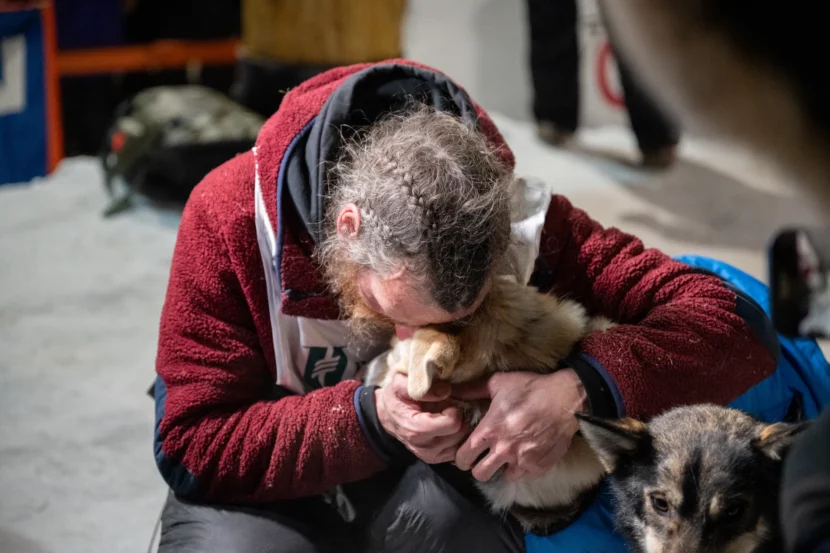
Jessie Holmes hugs his lead dog, Polar, after arriving to the finish line in Nome on Friday, March 14, 2025. (Matt Faubion/Alaska Public Media)

Race officials presented Holmes with a check for $57,200.

Longest Iditarod trail ever

Holmes, who’s originally from Alabama, lives in Interior Alaska, where he says he works as a carpenter. He starred on the reality TV show “Life Below Zero.”

This is Holmes’ eighth Iditarod race. He has placed in the top 10 nearly every year, as high as third, and won Rookie of the Year in 2018.

He notched his first Iditarod victory in 10 days, 14 hours and 55 minutes — the longest time it’s taken a winner to finish the race in over two decades.

“Those are 10 quality days, I got my money’s worth,” Holmes said at the finish, laughing.

This year’s mushers were racing on the longest Iditarod trail in history, at an estimated 1,128 miles. The route is normally closer to a thousand miles, but scarce snow in Southcentral Alaska forced race officials to move the trail north at the last minute. It’s the fourth time the race has started in Fairbanks, and it’s a change that climate specialist Rick Thoman expects will likely have to happen more often in a warming climate.

Holmes said he soaked in every minute of this year’s race — “the lows, the highs, the in-betweens.”

“It’s not about this moment now,” he said at the finish line, “it’s about all those moments along the trail, you know, being up in the Blueberry Hills, and the most amazing sunset you could ever imagine, moon shimmering on the glazed snow and the northern lights.”

Jessie Holmes jumped over a guardrail to greet fans soon after his 10-dog team raced into Nome in first place on Friday, March 14, 2025. (Matt Faubion/Alaska Public Media)

‘My life hasn’t been a dream run’

Holmes said he also thought about prior Iditarod champions as his team traveled across Alaska, including the late Jerry Riley, his mentor, and late four-time winner Lance Mackey.

“Just wanted to join that club with them,” he said. “And, you know, I’ve wanted that for a long time. It’s unreal.”

He spoke to a crowded room at the race headquarters in Nome about his struggles as a young man.

“My life hasn’t been a dream run,” Holmes said.

Holmes said his love for animals, along with help from Riley, turned his life around. A win, he said, motivates him to give back to communities and young people.

“If I could do anything in this world, it would be to be able to give all of you some of this joy that I feel,” he said. “And, you know, people that are struggling, especially.”

Rob Urbach, Iditarod’s CEO, said that Holmes has an especially strong bond with his team. In White Mountain, Holmes laid with his dogs in a bed of straw — what he calls a “cuddle puddle.”

“He found he was born to do this,” Urbach said. “His relationship with his dogs is a very special thing to see.”

A banner year for Interior mushers

This year’s race was a game of leapfrog between Holmes, Matt Hall and Paige Drobny, who were all chasing their first Iditarod win.

“They’re awesome competitors,” Holmes said. “And, you know, I never once thought I had this thing until we made it over Cape Nome.”

All three mushers live not too far from one another in the Interior and all three have come close to winning before — Drobny placing as high as fifth in her prior Iditarods and Hall was last year’s runner-up.

Holmes said he and Hall have been friends for decades. The two met in Eagle, a village on the Yukon River, where they worked at Hall’s father’s trapline.

At one point when they saw each other on the trail this year, Holmes said, he yelled out.

“I go, ‘Man, 16 years ago, in Eagle. Can you believe this?’ Like, here we are, we’re leading the Iditarod and, like, it was a real cool moment between us,” Holmes said.

Holmes came back out to the finish chute Friday morning as Hall and his 10 dogs dashed in right before 6 a.m. to secure second place for the second year in a row. Holmes and Hall shook hands. Dozens of people cheered for Hall, including his wife, Elke.

Musher Matt Hall shares a celebratory kiss with his wife, Elke, after placing second in the 2025 Iditarod Trail Sled Dog Race on Friday, March 14, 2025. (Matt Faubion/Alaska Public Media)

Hall’s team was led by his dogs Dyea and Qivik, who he called the perfect pair to lead him into Nome. Dyea, he said, is “just this rock star, push-button leader.”

“He’ll do anything,” Hall said. “I can steer him right around, park him wherever we want to. And then for this race, Qivik, the one running next to him up there, was a little speed demon.”

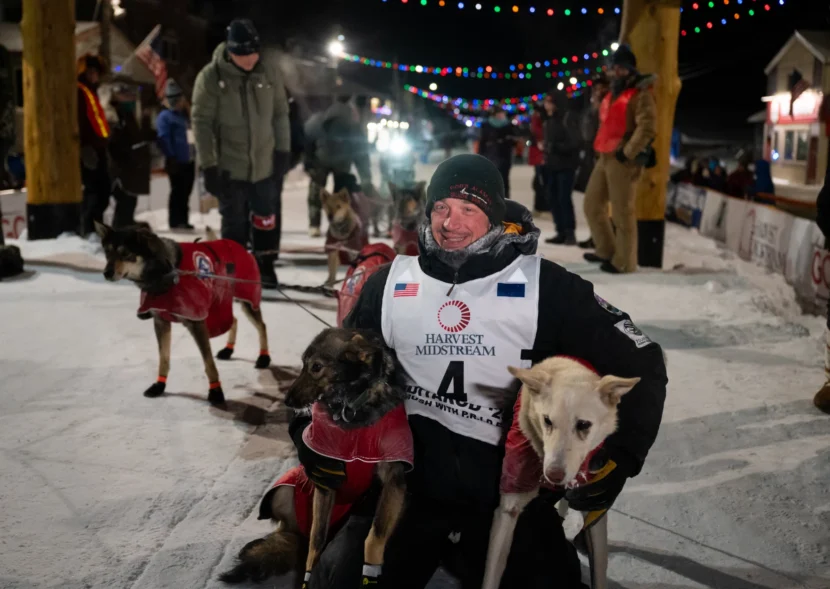
Musher Matt Hall poses with his two lead dogs Qibik (left) and Dyea (right) underneath he burled arch in Nome after placing second in the 2025 Iditarod Trail Sled Dog Race on Friday, March 14, 2025. (Matt Faubion/Alaska Public Media)

Holmes and Hall were both back at the finish line to congratulate Drobny for her third-place arrival. Veteran Jeff Deeter, another Interior musher who scratched earlier in the race, was there, too, to congratulate all three. Drobny also had a group of family and friends waiting for her.

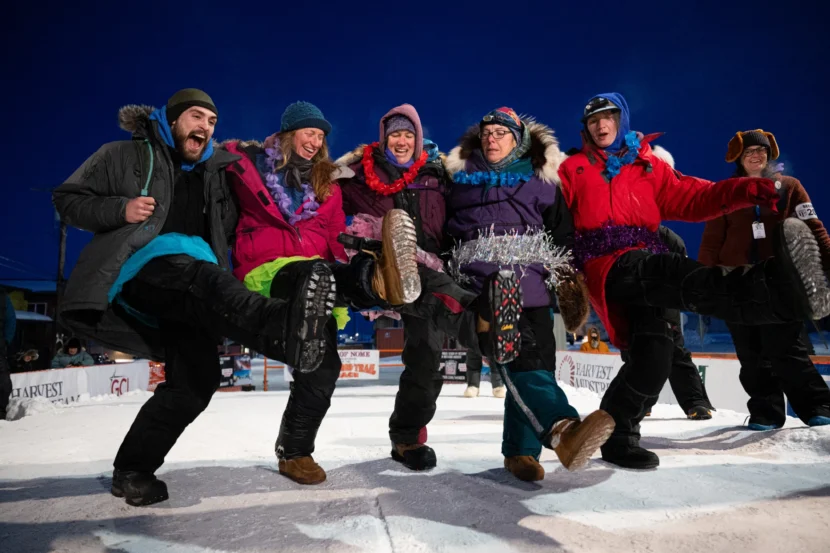
Drobny’s team, known as the Squids, is known for their themes — last year was disco, this year is tropical. As Drobny and her dogs raced in, her friends and family chanted in hula skirts, wearing flower leis around their necks, while doing a kickline. The crowd chanted along.

“Paige! Paige Drobny! Paige! Paige Drobny!”

Paige Drobny’s family and friends did the can-can dance while they waited for her arrival to the 2025 Iditarod Trail Sled Dog Race finish line in Nome on Friday, March 14, 2025. (Matt Faubion/Alaska Public Media)

Droby pulled underneath the burled arch just over three hours after Hall, at 8:38 a.m. Friday, led by Ladybug Mecca and Spinderella.

She gave all the credit to her dog team. She said she didn’t sign up for the Iditarod until a few months before it started, persuaded by the skill-level of her team.

“As we saw this year, this dog team is amazing,” she said. “I just really recognized that they deserve to be here and to play in this field.”


Tough trail conditions

It was not only the longer trail that led to this year’s slower race, but also tough trail conditions.

Mushers slogged through sections of soft snow and were even hit by a sandstorm early on. Further up the trail, between Kaltag and Eagle Island, frozen snowmachine tracks made for some of the worst trail conditions Drobny had ever seen, describing it as “70 miles of crap.” Mushers then faced strong headwinds heading up the coast.

Hall was raised on the Yukon River, which much of the trail followed. Still, he said, the trail this year went on for too long. It included a loop on the river that felt endless.

“Oh no, more Yukon, and more and more,” Hall said, laughing as he recounted the trail. “And then we got to go back on it again.”

Drobny agreed, and said the long river stretch is a lot more complex than it sounds.

“It sounds like it’s just a straight level path, but there’s a lot more to it actually,” she said. “I think that a lot of teams found that out there, that it wasn’t just like an easy trail, it was a pretty difficult trail.”

‘We love all three of them’

As mushers and dogs raced in Friday, fans crowded the finish chute. They came from all over.

Homer resident Denise Jantz and her sister Roberta Deal, who traveled from Indiana, experienced their first Iditarod finish together. They’re huge fans of the top three finishers and were glad to see Holmes take home his first Iditarod win.

“I think he has worked so hard and it’s so well deserved. I love that Paige is his neighbor, and she’s in the frontrunner too. I love it, and we love Matt too. We love all three of them,” Jantz said as Holmes waved to fans.


It’s been a tight race, and Jantz said watching the tracker has been nail-biting.

“It’s been obsessive,” she said. “Three in the morning, it doesn’t matter.”

This year not only had the longest trail, but the starting race field was also tied with the smallest ever with just 33 mushers.

Eight mushers have dropped out of the race, including one musher because his dog died. Two rookies were withdrawn Wednesday because officials said they were going too slow.

By the time Drobny raced into Nome Friday, the remaining 20 mushers were spread across more than 250 miles of trail.

Site notifications
Update notification options
Subscribe to notifications