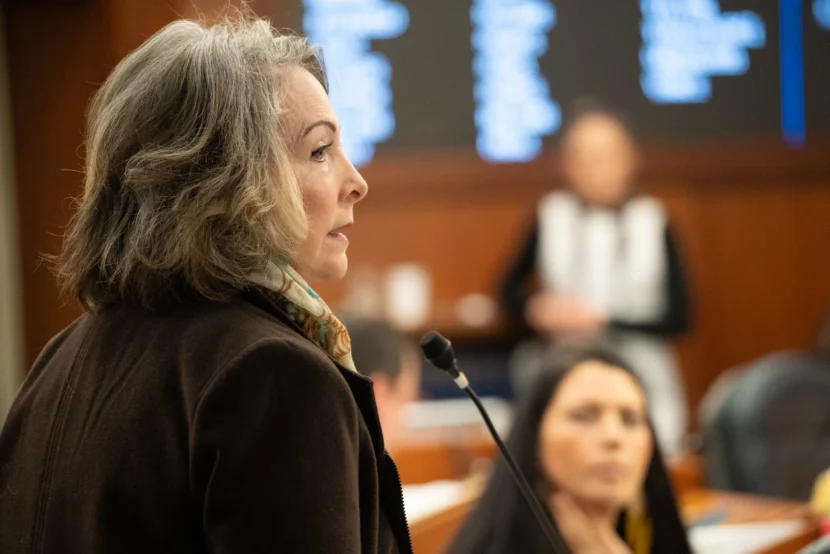
Alaska Public Media

Alaska Public Media is one of our partner stations in Anchorage. KTOO collaborates with partners across the state to cover important news and to share stories with our audiences.

Sullivan criticism of federal judge is off-base, attorneys say

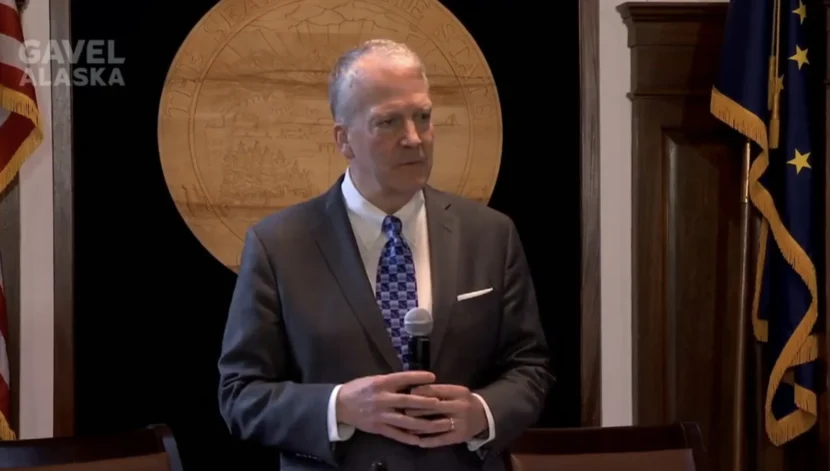
U.S. Sen. Dan Sullivan speaks to reporters in Juneau on March 20, 2025. (Screenshot from Gavel Alaska)

U.S. Sen. Dan Sullivan veered into criticizing a federal judge when he spoke to reporters at the state Capitol on March 20.

“I don’t want to get specific, but we have a couple district judges that rule with the far-left radical environmental groups every single time,” Sullivan said. “And that judge, in my view, has done more damage to our state than almost anyone imaginable.”

It was obvious whom he was talking about, because Sharon Gleason is now Alaska’s only fully active U.S. District Court judge. He went on to assail her impartiality again a moment later, when discussing his intentions for selecting the next federal judge to serve with Gleason.

“My red line is, we’re not going to have another judge like the one that we were talking about,” Sullivan said. “I’m going to make sure Alaska does not get a federal judge who sides with the far-left radical enviros on every case.”

Sullivan’s remarks caused a stir in Alaska’s legal community. Lawyers familiar with Gleason’s record say Sullivan is mischaracterizing her.

“She does not always rule in favor of environmental groups,” said former Anchorage attorney Jeff Feldman. “And I can say that both by looking at her history as well as from personal experience, because she has ruled against me in environmental cases, or against my clients.”

To cite a few prominent examples:

In 2021, Glease ruled against environmental groups trying to block oil leasing in the Arctic National Wildlife Refuge.

In 2023, Gleason dismissed lawsuits aimed at stopping Willow, ConocoPhillips’s oil and gas project in the National Petroleum Reserve.

And then, on March 25 she issued her decision favoring a state-owned investment bank that won leases in the Arctic Refuge.

Feldman, now a law professor at the University of Washington, said 81% of Gleason’s decisions are upheld on appeal, a slightly higher rate than other federal judges who have served in Alaska. Feldman considers Sullivan a friend. He said that while it’s fair to criticize specific judicial decisions, it’s inappropriate to “throw rocks at a judge” by alleging a bias that doesn’t exist.

“When a leader makes that kind of allegation, that suggests that a judge’s rulings are both wrong and politically motivated, that undermines faith and confidence in the judiciary,” Feldman said.

Federal judges are nominated by the president and confirmed by the Senate. By tradition, the senators from the state with the judicial vacancy play a big role. They usually select a candidate and send the name to the White House. For several decades, Alaska’s U.S. senators have made their selection with the help of the Alaska Bar Association. The Bar Association collects names of applicants and then polls its members about them.

Sen. Lisa Murkowski likes the process. Sullivan doesn’t.

“One bar poll is not a reflective of what’s out there, in my view, and I feel very strongly about that,” Sullivan said.

Case in point, Sullivan said, is Joshua Kindred’s selection. Kindred was the District Court Judge who resigned last July amid findings of improper conduct. Sullivan praised Kindred at his 2019 Senate confirmation hearing but speaks of him with disgust now and is quick to point out he wanted someone else.

To Sullivan, the Kindred fiasco shows the need for more pre-nomination screening. So Sullivan is using a method he devised: He’s appointed a committee of Alaskans to collect and review applications.

Sullivan has been keeping most of his process under wraps, including who the potential nominees are. Sullivan said confidentiality attracts more applicants.

Retired state court judge Elaine Andrews said the Bar poll works well if senators choose from the top end of the list. Kindred finished near the bottom. Andrews says she wonders about applicants who will only step up for Sullivan’s secret process.

“If they’re afraid of a terrible bar poll,” she said, “because they’re either inexperienced, intellectually unqualified, or an ideologue that they know people do not believe will be fair — well, then we’ve got a problem.”

Andrews said nominees should represent the best and the brightest, and that the Bar poll helps with that because attorneys are the ones who know the work habits and professionalism of their colleagues.

“The goal should be to find a person who is willing to work, who’s capable of understanding the complex matters that comes before the federal court, and who has the courage to apply the law to the facts and decide the case,” she said.

Alaska has two vacant positions on the U.S. District Court bench. Sullivan said he and Murkowski could not agree on judicial nominations last fall but are working to find candidates they both like.

Alaska Native corporation’s shareholders question migrant detention contracts

The downtown Anchorage corporate office of NANA Regional Corp. (Lex Treinen/Alaska Public Media)

An Alaska Native corporation’s shareholders are questioning its subsidiary’s lucrative government contracts for migrant detention, while the Trump administration’s immigration crackdown continues.

Akima, a subsidiary of northwest Alaska’s NANA Regional Corp., has faced accusations in national news stories about the poor treatment of migrants at detention facilities it runs. Now, a small but vocal group among NANA’s 15,000 Iñupiaq shareholders want the company to get out of the migrant detention business.

One recent story in the Guardian included a federal inspector’s report of excessive force used on a man detained at an Akima-run center in Texas and poor living conditions at the facility. Another story by USA Today detailed how detained women on buses in Florida were forced to urinate on the floor on their way to an Akima facility, where they were packed into cells and did not have easy access to drinking water. One woman held there told USA Today she wasn’t fed anything for 36 hours.

Akima’s contract to run an Immigration and Customs Enforcement detention center at the U.S. base in Guantanamo Bay, Cuba has also drawn scrutiny.

Jackie Qataliña Schaeffer is a former NANA board member who helped craft a recent survey of her fellow shareholders. She said there had been a lack of transparency from NANA leadership about the ICE contracts, and the survey was meant to gauge how the shareholders felt about the contracts after the recent news about Akima-run facilities.

While a minority of the survey respondents said they supported the contracts or weren’t sure how they felt about them, Schaeffer was unequivocal in her opposition.

“We are Iñupiaq, from the northwest Arctic, that are founded on Iñupiat illitqusait, which is our foundation of who we are,” she said. “And those values do not align with any of this type of work.”

‘Not all money is good money’

The survey circulated on Facebook, and Schaeffer said all of those who responded were verified to be NANA shareholders. More than three-quarters of the roughly 100 respondents said their corporation should not allow its subsidiaries to provide detention services for ICE.

“There must (be) and are other ways to make money in a more positive way for humanity’s sake,” wrote one survey respondent.

“If we want to continue to say we treat people with dignity and respect we must immediately end all relations with ICE and detention centers,” wrote another.

“Not all money is good money,” someone else wrote.

NANA’s communications staff and executive leadership team did not respond to multiple requests for comment this week. The chair of its board of directors declined to comment.

At a recent shareholder meeting, NANA’s leaders disagreed with the notion that Akima should get out of the migrant detention business.

Schaeffer and two other shareholders crafted and distributed the survey, and another shareholder presented the results at the meeting.

Two shareholders who wanted to remain anonymous, because they feared retribution from the corporation, said the chair of NANA’s board of directors, Piquk Linda Lee, defended Akima at the meeting and said staff at the detention centers had NANA’s Iñupiaq values in mind.

The shareholders said Lee also invoked Iñupiat illitqusait – which means “those things that make us who we are” in Iñupiaq – and said NANA and Akima would never treat anyone badly.

“Our employees are trained to recognize the difficulties individuals face and treat them as they would want their family members treated,” reads a slide NANA leadership shared at the meeting.

Led by chief executive Bill Monet, who is also NANA’s chief operating officer, Akima and its subsidiaries comprise NANA’s federal contracting branch. They generate a majority of the Alaska Native corporation’s overall profits, according to information presented at the shareholder meeting. Charts showed that Akima’s revenue each year is often higher than that of NANA’s Red Dog Mine, one of the world’s largest zinc mines, located in northwest Alaska.

Akima brought in about $2.2 billion last year, NANA executives told shareholders at the meeting.

‘Let’s support them as they support us’

Government contracting rules consider Alaska Native corporations to be small businesses, so they have an easier path to getting the contracts. NANA is not the only Alaska Native corporation that has subsidiaries with ICE contracts, but the scope of each corporation’s involvement is difficult to understand because of the many subsidiaries nested within each other. For example, within Akima itself are more than 40 companies, each aimed at getting contracts to provide different government services.

But some of NANA’s shareholders, who are technically the corporation’s owners, were not aware of Akima’s ICE contracts. A little more than half of those who responded to the survey said they did not know the NANA subsidiary was involved in migrant detention.

Still, others who responded to the survey were aware of the contracts and unbothered by the recent news reports, which some called “fake news.” One respondent said the survey questions were based on a prejudiced view of ICE, law enforcement, contracting and the current presidential administration.

“As a NANA shareholder, I am impressed and proud of the work Akima does and trust that Akima employees do their best,” the survey respondent wrote. “Let’s support them as they support us.”

Along with issuing dividends twice a year, NANA helps its shareholders with things like supporting their travel for healthcare, providing scholarships for post-secondary education and awarding grants for economic development in villages.

But Schaeffer, the former NANA board member who helped create and distribute the survey, said she couldn’t understand the viewpoint that shareholders should be proud of what Akima is doing or that the company shared NANA’s Iñupiaq values.

“I honestly can’t be in the skin of those people who say those things,” she said.

There’s a certain grim irony to the detentions and deportations, Schaeffer said, noting that Indigenous people were the original occupants of what became the United States.

“All the rest of America was founded on immigration. Every single person who’s not Indigenous to this land is an immigrant, or they come from immigrants,” she said. “How do you decipher who you choose to send away? The whole concern here is that these are inhumane behaviors coming from our contractors. Regardless, you’re choosing money over humane situations, so money over people.”

At a U.S. House hearing bashing NPR and PBS, Alaska is held up as a positive counterpoint

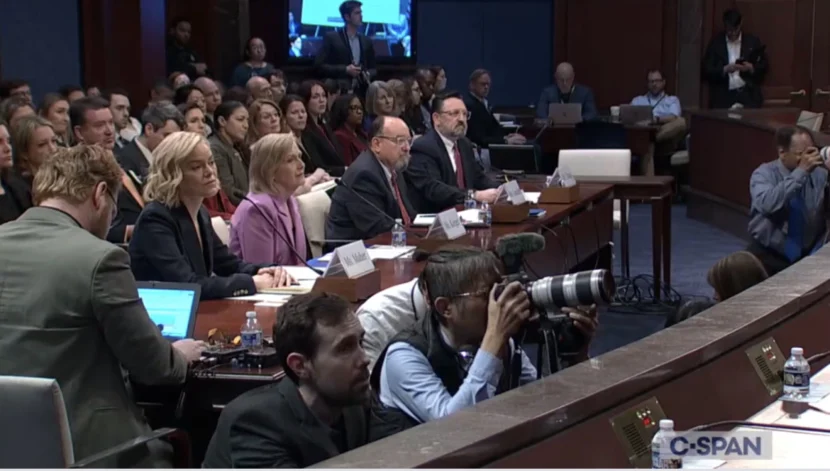
The witnesses at a U.S. House hearing on public broadcasting: NPR CEO Katherine Maher, PBS President Paula Kerger, Mike Gonzalez of the Heritage Foundation and Alaska Public Media President Ed Ulman. (C-SPAN Screenshot)

U.S. House Republicans put the top executives of NPR and PBS on the hot seat at a committee hearing Wednesday while Democrats used the event to spotlight Alaska as an example of the value of public broadcasting.

The hearing was one of the first of the House Subcommittee on Delivering on Government Efficiency. The chair of the so-called DOGE panel, Rep. Marjorie Taylor Greene, R-Ga., accused the public broadcasting networks of political bias.

“We will be calling for the complete and total defund and dismantling of the Corporation for Public Broadcasting,” she said.

CPB receives more than $500 million a year from the federal government, most of which goes to local stations. The stations produce local news and programs and pay NPR and PBS to air national content.

Alaska Public Media President Ed Ulman testified, at the invitation of Democrats on the panel. He said that in many parts of Alaska and the country, public media is the only local outlet for broadcast news and provides critical warnings and alerts during emergencies.

Ulman also pointed out that Alaska public media stations produce audio and video stories about Alaskans that air nationally, because of their affiliation with the national networks.

“Without PBS, without NPR, you wouldn’t hear stories — news stories, public affairs stories, community stories from Alaska. You wouldn’t see them on the PBS NewsHour. This is vital. It’s vital for Alaskans to know that they’re connected to their nation, and that what we do in Alaska matters to our nation,” he said.

The hearing was mostly focused on Republican complaints about the national networks. NPR President Katherine Maher acknowledged the network was wrong to initially dismiss the importance of certain news stories, such as what was on Hunter Biden’s laptop and the theory that the COVID pandemic began with a leak from a Chinese virology lab.

Why a Fairbanks lawmaker wants to put the governor’s mansion on Airbnb

People walk by the Governor’s House, as it’s referred to in official documents, in downtown Juneau, Alaska on Friday, March 21, 2025. (Clarise Larson/KTOO)

A Fairbanks Republican lawmaker wants to put the governor’s mansion on Airbnb.

“Airbnb! Airbnb!” Rep. Will Stapp chanted, both fists raised, on a catwalk outside the House chamber last week.

Stapp filed a bill March 17 that would require the governor’s office to offer the Juneau residence up for rent on a short-term basis while the Legislature is not in session and the governor has not reserved it in advance.

“I always try to look for ways to make government more efficient, and when you see that you have facilities that are underutilized, you should try to maximize them so they at least cover their own operating expense,” Stapp said in an interview. He said he’d also be open to renting out some of the Legislature’s facilities, including an apartment building lawmakers acquired in 2021 and later renovated to house legislators and staff.

Dunleavy spent a total 13 nights in Juneau during the first two months of the year, according to his public calendars. In recent weeks, the governor has spent time in Asia drumming up support for a North Slope natural gas pipeline.

Even so, Stapp told the Juneau Empire he did not intend the bill as a swipe at the governor. The governor’s office did not respond to emails seeking comment.

The state pays a full-time staff of four to run the more than 14,000 square foot mansion, including a manager, a private chef and two housekeepers. The three-story home with 26 rooms, 10 bathrooms and eight fireplaces was built in 1912 with a stipend of $40,000 from the federal government, according to the Anchorage Daily News.

Salaries and upkeep on the mansion currently cost about $800,000 a year, according to budget documents.

Stapp said he’d like to defray that cost. He said it’s a great place for any number of events — parties, weddings, even overnight stays for Instagram influencers.

“I don’t think a normal person would pay an exorbitant amount of money to stay at a normal hotel room,” he said. “But they would, actually, if, you know, they could rent the governor’s mansion.”

Most bills introduced in the Legislature have little chance of passing, and this one is no different. Senate President Gary Stevens, R-Kodiak, isn’t taking the new bill seriously.

“That’s pretty silly,” he said last week. “I’m sorry to hear that. I mean, we have serious things to accomplish here.”

At the same time, Stevens said, “silly things happen.” Stevens compared it to a resolution he introduced in 2005 that aimed to change Fairbanks’ name to Barnette’s Cache.

“It never passed. It never even got a hearing,” he said, “Sometimes you do things just for, you know, humor.”

Alaska House affirms Canada’s sovereignty and opposes tariffs

The flags of Canada and the United States. (KUAC file photo)

As tensions rise between the U.S. and Canada, the Alaska House of Representatives says it recognizes Canada’s right to govern itself and opposes efforts to restrict cross-border trade.

The state House passed House Joint Resolution 11 on Monday, recognizing Alaska’s close ties with its eastern neighbor.

“Alaska recognizes the importance of a strong and sovereign nation of Canada and firmly supports Canada’s right to self-determination, national security, and economic independence,” reads part of the resolution. “The Alaska State Legislature opposes restrictive trade measures or tolls that would harm the unique relationship between Canada and Alaska or negatively affect our integrated economies,” reads another.

Every member of the largely Democratic bipartisan majority joined most of the Republican minority to approve the resolution 33-4.

House Majority Leader Chuck Kopp, R-Anchorage, said lawmakers want President Trump and Canadian Prime Minister Mark Carney “to work together amicably to resolve the tariff situation in a way that shows the respect for territorial [integrity] and sovereignty of both nations, and in a way that recognizes how urgent we need this relationship.”

The once friendly relationship between the U.S. and Canada has taken a turn towards acrimony in recent months.

Trump has directly threatened Canada’s sovereignty. He has called for its annexation by “economic force” and addressed its prime minister as “governor.” He has also questioned the validity of the 1908 treaty that marks the boundary between the two countries, according to four unnamed people who spoke to the New York Times.

Trump has also at a dizzying pace imposed, paused, delayed and promised to expand tariffs on Canada and Mexico, among other countries.

Trump said early this month he would pause the sweeping 25% tax on Canadian imports — but only for the roughly 38% of goods and services covered by a trade deal Trump negotiated during his first term in office.

Canada’s leaders have repeatedly asserted their country’s sovereignty, sometimes with hockey-themed slogans. Canada has also retaliated with tariffs of its own. Concerns over a trade war between the two allies and beyond have spurred fears of an economic slowdown in the U.S. and around the world.

Closer to home, leaders in British Columbia have threatened tolls on Alaska-bound trucks.

The dispute has led residents and officials in border towns like Haines and Skagway to urge their leaders to cooperate with one another and find a way forward.

Anchorage Republican Rep. Dan Saddler called Alaska and Canada “partner provinces” that share a “frontier spirit.”

“No relationship or friendship is perfect, and no relationship is conflict-free, but if there is any stress in that relationship, we work it out,” he said. “It’s like, if you have a spouse, and you have a disagreement, you don’t divorce. You work it out based on your mutual commitment and mutual benefit.”

Republican Reps. Jamie Allard of Anchorage, Bill Elam of Soldotna, Mike Prax of North Pole and Cathy Tilton of Wasilla were the only members to vote against the resolution. They did not provide a reason for their opposition during debate.

The resolution now heads for the Senate, which is considering a similar measure.

Alaska lawmakers reject Gov. Dunleavy’s order creating state agriculture department

The most prominent supporter of Gov. Dunleavy’s proposal to create a state agriculture department, Sen. Shelley Hughes, R-Palmer, speaks on the floor of the Alaska House of Representatives on Wednesday, March 19, 2025. (Eric Stone/Alaska Public Media)

Lawmakers narrowly rejected an executive order from Gov. Mike Dunleavy on Wednesday that would have created a cabinet-level state agriculture department.

Dunleavy’s proposal would have split out the existing Division of Agriculture from the Department of Natural Resources. Dunleavy pitched it as a way to give farmers, ranchers and other food producers a seat at the cabinet table, even after he’s no longer governor.

He said he was inspired by supply chain interruptions during the COVID-19 pandemic, especially as speculation swirled that the Port of Seattle might close temporarily.

“It was at that moment that myself and a number of other leaders in the state of Alaska decided that we were going to make agriculture and growing things here in Alaska a priority,” Dunleavy said in a promotional video.

Lawmakers in the largely Democratic coalitions that control the House and Senate said they supported the idea of a state agriculture department. But Rep. Sara Hannan, D-Juneau, told her fellow lawmakers the governor’s order was not the right approach.

“Executive Order 136 as currently constructed and described before the Finance Committee does not grow agriculture. It grows government,” she said. “It appoints a commissioner, establishes administrative offices, and does not add one dollar to our supports for food security.”

Dunleavy revised the initial cost estimate for the order after lawmakers said they were skeptical the state could afford it while facing large deficits. Dunleavy most recently pitched the plan as cost-neutral.

But Sen. Bill Wielechowski, D-Anchorage, said he wasn’t convinced the department could be both cost-neutral and effective, especially over the long term.

“If you’re just going to stand up a new department and have 13 people who are accountants and IT people, I don’t know how that helps farmers a whole lot. You have to add technical people to that,” he said.

Opponents also said they would’ve preferred the governor introduce a bill creating the new department rather than an executive order. They said that’s because there’s little lawmakers can do to tweak an executive order in response to testimony from experts and the public.

The combined House and Senate voted 32-28 to reject the proposal.

Lawmakers who favored the order — which included every member of the all-Republican minority caucuses in the House and Senate, plus Reps. Andrew Gray, D-Anchorage, Nellie Jimmie, D-Tooksook Bay, and Chuck Kopp, R-Anchorage — said lawmakers could allow the order to go through and later pass a bill modifying the new department to their liking.

Senate Minority Leader Mike Shower, R-Wasilla, said any costs associated with the new department would be minor when compared to the state’s $15 billion overall budget. He chalked much of the opposition up to politics.

“They’re just unwilling to give the governor a win on almost anything. That’s my view of it,” he said.

Senate leaders rejected the accusation.

The most vocal supporter of the governor’s agriculture department proposal has been Sen. Shelley Hughes, R-Palmer. She chaired a legislative task force that wrote a lengthy report offering numerous recommendations for improving the state’s food security.

“We did accomplish some things, but there’s probably about 30 or so that we have not yet accomplished,” she said during debate on the order. “The only way that they will be accomplished is if there’s a Department of Agriculture, because you need someone to oversee that they happen.”

But even Hughes, in an interview ahead of the vote, said Dunleavy was at least partially to blame for what she called “confusion” over how the department would be paid for.

“There were some misstatements by the governor,” she said.

Dunleavy released a video in the runup to the vote in which he said “proceeds from what the farmers are growing” would help offset the department’s cost. Some conservative commentators took that to mean that Dunleavy was contemplating taxes on crops. The governor’s office later clarified that state land sales, not taxes, were what Dunleavy was referring to.

Though members of the Senate majority said they’d spoken with Department of Natural Resources Commissioner John Boyle about the proposal, Senate President Gary Stevens, R-Kodiak, said Dunleavy had not been personally lobbying lawmakers to assent to his order.

Compared to Dunleavy’s predecessors, that’s unusual, Stevens said.

“Past governors have been in the building and much more receptive and much more willing to meet with us,” he said. “The governor normally would — say, in this issue, [he] would have been around the floor, you know, talking to us, knocking on our doors.”

Asked whether the governor should have done more to convince legislators to support the proposal, Hughes said the governor is only human.

“All of us can always do more. He’s got some big things on his plate right now regarding the opportunity for a gas line [from the North Slope to Southcentral Alaska], for example,” she said.

Rep. Rebecca Schwanke, R-Tazlina, disagreed, saying the governor could not have prevented a “last-minute change of heart” on the part of some unspecified lawmakers whose votes she said ultimately doomed the executive order.

In a statement on social media after the vote, Dunleavy thanked the lawmakers who supported his proposal and said food security would remain a priority.

Senate leaders said they planned to schedule hearings on newly introduced bills that would create a state agriculture department in the near future.

Site notifications
Update notification options
Subscribe to notifications