Alaska Public Media is one of our partner stations in Anchorage. KTOO collaborates with partners across the state to cover important news and to share stories with our audiences.
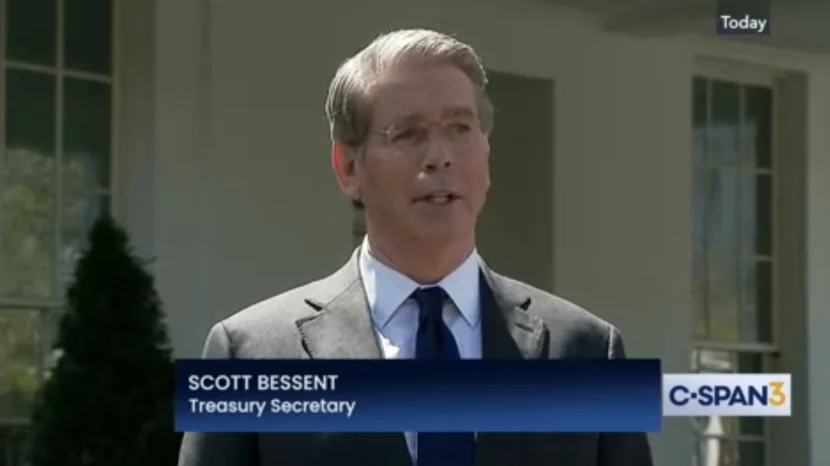
Treasury Secretary Scott Bessent spoke to reporters outside the White House on April 9, 2025. (Screenshot from C-SPAN2)
If countries want to keep the Trump administration from imposing tariffs on their exports to the United States, Treasury Secretary Scott Bessent suggests they invest in Alaska’s proposed Liquified Natural Gas project.
Bessent spoke Wednesday outside the White House, after President Trump announced he would pause reciprocal tariffs for 90 days to allow countries to negotiate. A reporter asked Bessent what it would take for a country to block the imposition of tariffs beyond three months.
That’s when Bessent raised the Alaska project as a possible deal-maker.
“These are trade negotiations, but if countries want to come and offer other things — so I talked about yesterday that we are thinking about a big LNG project in Alaska, that South Korea, Japan (and) Taiwan are interested in financing and taking a substantial portion of the off-take,” Bessent said.
A country’s investment and purchase of Alaska’s natural gas would help reduce its trade imbalance with the United States, he said.
The State of Alaska has tried for years to secure investment in the project, particularly from potential customers in Asia. Cost remains a high hurdle. It would take an estimated $44 billion or more to build an 800-mile pipeline from the North Slope to the Kenai Peninsula, with a processing plant at the north end and a liquefaction plant at the terminus. From there, LNG tankers would take the fuel across the Pacific.
Countries might have more incentive to invest in Alaska LNG with the threat of tariffs hanging over them. But Trump’s tariff announcements have caused global economic shocks, which could hinder investment in big projects.
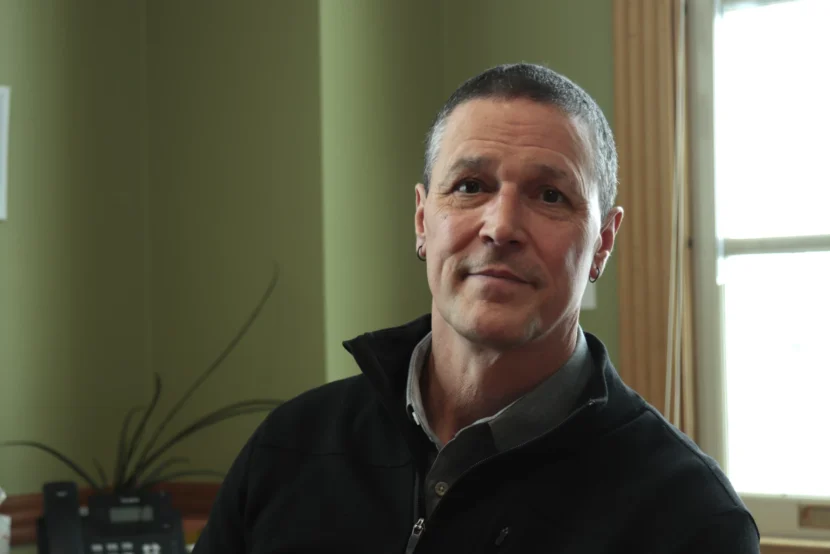
Kameron Perez-Verdia is president and CEO of the Alaska Humanities Forum. (Wesley Early/Alaska Public Media)
The Alaska Humanities Forum faces a massive cut to its budget after the Trump administration’s slashing of the National Endowment for the Humanities.
The more-than-50-year-old organization uses federal money, combined with matching dollars from local grants and donations, to fund programs around the state aimed at bringing communities together.
Kameron Perez-Verdia is president and CEO of the Alaska Humanities Forum.
“Youth programs that are happening around the state,” Perez-Verdia said. “It’s programs that are doing language preservation. It’s grants that are doing historical projects.”
The forum received a letter April 2 from the National Endowment for the Humanities that its federal grant — totalling about $900,000 — was terminated, effective April 1.
Alaska isn’t alone. Last week, humanities programs in all 50 states that rely on the national endowment received notice that the White House’s Department of Government Efficiency aims to cancel roughly $175 million in grant funding that had not yet been disbursed.
The short notice is troubling, Perez-Verdia said, and his organization is exploring legal options to get its funding restored.
“We believe that this is an illegal action,” he said. “It’s funding that was already granted. Our organization, and all of these councils, are in charter. So these are in our U.S. law that our organization exists and gets funded.”
If the funding isn’t restored, it would be very difficult to raise local funds to make up the loss, Perez-Verdia said.
“To be able to raise this kind of money is going to be really challenging,” he said. “We as an organization would have to restructure significantly, and we would lose a lot.”
Representatives from the offices of Sens. Lisa Murkowski and Dan Sullivan and Congressman Nick Begich did not immediately respond to a request for comment. However, Perez-Verdia said the state’s congressional delegation has expressed support for the Alaska Humanities Forum.
““We believe we will ultimately win this fight. We have strong support from Alaska’s congressional delegation and from national partners,” Perez-Verdia said. “But it’s going to take time.”
Whittier is a small Alaska city, unique in that nearly everyone lives in one apartment building, shown in the center of this aerial photo. (Gabriel Wolken/Alaska Department of Natural Resources)
The state of Alaska has charged 10 U.S. nationals in the small community of Whittier with voter misconduct and perjury.
The charges say the defendants were born in American Samoa, which makes them nationals but not citizens. Alaska law allows only U.S. citizens to vote.
The case is sure to get attention, because non-citizen voting has become a hot-button issue nationally. President Trump has claimed, without evidence, that widespread voter fraud was a reason he lost the 2020 election.
The state began investigating the Whittier case in late 2023.
“There was an anonymous call that came to the Division of Elections about non-U.S. citizens that had registered to vote, who were voting,” said Alaska Deputy Attorney General John Skidmore.
The charges say all 10 defendants voted or tried to vote in Whittier City elections or for the regional school board. Some are also alleged to have at least tried to vote in primaries.
Mathew Pese, 32, is among the few alleged to have made an attempt, or actually voted in the 2020 general election. A Facebook account that appears to be his has a lot of religious posts and several that praise or celebrate Trump. He did not respond to a Facebook message for comment, nor did several other defendants Alaska Public Media attempted to contact through Facebook.
The charges say Pese told investigators that he remembered his wife had once said he couldn’t vote because he wasn’t a citizen. Other defendants said they thought they were allowed to vote in local elections but not for president, according to the charges.
Troopers investigated by looking at the list of all 288 registered voters in Whittier and determining which were born outside of U.S. states.
Skidmore said it’s important in any democracy to ensure that only eligible voters cast ballots.
“We’re not interested in anyone’s race, ethnicity, political background — none of that stuff matters,” Skidmore said. “We’re simply looking at the laws that say, ‘This is how you determine who is supposed to be voting. This is how you determine who isn’t.’ And when we get complaints of people that shouldn’t be voting, that’s what we look into and investigate and, where appropriate, file charges.
Every year the state gets a few allegations of illegal voting and has charged about five cases in as many years, Skidmore said.
“If you think about all of the folks across the state that vote in any given election, to have this few charges filed means by and large, it’s not something that we find happens,” Skidmore said. “Most of the investigations that we conduct result in determinations that charges are not appropriate to be filed. But in those cases where we do find sufficient evidence to say that crimes did occur, then we will file charges, as we have here.”
Each defendant has been charged with at least one perjury charge, a Class B felony that is punishable by up to 10 years in prison, though Skidmore said it was too early to know any conviction would result in jail time. The defendants have not been arrested but have summonses to appear in court.
Trump swept Whittier in the divisive 2020 election. He got 74 votes, more than twice the vote total of Joe Biden.
A sign outside the Planned Parenthood building in Juneau on Thursday December 12, 2024. (Photo by Mikko Wilson/KTOO)
The Trump administration froze $1 million in funding for Planned Parenthood in Alaska at the end of March, according to Rebecca Gibron, CEO of Alaska’s regional Planned Parenthood alliance. She said programs in twelve states are impacted by the freeze.
The funds are through the federal Title X program, which covers family planning and preventive reproductive health care for low-income families. The funding can’t be used for abortions.
Gibron said if the funds aren’t restored, healthcare for Alaskans will suffer.
“We’re talking about cancers going undiagnosed,” she said. “We are talking about people not having access to annual wellness exams. Sexually transmitted infection rates will spike, so this is a program that absolutely must be protected at all costs.”
According to reporting from Politico, the administration froze funds for possible civil rights violations related to diversity, equity and inclusion or DEI initiatives. And, because the clinics serve people regardless of immigration status, the letter freezing funds pointed to an executive order prohibiting using taxpayer funds for undocumented immigrants.
Gibron said Planned Parenthood will operate as normal in the state for now, while they evaluate next steps in the courts. A representative for the organization wrote over email that they are “looking at everything possible to ensure Alaskans do not lose access to the essential health care they need and deserve.” The two centers see about 5600 patients in person in the state per year and Gibron said about half their patients use Title X funds.
There’s only one other provider in the state that uses title X funds, Kachemak Bay Family Planning Clinic in Kenai.
Gibron said Planned Parenthood is examining legal options and will push back.
“There are not other providers who will be able to absorb the number of patients with low income who are in need of sexual reproductive health care,” she said. “So we are going to fight this every step of the way until these funds get released.”
Gibron said Planned Parenthood was notified March 31, two days before they were supposed to receive the funds, that the money wouldn’t be available.
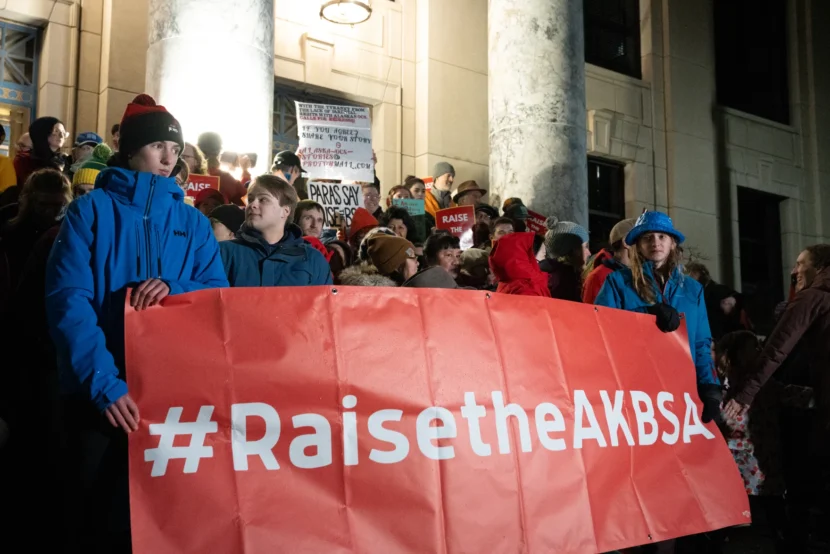
Protestors hold a banner calling for an increase in the base student allocation, a key part of the state’s education funding formula, during a protest at the Alaska State Capitol on Jan. 29, 2024. (Eric Stone/Alaska Public Media)
It’s been a constant chorus for years: Alaska’s schools are underfunded and struggling to do the very basics of educating the state’s kids.
Just this year, Sen. Cathy Giessel, R-Anchorage, read a letter from a second-grader about classrooms where there isn’t enough room for kids to sit on the rug together. In Ketchikan, Superintendent Michael Robbins told lawmakers interventions for kids identified as falling behind — an initiative he spearheaded after taking the helm of a district facing a leadership crisis just a few years ago — aren’t happening. There’s just no money.
The Anchorage School District passed a budget last month to lay off hundreds of staff and slash everything from gifted programs to sports if the basic input into the state’s public school funding formula, the base student allocation, doesn’t rise significantly.
Lawmakers from both parties appear to agree: school funding should be increased. But by how much — and whether the bill that passes will survive a veto from Gov. Dunleavy — is unclear.
Leaders in the state House said early this session they planned to get a school funding bill out the door sometime in March. (School district budgets for the next fiscal year, starting July 1, are typically due to local governments in the early spring.)
But that deadline has come and gone. So, this week, teachers across the state got notices telling them they may not have jobs this coming year — 160 on the Kenai Peninsula alone, Superintendent Clayton Holland said.
Some 185 teachers in Anchorage would be displaced without a funding boost, in addition to nearly 170 already-unfilled teacher jobs, said said Lon Garrison, the head of the Association of Alaska School Boards. In Fairbanks, over 100 staff are likely to lose their jobs if funding remains at current levels, he said, and 25 to 35 jobs are at risk in Ketchikan.
We’ve seen this before. Several times. Many of the teachers will, in fact, have jobs next year. But many others will seek greener pastures elsewhere.
Just ask Rick Dormer, the Ketchikan High School principal who’s interviewing for jobs in Oregon after more than a decade leading schools in Southeast Alaska.
He says he doesn’t want to leave, but it’s getting harder to justify staying in Alaska when other states pay higher salaries and offer better retirement and benefits packages. Teachers and school staff have left the state in droves: this year, over 600 certified teacher positions were vacant on the first day of school, according to an advocacy group.
Meanwhile, Alaska’s test scores remain near the bottom of national rankings with little sign of improvement.
That’s no coincidence, said Lisa Parady, the executive director of the Alaska Council of School Administrators, in testimony before the House and Senate Education Committees:
“When I hear ‘Education is failing,’ I say, ‘No, education is starving,’” she said.
Why funding is in question
How much will schools ultimately get this year? That’s still up in the air, though a final decision is nearing.
Senate Education Committee Chair Löki Tobin, D-Anchorage, revised and moved forward the leading education funding bill on Wednesday with a $1,000 boost to basic per-student funding. That’s the same amount approved by the House last month.
“We recognize that we need to have a substantial increase to school funding to help stave off so many of the devastating impacts that our districts have been communicating to us,” she told reporters on Tuesday.
After clearing the Education Committee, the funding boost bill, House Bill 69, now heads to the Senate Finance Committee, responsible for balancing the state budget.
Whether the $1,000 figure will survive the Finance Committee is unclear.
The state’s finances continue to look worse than they have in decades, according to the Senate’s top budgeter, Sen. Lyman Hoffman, D-Bethel, who has been a legislator since 1987. According to estimates following a worse-than-expected revenue forecast, due largely to faltering oil prices, Alaska lawmakers have to find $677 million just to maintain what is essentially the status quo.
Turmoil in the financial markets is likely to add to the pain.
Crude oil dropped 7% on Friday to its lowest level since 2021 as the world reckoned with the fallout of President Donald Trump’s decision to impose double-digit tariffs on countries around the world. The stock market, which plays an increasingly important role in Alaska’s state’s budget, is also in freefall, with the S&P 500 down 17.4% from a February record high. Nearly 11% of that loss has come in the two days since Trump’s tariff announcement.
The Alaska Permanent Fund, which provides more than half of the state’s general-purpose revenue with an annual transfer of 5% its market value, lost about 1% of its value from Wednesday to Thursday, spokesperson Paulyn Swanson said, a substantially smaller loss than the market as a whole.
“The Alaska Permanent Fund Corporation has a diversified portfolio designed to mitigate market volatility,” she said via email. “It holds investments across various asset classes, including bonds and real estate, that provide steady income streams that are less affected by market fluctuations.”
Because the transfer is based on a five-year average of the fund’s value, a sustained downturn could put downward pressure on state revenue for years to come.
Federal funding, the largest source of overall state revenue, is also under threat as Trump and Elon Musk’s Department of Government Efficiency seek to slash government spending. A forthcoming congressional tax and spending cut package put forward by Republicans at Trump’s request also casts a long shadow over the state’s financial future.
The state’s bad and worsening financial picture has pushed Hoffman, who chairs the Senate Finance Committee as it considers the annual operating budget, to repeatedly call for a smaller increase in school funding this year. Scenarios he’s requested from nonpartisan budget analysts have assumed a $680 increase in the base student allocation.
This week, he sent a memo to Senate budgeters urging them to strenuously avoid any budget increases so that the state can afford a $680 increase. The memo was first reported by the budget-focused Alaska Political Report.
A $680 increase in the base student allocation would essentially keep school funding flat from where it ultimately landed last year, when lawmakers decided to provide $175 million in one-time funding for school districts.
Tobin, the Education Committee chair, argues that despite the grim financial picture, a $1000 increase is badly needed.
“$80 million more to help keep some of the programs that we all deeply love in our public school systems, to retain nurses, to keep after-school programs, to keep sports,” she said Thursday, “is a very prudent and reasonable investment in the future of our kids.”
But it’s unclear how many senators share her view.
“My caucus is split on the issue,” Senate President Gary Stevens, R-Kodiak, said Tuesday. “I wish I could say that … we’ve consolidated around a particular number, but we have not done that.”
Tobin said passing Senate-proposed corporate and oil tax increases — which face long odds in the House and even longer odds at the governor’s desk — would help ease the financial pressure.
Another wild card: Gov. Dunleavy’s veto threat
Complicating the future of school funding even further is a veto threat from Gov. Mike Dunleavy. Though members of the House and Senate’s Democrat-heavy bipartisan majority caucuses prefer a no-strings-attached increase, Dunleavy has said repeatedly he’ll veto any school funding bill that does not include specific policy items that he says will boost student performance.
He applauded the bill that passed the House, calling the various policy changes attached to it — among them, a ban on cellphones in schools, a new open enrollment policy and a literacy-focused incentive program — “positive movement.” But, simultaneously, he called for additional “improvements, both in cost and policy.”
Dunleavy and his spokespeople have been silent on the specific funding level the governor would support, leaving lawmakers to speculate.
“Just reading the tea leaves, I think there’s probably a good chance the governor would veto $1,000 and if he does that, then where are we?” Stevens said. “Would he veto $680? I’m not sure of that.”
Meanwhile, if you ask Dunleavy, the bill is moving the wrong direction when it comes to the policy changes included within it.
Dunleavy took particular issue with a provision within the new bill that would require homeschooled students in correspondence programs — about one in five Alaska students — to take a standardized test or alternative assessment, like a portfolio review, in order to access cash payments for curriculum and services.
“While there was initially positive movement on HB 69, the Senate Education Committee’s version falls short of the education reforms Alaskan families deserve and puts inequitable constraints on correspondence school students,” Dunleavy said on social media. “This current CS does not pass muster.”
Tobin, the Education Committee chair who added the provision, said the testing provision is a “proactive” effort to help the state achieve the requirements of the federal Every Student Succeeds Act and a landmark 2005 consent decree.
Though the governor’s office worked closely with lawmakers on the version of the bill that passed the House, closed-door negotiations between Dunleavy and lawmakers appear to have stalled.
That’s no accident, Tobin said.
“The best way to get public input is through a very public and transparent committee hearing process. At this point, the community has a right to have input in the legislation,” Tobin said. “It should not be superseded by the elites in this building.”
But what that means for the future of the education bill is anybody’s guess.
A man walks his reindeer toward the Park Strip as part of a parade for veterans in downtown Anchorage. (Zachariah Hughes/Alaska Public Media)
Star, an iconic reindeer who lived in downtown Anchorage, died Tuesday – weeks after he was possibly poisoned. Star was the seventh reindeer to live at the corner of 10th Avenue and I Street.
Star was euthanized Tuesday according to his owner Albert Whitehead.
“His health was so bad that he was not doing very well,” Whitehead said. “He was suffering.”
Star was a male reindeer who would’ve been eight next month, Whitehead said. On average, reindeer live around 15 years.
Star was the target of several alleged crimes earlier this year. In January, someone cut the lock to his enclosure. Whitehead said that person “did something to make him go off diet.” Star stopped eating for a while after that, he said, and started losing weight.
In February, the gate lock was cut again. The person, who hasn’t been identified by police, took Star out of his enclosure, which is attached to Whitehead’s house, and walked him downtown. The next day, Whitehead said he caught someone spraying an unknown substance into Star’s face and he later developed pneumonia.
He said he thought Star was recovering, but things took a turn.
“Suddenly he relapsed, and some other issues developed. So (I) really don’t know what caused him to die. The vets now are going through a necropsy with him, and we won’t have a result of that for a couple weeks,” he said.
Anchorage Police Department spokesman Christopher Barraza didn’t have any updates Wednesday on an investigation of the spraying incident.
Having a reindeer living in downtown Anchorage is part of a longtime tradition started by a couple, Ivan and Oro Stewart, in the 1960s. When asked if the tradition would continue with an eighth reindeer, Whitehead said it’s a tough question.
“Would you be willing to put another animal into that enclosure, knowing there’s somebody out there that has doing this kind of stuff to him?” Whitehead questioned.
Whitehead called the reindeer “Star number seven.” All of the reindeer before him were females.
Close
Update notification options
Subscribe to notifications
Subscribe
Get notifications about news related to the topics you care about. You can unsubscribe anytime.