Alaska Public Media is one of our partner stations in Anchorage. KTOO collaborates with partners across the state to cover important news and to share stories with our audiences.
A 29-year-old man has been arrested in the shooting of a Fairbanks police officer. Anthony George Jenkins-Alexie was taken into custody by Fairbanks police Tuesday morning in connection with the shooting of police Sgt. Allen Brandt.
Jenkins-Alexie has been charged with first degree attempted murder, first degree assault, vehicle theft and tampering with evidence.
Fairbanks acting police chief Brad Johnson said the suspect has a “lengthy criminal history and has previously made threats against law enforcement.”
Jenkins-Alexie was arrested while out taking a walk.
Johnson said at a news conference Tuesday afternoon that the suspect posed “a serious threat to everyone.”
Jenkins-Alexie is accused of opened fire on Brandt on Sunday. Brandt was struck four times in the lower part of his body and once in the chest. Brandt was wearing body armor that protected his chest area, but his legs were badly injured and he sustained shrapnel in his left eye, Johnson said.
“He is awake, alert and in stable condition,” Johnson said.
Brandt remains in stable condition at an Anchorage hospital.
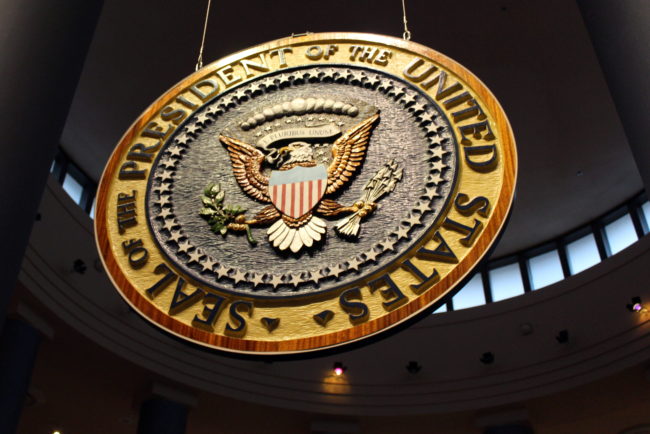
The seal of the president of the United States of America hangs in the Jimmy Carter Library and Museum in Atlanta. Atlanta sculptor Charles Mitchell carved this mahogany presidential seal. (Creative Commons photo by Wally Gobetz)
In the presidential race, Alaska has not voted for a Democrat since Lyndon Johnson in 1964. But national pundits say even red states like Alaska are in play now, as Republican Donald Trump’s path to victory is increasingly uncertain. One poll of Alaskans shows Trump and Clinton neck and neck.
Pollster Celinda Lake, of Lake Research Partners, found Trump was just one point ahead of Clinton last week. But don’t read too much into that.
“No. Alaska’s not turning blue,” Lake said, laughing at the suggestion. “But Alaska’s very independent. And they are expressing that sentiment again.”
Lake is a Democratic pollster. Her list of past clients includes Bill Clinton, Joe Biden and Mark Begich. The statisticians at the politics blog FiveThirtyEight give her high marks for accuracy. Compared to an August poll, Lake found Trump dropped just one point, from 38 percent to 37 percent, but Clinton really gained six points, to 37 percent.
“She took from (Libertarian Gary) Johnson, primarily, and also from ‘undecided,’” Lake said. “And she picked up, ironically, with men. She’s now at 32 percent with men, and she’s winning women.”
(Her sample was 500 likely Alaska voters, interviewed by phone, including cell phones. Margin of error: 4.4 percent. She said she couldn’t disclose the sponsor. The Alaska Democratic Party released a portion of her results. U.S. House candidate Steve Lindbeck is one of Lake’s clients.)
Alaska has a strong Libertarian streak, but that doesn’t seem to be helping Johnson. Lake said Alaska’s fiscal crisis may be the reason.
“I think it’s bad times in Alaska,” she said. “And people think it should be very serious leadership. Qualified leadership. I think also that you all in Alaska understand foreign policy better than a lot of places. And you understand the danger, the international danger, of somebody with Trump’s temperament.”
Republican political consultant Art Hackney said he doesn’t doubt Lake’s findings that the race is tight.
“Celinda does not play games with polls. She’s a very credible pollster,” Hackney said. “So do I think that’s accurate? My inclination would be yes.”
Hackney said he can’t imagine Clinton doing well among Republican voters in Alaska. She has, for instance, come out against offshore Arctic drilling. Don’t mistake Hackney for a Trump fan, though.
“There’s no other way to put it: I’m mortified by all my choices,” he said. “But certainly never in a million years could I support Hillary for her positions in Alaska.”
Hackney is working on Congressman Don Young’s re-election campaign. He doesn’t think negative feelings about Trump will depress the Republican vote to the point that it hurts Young. He’s more worried about some of Trump’s ardent supporters, who might not understand that it was Alaska’s U.S. senators who asked Trump to step aside after the video surfaced of Trump’s crude comments about women. Hackney said Young just condemned Trump for the comments, but didn’t ask him to quit the race.
“We’re already dealing with people who are calling in to talk radio in Fairbanks, thinking that Don took the same stand that Lisa and Dan did, and he did not,” Hackney said.
Another Republican consultant, Cale Green, isn’t so convinced of Lake’s poll. He said pollsters tend to miss a wary population of Alaskans that skews right but is hard to reach.
These are “people who don’t want to answer your questions, who are paranoid about people asking them questions, who don’t answer their phones,” said Green. “Who might not even have phones.”
Green said voter dismay is a big factor in this election, but it’s hard to say how it will cut, for or against, Clinton or Trump. At this point, Green can’t say how it cuts with him, and he says Johnson, the Libertarian, doesn’t seem to have a good grasp of the issues.
“As an American, I can’t vote for Donald Trump,” Green said, citing the value placed on religious liberty. “As a Republican, I can’t vote for Hillary Clinton. And as a sane human being who likes reason above all other things, I can’t vote for Johnson.”
Trump’s Alaska campaign coordinator, Jerry Ward, said the campaign’s internal polls show Trump is ahead in Alaska by a comfortable margin.
“I believe we’re going to (win) Alaska, along with 44 other states,” Ward said. “I think it’s going to be a landslide. I believe the American public has woken up and they are not going to let their country be destroyed.”
So far, on many political forecasts in the presidential race, Alaska is still shown as solid red.
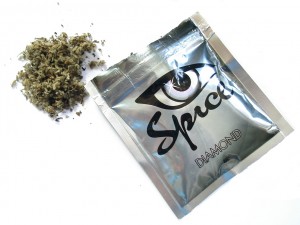
When spice first emerged it was a brand for synthetic chemicals purporting to replicate the effects of marijuana. (Public Domain photo courtesy of the U.S. Marine Corps)
A year ago, Anchorage was facing a public health emergency from the synthetic drug known as Spice. From July until November in 2015, ambulances were bringing an average of seven patients to area hospitals every day.
A new paper published by the Centers for Disease Control looks at what happened, and why the spice outbreak has now largely petered out.
Yuri Springer works for the state’s Department of Public Health studying patterns of disease and is the paper’s lead author. And because Spice hit Anchorage so hard and fast last summer, responders adopted the kind of coordinated response you’d see in a similar public health emergency.
In his office, Springer pointed to a chart showing medical transports for people who used Spice. At first, there’s almost nothing– zero, one, or two ambulance trips a day. Then suddenly the columns jolt upwards.
“We hit the middle of July 2015, and we saw this large spike in the number of transports, sometimes exceeding 20 or 25 ambulance transports a day for Spice-related illness,” Springer said.
“During July 15, 2015-March 15, 2016,” the authors write, “a total of 1,351 ambulance transports to Anchorage emergency departments for adverse (synthetic cannabinoid) reactions were identified.”
The numbers begin edging downward in mid-November after the municipality passed an ordinance that increased the criminal penalties for possession, sale, and use of spice. For months afterward the tally of emergency medical transports slides gradually downward. Nowadays it’s back around the original baseline.
The ordinance came through the mayor’s administration and assembly and was intended to give law enforcement more tools for going after manufacturers and dealers. Researchers say that’s a large part of what led to the drug’s decline in Anchorage. Another piece was educational outreach and collaboration between healthcare providers, social services, and city officials. According to Springer, this paper is intended partly as a template for a successful intervention.
“The point here is to disseminate the findings of the investigation so that folks in other jurisdictions who might encounter similar problems get a sense of what we faced and how we dealt with the challenges,” he said.
The study draws on a collage of evidence to give an account of the significant toll Spice was taking on users, city resources, and the local healthcare system.
During the eight-month period researchers looked at, ending in March of 2016, spice accounted for 10 percent of the city’s ambulance transports — which was not only expensive but tied up emergency response units already spread thin. During one particularly intense ten week period, 34 percent of emergency department visits were Spice-related.
The overwhelming majority of those transported, 81 percent were men. The median age was 34-years-old. And some people were brought to emergency rooms with disproportionate frequency: one pocket of 17 people was picked up by ambulances ten or more times, making up 20 percent of the overall transports.
The researchers also looked at 167 hospital charts, which offered more detailed personal and medical information about what was happening. A significant number of the spice cases involved drastic medical interventions like intubation or admission to an intensive care unit.
Many of the users reported that they were homeless, about 40 percent. But such information is tricky to verify, and researchers believe that number may be higher. 71 percent of the emergency transports began in an area of downtown “known to be a hub for the local homeless population,” the report states.
Among the study’s various methodological limitations, a significant number of the medical transports were the Alaska Native Medical Center, which didn’t make any patient charts available to researchers.
Though anecdotes abound, the authors write that this is the first such study to demonstrate with evidence a Spice outbreak disproportionately hitting homeless residents.
Researchers also found 11 chemical substances in the product and paraphernalia they were able to test. Meaning people who were using a drug purported to be synthetically replicate a high similar to marijuana were, in fact, ingesting chemicals few people know much about or understand.
And though it’s hard to prove, state investigators believe this class of drugs caused four people’s deaths in the municipality during the period under review.
“The cause of death was likely attributable to Spice use, and so that’s pretty significant,” Springer said. “That’s four people…who, in the Medical Examiner’s opinion, died in large part or entirely because of their consumption of spice.”
The paper, titled “Increase in Adverse Reactions Associated with Use of Synthetic Cannabinoids — Anchorage, Alaska 2015-2016,” appears in the October 14th issue of the CDC’s Morbidity and Mortality Weekly Report.
Russia is antagonizing the U.S. on multiple fronts these days, in Europe, in Syria and in cyberspace, if claims prove true that Moscow is behind some high-profile email hacks.
But in the Arctic, Russia is still playing nice, one conclusion a panel of national security experts made at a Washington, D.C., briefing Thursday.
Russia has certainly built up its military on its side of the Arctic.
It has installed or refurbished Arctic bases, enlarged ports and built new airfields.
“But the fact is there’s really no evidence of aggressive intent by Russia,” said Julia Gourley, the senior Arctic official at the State Department.
She says it appears Russia is gearing up to protect its economic interests. (It has offshore oilwells.)
“Frankly, all countries would do the same,” she said at a Capitol Hill briefing for Congressional staff.
Warnings of a massive Russian land grab have been circulating since 2007, when a Russian submarine planted a flag on the Arctic seabed, at the North Pole.
Russia has submitted a claim to a U.N. commission for more Arctic territory, based on how far it says its continental shelf extends into the ocean.
The documents aren’t public, but Gourley said the State Department believes Russia did not make an outlandish claim.
“In determining its outer limits of the continental shelf, so far there are no overlaps with the United States, from what we know of its submission,” she said.
The U.S. is still mapping its continental shelf in the Arctic.
John Pendleton, a military expert at the Government Accountability Office, agreed: It’s likely Arctic warfare is NOT on the horizon.
The Department of Defense “has assessed the threat of military conflict – we have it from several sources – is low in the near term. Armed conflict,” he said.
Sherri Goodman sounds more wary.
A former Pentagon official and now a think-tank fellow at the Woodrow Wilson International Center said the U.S. needs to assert its military presence in the Arctic and remain alert for changes in Russia, for signs it may be “resurgent” in the north, as it is elsewhere.
“I agreed that today we are not facing those challenges in the Arctic, with Russia,” she said. “But we’ve got to operate up there with eyes wide open.”
All the panelists concurred on the need for more icebreakers and for Arctic ports.
They were speaking to a room full of Congressional aides, the people who work for the people who could fund such projects.
Indian law is often complicated and obscure. But one bit of Indian law just got a lot more concrete for the Southeast community of Craig: the concept of land into trust. The Craig Tribal Association is the first Alaska tribe to apply to put property in trust with the federal government.
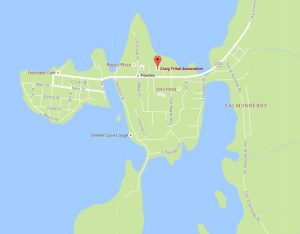
The Craig Tribal Association building is in the center of Craig. (Image: Google)
The tribe wants to place slightly over one acre in trust. It’s in downtown Craig, and it’s the building that houses the tribal offices. It’s zoned commercial and parts of it are leased to others. It also has a big hall the tribe rents for weddings and dinners.
Craig Tribal President Clinton Cook, Sr. says if the Interior secretary agrees to take the tribe’s building and the adjacent parking lot into trust, the tribe of about 450 will be better able to chart its own future.
“The goal for all tribes is to be able to be self-determined, away from the state and municipality telling you what you can do with you land,” he said.
Tribal lands held in trust have a legal status similar to Lower 48 reservations. Trust lands are free of some state and local regulations, though exactly which is a complicated question. Cook says the tribe has no plans to change the use of the property, but they have pondered some ideas. Among those ideas is gaming.
“There’s really no gaming in Craig, because … you have to file through the state and city, and get a gaming license and you’re subject to a lot of taxes,” he said. “Land-into-trust will eliminate a lot of tax burden on a casino or a gaming (operation).”
Cook says they’ve also thought about retail opportunities.
“The marijuana business is something that has been touched upon by our tribal council,” he said. “But just talking about it. It doesn’t mean we’re going that way. It means it will allow us to do this, with land into trust.”
The federal rules allowing Alaska land-in-trust have been on hold due to a legal challenge. But the state dropped its opposition, opening the door for tribes to begin applying.
Cook says he thinks the BIA officially received the Craig application first because there’s little or no opposition in the city of Craig, which has a population of about 1,200. The tribal president says he doesn’t know if the municipality objects. The city already exempts nonprofit enterprises, including the tribe, from its tax rolls, so he doesn’t think the city would be hurt by the change.
The Craig city administrator declined to be interviewed for this story, saying he wanted to hear the tribe’s intentions first.
The idea of having pockets of Indian Country around Alaska is certainly controversial in some circles. Don Mitchell is an Anchorage attorney and author. He’s become the arch-enemy of many Native advocates because he disputes Congress intended to accord the legal status tribal sovereignty on Alaska Native communities. He says the Craig application illustrates that the potential impact isn’t just to distant acreage.
“One thing that people do not understand is the statute gives the secretary the authority to take title into trust of any land, located anywhere,” Mitchell said. “So in this case, the first example out of the block is down in the Southeast Alaska community of Craig. It could just as easily be in downtown Anchorage.”
The BIA has asked for comments on the Craig proposal. The agency is accepting them through the first week of November.
Republican presidential nominee Donald Trump points out to the crowd of supporters as he arrives at a campaign rally on Oct. 4, 2016 in Prescott Valley, Arizona. Ralph Freso/Getty Imagesib
Both of Alaska’s U.S. senators said over the weekend they won’t support Republican Donald Trump for president, not after seeing him brag on a 2005 videotape that being a star meant he was free to grab women by the private parts.
Rep. Charisse Millett, an Anchorage Republican and the state House majority leader, also announced Sunday she’s no longer supporting Trump. But as of today, the Republican party in Alaska was officially sticking with Trump.
Republican state party chairman Tuckerman Babcock said he sent out an email Sunday night reminding party officers they can’t publicly support anyone but Trump for president.
He said, speaking negatively about Trump, is, in effect, supporting a rival.
“Well, you can be neutral or you can be supportive,” he said, “but you can’t be in opposition to a Republican candidate and stay on the Central Committee and be an officer of the party.”
Babcock reminded party officers of that same rule when Fairbanks attorney Joe Miller entered the U.S. Senate race last month, as a Libertarian.
A few party officials did resign then, to publicly support Miller over incumbent Republican Lisa Murkowski.
Babcock said he doesn’t know of anyone resigning their party office now to they can renounce Trump. He says the calls he’s fielded and the comments on the party’s Facebook page show something else.
“The main thing that I heard was distress over whether or not expression of these opinions would cause Hillary Clinton to be elected,” he said.
Murkowski announced Saturday she can’t support Trump.
She said the offensive comments he made in 2005 reveal his true character.
She’s not an officer of the party, and Babcock says she’s free to speak her mind.
The Republican Party of Alaska re-posted her statement and the blowback has been fierce. At least, that’s how it looks on Facebook.
Dozens of people have called Murkowski out for turning against the party’s nominee.
The campaign coordinator for Trump Alaska 2016, Jerry Ward, wouldn’t acknowledge any Republican distress by Trump’s comments on the 2005 video.
“Alaska absolutely is going to vote for Trump-Pence,” said the former state senator. “We’re a Republican state and our presidential candidate has said that he is going to develop our resources.”
Ward wasn’t budging off that point. His response to a direct question about fallout from the video — “What do you say to folks who were upset by the video and who think that person shouldn’t be president?” – yielded the same message: “People in Alaska are going to vote overwhelmingly for Donald Trump. They want to have a bright future,” he said.
For his part, Trump posted on Twitter that Republicans who abandon him are “self-righteous hypocrites” and he says they’ll lose their elections.
Close
Update notification options
Subscribe to notifications
Subscribe
Get notifications about news related to the topics you care about. You can unsubscribe anytime.