Alaska Public Media is one of our partner stations in Anchorage. KTOO collaborates with partners across the state to cover important news and to share stories with our audiences.
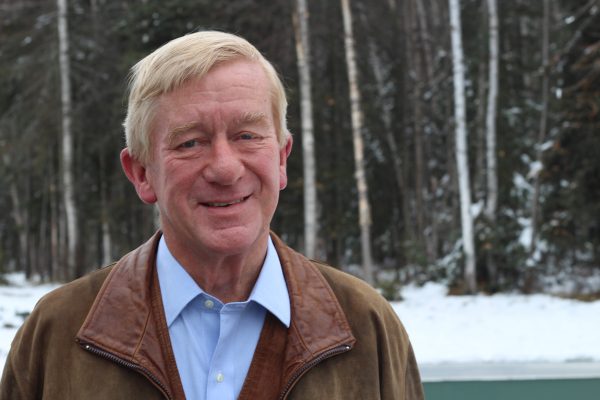
Bill Weld, former governor of Massachusetts, is the Libertarian Party’s nominee for Vice President with running mate Gary Johnson. He stopped by Alaska Public Media to discuss his platform. (Photo by Wesley Early, Alaska Public Media)
Libertarian vice presidential candidate Bill Weld capped a two-day campaign trip to Alaska on Friday, trying to shore up support for his running mate, Gary Johnson, and to increase the visibility of the Libertarian Party in Alaska.
“We have two objectives now,” Weld said. “Not having gotten into the debates, I think the chances of running the table because of the superiority of our ticket are hugely diminished. But, in addition to trying to pick up states, we also want to make sure that we get over 5 percent nationally, which would give the Libertarian Party a permanent seat at the table going forward, which I think would be good for Washington.”
“It would enable us to have matching funds and not have to worry about ballot access,” he said.
Weld said he is not an expert on many of the issues faced by Alaska Natives and people in the state’s rural areas, but he is familiar with resource development.
He wants to open up more of Alaska to energy exploration and production.
Weld said the U.S. is too Euro-centric in its trade policy and noted that Alaska is in a great place, geographically-speaking, to take advantage of the growth of the pan-Pacific region.
Weld supports the Trans-Pacific Partnership — a trade agreement signed by President Barack Obama that’s derided by conservatives for being too good a deal for Asian nations.
Weld believes the Libertarian Party platform is a good fit for Alaska, but the state’s Libertarian candidate for U.S. Senate, Joe Miller, is not a good fit for the party.
“Mr. Miller doesn’t really represent either my point of view or the national Libertarian Party’s point of view,” Weld said. “Fine guy, but not in tune with Gary Johnson’s and my thinking.”
Polls show the Johnson/Weld ticket has between 7 percent and 18 percent support in Alaska, more than double the national average.
The Alaska Republican Party is attacking U.S. Senate candidate Joe Miller in a series of hard-hitting mailers.
This is the same Joe Miller who was the Republican Party’s own nominee six years ago, when he beat the incumbent Republican senator, Lisa Murkowski.
Now the party is accepting money from Murkowski’s campaign and using it against Miller.
Miller calls that money laundering, but the party says it’s perfectly legal.
Shannon Connelly has received three of the anti-Miller mailers so far, and she’s upset the Republican Party, her party, is sending them.
“It almost feels like there’s a war going on right now with our base,” said Connelly, a former Republican District chairman for greater Palmer.
Connelly stepped down from her party positions in September so she could openly support Miller, a conservative running this time as a Libertarian.
Connelly said he better represents Republican principles.
The first two mailers the Republican party sent rehashed a story about how Miller had to resign from his Fairbanks North Star Borough job in 2009 after misusing his co-workers’ computers. (Miller, though a spokesman, declined to be interviewed for this story, but after it aired disputed any connection between the computer incident and his resignation some 18 months later. As Alaska Dispatch reported, a series of events preceded Miller’s departure.) The third flier tells how he deleted thousands of borough emails, and it compares Miller to, of all people, Hillary Clinton.
“To Republican people who follow the platform, that is quite the insult,” Connelly said.
Republican State Party Chair Tuckerman Babcock acknowledges a certain dissonance, especially since he’s working to elect Murkowski and presidential nominee Donald Trump, but Murkowski has denounced Trump.
“It’s a strange place for me to be, as Tuckerman Babcock, certainly,” he said. “As far as the Republican Party, our mission is clear: We defer to the Republican Primary voters. They’re the people who tell us these are our candidates, and then we are obligated to support the election of every Republican candidate who is nominated.”
Murkowski won the Republican nomination this year, and Miller didn’t run in the primary, so Babcock said he’s doing what’s right for the GOP.
“It’s important for the Republican Party to make a statement to anyone who is thinking about running as a third party and wants to skip the Republican Primary, that they will face a full-throated opposition from the Republican Party,” he said.
Babcock is paying for that attack primarily with money Murkowski last month transferred from her campaign to the state party coffers, more than $150,000.
Miller says the transfer is legally suspect.
“Well, we don’t know for sure, but the implications, if all of this money was spent on her behalf, the implications are that essentially the Murkowski campaign is laundering money,” said Miller campaign aide Matt Johnson, at a news conference this week.
Murkowski’s campaign attorney, Tim McKeever, said the transfer of money was entirely legal.
“There’s no limit on the amount of the transfer of excess campaign funds that can be made by a candidate’s committee to their state party,” McKeever said. “Sen. Portman of Ohio just made a transfer of a million dollars to the Ohio state party.”
McKeever said federal law doesn’t limit when such transfers can take place or what the party can do with the money.
Babcock said it’s not laundering because he, as party chairman, was free to ignore any of the campaign’s recommendations and says he spent the money as he saw fit.
For proof of that, he said, wait until the fourth anti-Miller flier hits mailboxes. It’s the first in the series to promote Murkowski by name, and Babcock included something you won’t see in Murkowski’s campaign leaflets: a plug for Donald Trump.
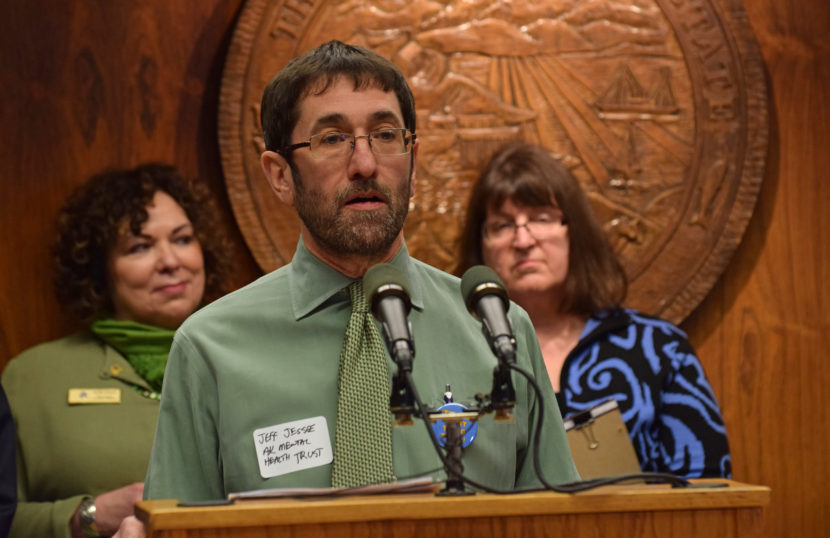
Jeff Jessee addresses reporters at a press conference in the Capitol, March 17, 2015. He was the CEO of the Alaska Mental Health Trust authority at the time, but resigned Wednesday. (Photo by Skip Gray/360 North)
Some trustees of the Alaska Mental Health Trust Authority are alleging that their CEO’s resignation indicates violations of the Alaska Open Meetings Act.
Jeff Jessee submitted his resignation letter during a special meeting of the board of trustees on Wednesday afternoon.
Trust board chair Russ Webb said Wednesday that the transition was under discussion for several years, though an unofficial transcript of the meeting shows that several board members were surprised by the decision.
When asked why he was changing roles, Jessee, who was accompanied by the trust’s chief communications officer, began reading from his resignation letter.
“It is clear that a majority of the board of trustees believes that significant changes in the trust’s organization and efforts must be made to meet these challenges,” he read. “And they believe ‘these changes will require new perspectives and ideas to ensure that the trust can meet the needs of the beneficiaries well into the future.’”
When asked if he agreed with this position he responded, “Well, I believe it’s in the best interest of the beneficiaries, the trust and myself that I take a position within the trust where I can continue to serve the beneficiaries, which is why I got into this field in the first place.”
When asked if he felt the best position he could be in would not be as the CEO, he paused for several seconds and declined to comment.
Jessee will transition to a new role focused on programming, ahead of his planned retirement in three years.
The Mental Health Trust was created to fund comprehensive care for people with mental health illnesses and other disabilities. It is a state-owned corporation with cash and land assets that are managed by different state agencies.
If the governor’s office approves, Greg Jones, who formerly served as the executive director of the Trust Land Office, will serve as the interim CEO. The board of trustees voted 4-3 for the switch in roles.
During the meeting, Mental Health Trustee Laraine Derr alleged that other trustees were holding secret meetings about the future structure of the trust.
“You’re trying to move Jeff out of his job, and you don’t know where you’re going,” Derr is quoted as saying in the transcript. “I mean, I assume you probably do, because you guys have had enough meetings, secret meetings that we don’t know what’s going on. … Until yesterday, I didn’t know what you guys were doing. We have not been included. You’re trying to remove the CEO. … There are three of us sitting here that don’t know — that have never been involved in a meeting.”
Fellow trustee Jerome Selby agreed. Speaking by phone, he said he did not receive any information about the resignation before the meeting. There was not a board packet either.
“The motion that was read that accepted Jeff’s resignation appointed this person I’ve never heard of as the interim CEO, and then gave instruction to that new interim CEO to put Jeff in this new position — had never been discussed at any meeting that I’m aware of. Official meeting,” he said. “So how did it get to the meeting yesterday, all written out? There must have been a fair amount of discussion going on among those four people which violated the Open Meetings Act of the State of Alaska.”
The board has been openly discussing hiring someone to look at the organizational structure of the trust.
Selby said it’s a bad time to lose someone like Jessee in the CEO position, especially because of his experience advocating on behalf of trust beneficiaries in the legislature.
“I think it’s the worst possible time for him to resign, personally. We’re facing what’s probably going to be one of the hardest legislative sessions budget-wise in the state of Alaska.”
The trust was also recently criticized in a letter written by former Attorney General Bruce Botelho and former Commissioner of Natural Resources Harry Noah, both of whom were involved in establishing the trust in 1994.
In the letter, Botelho and Noah ask Rep. Mike Hawker and the Legislative Budget and Audit Committee to request a special audit because they believe the corporation is not following the statutory requirements for how its assets are managed.
They allege the board is taking money from the principal of the trust and using it to buy real estate instead of contracting with the Alaska Permanent Fund Corporation to manage the assets as is required by statute.
During the meeting, board chair Webb directed the board to discuss the letter at a later date, after they had fully read and understood it.
Jessee did not have any comments on the letter and said it was not part of the decision for him to shift roles.
On Wednesday, Webb called it a “separate and irrelevant issue” and said the allegations that others are managing the fund are “manifestly untrue.”
Selby, who was appointed to the board in February, said the concerns about the trust’s fiscal management need to be taken seriously and investigated.
“All of my red flags are waving at the moment,” Selby said.
Webb could not be reached for further comment. Jessee said he is not usually involved in revenue generation for the trust.
The exact details of Jessee’s new role and salary are yet to be determined. In 2015, he received more than $215,000 in compensation. He served in the position for 21 years.
Editor’s note: KTOO’s building sits on land leased from the Alaska Mental Health Trust Authority. KTOO has also applied for and received occasional grants for special reporting projects from the authority.
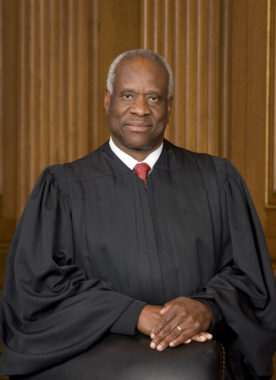
An Anchorage attorney says U.S. Supreme Court Justice Clarence Thomas groped her 17 years ago, when she was a scholar in a post-college program in Washington, D.C.
Moira Smith, now an attorney for the gas utility Enstar, wrote on Facebook that it happened before a dinner party at her then-boss’s house in a Virginia suburb. She said in her Oct. 7 post that, “to my complete shock, he groped me while I was setting the table, suggesting I should sit ‘right next to him.’”
Smith’s post came as the country was reacting to a video of Donald Trump boasting he could grab women with impunity. Thousands of women took to social media to tell their accounts of being harassed and assaulted by men, many of whom were never held to account.
Smith later took down her Facebook post. The National Law Journal broke the story. Smith’s friends said today she’s not doing interviews but she issued a statement. In it, she said she was speaking up to set an example of truth-telling for her children and in hopes of ending the pervasiveness of sexual misconduct.
National Law Journal reports that Thomas denies the accusation and called it “preposterous.”
Anchorage Assemblyman Bill Evans said he’s known Smith since she was an intern at the law firm where he worked, Dorsey and Whitney. Evans said Smith is honest and trust-worthy.
“Certainly as credible as anyone I know. I believe entirely in what she said.”
Smith clerked for state Supreme Court Justice Dana Fabe and later worked at the firm Ashburn and Mason in Anchorage.
Assemblyman Evans said he and Smith run in the same social circles and saw her original Facebook post a few weeks ago.
“It was shocking and very saddening.”
Thomas is in his 25th year on the Supreme Court. The Senate confirmed him in 1991 despite law professor Anita Hill’s accusations of sexual harassment.
Jeff Jessee tells reporters why he supports Gov. Bill Walker’s efforts to expand Medicaid at a press conference in the Capitol, March 17, 2015. He was CEO of the Alaska Mental Health Trust Authority at the time, but left the position on Wednesday. (Photo by Skip Gray/360 North)
The CEO of the Alaska Mental Health Trust Authority resigned on Wednesday and will take on a different role in the organization. Jeff Jessee served in the position for 21 years. He will be transitioning to a new role focused on programming ahead of his planned retirement in three years.
In a phone interview Wednesday evening, Jessee and trust board Chair Russ Webb said the transition has been under discussion for several years.
They said the primary reason for the change was so the trust could shift efforts to focus on raising revenue for its beneficiaries and programs.
Jessee said he is better suited to focus on programming, not managing financial assets.
Greg Jones, who formerly served as the executive director of the Trust Land Office, will serve as the interim CEO while the board recruits a new CEO.
The Mental Health Trust was created to fund comprehensive care for people with mental health illnesses and other disabilities. It is a state-owned corporation with cash and land assets that are managed by different state agencies.
The trust was recently criticized in a letter written by former Attorney General Bruce Botelho and former Natural Resources Commissioner Harry Noah, both of whom were involved in establishing the trust in 1994.
In the letter, Botelho and Noah ask Rep. Mike Hawker and the Legislative Budget and Audit Committee to request a special audit of the trust because they believe the corporation is not following the statutory requirements for how their assets are managed. They allege the board is taking money from the principal of the trust and using it to buy real estate instead of contracting with the Alaska Permanent Fund Corp. to manage the assets as is required.
The Oct. 22 letter indicates copies were sent to both Webb and Jessee.
Jessee and Webb say they have not seen the letter or read it in full, and it did not play a role in Jessee’s decision to resign.
Webb called it a “separate and irrelevant issue from today’s decision” and said the allegations that others are managing the fund are “manifestly untrue.”
The exact details of Jessee’s new role and salary are yet to be determined.
In 2015, he received more than $215,000 in compensation.
Editor’s note: KTOO’s building sits on land leased from the Alaska Mental Health Trust Authority. KTOO has also applied for and received occasional grants for special reporting projects from the authority.
This story has been updated and expanded. Additionally, the day Jeff Jessee stepped down has been corrected. He resigned Wednesday, not Monday.
Alaska’s first marijuana retailer will opening Saturday.
At least, that’s the plan.
Leif Abel owns Greatland Ganja in Kasilof, and said by phone Wednesday that after dropping off his first batch of cannabis at a testing facility in Anchorage this week, the results are in.
“They confirmed that our product samples were all very clean, some of the cleanest product that they’ve seen,” Abel said.
“Of course, they’ve only looked through two or three cultivators at this point,” he added.
Greatland Ganja is a cultivation business, which means they’ll sell cannabis to shops, but not directly to consumers.
The positive results from the testing facility mean Abel can begin transporting product to retailers like Herbal Outfitters in Valdez, which is holding it’s grand opening this Saturday.
If everything proceeds as planned, Herbal Outfitters will be the first shop to sell marijuana in Alaska — 722 days after voters opted for a commercial industry at the polls in 2014.
The first retail store in Anchorage, Arctic Herbery, is on track to open at the end of next week.
Close
Update notification options
Subscribe to notifications
Subscribe
Get notifications about news related to the topics you care about. You can unsubscribe anytime.