Alaska Public Media

Alaska Public Media is one of our partner stations in Anchorage. KTOO collaborates with partners across the state to cover important news and to share stories with our audiences.

PFD automatic voter registration could increase turnout — for a price

PFD Voter Registration
PFD Voter Registration ballot initiative supporters carries signature boxes and banners to the Alaska Division of Elections in Anchorage, Jan. 14, 2016. (Photo courtesy PFD Voter Registration campaign)

On Nov. 8, Alaskans will vote on Ballot Measure 1, which would automatically register eligible individuals to vote when they apply for a Permanent Fund Dividend, unless they opt out. Through mid-October, the campaign in favor of the initiative had spent over $1 million, despite the lack of formal opposition. But would the initiative actually improve voter turnout?

In order to vote in Alaska, a person needs to register 30 days before the election. That means going to a place like the DMV or a tribal office to fill out a form, printing the application and mailing it in, or using the new online option. A bipartisan coalition of organizations and state leaders hope to add automatic voter registration with PFD applications through Ballot Measure 1.

Five states have recently enacted similar automatic voter registration laws.

Professor Barry Burden with the Elections Research Center at the University of Wisconsin said in most countries, all voters are automatically registered. Putting the onus on the voter to register is the exception, not the norm. The process was created in the United States about 120 years ago for a couple of reasons, he said.

“One of the incentives for voter registration was to prevent fraud and try to provide a secure system to ensure each person got to vote once and only once,” Burden said. “But it was also an effort to try to keep immigrants from participating, undesirable populations, transient groups, sometimes Irish or Germans from participating, so it had a sort of discriminatory effect.”

Automatic voter registration can reduce some of those problems, he said.

Oregon is the only state where automatic registration is already happening, and because it was just implemented, it’s too soon to see how it impacts voter turnout. But Burden said other data suggest the practice will get more people to the polls.

“There are surveys, for example, in previous presidential elections that ask nonvoters why they didn’t vote. In 2012, something between 5 and 6 percent of nonvoters told us the reason was something related to voter registration. So it’s likely to have a modest but positive effect on voter turnout.”

The Division of Elections estimates that automatic registration could catch up to 70,000 people who are qualified to vote but not registered. The process, if implemented, would also update registration records.

Kim Reitmer, who is helping run the campaign in favor of the ballot initiative, said if it passes, organizations like Get Out the Native Vote can shift focus from voter registration to education.

“We’re hoping that by allowing people to have this automatic process, they can then put their resources and time into learning who they might want to vote for, the ballot initiatives, a little more of that education process, too,” Reitmer said.

But Suzanne Downing, who writes the political blog Must Read Alaska, said the initiative solves a problem that doesn’t exist because people can already register in many different ways.

“And it is a function of citizenship that you go and you actually fill out one form, very easy to do, and if you file for your PFD, you can certainly figure out how to register to vote,” Downing said.

Downing also claims the idea is an expensive proposition.

In 2015, the lieutenant governor’s office estimated that if the ballot initiative passes, it could cost about $930,000 to implement and $300,000 every year after that.

Proponents of the cause say those numbers are outdated because they don’t reflect Division of Elections computer upgrades or how much time and money can be saved by sharing data.

The division said it wouldn’t know the exact impact on finances, computer system compatibility or work flow unless the initiative passes and contracts are put out to bid.


Miller irks GOP by sending old fliers bashing Murkowski

The Joe Miller campaign obtained 2010 GOP flyers and sent them, with a few modifications. (Image courtesy Miller campaign)
The Joe Miller campaign obtained 2010 GOP fliers and sent them, with a few modifications. (Image courtesy Miller campaign)

In another sign that this is a strange election year, the U.S. Senate campaign of Libertarian Joe Miller is mailing leftover fliers the Alaska Republican Party printed in 2010, but didn’t send. The fliers are critical of the incumbent, Sen. Lisa Murkowski.

In 2010, she was the candidate the party was trying to defeat in the general election. Now, Murkowski is the Republican nominee, so the Republicans are crying foul on Miller.

The GOP has complained to the Anchorage Police Department and party Chairman Tuckerman Babcock said the Postal Service informed him it is looking into the mailing.

“I don’t know if they were printed up recently and not reported, or whether someone hoarded them in their garage for six years hoping that there’d be another contest between Miller and Murkowski,” Babcock said. “I don’t know. But it’s a pretty bizarre situation.”

Miller said last week someone dropped off boxes of the leftover GOP fliers at his campaign.

“Many boxes were brought. I wasn’t here when they were brought,” he told reporters.

Miller treated it as a contribution from the party to his campaign. On his campaign finance report he put the value at $4,500.

A Miller spokesman said the campaign paid a printer to black out the original bulk mail permit and added “Paid for by Citizens for Joe Miller.”  They affixed first-class stamps and mailed an undisclosed number of them. There are two other additions to the mailer: At the very top, the Miller campaign wrote “What the Republican Party said in 2010 ….” and, further down, “What has changed?”

Babcock said the mailer would confuse voters, because it has the original disclosure, saying it’s paid for by the Alaska Republican Party, and another saying the Miller campaign paid. Babcock said a postal employee told him the service had refused to accept some version of the flier late last week, although it is not clear why. Babcock said he was told there was no attempt to use the Republican Party’s bulk mail permit. The Postal Service confirmed the matter is under review but did not immediately provide specifics.

Miller, on Monday evening, was striking back, accusing the Republican Party of making a false police report.

For Moda customers pushed to Premera, insurance rates will jump 35 percent

The open enrollment period for the federal health insurance marketplace opens Nov. 1, 2016. (Photo by Josh Edge/APRN)

Open enrollment in the federal health insurance marketplace begins Tuesday, and two-thirds of enrolled Alaskans will see about a 35 percent rate increase as they transfer from Moda Health to the lone provider left in Alaska’s market.

Lori Wing-Heier, director of the state’s Division of Insurance, said about 14,000 individuals will swap over to Premera Blue Cross Blue Shield.

“Their plans will automatically go from Moda to Premera,” Wing-Heier said. “But if they want to see what else is out there they’re going to have to to into the marketplace and make the decision themselves, because it may not be the plan that they want due to the cost.”

“So we are encouraging them to get out and take a look at what the new plan is and if it’s the correct plan for them at the correct premium.”

Moda announced their departure from the Alaska market earlier this year, citing financial troubles.

Customers already enrolled with Premera will see an average rate increase of 7.3 percent.

Wing-Heier said the state is encouraging Alaskans to start shopping early.

“To see what’s available for them and to see what they qualify for, if they qualify for, an offset of a premium tax credit or a subsidy,” she said.

About three-quarters of enrolled Alaskans qualify for a subsidy.

Wing-Heier said assistance is available for those who are re-enrolling and for Alaskans enrolling for the first time.

“We also are encouraging people to reach out to a broker, a navigator or an assister, depending on what is in their area, to help them, to walk them through the marketplace and what their options are,” she said.

The enrollment period begins Tuesday and is open through the end of January, but in order to have insurance coverage in effect by the first of the year the enrollment deadline is Dec. 15.

As of September, just over 21,000 Alaskans were enrolled in the individual marketplace.

Alaska Air flight grounded after e-cig batteries ignite

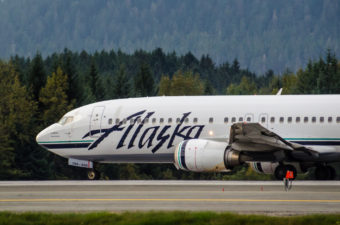
Alaska Airlines jet at the Juneau International Airport
An Alaska Airlines plane at Juneau International Airport. (Photo by Heather Bryant/KTOO)

Passengers on an Alaska Airlines flight from Seattle to Anchorage on Sunday were delayed over five hours after a passenger’s backpack started burning. Batteries for an e-cigarette are the likely culprit.

Flight 67 had just made a scheduled stop in Ketchikan at 3:30 Sunday afternoon, and about half the passengers had deplaned when the incident occurred.

Andrew Hames was seated just a few rows behind the passenger.

“And I heard sort of a whooshing sound, like a quick hiss of air, and I looked up and about 3 rows in front of me a guy’s backpack started smoking and burst into orange and blue flame” Hames said. “He quickly got it off and hit it to the ground and some other passengers got up and started stomping on it.”

Hames said the man thought the source of the fire might have been an e-cigarette, but that wasn’t the complete answer. After all passengers had stepped off into the Ketchikan airport, Hames spoke briefly with the man as he emptied out his pack.

“And he said it was this device,” Hames said. “And he held up the charger itself. And it looked like there were some coins in the bottom and somehow made contact with that. And he also had several charred quarters sitting on the table as well.”

Hames also said the man appeared quite chagrined, and cooperated fully with authorities in the airport.

In a prepared statement, Alaska Airlines confirms that freshly charged batteries were to blame. Spokesperson Ann Zaninovich also doesn’t call this event a fire.

“Technical experts believe that when the batteries came in contact with metal keys and coins it caused a spark,” Zaninovich said. “There was visible smoke, and a set of keys and candy fell to the ground through a burnt hole in the backpack. While there was not fire, there was sparking, which prompted the flight attendants to take swift action and use the fire extinguisher.”

Zaninovich said that “out of an abundance of caution” the aircraft’s first officer put “a device” in a fire containment bag, which is carried on all of the airline’s planes. She offered no comment on whether the incident would affect rules regarding the transport of e-cigarettes or battery chargers on aircraft.

Andrew Hames, however, considers the event an eye-opener.

“I imagine if those items had been underneath the airplane in the luggage compartment and somehow that same event had happened, it absolutely could have been more exciting than it already was,” Hames said.

Another aircraft was sent to take passengers on to Juneau and Anchorage. Hames and his family arrived in Sitka about five hours behind schedule. The original aircraft used for Flight 67 was returned to service about six hours later. A 12-inch square of burned carpet had been replaced.

State continues efforts to privatize Mat-Su slaughterhouse

The state is continuing its mission to privatize Palmer’s Mt. McKinley Meat and Sausage plant.

The Department of Natural Resources’ Board of Agriculture and Conservation issued requests for proposals Friday to lease or purchase the plant.

“The minimum price for purchase is $700,000,” Amanda Swanson, the loan officer for the state’s Agricultural Revolving Loan Fund, which currently supports the plant, said. “We left it pretty much open for proposed lease terms.”

“And preference will be given to bidders who plan to continue to operate it as a meat plant and processing facility,” Swanson said.

Mt. McKinley Meat and Sausage is the only U.S. Department of Agriculture-approved slaughterhouse in Southcentral Alaska.

The state has operated the plant since 1986.

Past efforts to privatize the plant were unsuccessful.

A number of ranchers, primarily in the Matanuska and Susitna Valleys, are concerned that if the plant closes, the area’s fledgling livestock industry will collapse.

Proposals are due no later than Monday, Nov. 28.

Mushers frustrated over allowing cell phones on Iditarod trail

Wade Marrs pulls in to Galena in the 2016 Iditarod. (Photo by Zach Hughes/KSKA)

Mushers are expressing frustration over controversial rule changes the Iditarod made during a board meeting Friday.

The race’s Trail Committee is upholding rule 35, which for the first-time ever will allow the use of two-way communication devices, including cellphones and satellite phones along the trail.

The organization thinks the measure will make for a safer race, a news release said.

“This rule change involved more than the usual amount of discussion and deliberation over the last eight months, which included a tremendous amount of input from the competitors in this event,” according to the release.

Mushers have been critical of the rule, saying it represents one of the biggest changes ever made to the race.

Iditarod veteran Wade Marrs attended the board meeting.

“Every musher there was opposed to the rule,” Marrs said by phone Friday afternoon. “It will change the race drastically I believe.”

Mushers said the measure could open the door to coaching and unfair advantages, a violation of race rules, but something that competitors say will be practically unenforceable.

“You can bet that someone’s going to call home and get help and outside assistance,” Marrs said.

Marrs, like other mushers, cited the controversial rule 53 — the so-called gag-order passed last year– in reserving criticisms of the decision by the board to change the rule.

Another source of tension from today’s meeting is a decision to change where equipment can be carried on sleds.

Rumors were circulating that the measure was a ban on trailers, which have been used by many of the top-performing mushers the last few years to haul dogs, supplies, and even a stove.

The Iditarod Trail Committee said that is not the case, and will be sending out the new official language to competitors.

Site notifications
Update notification options
Subscribe to notifications