Alaska Public Media

Alaska Public Media is one of our partner stations in Anchorage. KTOO collaborates with partners across the state to cover important news and to share stories with our audiences.

Lower 48 ivory bans hit Alaska Native carvers

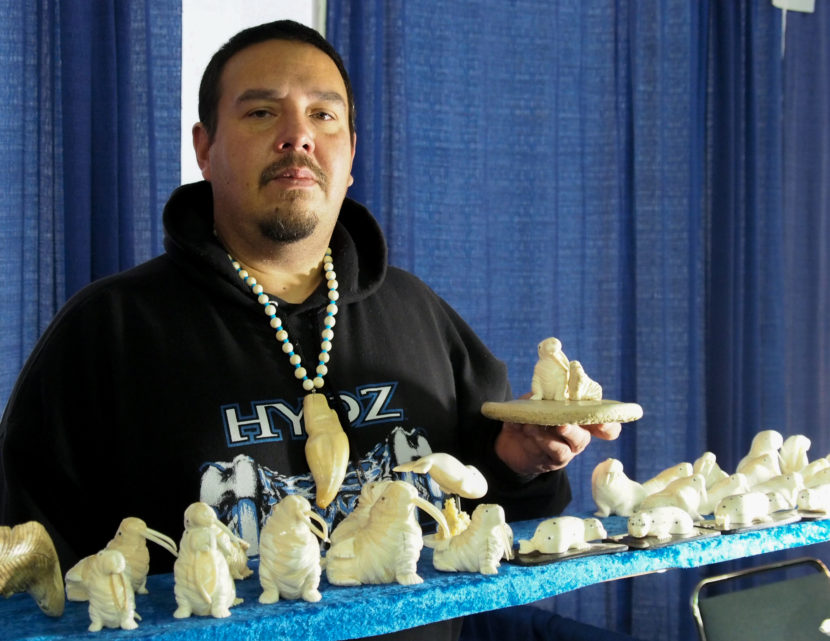
Dennis Pungowiyi shows off one of his favorite carving motifs, a mother walrus with her pup. (Photo by Zachariah Hughes/Alaska Public Media)

Recent measures to curb elephant poaching in Africa are having unintended consequences in Alaska.

This July, the U.S. Fish and Wildlife Service’s near-total ban on the commercial ivory trade went into effect. At about the same time, state-level bans passed in California, Hawaii, New Jersey and New York, after targeted lobbying efforts from conservation groups.

These regulatory changes are starting to bite into Alaska’s ivory market, made up primarily of walrus, mammoth and fossilized ivory, even though none of those are illegal.

For hunters, artists, and regional leaders, it’s expected to get worse.

Inside the craft fair during the Alaska Federation of Natives convention in Fairbanks in October, the glitter and gleam of Dennis Pungowiyi’s ivory stood out.

His table was crowded with everything from small, intricate sculptures of birds to an ornate full mount and curved cribbage boards etched into tusks.

Pungowiyi is best known for his carvings of walruses, where the angular rendering of the hides hints at an abstract interpretation.

“These bigger ones are from a 10-pound tusk, and I only get two or three of those tusks a year,” Pungowiyi said, who wore a necklace of a fist-sized tooth of a killer whale with a polar bear’s head carved into the top.

Walruses are not an endangered species, and Alaska Natives are allowed to carve and sell their ivory under provisions in the Marine Mammal Protection Act.

Pungowiyi’s family is from Savoonga, which, along with Gambell on St. Lawrence Island, accounts for the vast majority of walruses harvested each year in Alaska.

Since 2012, hunters from St. Lawrence Island have harvested anywhere from 433 to 1,206 walruses in a year, according to tagging statistics provided by the Fish and Wildlife Service.

The primary reason for the hunt is food, but the sale of tusks and carvings helps bring in cash.

“We’ve taken a pretty big hit on this elephant ivory ban,” Pungowiyi said, adding that potential buyers have begun to conflate elephant and walrus ivory.

Pungowiyi lives in Wasilla most of the year, in part to have better access to the ivory market on the road system. But his livelihood still depends on regular trips to Savoonga each spring to hunt and buy raw tusks.

Since the summer, federal and state regulations cracking down on the domestic market for elephant ivory have caused people to think all ivory is illegal.

“I’m down probably a good 40 percent,” Pungowiyi said. “This show here is what I’m banking on getting me through the winter.”

At some of the other tables, sellers said they’ve heard of the bans, but haven’t seen an impact yet. Pungowiyi thinks that’ll change this year when ivory buyers go out to villages.

Alarm bells are already sounding.

During AFN, U.S. Senator Dan Sullivan convened an official field hearing to assess what can be done.

“While perhaps well intentioned, these state bans have had the unintended consequences of limiting the ability to trade in authentic articles of Native handicrafts, and in other cases they have created confusion,” Sullivan said.

Regional leaders testified at the hearing that not only are they seeing ivory prices drop, but there’s been an uptick in unlawful confiscations by federal agents.

Melanie Bahnke is president of Kawerak, the regional nonprofit for the Bering Strait Region. Like Pungowiyi, she is from Savoonga and has siblings whose carvings help pay for clothing, heating oil and essential goods.

Earlier this summer, Kawerak flew in carvers from around the region for a craft fair in Nome to greet wealthy tourists when the Crystal Serenity cruise ship docked.

But it was a bust.

“Once they realized something was made out of ivory, you could tell that there was almost disdain,” Bahnke said in an interview during AFN.

Alaska has a robust internal market for walrus ivory, where subsistence hunting is not controversial and the use of marine mammal products is common.

But carvers are reliant on commerce with outside states.

Even though California and New York are far away, the drop in demand means Alaska ivory isn’t making it to market, an effect Bahnke and others worry could be devastating to rural communities like Savoonga.

“It can be a huge part of a family’s income,” Bahnke said. “Whether it’s an $80 carving or $8,000, when our communities are already living below poverty that’s a big source of income for our people.”

To conservationists, however, the demand for ivory that has funneled cash from tourists, merchants and galleries back to Alaskans is the same one threatening to wipe out elephants in Africa.

“We’re talking about the survival of a species,” said Elly Pepper with the Natural Resources Defense Council.

“Given the current poaching crisis, we’re trying to close as many loopholes as we can to get the situation under control,” Pepper said, speaking from her home in Maine.

NRDC is one of the national conservation groups that has lobbied state legislatures on ivory bills. They focused on California, Hawaii and New York because they are the states that play the biggest role in illegal wildlife trafficking.

In the last decade, elephant poaching has reached unprecedented levels, driven by surging demand from China, Pepper said.

While the U.S. has long outlawed sales of “new” elephant ivory, there were enough allowances to fuel a black market.

“The U.S. has historically allowed the sale of old or antique elephant ivory. That created a huge loophole that lead to a parallel illegal market, because it’s very difficult to distinguish ivory date,” Pepper said.

The four state bans that have passed do technically include exemptions for walrus ivory harvested by Alaska Natives.

Pepper concedes that in the rush to deglamorize ivory overall, those nuances may have been lost.

“I think most people have tried to make it pretty specific to elephant ivory, but I think maybe the messaging has been conflated,” Pepper said.

Alaskans have few options for recourse over bans passed in other states. Subsistence advocates are recommending language in state bills that more explicitly acknowledges the rights of Alaska Natives, along with a public relations campaign highlighting the sustainable nature of walrus ivory.
Alaska Human Rights Commission takes up LGBTQ community protections

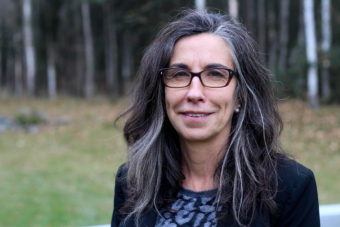
Marti Buscaglia
Marti Buscaglia is the director of the Alaska State Commission for Human Rights. She took over the agency in May 2016. (Photo by Wesley Early/Alaska Public Media)

Alaska’s Human Rights Commission is taking steps to legally protect members of the LGBTQ community from discrimination.

Last week it passed a resolution that would interpret sex discrimination to include gender identity and sexual orientation. That’s the interpretation used by the U.S. Equal Employment Opportunity Commission under Title VII of the 1964 Civil Rights Act.

Kathryn Dodge, the acting chair of the commission, said the regulation changes could be examined by a legislative committee but would not require approval by the state legislature.

“The brilliance of this resolution was we actually have power to do this without the legislature,” she said.

The commission’s Executive Director Marti Buscaglia has previously said the change would require legislative action.

The commission’s lawyers will draft regulation changes that will be reviewed by the Department of Law, Dodge said. Then there will be a public comment period.

“This really is about starting a conversation around the state. We don’t get to just, as a commission, say this is what we think and go do it,” she said. “We’re developing regulations, and there’s requirements for public comment all the way along.”

It also has to be approved by the governor’s office.

Buscaglia said the interpretation of the regulations would be similar to the nondiscrimination ordinances that already passed in Anchorage and Juneau. She said it would make state law more closely reflect changing social views.

“Same sex marriages are taking place but yet you can go to work and be discriminated against for having a same-sex partner and that just feels wrong,” she said.

The resolution also asks the legislature to pass a bill that would protect people based on gender identity and sexual orientation, Dodge said, but she doesn’t think they would take it up this year. This resolution offers an alternative path to providing protections, she said.

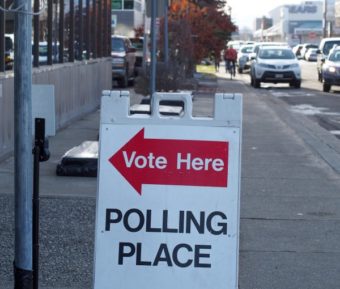
Alaska Public Media and Electionland want to hear about your vote!

Alaska Public Media is participating in Electionland, ProPublica’s project covering access to the ballot and problems that prevent people from exercising their right to vote during the 2016 election.

And we need your help!

After casting your ballot, let us know what your experience was like. How long did you wait? Was the process routine or different this year? By marking it, you’ll help us spot any problems or patterns emerging at the polls.

You can tell us about any issues at your polling place or voting precinct in a few different ways.

Text the words “Alaska Public” or “Electionland” to 69866 to participate by text message, and get a reminder on Election Day.

On social media, you can use #Electionland in tweets and Facebook posts to help flag any potential problems. That helps us spot claims and get to work verifying them.

You can find more information about ProPublica’s national Electionland project here.

Elections officials see strong turnout for early voting across Alaska

An early voting location at the Division of Elections’s Region II office in midtown Anchorage (Photo: Zachariah Hughes, Alaska Public Media – Anchorage)
An early voting location at the Division of Elections’ Region II office in midtown Anchorage (Photo by Zachariah Hughes/Alaska Public Media)

Across the country, the number of people voting early in the general election is up. It’s not clear from the numbers yet whether Alaskans are keeping pace with that trend. But people on the ground say it’s the busiest election they’ve seen.

Around lunch-time, Martha Upicksoun came to the Division of Elections’ regional office in midtown Anchorage to vote. But then, she turned around and walked back toward the parking lot.

“The line is to the door,” Upicksoun said. Sure enough, the line snaked down a hallway and into the vestibule, with people crowding inside to get away from the cold.

Upicksoun calls herself a “super-voter,” someone who dutifully turns out for every election. But this is the first time in forty years of casting ballots she’s trying to do it before Election Day.

“I’ve been hearing about early voters, I’ve been following the predictions,” she said. “I just thought ‘well, I think I’m going to give it a try.’”

Upicksoun isn’t annoyed by the long line but has other errands to run and thinks the polling site will be less busy later on. If not, she says she’ll try one of the other locations around the municipality.

Another early voter, Michele Pamer, was in an upbeat mood even though she waited 40 minutes to cast her ballot. But she had to vote today, she explained because she’s “out of time.”

“I have too many obligations next Tuesday — taking seniors to vote!” Pamer said.

Pamer votes in every election, which is also the case for Richard Miller, who said his 15-minute wait was completely painless.

“Normally I vote on Election Day, but I knew I was going be out of town,” Miller said. “So I came down to do it.”

He’s voted at this site in the past, he said and added, “This is the biggest crowd I’ve ever seen here.”

That seems to be the consensus around Anchorage, and around the state. As of Thursday, 45,794 Alaskans had voted, according to figures from the Division of Elections. That’s only about half the number of early votes cast in the last presidential election in 2012 — 99,684 total. But there are a few days left, including a weekend, and ballots are still pouring in by mail.

Local and state officials say that from their perspective, the early returns are “strong.”

“It’s an exciting election,” said Julie Hussman, supervisor for the state’s elections operations in Anchorage.

Hussman said her staff is processing more than 2,000 ballots a day at sites across the municipality. She doesn’t have the hard numbers, but it looks busier than past elections in Alaska she’s overseen.

Despite the uptick, she isn’t hearing about any problems from voters.

“People have not complained,” she said by phone. “The people have been great.”

Voters are generally waiting 15 to 20 minutes in Anchorage, according to Hussman.

Early voting hours and locations can be found here.

Lindbeck digs at Young in House debate; Miller and Stock criticize Murkowski in Senate debate

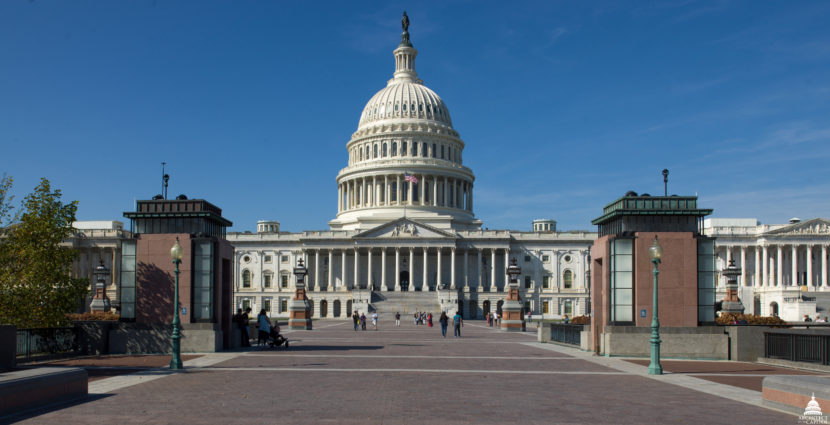
The U.S. Capitol in Washington on Oct. 18, 2016.
The U.S. Capitol in Washington on Oct. 18, 2016. (Public domain photo courtesy Architect of the Capitol)

During Thursday’s Debate for the State hosted by Alaska Public Media, races for U.S. House and Senate took on very different tones.

In the House race, Republican incumbent Don Young held up his years of experience and familiarity with the federal government as some of his strongest assets. But those were exactly what Democrat Steve Lindebeck, a former general manager for Alaska Public Media, went after.

During the chance to ask a question, Lindebeck dug in on Young’s record.

“You’ve been investigated by the FBI, you were reprimanded only two years ago by the House Ethics Committee, you’ve broken federal ethics disclosure rules for a long time now. If you’re re-elected, how could Alaskans possibly believe that the next two years will be any different?” Lindbeck asked.

In his response, Young batted away the question. It was a rare spark in an otherwise cordial debate. Young, Lindebeck, as well as the two other candidates, Libertarian Jim McDermott and independent Bernie Souphanavong, were amiable, even though there were huge differences in their approaches to the Arctic, the economy and immigration.

Even on the divisive topic of transgender bathroom access, a political flashpoints both locally and nationally, Young and the others were largely on the same page.

“I’m not sure the federal government has a role in this, but they’re gonna pursue it, the Supreme Court’ll make that decision,” Young said. “But there’s a lot of other serious problems occurring in this country right today, and remember, everybody uses the same bathroom in your home.”

Just after the House debate, the four candidates running for U.S. Senate had their chance to make a case to Alaskans ahead of election day. And things were much less diplomatic, with candidates talking over one another and frequently going out of their way to take digs at opponents. Incumbent Republican Lisa Murkowski caught criticisms from both sides, on the right by Libertarian Joe Miller, and from the left by independent Margaret Stock.

For example, both challenged Murkowski over her response to the nomination of Merrick Garland to the Supreme Court.

“But he has suggested that somehow or another I have supported Merrick Garland,” Murkowski said, referring to comments from Miller. “We haven’t had an opportunity to weigh in on Merrick Garland. So I just wanna make sure that people understand that what I supported was a process that allows –”

“I’m not sure you can have it both ways,” Miller interjected.

“You can absolutely have it both ways,” Murkowski shot back as moderators steered the conversation back on course.

Candidates’ answers ran the ideological gamut, from extremely conservative, to populist progressive platforms, like Democrat Ray Metcalf’s call for a public option in healthcare. The focus throughout was much more national in its scope than the preceding House debate.

State and federal elections are Tuesday, Nov. 8.

Alaskan Cub superfans react to their team’s historic victory

Last night, an estimated 40 million people tuned in to game seven of the World Series.

What they saw was history in the making: the Chicago Cubs beat Cleveland, 8-7 in 10 innings to win their first title since before World War I.

Megan Baldino’s living room last night was riotous as she and her friends and family watched the Cubs win the World Series for the first time since 1908.

Baldino is a former reporter for KTUU in Anchorage. She now works for GCI. She’s also a lifelong Cubs fan, from Chicago.

Like most fans of the team, Baldino has been waiting for this moment her entire life.

“It’s truly unbelievable. It feels surreal,” Baldino said. “I mean, I keep kind of pinching myself and crying and saying, ‘Wow! This is really happening. We just won the World Series.’ And in a game like that. It was outrageous for any team to have won that game, let alone the Cubs with the history we have. It’s just unbelievable. We’re overjoyed.”

Another longtime Cubs fan, Matt Nevala is a former sports writer for the Anchorage Daily News.

Nevala said the moment of the big win was an emotional one.

“The first anecdotal thing I can think of that was pretty funny was my 8-year-old daughter saying out loud that she’d never seen her dad cry before so that pretty much sums up the deal,” Nevala said. “Just the combination of disbelief and pure joy at the same time, I suppose.”

The game was particularly nerve wracking for Cubs fans when, in the bottom of the eighth inning, Cleveland scored three runs to tie the game at 6-6 going into the ninth, and later, an extra 10th inning.

The suspense gave Nevala mixed emotions.

“There was this weird, kind of calm to it of, ‘OK. Let’s see what happens here.’ They either bag it and go down horribly, or they find a way,” Nevala recalled.

For Baldino, the up-and down nature of that moment was crystal clear.

“You know, we went to the depths of despair when they tied it up. And when that happened, I had a bunch of people at my house last night and I did not sit the whole time,” Baldino said. “Someone said, ‘Do you have a Fitbit on? ‘Cause you are just pacing.’ And so you go to that place again, ‘don’t let it slip away.’ But then when Zobrist did what he did, we were flying off the walls.”

Baldino is referencing a hit from Ben Zobrist in the 10th inning that scored a run for the Cubs. Miguel Montero scored another hit shortly after to increase the Cubs lead to two.

“And then, to that final Bryant to Rizzo, the final out, I mean we just went ballistic. We went absolutely ballistic,” Baldino said.

It’s been 108 years since the Cubs won the World Series. That’s a lot of history passing by without a baseball championship in the Windy City.

“If you saw the broadcast, last night where they’re saying Mark Twain was 71 or 73 in 1908, Haley’s comet has come past not once, but twice in that time,” Nevala said. “You know, it’s part of what you see. All these pieces when they’re talking to celebrities and it’s a part of this lifelong commitment you make to that franchise and to that organization and to the game itself.”

Even though it took more than 100 years for the Cubs to win it all, many fans believe that 2016 is just the beginning for the team.

“I’m overjoyed,” Baldino said. “This feeling’s not gonna go away from me and let me remind many people that Chicago is a city with a great history of teams becoming dominant. The Bulls with Michael Jordan. The Blackhawks recently. So I am supremely confident that the Cubs will continue to be, at least for the next couple years, one of the strongest teams in baseball.”

For Nevala, it’s the end of a journey that started when he was just a boy.

“This all started for me from the fact that I played backyard baseball with the same group of buddies when we were 7, 8 9, 10 years old,” Nevala said. “You’d spend all day playing in the backyard playing, and then the Cubs would come on in that afternoon back in Michigan where I was from. And it kinda becomes part of what makes your DNA and what makes your insides work, if you will. This is the ultimate payoff.”

Site notifications
Update notification options
Subscribe to notifications