Alaska Public Media is one of our partner stations in Anchorage. KTOO collaborates with partners across the state to cover important news and to share stories with our audiences.
This weekend, the first veterans town hall to be held in Alaska is happening in Palmer.
The event is part of a growing national movement to better integrate the lives and experiences of veterans with the civilian world.
Veterans town halls are non-partisan opportunities for former service members to speak to an audience for ten minutes apiece about “what it felt like to go to war.”
Non-veterans are invited to listen.
The forums started last year in Massachusetts from an idea by former conflict journalist Sebastian Junger.
This year they’re happening in eight states.
Team Red, White and Blue, a veterans support community in Alaska, helped organize the town hall.
“I hear a lot, ‘I wish I knew how to support our veterans,’ and I think that we often try to fill that gap by doing something like giving people a 10 percent discount or saying ‘thank you for your service,’” organizer Amy Buschatz said. “Those are great things, but if you knew somebody’s story and knew where they were coming from you might be better equipped to reach into their lives and do something that’s actually going to impact them.”
Buschatz also is a reporter and editor with the news site military.com, and her husband served in the Army.
The Team Red, White, and Blue’s overall aim is connecting vets with nearby members of their community, usually through activities, public service or exercise, she said. The town halls fit the same mold.
“We believe that people do better in community. That we want to have community and that we need community to really thrive,” Buschatz said. “And our veteran are coming from a place where they are used to that community and then thrown into the civilian world where they don’t necessarily have that.”
The Veterans Town Hall will be from 2-4 p.m. Sunday, Nov. 13, at the Palmer Depot.
You can find more information about Anchorage’s chapter of Team Red, White, and Blue by searching for them on Facebook.
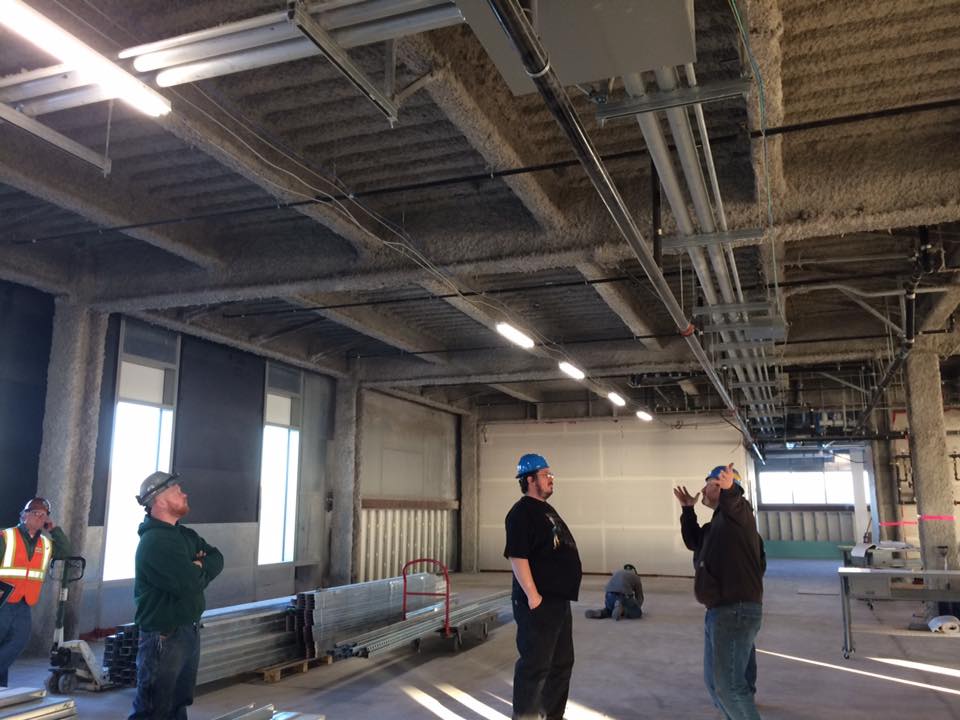
Work continues on the UAF Engineering Building in Oct. 2016. (Photo via UAF Engineering Building Project Facebook Page)
Aging infrastructure throughout the University of Alaska is causing a $1 billion maintenance crunch, and campuses are trying to find ways to cope with a growing backlog of projects.
University Relations Vice President Michelle Rizk said the Board of Regents has been working for years to find ways to reduce the backlog of projects.
“As our buildings have been aging, you know the average age exceeds 30 years and we have over 400 facilities across the state of Alaska – as the buildings age, the need for emergency maintenance increases,” Rizk said. “So there’s roofs that are leaking and that need to be replaced, sewer systems, there’s a variety of issues out there.”
Traditionally, funding for deferred maintenance and projects to renew or re-purpose old buildings comes from the state legislature. If money is appropriated, then it’s often a drop in the bucket compared to the actual need.
According to John Faunce, the director of planning and construction for the Anchorage campus, about $10 million per year went to University of Alaska Anchorage.
“Our deferred maintenance grows at a rate of about $14 million per year,” Faunce said. “So we’ve got a backlog already of $240-250 million, and we continue to grow at $14 million a year.”
That’s just at University of Alaska Anchorage.
No deferred maintenance funds were allocated by the state for this fiscal year, but the University was able to funnel about $10 million from its operating budget into deferred maintenance – about $2.5 million of that went to the Anchorage campus.
Chris Turletes, the associate vice chancellor of Facilities and Campus Services at University of Alaska Anchorage, said that money helps, but it’s not enough.
“Kind of what we’ve been doing is keeping the roof from caving in and doing just-in-time work, systems that are broken or not operating efficiently, just keeping them running,” Turletes said. “And that’s what we’re doing a lot of. And eventually they break and you’ve got a problem.”
And those problems are not limited to UAA; the university system maintains buildings in Fairbanks, Juneau, and satellite campuses in many smaller communities across the state.
Michelle Rizk said the Board of Regents’ goal is to reduce the project backlog to a manageable level, but the exact path to doing so is not clear.
“Of course, one way to reduce the deferred maintenance of a building is actually to get rid of the building,” Rizk said. “And so we’re assessing is there some of our buildings over time should we sell them, should we lease them, to reduce our overall operating expense.”
And Rizk said the university will continue to seek funding from the state and other sources, but deferred maintenance can be a hard sell.
“A lot of people instead of fixing what you have, I mean, they wanna build a new facility, you know, so it’s hard to get donors and others excited about funding a roof replacement,” Rizk said.
In recent years, the university built the Alaska Airlines Center and a state-of-the-art engineering building on the Anchorage campus, and another engineering building on the Fairbanks campus remains partially complete.
The University of Alaska Board of Regents will address deferred maintenance and a variety of other capital and operating budget issues this week in Fairbanks.
Alaska crews from multiple state and federal agencies are headed to the Lower 48 to assist in firefighting efforts there.
Tim Mowry, a public information officer for the Alaska Division of Forestry, said over the last two weeks more than a dozen Alaska people have been sent to drought-stricken areas in the Southeast United States.
“Unlike Alaska and some of the places in the West, these aren’t real big fires – I think the biggest fire is like 3,000 acres – but they’re getting a lot of fire activity, and because that area is much more densely populated than the areas in Alaska and even in the West, they have to jump on those fires pretty quick,” Mowry said.
The Alaska personnel have been assigned to fires in Alabama, Georgia, Kentucky, Mississippi, North Carolina and Tennessee.
Mowry said Alaska has primarily sent support staff.
“Dispatchers, division supervisors, crew bosses,” Mowry said. “Right now all our crews are laid-off because our fire season is over.”
Mowry said Alaska agencies are trying to cobble together at least one Type 2 Initial Attack team to send to the Lower 48.
Workers from the Alaska Division of Forestry, Bureau of Land Management – Alaska Fire Service, U.S. Fish and Wildlife Service and U.S. Forest Service have been deployed to other states.
Their involvement is part of a national effort to support firefighting efforts in the Southeast United States.
Jerry Ward, a former state senator and Alaska state director for the Trump campaign, reacted to Fox News’s official declaration that Donald Trump had won the 2016 presidential election. (Photo by Rachel Waldholz/Alaska’s Energy Desk)
While Democrats have gained power in the Alaska legislature, Donald Trump’s upset victory in the presidential race left national Republicans in control of both the White House and Congress.
As that realization rippled through Anchorage Tuesday night, Trump supporters reacted with elation, Democrats with shock, and surprised Republican officials ticked off a wish list of priorities that suddenly seemed within reach.
Alaska voters went for Trump over Hillary Clinton, 51 to 37 percent, while Libertarian Gary Johnson took just under 6 percent. Incumbent Republicans U.S. Sen. Lisa Murkowski and Rep. Don Young also won their races by wide margins.
At a campaign watch party at Flattop Pizza in downtown Anchorage, Trump supporters erupted in rapturous cheers when Fox News officially called the race at about 10:40 p.m.
George LaMoureaux was the statewide volunteer coordinator for the Trump campaign. Asked if he was expecting the win, LaMoureaux said, “Praying for it. I had high hopes the whole time.”
John MacKinnon took in the scene with his wife, Republican state Sen. Anna MacKinnon. He said the vote sent a clear message.
“I think we’re seeing America come out and say, ‘We’ve had enough,'” MacKinnon said. “Enough regulation. Enough government. Enough telling us what we have to do and not what we want to do.”
That sentiment was shared by Brady Huseby. Huseby, 30, is a member of the Carpenters’ Local 1281. He said the union supported Clinton.
“They post a union booklet on who we’re supposed to vote for, and it’s Democrat across the board,” Huseby said. “And everybody threw it in the garbage.”
Meanwhile, Democrats gathered just across the street at the restaurant Williwaw were in shock. Many in the audience cried and consoled each other as the outcome became clear.
Maka Jinaatlaa Monture watches results come in toward the end of the night at the Democrats’ event at Williwaw in downtown Anchorage. (Photo by Zachariah Hughes/Alaska Public Media)
James Primm is vice president of the Alaska Young Democrats. He said he was sure Trump’s values were out of sync with the majority of voters — until he saw the results.
“I think a lot of people really thought that they would reject Trump’s message,” Primm said. “And instead what you have is a lot of people who really seem to think that is the answer, instead.”
Democrats weren’t the only ones surprised by the outcome.
At Sen. Lisa Murkowski’s victory party, people congregated around the television screens, stunned by the presidential results.
Both Murkowski and Congressman Don Young trounced their nearest challengers. Murkowski beat Libertarian Joe Miller by about 14 points and Young defeated Democrat Steve Lindbeck by about the same margin.
The bigger surprise was Trump’s win.
Alaska Republican Party chairman Tuckerman Babcock was joyfully adjusting to the idea of a Trump presidency. Babcock said Trump appealed to a different segment of the party than his own.
“He speaks kind of right by me,” Babcock said. “He speaks to a group of people who feel disenfranchised and who really came out to vote for him in the upper Midwest and the South, and I am surprised. I’m happy. But I am surprised.”
Babcock said Trump will be good for Alaska on energy, and maybe federal land policy, too.
“That’s probably the biggest question, is how much the federal government will transfer management of lands to Alaska,” Babcock said. “It’s long been a goal of the Republican party in Alaska. I don’t know if Mr. Trump shares that goal. But he shares a lot of goals. Just (being) pro-oil and gas development and (for) the robust military are going to make a big difference.”
Murkowski told reporters that one of her first efforts will be a push to open the Arctic National Wildlife Refuge to oil drilling, a goal that has eluded Alaska’s congressional delegation for decades. She also spoke of finally getting a road through the Izembek National Wildlife Refuge to help King Cove. And then she checked herself.
“This is not Christmas. This is governing and governing is hard work,” Murkowski said.
She said Republicans in the Senate will still need to work with the Democrats in Congress.
“And we will. I will,” Murkowski said. “It doesn’t mean that you run them over. It means you still work to gain that consensus. And we’ll need that with ANWR. We’ll need that with other issues that always have been complicated in Alaska.”
Young said the House Republican leadership plans to make energy a top priority, and he thinks that could include developing the coastal plain of the Arctic Refuge.
“Oh, ANWR is possible and I think likely,” Young said.
Young said the leadership’s initial to-do list also includes repealing or reforming Obama’s healthcare law, deregulation and a transportation package.
And with complete control by a single party, Young and Murkowski acknowledged, the pressure will be on Republicans to deliver.
Zachariah Hughes contributed to this report.
Correction: An earlier version of this story misidentified Brady Huseby as a Clinton supporter. He supports Trump.
George LaMoureaux, statewide volunteer coordinator for the Trump campaign, celebrated with his daughter, Ashley LaMoureaux, at Flattop Pizza in downtown Anchorage. (Photo by Rachel Waldholz/Alaska’s Energy Desk)
While many parts of the country — and the world — were stunned by Donald Trump’s upset win Tuesday night, there was one place in Alaska where people claimed they saw it coming all along.
True believers gathered at a Trump campaign watch party at Flattop Pizza in downtown Anchorage. When Fox News officially called the race at about 10:40 p.m., the room erupted in rapturous cheers.
John MacKinnon was taking in the scene with his wife, Republican state Sen. Anna MacKinnon.
“I think we’re seeing America come out and say, ‘We’ve had enough,’” he said. “Enough regulation. Enough government. Enough telling us what we have to do and not what we want to do.”
Jerry Ward, a former state senator and Alaska state director for the Trump campaign, reacted to Fox News’s official declaration that Donald Trump had won the 2016 presidential election. (Photo by Rachel Waldholz/Alaska’s Energy Desk)
Meanwhile, Democrats gathered just across the street at the restaurant Williwaw were in shock. Many in the audience cried and consoled each other as the outcome became clear.
James Primm is vice president of the Alaska Young Democrats. He said he was sure Trump’s values were out of sync with the majority of voters — until he saw the results.
“I think a lot of people really thought they would reject Trump’s message,” Primm said. “And instead what you have is a lot of people who really seem to think that is the answer.”
That was clearly true in Alaska, where Trump was ahead nearly 52 to 37 percent with 94 percent of precincts reporting early Wednesday morning.
As the first Alaska results rolled in, Sen. Lisa Murkowski said she wasn’t taking victory for granted yet. But, she said, if she wins re-election, she will work with whoever is in the White House, even if it’s Donald Trump.
“When they want to work with us to do good things for Alaska, we’ll be working together,” Murkowski said. “And if there are things that we need to block because they’re bad for Alaska, we’re going to do that. So yes, I can absolutely working with anyone.”
Murkowski never supported Trump, and after the videotape emerged of him speaking aggressively about women, Alaska’s senior senator called on Trump to step aside.
On election night, Murkowski said she didn’t know if Trump would exact a price for that, but she said victory tends to soften hard feelings.
“If there was somebody that was harboring ill will toward someone and you win, there’s no reason to hold grudges,” Murkowski said.
With Republicans likely to remain in control of the U.S. Senate, Murkowski, with a win, retains her chairmanship of the Senate Energy Committee for up to four more years.
Close
Update notification options
Subscribe to notifications
Subscribe
Get notifications about news related to the topics you care about. You can unsubscribe anytime.