Alaska Public Media

Alaska Public Media is one of our partner stations in Anchorage. KTOO collaborates with partners across the state to cover important news and to share stories with our audiences.

Obama’s Alaska regulations could cling long into Trump’s term

As a candidate, President-elect Donald Trump said he’d liberate business by striking as much as 70 percent of federal regulations.

Trump vowed to dump Obama-era policies and unleash the energy industry to produce more oil, gas and coal.

It would seem like good times for natural resource extraction in Alaska, but Trump will find some policies easier to dismantle than others.

President Barack Obama’s policies for Alaska are embedded in a variety of documents: executive orders, memoranda, agency action and formal rules. Some can be undone with the stroke of a pen.

Consider the Pebble Mine, a massive project proposed for southwest Alaska that opponents say is a threat to the salmon runs of Bristol Bay.

Pebble spokesman Mike Heatwole said it’s unlikely Trump would want to continue the EPA’s efforts to block the mine using the so-called “veto authority” in the Clean Water Act.

“Mr. Trump campaigned on halting and reversing EPA overreach across the country,” Heatwole said.

Heatwole doesn’t know whether Trump has specifically taken a position on Pebble but he sees no reason why Trump’s EPA wouldn’t just reverse course.

“Certainly, the EPA’s pre-emptive actions against Pebble — you could probably call it a poster child in that regard, in terms of EPA overreach,” he said.

Tom Waldo, attorney for the environmental law organization, Earthjustice, also said there’s nothing stopping the EPA from making a U-turn on Pebble.

“Yes, I think it’s entirely possible that EPA in a Trump administration may choose not to continue the process,” Waldo said.

Waldo hopes Pebble won’t get the financing it needs to proceed, but if it does, Waldo points out Pebble will still need federal permits.

“There are laws that protect the resources in Alaska and the United States, and there are procedures the agencies are required to go through in making changes,” Waldo said. “And we will be vigilant in making sure the laws are obeyed and the procedures are followed.”

Obama has issued hundreds of executive orders and memos that Trump can undo once he takes office, just as Obama did after his inauguration.

Some of Obama’s Alaska policy is enshrined in formal rules, and they’re more firmly set.

Among them are restrictions on predator hunting in Alaska’s national preserves and refuges, which opponents see as Obama intruding on Alaska’s right to manage fish and game, and Arctic drilling standards.

The so-called WOTUS rule, defining which waters are subject to the Clean Water Act, would also have a big impact in Alaska.

“It takes a lot of work to overturn a policy that has already been set by a rule,” said Tom Lorenzen, a Washington, D.C., lawyer at the firm Crowell & Moring who used to work for the government, defending EPA regulations.

Generally, when a president wants to alter or toss a regulation, agencies have to go through the same laborious rule-making procedure it took to get the reg on the books, with notices, public comment periods and a lot of documentation.

It can take a year or more.

Then, Lorenzen says, whatever group that liked the rule as it was will likely to sue.

“Well, I’ll tell you, I’ve been through two transitions: from Clinton to Bush, and from Bush to Obama, both inside the Department of Justice, and (repealing regulations) is not as easy as people might lead one to believe,” he said.

Often, the administration prevails years later. Or never.

Case in point: The Roadless Rule for national forests. President Bill Clinton’s regulation lives on, despite the Bush administration’s best efforts to kill it.

We’ll see if President Trump takes a stab.
Will Trump follow through on changing Denali’s name back?

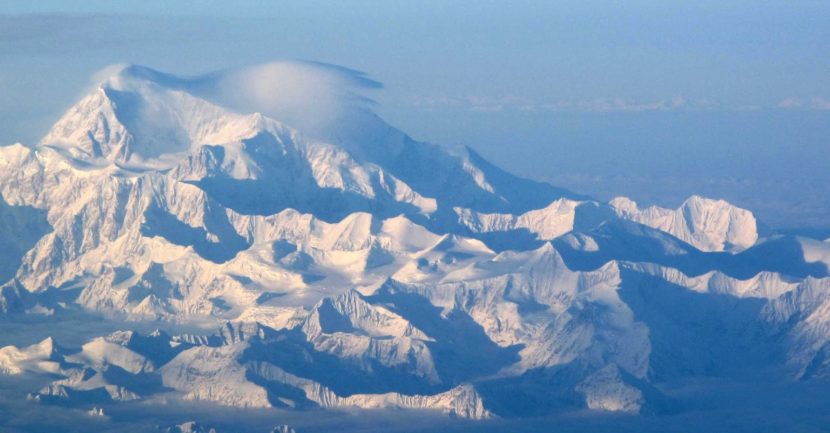
Despite volcano-like rumbles deep beneath the mountain, Denali will not erupt soon. (Photo by Ned Rozell/UAF Geophysical Institute)
Denali. (Photo by Ned Rozell/UAF Geophysical Institute)

President-elect Donald Trump made many a campaign promise during his run for the White House.

Shutting down the Environmental Protection Agency and killing the Affordable Care Act were among them.

One of Trump’s rhetorical pledges affects Alaskans specifically: his Twitter vow to re-name Denali.

Orville Huntington, parks director with the Tanana Chiefs Conference, is from the Koyukon Athabascan village of Huslia.

“Well, I can only speak from the Interior Athabascans. It’s always been called Denali, we never called it any other name,” Huntington said. “Every mountain has four names, depending on which direction you are traveling, so, for us we were going toward the South, and you know, you see Denali, and it is pretty prominent, and so that’s why it got the name. And it’s always been the name, as far as I know, we never called it anything else.”

Huntington said the name Denali, means “The Great One.”

Alaska Native names of the mountain could be different, depending on which of the Athabascan, Dene’, languages are spoken, he said.

“I wouldn’t know, you would have to go to the Dena’ina name, it may be the same,” Huntington said. “I have no idea what it is in Upper Tannana. I don’t know that language.”

To many Alaskans, it has always been Denali.

After last year’s visit to Alaska to promote his environmental agenda, President Barack Obama announced his administration’s recognition of Denali as the official name of the nation’s highest peak.

Trump proceeded to erupt on Twitter and vowed to change Denali back to Mount McKinley after former President William McKinley.

Of course Ohio, the home state of McKinley, also figured prominently in Trump’s campaign agenda as one of the hotly contested “battleground” states.

It remains to be seen if Trump will follow through on his promise.

Anchorage police officer shot in ambush, suspect dead

Anchorage police said that one of their officers had been “ambushed” and shot multiple times early Saturday morning.

At a 10 a.m. press conference, Anchorage Police Chief Christopher Tolley said that the officer is undergoing surgery for serious but not life-threatening wounds. APD said the suspect, who has not been identified, was shot and killed by responding officers.

Tolley said the officer, whose name will not be released for a “few days,” was trying to identify a theft suspect near Fifth Avenue and Cordova Street at 4:36 a.m. Saturday when the man approached the officer and began shooting.

“It was a clear and intentional ambush,” Tolley said. “But it will take a while to sort through the information and conduct interviews of those involved and other potential witnesses, as well as collecting other evidence.

Tolley said that he had seen video footage of the shooting, but said that police would be releasing few details about the incident.

“It wouldn’t be fair to put too much information out there right now because we don’t want witnesses to be swayed by the information that is put out there,” Tolley said.

Anchorage Mayor Ethan Berkowitz joined Chief Tolley at the press conference.

“It’s a reminder that when we hear sirens someone’s heading into danger, and they are doing it to make sure the entire community is safe. The response of the police department reflects a tremendous amount of, not just professionalism, but courage,” Berkowitz said.

The Anchorage officer is the second Alaska police officer in less than a month to be ambushed and shot. Fairbanks Police Sgt. Allen Brandt was shot multiple times by a theft suspect he was attempting to contact on Oct. 16. Brandt died 12 days later, from complications from his wounds.

The State Office of Special Prosecutions will determine if the officers’ use of force was justified and APD’s Office of Internal Inspections will determine if their use of force was within department policy.

Both officers who fired their weapons have been placed on administrative leave for four days, per department policy, and their names will be released within 72 hours.

Alaskans set up camp at Standing Rock in support of protestors

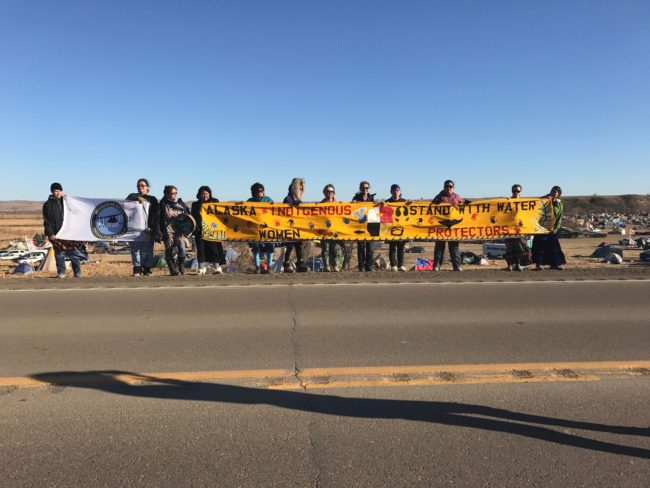
The delegation of indigenous women from Alaska presented a flag from the Chickaloon Tribe and a banner to the Standing Rock Sioux Tribe. (Photo by Amanda Frank)

A delegation of indigenous women from across Alaska traveled to the Standing Rock Sioux Reservation in North Dakota this week. The group brought gifts and resolutions from their communities to support the ongoing protest of the Dakota Access Pipeline project.

The Obama administration is set to issue a decision on whether to approve the pipeline route in the next few days.

Kari Shaginoff traveled to Standing Rock on Nov. 7,  carrying gifts and a resolution from the Chickaloon tribe. During a dinner of moose stew, salmon patties and fry bread a few days later, Shaginoff and other members of the Alaska delegation presented a beaver fur hat and jars of salmon from Alaska to Standing Rock Sioux Tribal Council Chairman Dave Archambault II.

Archambault thanked the group for the dinner, gifts and resolutions. He said his tribe has received a lot of support from other tribes across the nation.

“The response was overwhelming,” Archambault said. “I’d say there’s over… 350 tribes or organizations who wrote letters of support or who passed resolutions by their nation’s government”

About 16 Alaskans are camped at the Oceti Sakowin Camp next to where the proposed pipeline project is underway. The group is stationed in a part of the camp set up by the Indigenous People’s Power Project, a nonviolent, direct-action support network of Indigenous trainers.

The Alaska delegation is setting up tents for others to use during the winter months and helping in the camp’s kitchen, cleaning and preparing meals.

Shaginoff, a member of the Chickaloon Tribal council, shared her experience fighting a proposed coal mine across from the school in Chickaloon. She worries about having to take similar actions as the tribe in Standing Rock.

“Everything we’ve been seeing here, I feel like we are watching things happen that we are going to have to do,” Shaginoff said.

Lisa Wade is from the village of Chickaloon. She spent election day at Standing Rock and was disappointed to hear the national election results. She said she doesn’t know what platform President-elect Donald Trump has regarding indigenous people.

“For me personally, I was concerned about my home community and how they might be feeling today,” Wade said.

Wade plans to return to Alaska this weekend.

She wants to take what she learned at Standing Rock back to communities in Alaska to rally support.

“Everybody has some way they can contribute to helping down here,” Wade said.

Faith Gemmill, of Anchorage, said the group is at Standing Rock to bring their love, blessings, and prayers to the camp. She said a majority of the delegation from Alaska are also from communities affected by resource development.

“We live up there in the north, a traditional-based lifestyle that is based on the land and the waters. We hunt. We fish. We gather to survive,” said Gemmill.

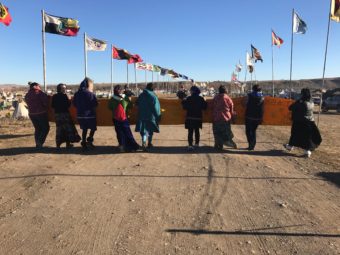
The group carried the flag and banner into the camp and sang Athabascan songs. (Photo by Amanda Frank)

The Alaska delegation delivered a banner to the main protest camp that keeps a fire burning around the clock. The banner was decorated with hand prints and various animals and food that many Alaskan communities rely on.

“You see our children’s hand prints,” Gemmil said. “All of these little hand prints are our children. They gave their hand prints. That’s why we’re protecting our lands and fighting for our waters.”

Most of the group will return home to Alaska this weekend. Gemmill plans to stay until next week to help another group from Alaska set up at camp.

University of Alaska announces 5% tuition hike

University of Alaska students will see a 5 percent tuition hike next year.

For Alaska residents, that means lower division classes for the 2017-2018 school year will cost $202 per credit hour at all campuses except Kodiak and the Prince William Sound College, which will be slightly cheaper.

Upper division classes jump to $244 per credit hour, and graduate courses will ring in at $466 per credit.

Non-resident tuition increases to more than $513 per credit.

The Board of Regents approved the increase at its Nov. 10 meeting in Fairbanks.

The tuition rate goes into effect starting with the fall 2017 semester.

Site notifications
Update notification options
Subscribe to notifications