Alaska Public Media is one of our partner stations in Anchorage. KTOO collaborates with partners across the state to cover important news and to share stories with our audiences.
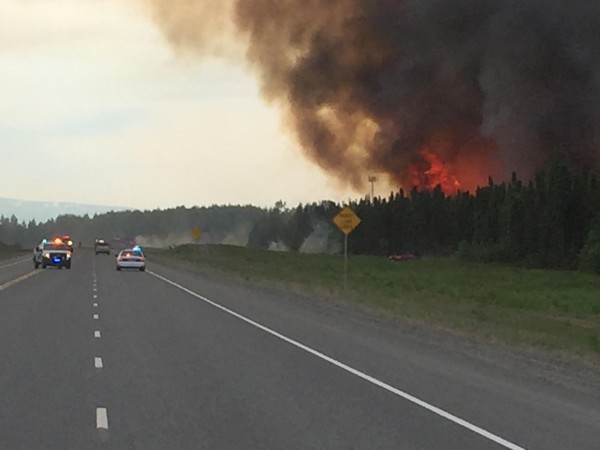
The Sockeye Fire devastated Willow in 2015. (Photo courtesy Mat-Su Borough)
The trial of an Anchorage couple charged with igniting the devastating Sockeye fire last year is scheduled to start Tuesday in District court in Palmer.
The fire destroyed 55 Willow area homes and cost $8 million to fight.
State prosecutors say defendants Greg Imig, 60 and Amy DeWitt, 42, burned debris in June 2015 without properly clearing the area or keeping water on hand. The fire escaped into the forest, where hot, dry conditions and high winds fueled the blaze.
Efforts by state attorneys to negotiate a settlement stalled in mid-summer of this year. The state has charged Imig and DeWitt with eight misdemeanor counts, ranging from reckless endangerment to failure to obtain a burn permit.
The state expects to call scores of witnesses, such as firefighters, homeowners, state troopers and fire investigators.
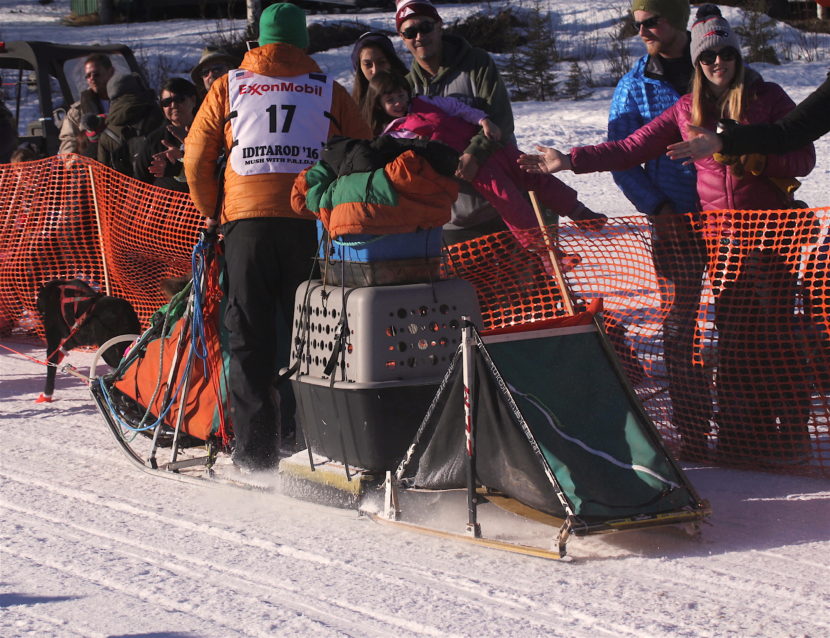
Kelly Maixner can carry up to four dogs in his tow-behind trailer. (Photo by Ben Matheson/Alaska Public Media)
Citing safety concerns, Iditarod officials have ruled that its mushers will no longer be able to carry dogs in trailers behind their sleds.
Aaron Burmeister is treasurer for the Iditarod Board of Directors and said the change came during a meeting on Oct. 28.
“Mainly it clarifies that dogs will be hauled in the front sled if they’re being hauled during the race,” Burmeister said. “It’s clarifying we’re not hauling dogs in trailers for safety reasons.”
Though used by a minority of Iditarod mushers, trailers fixed behind the primary sled have grown in popularity as a way to cycle dogs through rest, particularly among the sport’s top performers. Burmeister said as their use becomes more common, mushers risk losing or injuring animals if a trailer detaches.
“This is a rule that didn’t just come up yesterday or at the last board meeting, this is a rule that’s been in discussion for several years,” Burmeister said. “We’re not saying that you can’t haul a dog or anything else, we’re saying you can’t haul dogs in trailers, that way the dogs will be hauled in front of you in the main sled, where they can be supervised and managed if anything should happen.”
Some mushers have been critical of the rule, along with another controversial change passed by the board that allows for two-way communications devices like cell phones to be carried on the trail.
The new rules will be in effect for the upcoming Iditarod in March.
Alaska law enforcement officials are investigating two suspicious deaths in Soldotna. According to an Alaska State Trooper dispatch posted Monday, two burned bodies were found in a burned-out Ford Bronco that was located off a trail near a Soldotna residence.
On Nov. 20, two people were reported missing at the trooper post in Soldotna. The two were known to drive a Ford Bronco and had not been seen since Nov. 14.
The remains were found Sunday night, as Troopers were following up on the missing persons case at the residence where the two were last seen.
Troopers believe the remains are of the missing people. Trooper spokeswoman Megan Peters said the bodies are being examined by the state medical examiner for positive identification and cause of death.
The Alaska Bureau of Investigations has joined the investigation.
Anchorage Assembly member Bill Evans is readying a measure that could bring a 4 percent tax on goods and services.
“People have been pretty upset about the rising property taxes. There’s a limit to what I think you can bear in property taxes in a municipality this size,” Evans said by phone Tuesday. “So diversifying the revenue stream, I think, makes a lot of sense, and takes in some people that currently aren’t paying taxes in Anchorage, people that are commuting here, tourists, things like that.”
Evans said the sales tax is designed to offset property taxes “dollar for dollar.” By shifting the city’s revenue sources without expanding the size of the budget, the measure is designed to stay below the municipality’s “tax cap.”
“If property taxes in the city start to decline, which is a very real possibility given the state’s situation, the city could be in a huge problem because everything is just so loaded onto those property taxes,” Evans said.
“It would be much more sensible to have at least a couple irons in the fire as far as how you determine your revenues,” he added.
Evans acknowledges that with legislators in Juneau also floating the idea of a state-wide sales tax there’s the possibility of double-burdening Anchorage residents.
In order to “combat the regressive nature of a sales tax” Evans is including provisions to exempt essential goods like “food, prescription medicines, utility payments, gasoline and heating fuels, child and adult care services,” as well as rent payments, according to a draft of materials to be submitted with the ordinance.
“I think one of the hardest hit groups right now are people that are the more or less ‘working poor,’ who have a house but that increasing property tax that they can’t get out from almost threatens their ability to keep their house,” Evans said.
The measure has a long way to go. Evans hopes to file it within a week, bringing it before the Assembly for action in December or January after public testimony. If the 11-member body passes it, then the measure would go before Anchorage voters in the April municipal elections — where it would need to get at least 60 percent approval in order to pass.
There has never been a sales tax in the municipality.
A 2006 measure to introduce one failed.
Evans, a fiscal conservative from South Anchorage, is not running for re-election once his term ends in 2017.
Community members gather for the Transgender Day of Remembrance on Nov. 20, 2016. (Photo by Anne Hillman/Alaska Public Media)
Standing in a wide circle around the edges of the sanctuary at St. Mary’s Episcopal Church on Sunday afternoon, more than 80 community members held candles and read the names of some of the transgender individuals from around the world who were killed this past year.
International Transgender Day of Remembrance honors those who lost their lives because of transphobia. The Trans Murder Monitoring project reports that at least 295 transgender and gender-diverse people were killed in the last 12 months worldwide, however that number is “just the tip of the iceberg.” According to the organization, which tracks the data, the number is far from complete because it only includes cases where the victims are identified as trans in the reports of their deaths. The organization says most countries don’t track murders of transpeople, and in some places trans-identities are not openly acknowledged.
The walls of the sanctuary at the Anchorage event were covered with 295 brightly colored paper stars. Christina Eubanks-Ohana came up with the idea of covering the walls with stars and purposefully chose bright colors to honor how families will remember those who were lost.
They were “lost in such a tragic way,” she said, “and yet they will always be to (the families) those toddlers and those rambunctious children. I really liked that this was a vibrant way of remembering them.”
Event organizer Jessica Greene said the Day of Remembrance is about more than just acknowledging the victims. It’s also a call to action for the wider community to recognize and support trans people.
“It’s about using that privilege — whether it’s white privilege, male privilege, cisgender privilege — it’s using that privilege that we just get because we’re some way to really advocate for those who don’t get that privilege,” she said.
Antonette Harper, who spoke during the ceremony, said the best way to fight violence against the transgender community is to increase awareness because violence stems from fear of the unknown. “So for the rest of the transworld, my suggestion is don’t start hiding now, and silence is no longer golden.”
She said people need to know one basic thing: “That we are human. We are not some alien beings, you know, that are out to molest and abduct your children or steal your husbands. No, we are human beings,” she stated. “We live just like everyone else. We have jobs. We pay taxes. We vote.”
You can find out more about being transgender here.
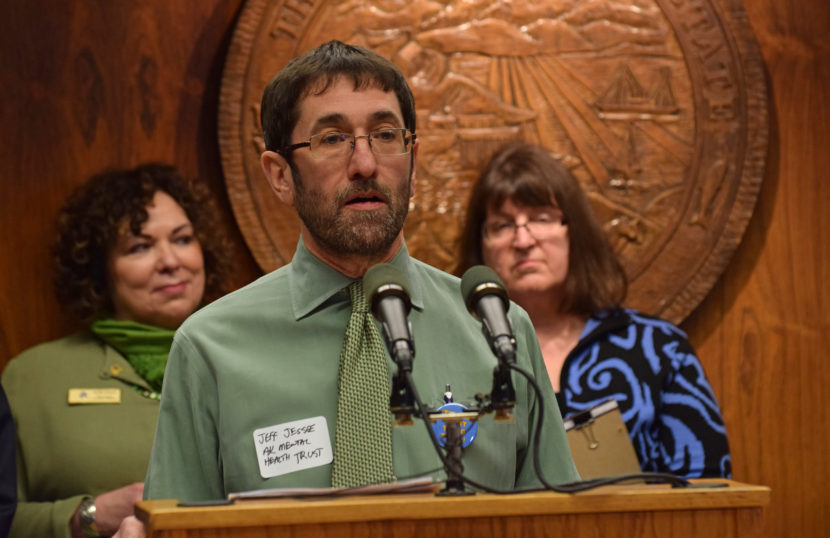
Jeff Jessee has officially resigned as CEO of the Alaska Mental Health Trust and will take a new position as a program officer. Photo taken on March 17, 2015. (Photo by Skip Gray/360 North)
The change in leadership at the Alaska Mental Health Trust Authority was made official on Thursday. Many trust advisory boards and beneficiaries expressed concerns about the Board of Trustees’ unexpected October decision to hire retired Trust Land Office Director Greg Jones as the interim CEO.
Former long-time CEO Jeff Jessee officially resigned his position and will take a new post as a program officer.
The governor’s office signed an official memorandum on Tuesday allowing for the change, though Jones may only be hired on an interim basis.
In an email to concerned advisory board members and citizens, Deputy Chief of Staff John F. Hozey III wrote the changes were approved “on the condition that final decisions regarding a permanent CEO require consultation with the supporting boards.”
He also wrote that the governor will consider the concerns when deciding who to appoint to the board in the coming weeks. Trustee Larry Norene’s term expires March 1, 2017. He is eligible for reappointment.
“It is through the appointment process that the Governor can affect the direction of any board,” Hozey wrote. “It is not appropriate for the Governor’s office to micro-manage individual actions that are within the legal responsibility of any board.”
During Thursday’s Trust board meeting, Trustee Jerome Selby asked the board to reconsider the decision.
“I’m gravely concerned, Mr. Chairman, because I think we heard some good input yesterday from a number of folks [during public comment] that maybe we need to step back, slow down a little bit,” he said. “We’re moving too fast. Our house is not in order.”
The seven-member board voted along the same 4-3 split as the original decision to replace Jessee.
Jones, the new CEO, was not present at the meeting because of a previously planned trip.
During an interview, board chair Russ Webb said shifts in leadership are normal and often make people feel anxious and uncertain, but things will quickly smooth over. He said they listened to the community’s comments with interest.
“I think unfortunately there’s much of the issues related to this are not a matter that can be made of public record,” Webb said.
Other board members, during and after the October 26 meeting, said they thought the decision-making process to change the CEO indicated potential violations of the Open Meetings Act.
Webb said those allegations “are neither true nor correct.”
“I won’t further address allegations made by anyone,” he said. “I think it’s frankly beneath me to do so.”
The Board of Trustees has authorized up to $35,000 to be spent on a facilitated training session on the Ethics Act and the Open Meetings Act, and a discussion of the reorganization of the Trust Authority. It will be led by the Trust’s independent counsel, Nelson Page, through a separate contract.
Close
Update notification options
Subscribe to notifications
Subscribe
Get notifications about news related to the topics you care about. You can unsubscribe anytime.