Alaska Public Media

Alaska Public Media is one of our partner stations in Anchorage. KTOO collaborates with partners across the state to cover important news and to share stories with our audiences.

Local corporation sues city of Utqiagvik to halt name-change

Updated 3:29 p.m. Dec. 1: A local native corporation is suing the city formerly known as Barrow, demanding it halt the official name-change to Utqiagvik. At least for now.

The official switch from Barrow to Utqiagvik went into effect on Dec. 1, but city officials said they would hold off on changing any signs, letterhead, or anything else until the lawsuit is settled.

The suit was filed Wednesday by lawyers representing Ukpeagvik Inupiat Corporation, or UIC. In materials submitted to the state court, UIC alleges the city council voted to put the name-change on the Oct. 4 municipal ballot “without providing the required notice to the Barrow public.”

The filing also claims that after repeated requests, city officials have failed to provide any public notices or meeting minutes about the name-change ordinance from when it passed Aug. 25, a possible violation of municipal rules.

The main contention of the lawsuit is that the city council’s actions led to the “passage of a flawed law.”

UIC asserts that “Utqiagvik”, which is translated as “the place to gather wild roots,” is a corruption of the name that appears in primary sources. The suit cites 1978 testimony from an Inupiaq elder that the indigenous name was in fact Utkqiagvik, which means “the place where we hunt snowy owls.” Because of the speed with which the city council passed it’s ordinance, knowledgeable elders weren’t consulted, according to the court filings.

UIC, claims the change is costing the city money with a growing list of expenses to change signage, letter-head, and employee hours spent amending language in contracts. UIC says that’s at odds with the fiscal note attached the measure when voted on by area residents. According to an affidavit from former North Slope Borough Mayor Charlotte Brower the full cost for implementation could be in the millions.

All of this is happening as the city council itself voted Nov. 30, to bring a potential repeal of the name-change measure before voters in January. According to the motion filed with the court, the council’s meetings this week were so well attended that extra chairs had to be brought into chambers — a stark contrast to the sparsely attended August meeting. After Wednesday’s meeting, a vote on whether to repeal the name-change measure is now scheduled for Jan. 25.

The main contention of the lawsuit is that the city council’s actions led to the “passage of a flawed law,” and risks spending money to change signs, contracts, and seals that won’t be able to be recovered.

Fannie Suvlu is the mayor of Utqiagvik, and presided over the ceremonial renaming earlier Thursday afternoon. She said the city appeared in court today, but it hardly settles the matter as it waits for judgement.

“As far as money being spent on like changing signage around town I believe once we have a clearer idea of what’s actually happening in the court system I’ll have a better opportunity to address that question,” Suvlu said.

Suvlu has also introduced an ordinance to the city council that would put the issue back before voters, asking whether they’d like to repeal to name change. She said that could appear during a special election in March.

Utqiagvik city council member Qiayaan Harcharek said that members were disappointed that money was being spent by the local native corporation on the name issue.


Earlier version

Originally posted 2:24 Dec. 1: A local native corporation is suing the city formerly known as Barrow, demanding it halts the official name-change to Utqiagvik. At least for now.

The official switch from Barrow to Utqiagvik is scheduled to go into affect today.

But a temporary restraining order was filed Wednesday by lawyers representing Ukpeagvik Inupiat Corporation, or UIC. In materials submitted to the state court, UIC alleges the City Council voted to put the name-change on the October 4th municipal ballot “without providing the required notice to the Barrow public.” The filing also claims that after repeated requests, city officials have failed to provide any public notices or meeting minutes about the name-change ordinance from when it passed on August 25th, a possible violation of municipal rules.

The main contention of the lawsuit is that the city council’s actions led to the “passage of a flawed law.”

UIC asserts that “Utqiagvik”, which is translated as “the place to gather wild roots,” is a corruption of the name that appears in primary sources. The suit cites 1978 testimony from an Inupiaq elder that the indegenous name was in fact Utkqiagvik, which means “the place where we hunt snowy owls.” Because of the speed with which the city council passed it’s ordinance, knowledgeable elders weren’t consulted, according to the court filings.

UIC, claims the change is costing the city money with a growing list of expenses to change signage, letter-head, and employee hours spent amending language in contracts. UIC says that’s at odds with the fiscal note attached the measure when voted on by area residents. According to an affidavit from former North Slope Borough Mayor Charlotte Brower the full cost for implementation could be in the millions.

All of this is happening as the city council itself voted Nov. 30, to bring a potential repeal of the name-change measure before voters in January. According to the motion filed with the court, the council’s meetings this week were so well attended that extra chairs had to be brought into chambers — a stark contrast to the sparsely attended August meeting. After Wednesday’s (Nov. 30) meeting, a vote on whether to repeal the name-change measure is now scheduled for January 25th, and UIC’s lawsuit is asking for a delay in implementing the change that was scheduled to go into effect today. The risk, council members says, is to public finances, which would be impossible to recovered if spent changing a name residents ultimately reject in a few weeks.

An official ceremony recognizing the restoration of the Inupiaq name was scheduled for Thursday (Dec. 1) afternoon just an hour ahead of a 2 p.m, court hearing.

This is a developing story, check back for updates.

Palin for VA? She seems eager

Former Alaska Gov. Sarah Palin speaks at the 2016 Politicon at the Pasadena Convention Center in Pasadena, California, June 26, 2016. (Creative Commons photo by Gage Skidmore)

The Donald Trump transition team hasn’t named a secretary for the Department of Veterans Affairs yet, but news broke Wednesday that ex-Alaska Gov. Sarah Palin is vying for the job.

Several news outlets, including ABC, NBC and the New York Times, report Palin is interested in running the Department of Veterans Affairs and is under consideration. The news accounts cite unnamed aides close to Palin and the Trump team.

Palin acknowledged the reports on Facebook and Twitter. She posted a link to the ABC story, and reposted a video of her speaking about veterans. It begins with accolades from her son-in-law, Medal of Honor recipient Dakota Meyer.

“The amazing woman that I’m introducing knows what veterans have been through,” he says on the video. “She knows because she’s lived it.”

Palin’s son Track is an Army veteran who served in Iraq in 2008. At campaign rallies for Trump, and at national conservative conferences, she has repeatedly spoken about vets’ issues. In one, Palin criticized VA bureaucracy, which she said is killing vets, and she offered a three-point plan to help.

“First, with health care: Give vouchers for treatment outside the VA,” she said in a 2015 speech, which she used as the foundation for a video to promote SarahPAC, her political action committee.

That seems to be the approach Congress took with the VA Choice card. But vets, particularly in Alaska, complain the program adds more layers of bureaucracy.

Palin’s second suggestion was to make it easier for skilled vets to get civilian jobs.

“Let them use the skills they learned in the military,” she said on the video. “Let them test out, and their military certification can transfer over. Common sense.”

That common sense has occurred to others, too. It’s the aim of multiple laws and government programs, stretching back years. Palin’s third point was that Congress should secure veterans benefits and not cut them.

Last year, Palin told CNN she wanted to be Trump’s energy secretary.

“Because energy is my baby. Oil and gas and minerals – those things that God has dumped on this part of the Earth for mankind’s use,” she said in that interview.

Palin’s name has also been floated as a possible secretary of the interior, the department that manages most federal lands and regulates oil and gas development. But another former governor is said to be on the short list for interior – Mary Fallin of Oklahoma.

Sen. Dan Sullivan, who sits on the Senate Veterans Affairs Committee, served as state attorney general under Palin. Sullivan spokesman Mike Anderson said in Alaska, with the highest number of vets per capita, the VA job is critical.

“Sen. Sullivan has much respect for Gov. Palin and believes our state would be well served with an Alaskan serving in President-elect Trump’s cabinet,” Anderson said.

Palin may have a champion in Steve Bannon, Trump’s chief strategist. In 2011, Bannon made a two-hour movie lauding the former Alaska governor for her guts in taking on the establishment.

But it’s not clear Palin is the favorite for the job. Former U.S. Sen. Scott Brown of Massachusetts has been spotted in the lobby at Trump Tower, and he told reporters he thinks he’s the best candidate for VA secretary.

ACLU sues Alaska over abortion restrictions

Blind Lady Justice with scales
(Creative Commons photo by Marc Treble)

The ACLU of Alaska Wednesday filed suit against the state challenging restrictions on second trimester abortions. Planned Parenthood Votes of the Great Northwest and Hawaii and the Center for Reproductive Rights joined ACLU as plaintiffs.

Joshua Decker, ACLU Alaska executive director, said three ’70s-era restrictions are obstacles to women’s reproductive health, because they ban second trimester abortions in out-patient clinics and force some women to seek abortions out of state.

“The reason we are doing this is because abortion is incredibly important,” Decker said. “One out of every three women will have an abortion in her lifetime. The number one reason in terms of women’s ability to fully and equally participate in lives of Americans in terms of economic prospects, in terms of jobs, in terms of education. It is the ability to decide by themselves and in consultation with their physicians, when and if to have a pregnancy be carried to term, when and if to have a child, when and if to become a parent.”

The restrictions require Alaska abortion providers to get a second opinion, to have blood and plasma supplies on hand at the clinic, and to have an operating room immediately available.

Tara Rich, legal and policy director for ACLU Alaska, says the suit challenges the constitutionality of the restrictions under Alaska Constitution provisions for privacy, equal protection and due process.

“So the Alaska Supreme Court is a much stronger test than the federal constitution,” Rich said. “Which is that an infringement on a women’s right to abortion cannot present an undue burden to that woman’s right. So we are challenging these regulations under the Alaska Constitution, not the federal constitution.”

Jessica Cler, public relations manager for Planned Parenthood Votes Northwest and Hawaii, said Planned Parenthood sends about 30 women a year out of state to its clinics in Idaho and Washington state for second trimester abortions.

State Department of Health and Social Services public information officer Rebecca Lynch said the department is not issuing a statement on the legal challenge at this time.

ACLU Alaska joined with ACLU in Missouri and North Carolina in filing lawsuits against abortion restrictions in those states on Wednesday.

Alaska fire crews battling blazes in Southeast U.S.

A burned-out car sits on the side of a road near Gatlinburg, Tenn. (Video screenshot from the Tennessee Department of Transportation)

Dozens of Alaska firefighters are battling blazes in the Lower 48, including deadly Tennessee fires that have destroyed or damaged hundreds of buildings.

Fire crews from around the United States are working to extinguish more than a dozen blazes around Gatlinburg and Pigeon Forge, Tennessee, which have left seven people dead, as of noon Wednesday.

Alaska Division of Forestry Public Information Officer Tim Mowry said more than 20 Alaska-based staff were in Tennessee earlier this week, when the fire became deadly.

“That night before, I talked to one of our guys down there and he said the winds were blowing in excess of 80 miles an hour,” Mowry said.

More than 700 buildings have been damaged or destroyed in Sevier County.

At its peak, about 110 Alaska-based personnel were scattered around the Southeast U.S. fighting fires in the drought-stricken region.

Mowry was among the deployed, and spent two weeks working in North Carolina.

He said Alaskans are filling a variety of roles ranging from support staff to initial attack crews.

“Helping engage fires in several states: Alabama, Arkansas, Georgia, North Carolina, South Carolina, Tennessee, Virginia, Kentucky, Mississippi,” Mowry said. “It’s really dry down there and all the states are having extreme fire danger.”

And, Mowry said fire conditions there are much different than those that crews are used to battling in Alaska.

“It’s mostly leaves that have dropped from the trees, and these fires are burning across the forest floor, and these leaves can get blown around and create spot fires,” Mowry said. “And I think that’s when you had winds in excess of 80-mile-per-hour in that Tennessee incident, it’s really hard to do anything with fire like that that moves so quickly — it’s almost like a grass fire.”

While basic firefighting principles remain generally the same from fire to fire, Mowry said the difference in a fire’s fuel can require that crews use different tactics than those used in Alaska’s backcountry.

“One of the big pieces of equipment that firefighters were using on our fire were leaf blowers, because these leaves were continually falling down and blowing off trees,” he said. “And so they were constantly having to go back and clear areas with leaf blowers and rakes and things like that.”

Mowry said it was a interesting, yet positive experience to work in an area where residents aren’t as accustomed to dealing with destructive, large-scale fires.

“People were very, very supportive; very appreciative of not just Alaska, but every state that responded to the call to send folks there to help,” Mowry said. “That was impressive to see, and you see that all the time everywhere, but it just seemed like this was an unusual sort of a historic event for them, and they were very thankful.”

About 75 Alaska-based personnel remain in the region.

Funding to fight the fires, which includes bringing Alaska crews down south, comes from a mixture of federal agencies and the states where fires are being fought.

Deadline nears for Murkowski’s far-reaching energy bill

Time is running out on one of Sen. Lisa Murkowski’s top priorities: a far-reaching energy bill.

Murkowski had hoped the legislation would serve as her crowning achievement after two years as chairman of the Senate Energy Committee.

But Senate Republican Leader Mitch McConnell on Tuesday listed a substantial number of priorities for the remaining weeks of the lame duck session.

The Kentucky senator sounded both hopeful and doubtful about negotiations with the House over Murkowski’s bill.

“We still have some hope the energy conference report will come together before the end of this week,” he told reporters at a news conference outside the Senate chamber.

To craft the bill Murkowski deployed a strategy that’s become somewhat rare in Congress: She let the minority participate.

The result is a bill that would help the fossil fuel industry and also promote renewables and efficiency.

Getting it into law is a test of Murkowski’s legislative ability and of her moderate approach.

Since the election, some Republicans see less need to compromise.

Murkowski said she met with her House counterparts before Thanksgiving and explained why, as she sees it, it’s unwise to ditch the bill and try again next year, when Republicans will control the White House as well as Congress.

“Because it doesn’t get easier next year, and we will have foregone all of the hard work that has gone into I think a pretty significant product that we built over two years,” she said.

House Republicans trying to negotiate the differences between the House and Senate bills have proposed a stripped-down version.

Murkowski and the top Democrat on her committee, Sen. Maria Cantwell of Washington, are pushing for provisions designed to appeal to both sides of the aisle, like speedy approvals for natural gas exports, renewal of the Land and Water Conservation Fund and help for hydropower.

In the Senate, it takes at least 60 votes to win just about any significant bill, and Murkowski points out, the Republicans lost two Senate seats in the election. So Murkowski says lawmakers really can’t afford to ignore the Democrats.

“In order to gain the support that we need, we’re going to have to make sure that we’re building bridges, not blowing them up.”

And for her bill, time is short.

The Senate is scheduled to be in session until mid-December, but a spokeswoman for Murkowski says the senator is trying to negotiate an agreement by the end of this week so it has time to pass both chambers.

Meet the new head of Alaskan Command: Gators fan, fighter pilot, erstwhile Alaskan

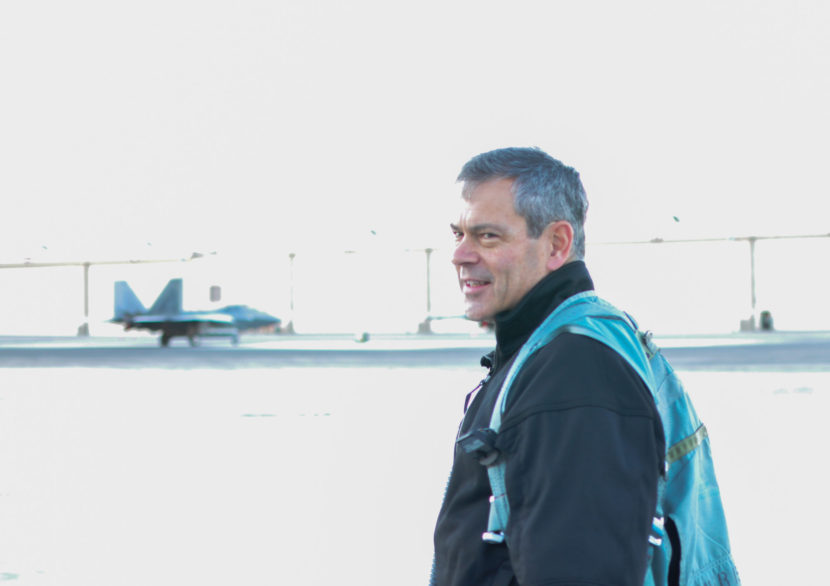
Lt. Gen. Kenneth Wilsbach walks out on the runway at Joint Base Elmendorf-Richardson to fly a training mission. (Photo by Zachariah Hughes/Alaska Public Media)

Alaska has a new top military commander. Lt. Gen. Kenneth Wilsbach started this August, taking over as head of the 11th Air Force, Alaska NORAD region and Alaskan Command from Lt. Gen. Russell Handy.

But this is hardly Wilsbach’s first time serving in the Alaska.

On a recent Wednesday inside a nondescript building nestled between airplane hangars at Joint Base Elmendorf-Richardson, eight fighter pilots in green jumpsuits huddled around a desk. A few ate handfuls of jalapeno popcorn as they listen to a pre-flight briefing.

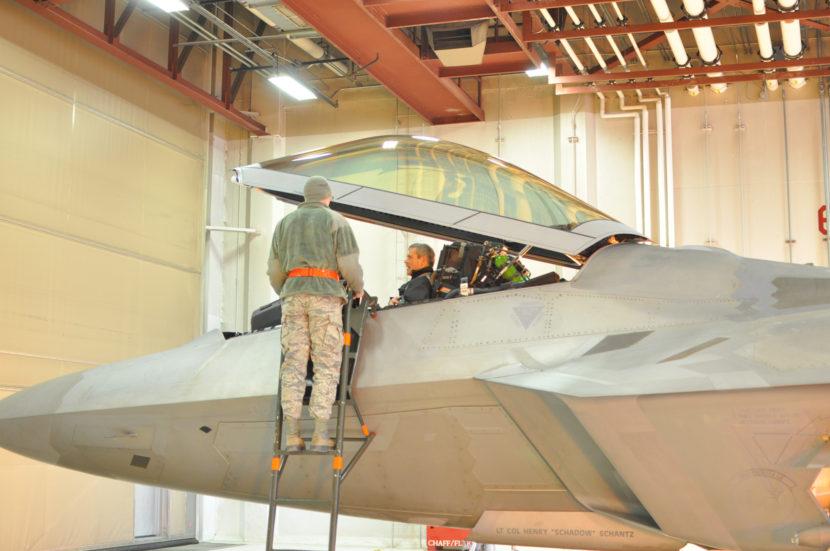
The pilots were getting ready to fly F-22 fighter planes for a training mission. Among them was Wilsbach, Alaska’s highest ranking officer, with duties sprawling all the way from JBER to installations in the Pacific.

Wilsbach rose through the Air Force flying and commanding fighter squadrons. As he walked out to a jet hangar buffeted by winds and temperatures in the teens, Wilsbach looked as calm as he was focused. Amid the din of roaring jet engines, he compared getting ready for flight to preparing for a sports game.

During an interview, Wilsbach lit up describing his lifelong love of flying: “I never met a plane I didn’t like.”

Lt. Gen. Kenneth Wilsbach prepares to depart in an F-22 for a training mission. (Photo by Zachariah Hughes/Alaska Public Media)

In spite of his high rank, Wilsbach still flies, which he believes informs his ability to command other pilots.

“I did this even when I was in Afghanistan, and I can’t tell you how valuable that was, for me to be out in the airspace conducting operations when my fellow generals were back in the headquarters,” Wilsbach said.

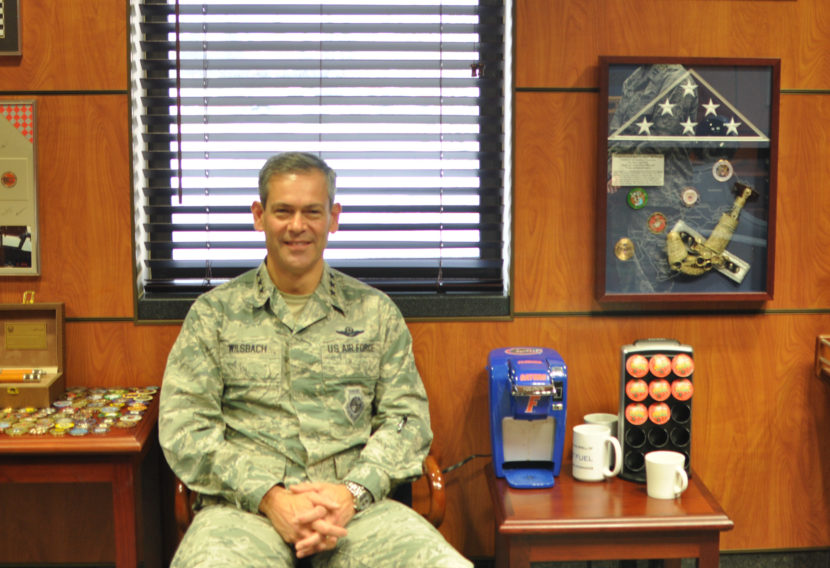
Inside his office, the general showed off commendations and gifts from his deployments around the globe, like a battle-ax from the United Arab Emirates, a framed sketch of the Soviet-built air tower at Bagram Air Base and a painted flight helmet from Okinawa, Japan.

“You can see it’s got my call sign, which is ‘Cruiser,’” Wilsbach said.

Wilsbach was reluctant to divulge details on his call sign.

“I can’t tell you that story,” Wilsbach said with a laugh.

On one side of the office was a coffeemaker emblazoned with a Gators logo for the University of Florida, where Wilsbach and his wife both went, and where he received his ROTC commission. The couple remain self-described “rabid fans” of the school’s sports.

Lt. Gen. Kenneth Wilsbach in his office, surrounded by mementos and awards, including a University of Florida Gators coffee-maker. (Photo by Zachariah Hughes/Alaska Public Media)
Lt. Gen. Kenneth Wilsbach in his office, surrounded by mementos and awards, including a University of Florida Gators coffeemaker. (Photo by Zachariah Hughes/Alaska Public Media)

In another corner of the room sit several bulky gray telephones used for classified calls around the globe.

“We try not to go through secretaries and middle people,” Wilsbach explained, pointing out a phone the size of a thesaurus with speed dial buttons to different high-ranking officers. “These are commanders talking to commanders on a classified phone.”

“This is just a regular phone, but you put a card in it, it scrambles and encrypts the signal, so I can talk secret on that one, as well,” Wilsbach added.

Wilsbach was stationed in Alaska from 1998 to 2002, and was in charge of an air squadron when 9/11 happened, which led to his first combat command.

But Wilsbach actually lived in Alaska once before. His dad was stationed on Adak in 1969, where he would camp and play among remnants of the Pacific campaign of World War II.

“It was certainly remote for my folks, but for a little kid it was great,” Wilsbach recalled.

Since his earlier postings in Alaska, the Air Force here and abroad has gone through substantial changes. Back then, the force was built to wage World War III and has since shrunk to the smallest it has ever been, primarily by shedding fighter squadrons. Instead, the current emphasis is on “intelligence, surveillance and reconnaissance,” staples of counterterrorism operations.

Alaska in some ways bucks that trend, however.

“We have about the same amount (of personnel) that we had here in the ’90s in Alaska, it’s been modernized, though,” Wilsbach said.

During his command, Wilsbach will oversee the installation of the newest generation of jet fighters to Alaska’s fleet. By 2022 there’ll be 54 F-35s here, doubling the size of Eielson Air Force Base in Fairbanks with 2,500 additional personnel and bringing up to $300 million in new construction, according to figures from Wilsbach.

Integrating those new tools smoothly into the military’s Northern and Pacific forces is one of the jet pilot’s main tasks in the years ahead.

Site notifications
Update notification options
Subscribe to notifications