Alaska Public Media is one of our partner stations in Anchorage. KTOO collaborates with partners across the state to cover important news and to share stories with our audiences.
Gov. Bill Walker announced Friday morning exactly how much Alaskans would receive in this year’s Permanent Fund Dividend check.
“There you go, $1,022,” Walker said. “So I’m glad that given our loss of 80 percent of our revenue that we are still able to have a dividend over $1,000 and I will look forward to working with the legislature to ensure that that will continue on for generations to come.”
Walker made the announcement in a pre-recorded video released Friday morning.
This year’s dividend checks could have been about twice as much, but Walker vetoed half the money appropriated to dividends earlier this year while the state battles a $4 billion deficit.
A standoff in Anchorage lasting more than 36 hours came to an end Friday morning.
The Anchorage Police Department says 69-year-old Robert Musser, who was barricaded in his home, is confirmed to be deceased.
APD says an investigation and autopsy will determine the cause and nature of Musser’s death.
Original story | 7:53 p.m. Thursday
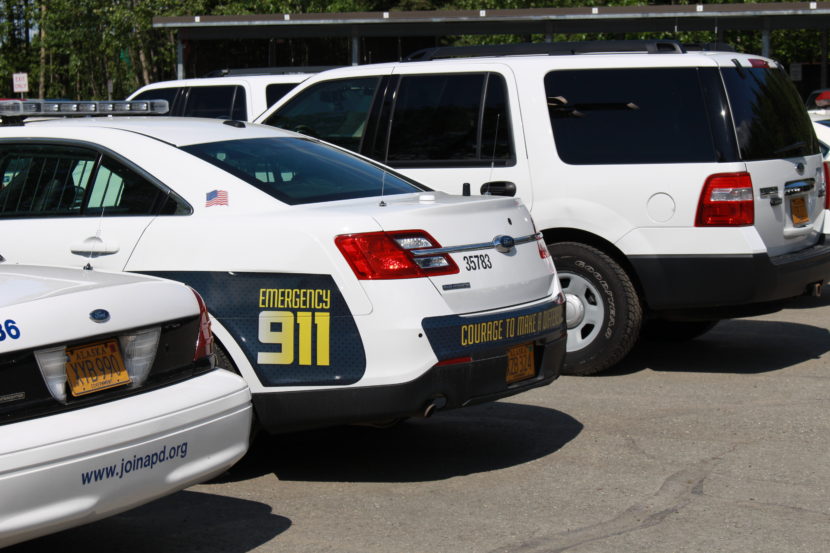
Anchorage Police Department vehicles, May 25, 2016. (Photo by Wesley Early/Alaska Public Media)
Police say a barricaded standoff in Midtown Anchorage is over. According to a release from the Anchorage Police Department, 29-year-old Joseph Szajkowski surrendered shortly after 3 p.m. once officers entered the barricaded home. Szajkowski is being held on charges of kidnapping and assault at the Anchorage jail.
Officers had been on the scene on Misty Springs Court, not far from the University of Alaska Anchorage campus, since early Thursday morning after getting reports of an assault.
Anchorage police spokeswoman Jennifer Castro said about a dozen people from APD responded and got assistance from the Federal Bureau of Investigation.
“A lot of our SWAT resources are dedicated over here,” Castro said, referring to a separate South Anchorage incident. She estimated dozens of officers had rotated through during the course of the last 24 hours, and said personnel from the Alaska State Troopers were on-scene assisting.
As of 4:30 p.m., that separate standoff at Ginami Street on the Anchorage Hillside continued. Castro identified the suspect as 69-year-old Robert Musser, who’s been charged with felony assault and recklessly firing a weapon.
He was suspected of shooting at workers trimming trees Wednesday on a utility easement. Police initially responded to a call just before 9:30 a.m. Wednesday that a man confronted employees of Carlos Tree Service, who were trimming trees for Chugach Electric near his hillside residence. According to an APD press release, the man yelled at the workers, then brandished a firearm and fired shots at the two employees.
The workers were not injured. Two officers were wounded by gunshots by a barricaded suspect.
“One officer was transported to a local hospital for treatment where he is expected to survive,” Castro wrote in a statement released at 12:48 p.m. “The other officer’s injuries were treated at the scene.”
That standoff has lasted for over a day.
“I’m not aware of a standoff lasting this long,” Castro said by phone from the Ginami Street location.
Shots were fired on officers around 4 p.m. Wednesday, according to APD, as police were preparing to use gas.
“The environment that we’re dealing with here is a little different from a lot of the ones that we traditionally respond to as far as barricaded subjects,” Castro said. “We have a much larger residence with a lot more things spread out.”
Castro declined to specify what kind of firearm was used against the two officers.
These are Anchorage’s second and third police standoffs since the start of the week. Why there have been so many standoffs in the last few days?
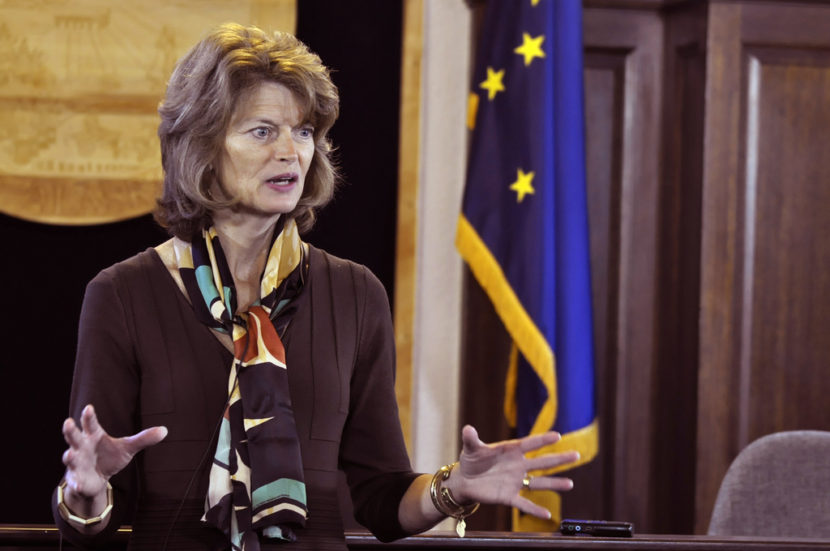
Sen. Lisa Murkowski talks with reporters during a press availability following her annual address to the legislature, Feb. 19, 2014. (Photo by Skip Gray/360 North)
U.S. Sen. Lisa Murkowski on Thursday morning brought some of her most controversial Alaska bills to the Energy and Natural Resources Committee, which she chairs. There are only a few legislative days left before Congress takes a recess for the election. The controversial bills stand almost no chance of passing in this Congress. But some, she hopes, will pack a punch anyway.
The most ambitious of the bills Murkowski brought to the committee reads like the Alaska delegation’s master wish list, the things they’ve been trying to convince Congress to pass for decades. The bill would open part of the Arctic National Wildlife Refuge to oil drilling. It would mandate lease sales in the National Petroleum Reserve-Alaska, and offshore. In the Tongass National Forest, it would allow new roads and carve out a new state forest. Murkowski said Alaska needs to develop these federal resources.
“Right now we’re facing pretty much a brick wall of opposition in these areas,” she said.
Conservation groups and their Senate allies sound the alarm and deploy the polar bear suits when efforts like these seem close to passage. This did not appear to be one of those times. The top Democrat on the committee, Maria Cantwell of Washington, objected, but dryly, almost parenthetically.
“I fought for many years to protect the Arctic National Wildlife Refuge, the Tongass National Forest and important conservation lands in Alaska which are important to all Americans,” she said.
Murkowski later told reporters that some of the provisions are intended to stake out her position on new oil production, for instance, for this administration or the next. One of her bills calls for the Interior secretary to develop a plan to add half a million barrels of oil per day to the trans-Alaska pipeline.
“OK, we know that’s not something we’re going to see. It’s not going to happen within that Congress,” she said. “That is certainly telling the next administration, ‘I want to see what your plan is. Here’s our plan, here.’”
The senator says other provisions are realistic before President Barack Obama leaves office. She cited the Alaska Mental Health Trust land trade. It would allow the trust to get land in the Tongass to avoid logging near Ketchikan and Petersburg.
Murkowski saved most of her passion for the long-disputed King Cove road. It would connect King Cove to an all-weather airport at Cold Bay, but it would go through the Izembek Wildlife Refuge. Murkowski keeps count of the number of emergency medical evacuations King Cove residents have endured since Interior Secretary Sally Jewell rejected a land trade for the road in 2013. It’s 52 so far. Jewell wasn’t at the hearing, so Murkowski gave BLM Director Neil Kornze a message to deliver to the secretary and to the president.
“Under their watch, people have been living in fear, in trepditation and with pain and suffering that could have been addressed,”she said. “It’s unexcusable, and I’m not backing down on this. One way or another … the people of King Cove are going to find safety. That’s the message you can take back.”
Kornze said he would.
Murkowski says she’s sure the administration is just running out the clock so it can wash its hands of King Cove, but with her words and bills, she aims not to let them forget it.
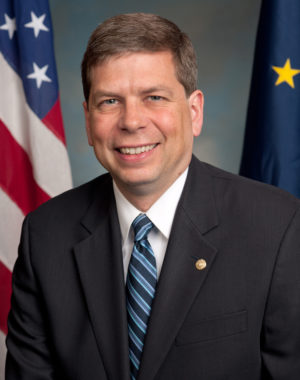
U.S. Sen. Mark Begich, D-Alaska. (Public domain photo)
Former Sen. Mark Begich says he will not enter the U.S. Senate race this year in the contest for Sen. Lisa Murkowski’s seat.
“I will tell you it’s a tough decision. It’s been a tough decision, over this last week especially. I feel like it’s not the right time for me and my family,” he said.
Begich spoke to Rick Rydell on 650 KENI Thursday morning. He said supporters asked him to consider running a write-in campaign after Joe Miller unexpectedly joined the ballot this month in the Libertarian slot. Begich, though, did offer some observations on the race. He said it won’t be a replay of the 2010 Murkowski-Miller brawl.
“Joe has much more controlled presentation. He’s not like he was six years ago. I think that election gave him a lot to think about,” he said.
Begich said it’s Murkowski’s race to lose, but he’s predicting a low turnout, which he said would favor Miller. On the other hand, he said, voters might opt for one of the lesser known candidates in the race — independent Margaret Stock or Democrat Ray Metcalfe.
“I think here’s what may happen: People may, like in the Clinton-Trump race, say, ‘OK, I’m not sure I like either one. I’m going to vote for somebody different,’” he said.
Begich was noncommittal on whether he plans to run for governor in two years and he acknowledged there’s speculation he might become interior secretary if Hillary Clinton wins the presidency.
Federal prosecutors in Alaska have charged four men with killing walrus gathered on the state’s northwest shore last year, removing the animals’ ivory tusks and leaving the meat to waste.
Prosecutors say the four residents of the village of Point Hope twice caused several hundred walrus to stampede, knowing that smaller animals in the herd could be crushed.
A person connected to a remote Air Force radar station in mid-September 2015 photographed 25 dead walrus at Cape Lisburne about 230 miles northeast of the Bering Strait.
Twelve pups were among the dead.
Only Alaska Natives who live in the state may hunt walrus. Prosecutors say all four men were qualified to take marine mammals for subsistence purposes.
Walrus killed only for ivory is considered wasteful and head-hunting is illegal.
Sen. Lisa Murkowski says the Navy is again snubbing the concerns of Alaskans as it prepares for the next Northern Edge, a military exercise held every two years that stretches from the Gulf of Alaska into the Interior.
The next Northern Edge is scheduled for May.
More than 100 Alaskans sent her letters this summer with concerns about the potential impact of the exercise, particularly on fish and marine mammals, she said.
“When the exercise moved forward in 2015, after a great deal of concern being expressed by the coastal communities, there was assurance by Navy (that) ‘well, after the exercise, we’ll basically provide answers to the questions people have,’” Murkowski said. “And they haven’t done it.”
Murkowski sent a sternly worded letter to the secretary of the Navy last week calling for more transparency.
She also chided the Navy for denying Alaska biologist Rick Steiner’s request, under the Freedom of Information Act, for reports on the impact of Northern Edge 2015.
Two years ago, military representatives said people were misinformed about the scope of the exercise.
They said environmental impact documents described dropping far more ordinance into the Gulf than the Navy actually intended to use.
Today, Air Force Capt. Anastasia Wasem, a spokeswoman for Alaskan Command, said the military is finalizing its public outreach plans.
“So far they include having representation at events such as the Alaska Federation of Native. Also the Alaska Forum on the Environment and CommFish,” she said. “And in addition to that, we’re going to be trying to work with the cities of Kodiak, Cordova, Homer and Seward to go to meetings for their Chamber of Commerce and city council, and also perhaps Rotary Clubs.”
Wasem says the exercise was moved from June to May, in part so the military can save money on airfares and lodging, and also so its aircraft won’t complicate air traffic control during high wildfire season.
Close
Update notification options
Subscribe to notifications
Subscribe
Get notifications about news related to the topics you care about. You can unsubscribe anytime.