Alaska Public Media is one of our partner stations in Anchorage. KTOO collaborates with partners across the state to cover important news and to share stories with our audiences.
A man at the Wildwood Correctional Complex died by apparent suicide Tuesday, though his death is still under investigation.
According to a State Trooper dispatch, Walter Shade, 30, of Soldotna was arrested and sent to Wildwood Pre-Trial Facility on September 1 for stealing $3,000 worth of tires from a store earlier this summer.
Department of Corrections spokesman Corey Allen-Young said Shade was found unresponsive in the shower about noon.
Medical staff and first responders could not resuscitate him.
The exact details of his death are under investigation by the department, the Medical Examiner’s Office and the State Troopers.
Shade was not under any extra supervision, Allen-Young said. He does not know if Shade was under suicide watch, undergoing any ongoing medical treatment or experiencing a diagnosed mental illness.
This is the ninth in-custody death this year. Joel Titus, 40, died at the Fairbanks Correctional Center on Sept. 3 while taking medication for alcohol detoxification.
In a last-minute bid to overturn a Matanuska-Suisitna Borough ballot initiative banning commercial marijuana, some cannabis supporters have served the Borough with a lawsuit.
The complaint wants the courts to force the Borough to take the initiative off the October election ticket, and the outcome of the case could have widespread implications.
The lawsuit, filed Tuesday in state Superior Court in Palmer, comes just a month before the Mat-Su Borough election.
The legal action alleges the Borough’s ballot initiative banning commercial marijuana grow and retail operations throughout the Borough, is invalid, because it violates state statues requiring planning commission review of land use ordinances.
Ronda Marcy sits on the Borough’s marijuana advisory committee and filed the suit with Thomas Hannon.
They’re also suing former Borough mayor Larry DeVilbiss and fifteen of the petitioners who sponsored the initiative. Marcy alleges the sponsors began collecting petition signatures prematurely.
“They were started before the law allowed them to do so.”
And she says, the initiative wording is confusing because it asks voters to make the marijuana industry illegal but allow the hemp industry to continue. It presents two questions in one initiative, which violates state law, she said.
“If the cannibis community is being brought in to follow the laws, then the other communities, like local governments, should also follow the laws.”
Borough attorney Nick Spiropolous said the suit caught the Borough by surprise. He was still evaluating it Wednesday.
“From my perspective, most of it focuses on the claim that this is a planning law, and that there are prior cases out there that say you cannot do planning laws by initiative,” he said. “They say, this is a planning law, and you can’t do planning laws by initiative, and then ask for the relief.”
The plaintiffs have asked the courts for expedited consideration and for injunctive relief to take the question off the ballot, or to have the ballots not counted if they are voted on, or to have the law not take effect if it passes, Spiropolous said.
“The Borough’s response will be that we did not act illegally, beyond that, I can’t really say.”
If the plaintiffs win their case, then the outcome could have implications for other local government cannabis ordinances.
Within the Borough limits, the cities of Palmer and Houston both have established commercial marijuana regulations through voter initiative, rather than through planning and zoning power.
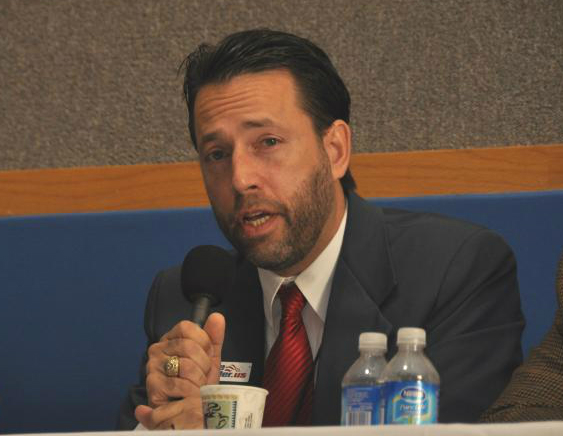
Fairbanks attorney Joe Miller announced Tuesday that he will challenge U.S. Sen. Lisa Murkowski after all.
Miller said Libertarian nominee Cean Stevens has withdrawn from the race and her party’s leadership agreed to let Miller appear on the general election ballot in her place.
Six years ago, Miller ran as a Tea Party-style Republican and beat Murkowski in the primary. Murkowski retained her seat, though, by mounting a write-in campaign for the general. By then, Miller’s campaign was sinking under a pile of revelations about his past, and the handcuffing of a news reporter at one of Miller’s campaign events by men acting as Miller’s security guards.
In his emailed announcement of his candidacy, Miller accuses Murkowski of being too liberal and said he’s running to offer voters a real choice.
Other candidates in the race include Independent Margaret Stock and Democratic nominee Ray Metcalfe.
A pioneer of Alaska mushing, who along with her husband, Earl, helped establish the oldest kennel for Siberian huskies in the world, has died.
Natalie Norris of Willow, Alaska, died Sunday, Aug. 28, 2016, “peacefully and in the presence of family,” according to a Anadyr Siberians Facebook page post.
Norris grew up in Lake Placid, New York, in the 1920s, when it was still common to see people driving dog teams.
She began collecting dogs at a young age, eventually competing in sled-dog races across New England.
Norris made the rare, bold move to Alaska in 1946 as a young, unmarried woman, taking with her nine dogs.
“Shortly before her move, Grandma was featured on the cover of this national magazine,” granddaughter Lisbet Norris said in a phone interview. “It was a picture of her, in her parka with one of her big beautiful Malamutes. And somebody mailed that magazine to my grandfather.”
Natalie Norris, then Natalie Jubin, from the cover of This Week magazine in December of 1945. Photo via Histoire des courses mythiques et des grands mushers)
“(Earl Norris) was already in Alaska. And when he read that she was planning on moving out there — soon as possible — he immediately wrote to her and offered to help in any way that he could. I think he was quite smitten by her photo,” Norris said with a slight laugh.
So smitten, in fact, that he met her at the dock, and not long after they married.
From the beginning, Norris’s life in Alaska was an inseparable mix of family, dogs, and the outdoors.
The young couple established their Anadyr Siberian husky kennel the same year they wed.
They raised their three children on a 120-acre homestead in Anchorage before moving to Willow in 1967, where the kennel has remained ever since.
Throughout, Natalie continued racing dogs.
“She was one of the earliest competitors of the Fur Rondy race in Anchorage,” Lisbet Norris said. Decades later, in the 1970s, Natlie won the Women’s Open North American. “That was kind of the culmination of her racing career.”
Norris’s real focus and passion was on Siberian huskies as a breed.
She traveled the world judging competitions and lecturing on the line’s traits.
Breeding and mushing Siberian huskies has stayed part of the Norris family itself. The kennel is now run by Norris’s son, J.P., and her granddaughter, Lisbet, has finished the Iditarod the last three years.
“They’re athletes,” Lisbet said of the family’s huskies, “and we believe that training and conditioning them for racing is the best benchmark for the breed.”
Lisbet Norris was extremely close with her grandmother, living in the same house with her for several years until just a few months ago.
It was her grandmother’s character, more than accomplishments, that have had the greatest influence on her.
“She was really the epitome of a pioneer woman. She was so gracious and kind to everybody that walked into that house. And she was a mentor to so many, including myself,” Norris said through tears. “I take a lot of comfort in knowing that I’m following in her footsteps today.”
Instead of holding a formal service, the family is planning a picnic this spring, “accessible by dog team, skis, or snowmachines,” along the nearby trails named for Natalie and Earl Norris.
Natalie Norris was preceded in death by her husband, Earl Norris, who died in 2001 at the age of 81.
The Salvation Army is collecting coats for school-age children again this year, and they are relying on more individual donors.
The organization is hoping to collect enough money and new or slightly used coats this year to help 3,000 kids from kindergarten to 12th grade.
Salvation Army Capt. Diana Gomes said they distributed 2,000 coats in the city last year, and it wasn’t enough.
“It’s very hard because it’s first come, first served, and the families are in line by the time we open. Like said, by noon (on distribution day), we were done with most of the large coats.”
She says they are hoping for more community contributions because one of the organization’s major donors is supporting other programs this year instead of Coats for Kids.
Salvation Army Communications manager Thomas Brown said they are also anticipating a greater need because of the economic downturn.
Salvation Army officers around the state are receiving more requests for help, especially for seniors, he said..
The Department of Defense is in the middle of a massive makeover in how it provides health care to soldiers and their families. The top official in charge of the new Defense Health Agency came to Alaska for her first visit. She spoke about how the military wants to provide care that’s not only better but smarter.
Inside a conference room at the hospital on Joint Base Elmendorf-Richardson, Raquel Bono is warm and casual. So much so that her assistant slides her a note:
Rear Admiral Raquel Bono, Chief, Medical Corps, United States Navy (Photo courtesy of the U.S. Navy)
That’s the Navy’s equivalent of a lieutenant general, putting Admiral Bono right beside Alaska’s most senior military commander. But you’d never know it by her disarming manner and eagerness to talk about how the military is changing its healthcare model.
“What we do is we provide the infrastructure support to Army medicine, Navy medicine, and air force medicine, so they can deliver the health care and the health services to all of their beneficiaries,” Bono said.
The military used to provide healthcare for millions of service members and their family in separate silos: the Army had its own healthcare, so did the Navy, so did the Air Force. But beginning in 2011, the military began streamlining.
“So instead of having like three heads of pharmacy, we would just have one,” Bono said.
Bono took over last November, just a month after the reorganization process was complete. Now, Bono’s agency is getting ready to roll out an electronic records system. They’re also trying to take lessons learned from the last 15 years of combat overseas where the military dramatically improved trauma care.
“The piece that came out of that was that it wasn’t a singular or a series of singular episodes of care: it had to be holistic, we had to include the family members. And that model, we’re realizing, is what we want to be able to provide in all of our healthcare services.”
Bono came to Alaska to see how the bases here are delivering care, and whether there are problems on the ground that she and her staff might not be aware of at their offices back in Virginia. In some ways Alaska and its bases are ahead of the curve: the Army and Air Force have collaborated for years at their joint base in Anchorage. Veterans can get treatment at the hospital here on base, even though that’d normally be reserved for folks that are still active-duty. Those are the kinds of integration the DHA is looking to replicate. But this is not been the sort of nimble innovation the military is known for.
“We were so accustomed to kind of doing things in the same way, over and over again, and to find a solution that’s really sustainable will really require us to think differently,” Bono said.
The sustainability piece is huge. DHA’s budget request for the next fiscal year is 33-and-a-half billion dollars. Bono said that spending level is buying taxpayers a healthcare system that’s increasingly designed around the needs of service members, rather than asking them to design their lives around it. The prospect of overhauling two of the densest bureaucracies in the country – healthcare and the military – sounds daunting. But when I asked Bono if she likes her job, I got a surprise.
“I love it, because…sorry…I really believe that the people who serve in uniform and the families of those of us in uniform can serve, deserve to be at the top of the game all the time,” Bono said.
And doing that, Bono said, means having a health care system that can meet everyone’s needs.
Close
Update notification options
Subscribe to notifications
Subscribe
Get notifications about news related to the topics you care about. You can unsubscribe anytime.