“I write stories that shine a light on environmental problems and solutions. In the words of Rachel Carson, ‘The public must decide whether it wishes to continue on the present road, and it can do so only when in full possession of the facts.’”
When Alix isn’t asking questions, you can find her hiking, climbing or buried in a good book.
Electric Capital Transit buses await passengers at the downtown transit center on Monday, March 17, 2025. (Photo by Clarise Larson/KTOO)
Juneau’s Valley Transit Center will soon have a new charging station for the city’s fleet of electric buses.
Construction will begin March 31 and should be completed in mid-July, according to Capital Transit Superintendent Rich Ross.
The city will close the parking lot, restrooms and the public electric vehicle chargers off of Mendenhall Mall Road during installation. Pick-up and drop-off will be temporarily moved to the park & ride lot next door.
The two new chargers will serve seven electric buses that arrived in December. Capital Transit drivers have been using slower chargers at their bus barn on Bentwood Place, which can take six hours to fully power up a bus when it’s dead. The new chargers should cut that time down to two hours, Ross said, and the more convenient location will keep buses on-route longer.
The charging station project is estimated to cost roughly $1.6 million dollars, most of which was provided by the Alaska Department of Transportation and Public Facilities. The city is covering $160,759.
The first electric bus that Capital Transit tested, made by Proterra, was out of commission for more than a year due to numerous repairs. The new buses were made by a different manufacturer, Gillig, which also made the city’s diesel buses.
Ross said that he was nervous about how the new electric fleet would perform, but so far “these are a completely different animal than that first bus we tried,” he said. “I think it’s a good value for the community.”
All of the new electric buses should be on the road in June, Ross said.
Correction: A previous version of this article misspelled Bentwood Place.
Mendenhall Glacier on Friday, Feb. 21, 2025. (Photo by Clarise Larson/KTOO)
Listen to this story:
Glaciers shape the land and lives of Alaskans — carving mountains, funneling cold freshwater into rivers, carrying nutrients to the sea and reflecting sunlight back to space.
Friday marked the first-ever World Day for Glaciers, a day observed by the United Nations to sound the alarm on the accelerating pace of global melting. Scientists who study Alaska glaciers spoke about their research to uncover how these rapidly changing systems affect our world.
Kiya Riverman studies what makes glaciers flow as a glaciologist and associate director of the Juneau Icefield Research Program.
“Often we have this sense that glaciers are this really static thing,” she said.
Before and after pictures show glaciers retreating, sure, but usually over the span of years and decades. It’s much faster than that, she said.
“They’re almost like living, breathing creatures that change a little bit every day,” she said.
They speed up in the heat of the day, and slow down as they cool at night.
Glaciers make up an area of land in Alaska nearly equal to the size of West Virginia — but we’re losing them quickly. The state is warming two or three times faster than the global average, and glaciers here have shrunk more — in gigatons per year — than anywhere else since the turn of the century.
As the ice melts, the average global sea level rises. Although this doesn’t directly affect much of Southeast Alaska, where the land is rising faster than the sea as it sheds the weight of glaciers. That’s called isostatic rebound, and it’s one reason why rising seas won’t lap up to every coastal community the same way.
Riverman said it’s challenging to predict and quantify the extent to which melting glaciers cause sea level rise.
“So we know that glaciers are changing, we know that the ocean is changing, but how those two impact each other is kind of the edge of the field still, and that’s a problem” because low-lying areas by the sea will get hit hard and that will impact millions of people worldwide, Riverman said. Alaska’s glacial meltwater has already contributed significantly to sea level rise, and scientists predict that will continue.
To understand what’s happening under the ice, Riverman and her team ski out onto the Juneau icefield every summer and put out seismometers that measure vibrations.
They strike the ice surface with a sledgehammer or shoot it with blank shotgun shells.
“We use those miniature earthquakes to study how thick the ice is and what materials sit underneath,” she said.
She also uses radar to pinpoint where pockets of water have formed, since water lubricates the ice and makes it flow faster.
Other scientists look at glacier mass, a measure of how much glacier matter there is. Louis Sass is part of the oldest study of glacier mass in North America as a glaciologist with the U.S. Geological Survey’s Alaska Science Center. It’s called the Benchmark Glacier Project, and it started tracking a few of Alaska’s glaciers — Lemon Creek in Juneau, Wolverine on the Kenai Peninsula and Gulkana in the Alaska Range — in the 1950s and 60s.
Back then, Sass said, it wasn’t clear whether Alaska’s glaciers were retreating continuously, or if they had just retreated some after the Little Ice Age and then stabilized.
“People didn’t really know what was happening, because people hadn’t paid really close attention,” Sass said. “There were just very few glaciers that had any sort of picture record or enough data.”
Sass and his team venture out to the same survey sites each spring and fall to calculate the change in mass. They dig pits into the snow or take cores and weigh it. Then they drill long stakes down into the glacier to measure the levels of snow and ice. This is all very similar to what was done back in the 1960s, Sass said.
But now, using satellite imagery, they calibrate that data with the elevation changes of those survey sites as they slide down toward the ocean — since ice melts faster at lower, hotter elevations. The sliding poses a research challenge, Sass said.
On Wolverine Glacier in the Kenai Mountains, “a sinkhole opened up, and that section of the glacier just sort of disintegrated, and the ice beyond it all melted away” so they lost the survey site stationed there, Sass said. “We’ve had to replace sites that have disappeared on all the glaciers now, as they melted out — and it’s changing so much faster.”
Suicide Basin, the birthplace of Juneau’s annual glacial outburst floods, sits about two miles above the terminus of Mendenhall Glacier. On Aug. 5, 2023, nearly 13 billions gallons of water drained from the basin, triggering the most destructive glacial outburst flood in Juneau’s history. (Anna Canny/KTOO)
Rapid melting has created a relatively new problem for people who live in the path of the freezing water’s path: glacial outburst floods.
In Juneau, Suicide Basin is a pool contained in steep rock and dammed by Mendenhall Glacier. During the summer, the pool fills with meltwater and puts pressure on the ice dam until it suddenly breaks and drains into Mendenhall Lake, which then floods parts of the neighborhood in the surrounding valley.
Jamie Pierce is a hydrologist at the U.S. Geological Survey who monitors Suicide Basin.
Equipment stationed in Mendenhall Lake shows Pierce early warning signs when a flood is coming.
“Water temperature will plummet, that’s a big one,” he said. “Then, of course, the lake stage will start rising precipitously.”
One summer day in late June of 2018, when he was setting up some monitoring gear in Suicide Basin, he thought he was witnessing the dam break in real-time. Bubbles started to rise up to the water’s surface among floating icebergs. It was noisy — crackling and popping.
“And then all of a sudden, a massive iceberg started to overturn, and it kind of set off a chain reaction,” Pierce said.
The glacier calved off a chunk of ice roughly 100 feet deep and 200 feet long. Pierce and his colleagues thought it was going to trigger the big release. It didn’t, but it showed the huge scale of change the glacier is going through, and meant that the ice dam went quite deep.
Major questions remain about Alaska’s glaciers. How long will they last? How big can glacial outburst floods get? And what will happen when the ice is gone?
Researchers are chasing answers to help Alaskans navigate a rapidly changing relationship with ice.
Protesters wave signs in front of the Alaska State Capitol building on Presidents’ Day, Monday February 17th, 2025. (Photo by Mikko Wilson/KTOO)
Listen to this story:
Some of the federal employees in Juneau who were fired as part of President Donald Trump’s federal staffing purge have been reinstated because federal judges in two separate cases recently ruled the mass layoffs unlawful.
Reinstatements have reached the National Park Service, National Oceanic and Atmospheric Administration and U.S. Forest Service in Juneau this week. NPR reports that roughly 24,000 people will be reinstated nationwide due to decisions handed down from federal district courts in San Francisco and Baltimore.
But not all who have been reinstated are going back to the office.
Gregory Larsen, a biologist in Juneau who studies marine mammals, was fired from Glacier Bay National Park on Valentine’s Day. On Wednesday at around 5 p.m. he got a call from his supervisor saying he’d been reinstated, with back pay. On Thursday morning, he got another call inviting him to return to the office.
“They are removing the termination notice from my record and treating the time since then as administrative leave,” he said.
But he said the reinstatement was done over the phone and he has nothing in writing from the agency.
“From my perspective, it’s disconcerting not to have a paper trail because I’ve already been victimized by people skirting the laws,” he said.
Larsen will return to work on Friday.
The staffing cuts targeted employees who were within the one or two-year probationary periods at their agencies. Their termination letters said that they were being let go due to their performance. But many had positive reviews and the firings came from the U.S. Office of Personnel Management, not their supervisors.
Aaron Lambert, a fisheries management specialist who was fired from NOAA last month, received a letter via email on Monday saying he’s been temporarily reinstated with back pay, but is on administrative leave until further notice.
“I feel good that it’s a step in the right direction and everything, but I have no idea what to expect at this point,” he said.
The Trump Administration has appealed the court decisions that ordered the reinstatements. If higher courts overturn the rulings, Lambert and Larsen could be terminated again.
“So I guess we’re just kind of in limbo at the moment,” Lambert said.
Federal agencies have not released a tally of the workers who were fired over the last couple of months, nor have they reported how many regional workers have been reinstated.
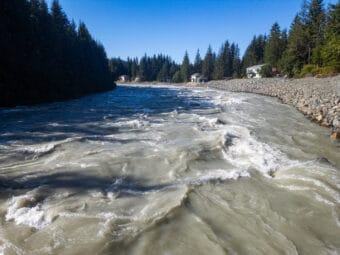
Water levels rise in the Mendenhall River beneath Mendenhall Loop Bridge during Juneau’s annual glacial outburst flood on Monday, August 5, 2024. (Photo by Eric Stone/Alaska Public Media)
Some of the funding needed to study long-term solutions to glacial outburst flooding in Juneau has arrived.
Last Friday the U.S. Army Corps of Engineers received $4.75 million to start working on a technical report that will inform a later, fleshed-out feasibility study of potential solutions to annual flooding in Mendenhall Valley.
The funding came from the federal American Relief Act and will be disbursed over the next four years. It adds to the $1 million that the city and U.S. Forest Service secured in December to study flood solutions.
Denise Koch, Juneau’s director of Engineering & Public Works, wrote in an email to flood-affected residents that this is “a fantastic first step,” but that the city must still find millions more for the full feasibility study, which they estimate will total around $10 million.
Bruce Sexauer, chief of civil works project management at the Army Corps, said the money will be used to answer key questions about the Mendenhall Valley landscape, including hydrological and geological studies that will form a basis from which officials can weigh different solutions.
“If you build a house with no foundation, the house is gonna fall down — similar to a levee or a dam or a flood wall — you need to know what the foundation is to be able to build a secure structure,” he said.
One of the major questions, Sexauer said, is “exactly how much water would be released in combination with, say, a major rainstorm, and how likely that would be.”
It’s a complicated question and the answer could shift as the Mendenhall Glacier melts faster, if new basins other than Suicide Basin form further up in the mountains or if precipitation patterns change.
Residents in flood-affected neighborhoods would like action sooner rather than later. Bob Deering lives along the Mendenhall River. He’s a retired engineer with 32 years of federal agency experience and wants this process to be treated with urgency, given that Valley homes are expected to flood each year.
“They shouldn’t have to spend a lot of time figuring out what might work here,” he said. “They should be able to come up with a solution in one year.”
Nate Rumsey, the city’s Engineering & Public Works deputy director, said he hopes the technical studies will “jump-start into what a more traditional feasibility study or general investigation would be.”
He said the future feasibility study will look at various ideas to protect Valley residents, such as building a dam or permanent levee, expanding Mendenhall Lake’s capacity, siphoning water out of Suicide Basin, or even blowing up the glacier or surrounding mountains.
“We’re just too early in the process to be able to give any definitive ideas about what the likely solutions are, but I think those are all at least feasible,” Rumsey said.
As the city and Army Corps consider long-term plans, the short-term plan to install temporary flood barriers along Mendenhall River is underway. Contractors are set to prepare yards along Killewich Drive this week for HESCO barriers that will arrive imminently.
Angoon on Sunday, Oct. 27, 2024. (Clarise Larson/KTOO)
Listen to this story:
A half-century ago, Angoon’s harbor was packed with small, family-operated fishing vessels. Salmon and halibut fed mouths and bank accounts.
Peter Duncan, Mayor of Angoon, remembers those days. But it’s not the same anymore. Fisheries limitation regulations have caused “devastating changes,” he said. “You just don’t find a troller in our harbors anymore.” That’s caused his village to depend more on government assistance programs, including food stamps, he said.
Duncan grew up fishing on his father’s seiner in the small Lingít village on Admiralty Island. He graduated to his own troll boat and commercially fished until the early 1990s, when he said he couldn’t make a living that way anymore.
He said the opening date for the king salmon fishery was pushed later in the season, when most fish had already gone further into the inside waters and up rivers to spawn. Folks weren’t catching enough salmon to make money, so permits became more valuable to sell.
“A lot of boats, you know, they just sold out, and they, they couldn’t do it anymore, and they’ve tried,” he said.
Many of those fishing permits left the island, and with them went the means for the village to sustain itself.
“It’s sad to know that at one time, we used to be a strong fishing fleet that took pride in going out and going fishing and making something for ourselves,” Duncan said.
Aerial view of Angoon in 2017. The Southeast RAC is recommending making lower Admiralty Island off-limits to sport hunters during deer season. (Emily Russell/KCAW Photo)
Duncan’s story isn’t unique. This reality has unfolded in most rural villages throughout the Gulf of Alaska, as first reported by Northern Journal. In part, it’s an unintended consequence of a state law that took effect in 1975, called the Limited Entry Act, which allowed the state to issue a set number of permits for each fishery. The goal was to address a sustainability problem. At the time, salmon populations were plummeting while commercial fishermen multiplied. The idea was simply to cap the number of people fishing, so there would be enough to go around.
But that’s not what happened in Native villages. Courtney Carothers, an environmental anthropologist at the University of Alaska Fairbanks, led a survey of 3,024 Sealaska Corporation shareholders and descendants about the community impacts of fisheries limitation policies.
She found that Sealaska villages owned half as many fishing vessels in 2019 than they owned in 1978, and held 38% fewer commercial salmon permits than they held in 1975.
“This is not good public policy if our communities in the Gulf of Alaska — surrounded by the ocean with thousands of years of fishing knowledge and history — within one generation, are cut out,” Carothers said. “I mean, this is an absolute crisis.”
Joe Nelson is interim President of Sealaska Corp., representing Lingít, Haida and Tsimshian interests in Southeast Alaska. His airy corner office in downtown Juneau looks out over Gastineau Channel. On a recent afternoon, clouds trundled into the snowy peaks of Douglas Island. Glossy magazine copies of Carothers’ study were spread out on a table.
The report points to a loss of fishing access as one of the main reasons people leave their rural villages. Nelson has watched this happen.
“It’s all been going one way, and that’s migration out of most of the fleet and most of the permits,” Nelson said.
That’s caused families to leave and village populations to dwindle, he said, which in turn leads to schools and other services closing down. And those who stay behind are aging out of the industry without enough young people to pick it up, he said.
“So the whole economy just shrinks. It’s much bigger than a single fisherman that decides not to show up anymore,” Nelson said.
He’s calling for the state to adjust the limited entry system so that native communities can fish commercially “without going bankrupt.”
Today, a seine permit in Southeast is worth about $140,000 and a drift permit is worth about $44,000 for the salmon fisheries, according to Reid Johnson, the research and planning project leader at Alaska’s Commercial Fisheries Entry Commission. Those numbers vary, depending on how well a fishery is doing.
Johnson says that while the Limited Entry Act helped make Alaska’s fisheries more sustainable, it created this new problem for rural villages. Now, the Commission is talking internally about potential solutions.
“There have been ideas that have been floated, such as making it administratively easier to transfer a permit to another rural resident in the same area that you live in,” Johnson said.
Carothers suggests there could be room for creating a new class of permit, such as an entry-level or small-scale permit, to get people started. But any such changes would have to come through the state Legislature.
There’s also a potential federal pathway for guaranteeing Indigenous fishing access, which was not compensated for through the Alaska Native Claims Settlement Act that distributed roughly 45 million acres and $1 billion to tribes in 1971.
“That act preceded any limitation of fisheries, and there was compensation for land, but not for fish,” Carothers said. “So I personally think there should be a repatriation of rights, because they’ve been taken away, dispossessed, in ways that I don’t think were fair.”
Sealaska is not advocating for specific policy changes just yet. Nelson says there must be open, public discussions that look at a slew of ideas for how to restore fishing access to Native villages. But first, he wants state officials to recognize that there is a problem.
The Tongass is the country’s largest national forest at 17 million acres, and it’s one of the last protected temperate rainforests in the world. (Photo by Alix Soliman/KTOO)
Listen to this story:
President Trump issued two new executive orders on March 1 to expand logging in national forests. They come after he suspended the Roadless Rule, which banned the construction of new roads in undeveloped wilderness and has flip-flopped with each presidency. Together, the orders could increase timber harvest in Tongass National Forest, but some locals aren’t so sure that will happen.
One order aims to get forestry projects approved more quickly, even if it means scraping out exemptions under the National Environmental Policy Act and the Endangered Species Act. The other order directs the U.S. Department of Commerce to investigate whether importing lumber is a national security risk, and how the government could step in to address that.
The Tongass National Forest is the country’s largest national forest at 17 million acres, and it’s one of the last protected temperate rainforests in the world. Locals say it has environmental value, but the main reason the orders probably won’t lead to more logging is that much of the industry has moved out.
Joel Jackson is president of the Organized Village of Kake, a tribe based on Kupreanof Island, and has seen logging come and go.
In economic terms, Jackson said that the real value of the forest is in tourism.
“People don’t want to come from down south and look at a scarred landscape,” he said. “They come up here because they like to look at the Tongass — the wildness of it.”
Millions of tourists travel to Southeast Alaska each year to experience the environment Jackson’s village depends on.
“The berries and medicinal plants and just everything it provides out there, and the animals — the deer, moose, bears — the shade from those old-growth trees along our streams that the salmon return to every year,” he said.
Now, since most lumber yards and pulp mills have closed shop, it’s costly for loggers to come harvest the trees and ship them out, Jackson said. He believes Trump’s orders won’t change the financial constraints of logging in this rugged and remote region.
Gordon Chew runs Tenakee Logging Company, a small father-son timber operation on Chichagof Island. He echoes Jackson’s sentiment, and said the industry would have to be completely redeveloped for the Tongass to deliver more timber.
“We don’t have people sitting on their hands that can’t wait to get into the forest and mow down all the trees,” he said.
Chew said he’s an environmentalist and his company sustainably harvests about 100 trees each year. They’re second growth — young trees that have grown back in areas that were heavily logged in the past.
“We live here in the heart of the Tongass National Forest, and don’t want to be a part of any deforestation or destruction. So we’ve always only purchased selective timber sales,” he says.
The Forest Service marks one out of no more than three trees in the selected tract, then Chew and his son carefully fell them by hand. He’s not convinced that Trump’s executive orders will accelerate logging in the Tongass, since the U.S. Forest Service is likely overwhelmed due to recent firings.
“They’re dealing with distraught human beings that have been cast aside,” Chew said. “So I know the hope was efficiency, but you don’t get more efficient with fewer people doing more work.”
If the administration is serious about increasing timber production, Chew suggests they go through Congress to streamline the approval process under the National Environmental Protection Act for small, sustainable operations like his.
“You can still have industry and do it responsibly,” he said, adding that environmental laws should be geared toward preventing wreckage, not preventing a couple of guys from thinning the over-crowded second-growth forest to build local cabins, boats and musical instruments.
Viking Lumber, a well-known logging company in the region, did not respond to a request for comment.
Robert Venables is the executive director of Southeast Conference, an organization that advocates for economic interests in the region. He said that there is room in the Tongass for additional logging, especially in second-growth areas, but it’s unlikely that the industry would scale up to the behemoth it once was.
“I believe it’s more likely to colonize the moon,” he said.
Because of the way the timber market has changed, Venables said that the past isn’t able to inform the future of the industry here.
The U.S. Forest Service declined an interview, but a spokesperson wrote that the agency will “continue to meet its commitments to protecting vulnerable wildlife while also meeting the President’s directive to provide the nation with abundant domestic timber, unhampered by burdensome, heavy-handed policies.”
Legal battles over logging in the Tongass roiled during Trump’s first term, and more could be on the way.
Correction: A previous version of this story misidentified the name of the National Environmental Policy Act.
Close
Update notification options
Subscribe to notifications
Subscribe
Get notifications about news related to the topics you care about. You can unsubscribe anytime.