State Government Reporter, Alaska Public Media & KTOO
State government plays an outsized role in the life of Alaskans. As the state continues to go through the painful process of deciding what its priorities are, I bring Alaskans to the scene of a government in transition.
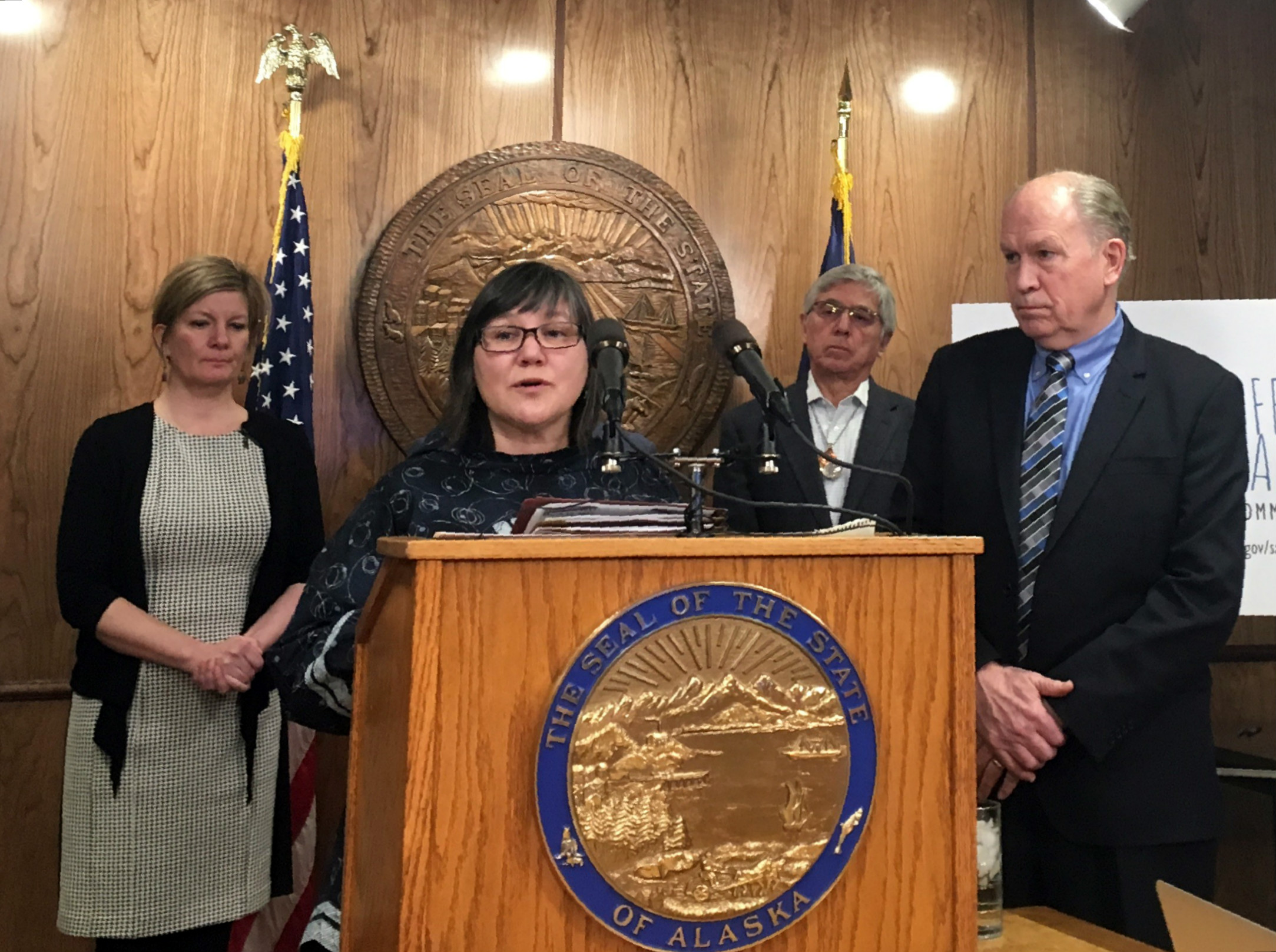
State officials discuss legislation aimed at curbing opioid abuse with reporters in the state Capitol on Monday. From left to right: Alaska Attorney General Jahna Lindemuth, Health Commissioner Valeria “Nurr’araaluk” Davidson, Lt. Gov. Byron Mallott, and Gov. Bill Walker. (Photo by Andrew Kitchenman/KTOO and Alaska Public Media)
A new bill is aimed at curbing opioid addiction and overdose deaths. The bill lets patients tell health care providers and hospitals to not give them opioids. It also requires health care providers receive training in opioid addiction.
Gov. Bill Walker introduced the bill.
“It’s not the be-all-and-end-all,” Walker said. “There’s many paths to recovery. There’s many other things that we are working on. But this is one we believe is quite significant.”
The bill also limits initial opioid prescriptions to a seven-day supply. The measure requires pharmacists and veterinarians to register their prescriptions in a database. Doctors and nurses who prescribe opioids would check the database.
The database would be updated daily instead of once a week if the bill is enacted. And prescribers would get a report card from the state Board of Pharmacy indicating how frequently they prescribe opioids compared with similar providers.
Health and Social Services Commissioner Valerie “Nurr’araaluk” Davidson said another important piece of treating addiction is the state’s Medicaid expansion. It’s added health coverage for 30,000 Alaskans.
“Every one of us in this room knows somebody – we’re related to somebody, we have somebody – who is struggling with opioid addiction,” Davidson said. “And I would encourage you, that if you think that’s not true, I would encourage you to look a little bit harder.”
Walker introduced the bill at press conference Monday in which he announced other opioid-related measures. The state will begin giving prison inmates who enter with addictions the medication Vivitrol. It helps them overcome addiction by blocking the effects of opioid drugs.
Two versions of the bill — House Bill 159 and Senate Bill 79 — were referred to the Health and Social Services and Finance committees in each body.
When Alaskans buy candy bars, they know how much they’re going to pay before they make the purchase. The same isn’t true for health care. Lawmakers are looking to change that.
Alaskans pay more for health care than anyone in the country. Anchorage Democratic Rep. Ivy Spohnholz wants them to know more about what they’re going to pay before they decide on a procedure.
That’s why she’s introduced House Bill 123, which would require the state and health care providers to post a list price of common procedures.
Ivy Spohnholz speaks after being sworn into office last March. She introduced a bill intended to increase health care price transparency. (Photo by Jeremy Hsieh/KTOO)
“Health care is the only industry that we have where we as consumers don’t know the price before we make a purchase or we utilize a service,” Spohnholz said. “This removes one of the fundamental tenets of capitalism, that is, the power of the consumer to make choices about what they do or they don’t purchase.”
Representatives for Alaska hospitals and insurers say they support price transparency. But they don’t necessarily agree on what should be included in legislation.
For example, the prices that would be available under the bill — known as chargemaster prices — generally are much higher than what any patient or insurer would pay. That’s because insurers negotiate discounts with health care providers. And uninsured patients usually aren’t charged the list price.
That’s why other states have mandated something called “all payer claims databases.” These databases include the amounts that are actually paid by insurers.
Spohnholz said she considered such a database in Alaska.
“But we passed on that, because that came with a half-a-million-dollars-a-year price tag, which seemed in this particular fiscal climate to be untenable,” she said.
The price lists mandated by the bill wouldn’t cost the state anything, because providers would compile the prices from lists they already have.
“The structure of the health care payment and delivery system is complicated, and it makes transparency pricing difficult to implement, even when all parties agree on its desirability,” she said.
Prices are based on the severity of patients’ problems, the amount of required treatment, and negotiations between insurers and providers. Some of these factors aren’t known before treatment starts.
And, Hultberg noted, people who have insurance plans that don’t require a lot of out-of-pocket expenses may not care about the prices.
“Economic theory and also reality support the idea that most consumers are only price sensitive and engaged in price shopping up to the point of their out-of-pocket exposure,” she said.
A separate concern was raised by Jon Zasada of the Alaska Primary Care Association. He directs policy for the group, which is made up of the state’s community health centers.
He said publicly posting list prices may mislead patients, since the centers charge patients based on a sliding scale that depends on their income. Centers don’t want to scare patients away with prices they won’t pay.
“We’d hate to put potential patients off from seeking … primary and preventive care,” he said.
Members of Premera – the state’s largest insurer — can get out-of-pocket cost estimates from the insurer based on their provider and the procedure.
Premera spokeswoman Melanie Coon said the company is monitoring the bill’s progress.
“If people can have a better understanding of health care costs in general and the health care services they’re paying for – that’s our ultimate goal for our customers,” she said.
Public testimony on the bill will be held on Tuesday.
Rep. Lance Pruitt, R-Anchorage, during a discussion about HB 115 in the House Finance Committee on Feb. 13. He opposes a change that would reduce the House minority’s budget influence. (Photo by Skip Gray/360 North)
For years, the minority caucus in the Alaska House has had a say in the state’s budget. But that may not happen this year, as the majority caucus looks to tap Permanent Fund earnings to close the budget gap.
House minority members say they’re being cut out of the budget process. House Minority Leader Charisse Millett, a Republican from Anchorage, said this:
“They’re not interested in what we have to say, and our contribution to the budget process,” Millett said.
To understand why the minority feels left out, it pays to understand what the state government’s two large piggy banks are – and what it takes to spend from them.
One account is the Constitutional Budget Reserve. The state Constitution requires three quarters of each house of the Legislature to vote to spend money from the reserve. That’s given the House minority leverage in past years, since it became impossible to balance the budget without this money.
The other piggy bank is the Permanent Fund earnings. For the past 35 years, the state has only spent money from fund earnings for Permanent Fund dividends. But if the Legislature wanted to, it could spend these earnings by a simple majority vote.
That’s what Rep. Paul Seaton wants to do.
The majority-caucus Republican from Homer has proposed drawing $4.2 billion from the earnings reserve to pay to close the budget gap. Of that money, $1.7 billion would go to the state’s education fund.
“We really want to work on the major thing that Alaskans want us to work on, which is the comprehensive, sustainable fiscal plan,” Seaton said. “And as long as we have an unfunded budget, we will be working on that for a long time. So we fully fund the budget by having that education fund.”
Anchorage minority-caucus Republican Rep. Lance Pruitt said the Senate will have the House minority’s back.
“I’m going to go back a ways, and go back to high school. I had friends and sometimes if you forget if people have friends and you mess with someone, then it comes back later and it really hurts,” Pruitt said. “And we got friends in the Senate. There’s a whole other body that this has got to go through.”
Pruitt said Seaton is manipulating the entire House majority by suggesting the budget change. Seaton is the House Finance Committee co-chairman, and proposed the change as the chairman of the committee’s budget language subcommittee.
“To try to hide something like that – that’s deceptive, that’s just flat-out deceptive,” Pruitt said. “But that being said, the whole caucus is resting on that one person.”
Seaton said past finance committee chairmen included changes to the budget language without any committee votes. On Tuesday, the committee did vote on Seaton’s proposal to draw from Permanent Fund earnings. It passed seven to four, along caucus lines.
“Every single amendment was offered and voted on by full Finance,” Seaton said. “So there were no balls hidden.”
Two years ago, the two caucuses were in opposite positions. The Republicans were then in the majority and wanted to shift Permanent Fund earnings in a way that would have allowed them to bypass minority support for the CBR. And most Democrats opposed the move, but they’re now in the majority that could bypass the minority.
Both sides distinguish their position two years ago from where they are now. Republicans say they only raised the idea of bypassing the minority two years ago because they wanted to avoid pink slips for state workers after months of budget negotiations. And those who were in the minority two years ago note the proposal then would have drained state savings by a larger amount than the current majority is considering.
For the earnings draw to be adopted, it would require another vote by the House Finance Committee, then votes by the full House and the Senate.
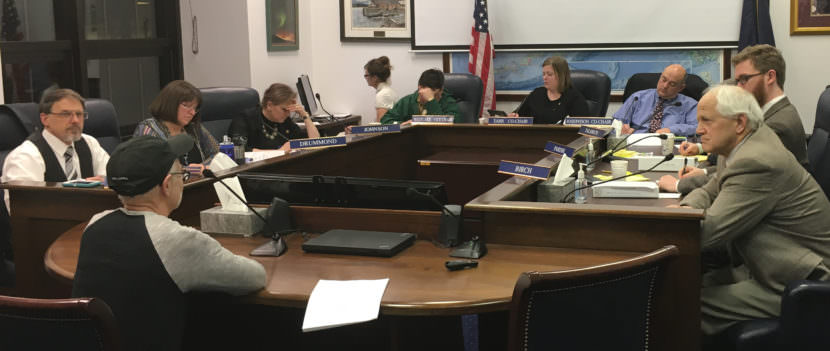
Members of the House Resources Committee listen to public testimony on a bill to overhaul the state’s oil and gas taxes and tax credits. (Photo by Andrew Kitchenman/KTOO and Alaska Public Media)
Most Alaskans who offered public testimony Wednesday on a proposed overhaul of the state’s oil and gas taxes and tax credits opposed the measure.
Fairbanks resident Cynthia Henry urged House Resources Committee members to vote against House Bill 111, a bill that would lower oil and gas tax credits and increase minimum production taxes.
“It would be a big mistake to raise oil taxes,” Henry said. “I’m certain the results would be less investment, less production, fewer jobs and a deepening recession.”
Many of those who oppose the bill cite personal experiences or the experiences of family members working in the oil and gas industry.
Ninilchik resident Jack Kvasnikoff said he has personal experience of the potential change.
“When the oil companies are profitable, you know, there’s more jobs, there’s more people working,” Kvasnikoff said. “And I strongly oppose HB111.”
Nearly three-quarters of the people who testified opposed the bill, some even saying that it doesn’t go far enough in eliminating tax credits.
But Skagway resident Robin Solfisburg supported the bill.
She said changing oil taxes should be the Legislature’s first option as it works to balance the state’s budget.
“I encourage you to stand for Alaska, and not for oil,” she said. “Our schools, public safety and dividends are equally if not more important as tax subsidies.”
The House Resources Committee will hear more public testimony at a future meeting.
Quinlan Steiner of the Public Defender Agency presents testimony relating to Senate Bill 54 on Wednesday before the Senate Judiciary Committee. (Photo by Skip Gray/360 North)
Lawmakers looking to tighten penalties for some felonies and thefts are weighing two factors.
On one hand, they’ve heard from members of the public and law enforcement that last year’s criminal-justice overhaul went too far in letting offenders go without jail time.
On the other, social science research that shaped the law points to evidence that sending many offenders to jail will actually increase the likelihood they’ll commit more violations in the future.
North Pole Republican Sen. John Coghill describes the dilemma in using research to set sentencing ranges that also will satisfy the public.
“I don’t know that we can actually get any data that will help us on this, unfortunately, because in looking at the data, they’re saying ‘The less jail time, the less recidivism,’ and our public is not going to be satisfied with that at this point,” Coghill said.
The Senate Judiciary committee on Wednesday discussed Senate Bill 54, which would revise last year’s crime law.
Until last year, those who committed class C felonies could receive up to two years in jail but the new law changed this. It allowed first-time offenders to receive probation. Now lawmakers want first-time offenders to serve some jail time, but there’s differences over how long the sentencing range should be. Prosecutors want it to be up to a year.
Department of Law Criminal Division director John Skidmore presents testimony relating to SB 54 before the Senate Judiciary Committee on March 1. (Photo by Skip Gray/360 North)
Department of Law Criminal Division Director John Skidmore said judges aren’t able to use their discretion.
“Courts have to have the discretion to look at a particular offense, to look at a particular defender and decide, is this someone who should be in jail, and we can put on probation, or is this someone who does need some jail time?” Skidmore said.
State Public Defender Quinlan Steiner argued that the sentences for class C felonies should be no more than 90 days.
He said the Alaska Criminal Justice Commission recommended scaling back sentences based on evidence from other states that first-time offenders engage in crime after they’re jailed.
“The very act of putting people in jail, put the public at risk when – if you didn’t put them in jail, they’re be less risk,” Steiner said.
The Senate Judiciary Committee also plans to weigh the cost of increasing jail times the Legislature cut last year.
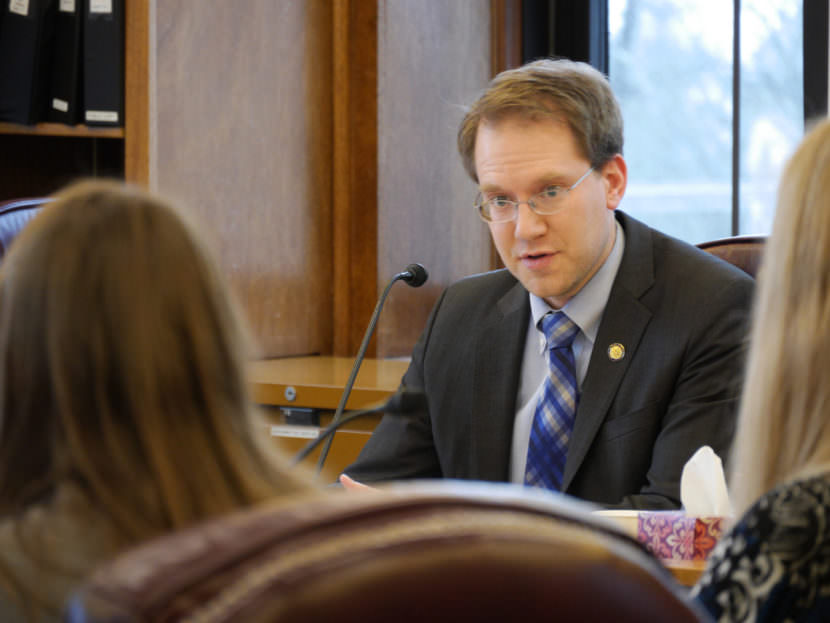
Rep. Paul Seaton, R-Homer, co-chairman of the House Finance Committee, listens to Rep. Steve Thompson, R-Fairbanks, on Monday. Seaton proposed a $48.7 million cut to school construct debt reimbursements. (Photo by Skip Gray/360 North)
Alaskans would pay more in property taxes if the state government cuts the amount it pays to offset the debt to build schools.
A House committee included a $48.7 million cut in state aid during a step in writing the state budget Tuesday.
The state government historically paid 60 percent to 70 percent of the cost of bond payments to build schools, with local property owners footing the rest of the bill.
Homer Republican Rep. Paul Seaton proposed cutting the state payment in half.
He noted the state has a $2.7 billion gap between what it spends and raises in oil royalties, taxes and fees.
He would rather cut spending on bonds than on teachers and other classroom costs.
“I think that everybody has been talked to and knows that education, K-12 education, is one of the biggest components of our budget,” Seaton said.
Fairbanks Republican Rep. Steve Thompson said communities will have no choice but to either raise property taxes or make cuts to other services.
“This was like a contract with our constituents saying, ‘OK, state, you pay this much, and we’re going to pay the difference,’” Thompson said. “Now we’re going to shove it back onto the communities.”
Gov. Bill Walker vetoed a quarter of school debt payments after the Legislature failed to pass a comprehensive plan to balance the budget in the long term last year. This prompted an outcry from local school and municipal officials, who hadn’t budgeted for the cuts.
While Walker didn’t include the cut in this year’s budget proposal, Seaton said passing it now gives communities time to plan ahead.
Anchorage school superintendent Deena Bishop said all school cuts present bad choices, but the debt payment cut affects only those who live in boroughs.
The state pays all school debt in the Unorganized Borough.
“It’s the ugly, the ugly and the ugly,” Bishop said. “To pick this over anything else, especially for really any municipality or borough is significant. Because the responsibility then resides back on local government.”
While state law has provided for the state to pay 60 percent to 70 percent of school bonds, whether the state actually pays the full amount is subject to annual appropriation.
The state is in the middle of a five-year break in paying for new school bonds. When the program returns in 2020, state law says the state will pay 40 percent to 50 percent of new bonds.
The House Finance Committee amended the budget to reflect the cut, but the committee still must review the entire spending plan before it recommends it to the full House. Then the budget goes to the full Legislature for a vote.
Close
Update notification options
Subscribe to notifications
Subscribe
Get notifications about news related to the topics you care about. You can unsubscribe anytime.