State Government Reporter, Alaska Public Media & KTOO
State government plays an outsized role in the life of Alaskans. As the state continues to go through the painful process of deciding what its priorities are, I bring Alaskans to the scene of a government in transition.
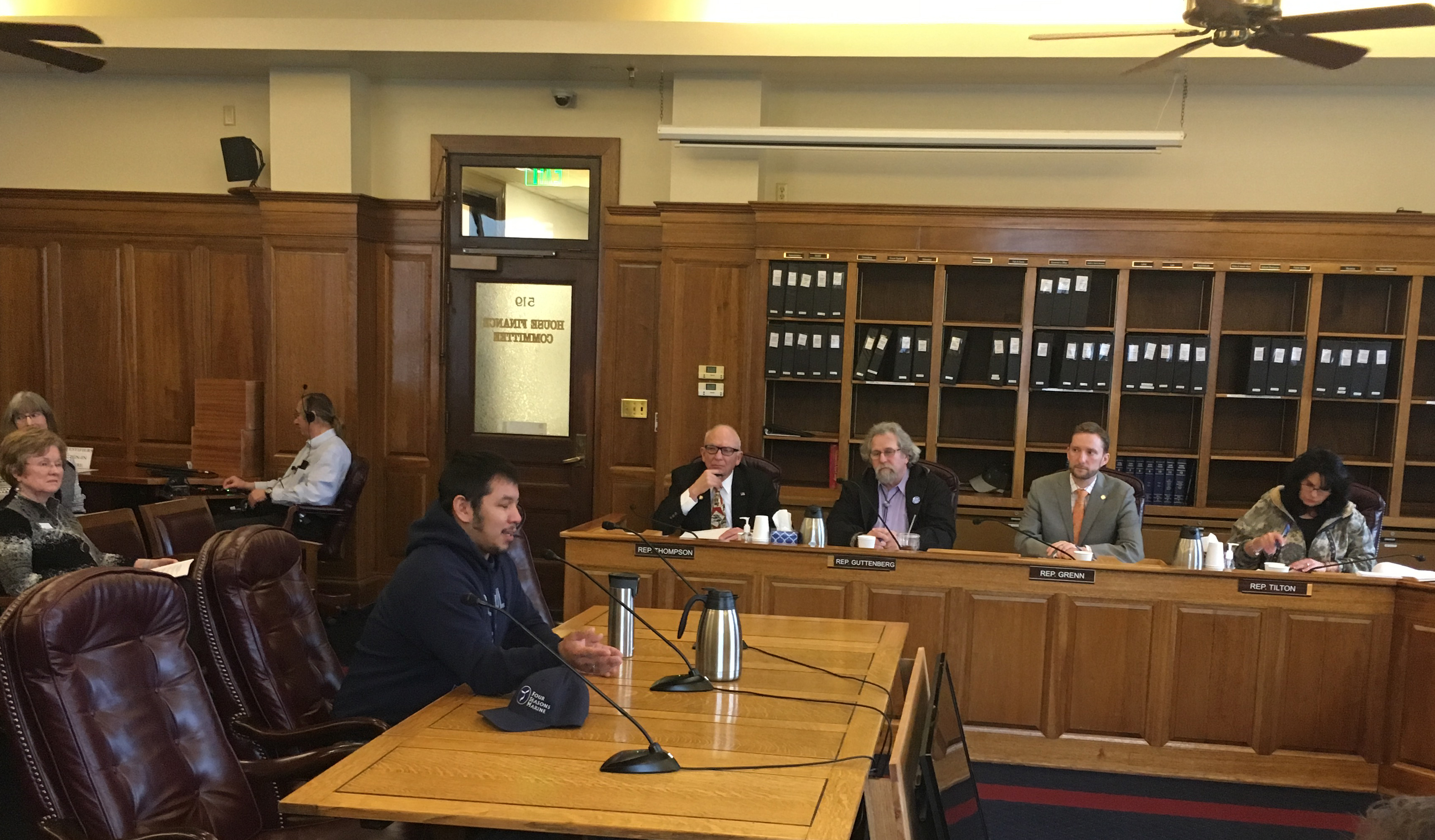
Juneau resident Martin Stepetin testifies Friday in favor of House Bill 115, which would introduce an income tax and draw Permanent Fund earnings to pay for state government. (Photo by Andrew Kitchenman/Alaska Public Media/KTOO)
Public testimony was split Friday on a bill that would introduce an income tax and use money from Permanent Fund earnings to pay for state government.
The measure would create a state income tax that’s 15 percent of federal tax liability and set Permanent Fund dividends at roughly $1,100.
“Living in Homer, a see a lot of people who make a lot of money here in Homer, seasonal workers – and yet other than the sales tax, they don’t participate in supporting our infrastructure, but they utilize it,” Person said.
Roughly 80 residents signed up to testify on the bill.
Martin Stepetin of Juneau told the House Finance Committee he also supports the bill. He would like to see more protection for the Permanent Fund.
“We have a situation right now where business in Alaska is holding their breath,” Stepetin said. “People don’t want to spend money because nobody knows what’s going to happen. So we need to do something here in this building to get it done.”
But Palmer resident Shannon Connelly said the bill would steal from the Permanent Fund and residents’ pockets.
“You’ve created a spending monster and now that the oil prices are down, you refuse to decrease your spending. Instead, you expect the working citizens of this state to pay for your incompetence,” Connelly said. “If I budgeted as you do, I would be in jail.
Fairbanks resident Barbara Haney agreed the Legislature hasn’t been disciplined in its spending.
“I mean, I don’t know,” Haney said. “You guys legalized marijuana, because there was supposed to be all of this revenue, which apparently has not come to fruition. Maybe you guys are smoking it, because I look at this bill, it’s not even going to catch a dent in any of the fiscal problems.”
Marijuana sales began in October, and roughly $236,000 were collected in the first three months. The state has a $2.7 billion gap between spending and the amount of revenue raised in oil royalties, taxes and fees.
The Senate has discussed two other bills that would draw money from the Permanent Fund to pay for the budget. These bills don’t include an income tax.
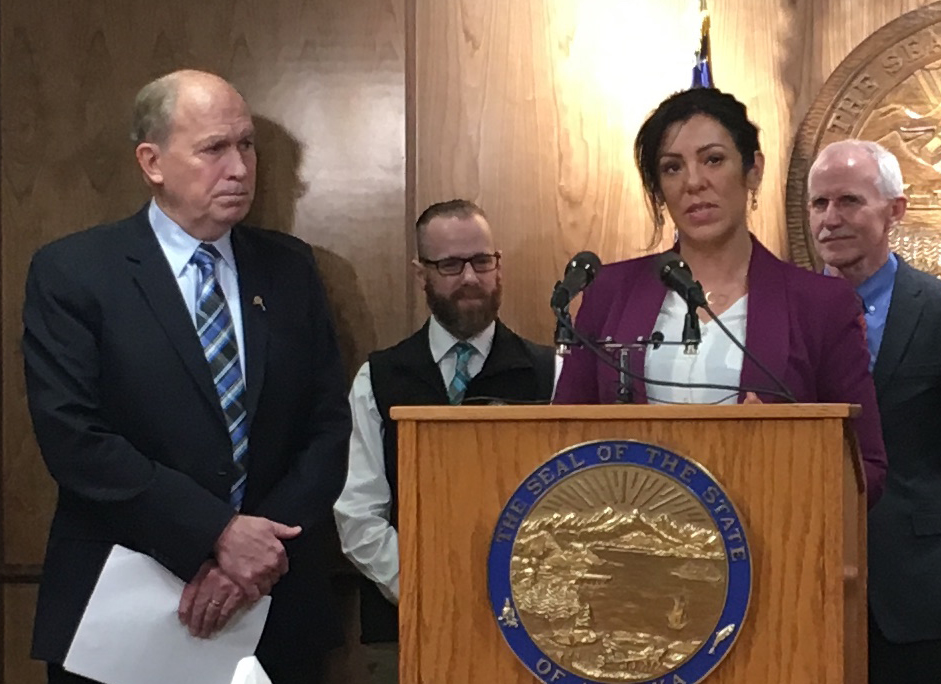
Gov. Bill Walker, state Emergency Programs Section Chief Andy Jones, Kara Nelson and state Chief Medical Officer Dr. Jay Butler during the Feb. 16 announcement of Walker’s order on opioid addiction. (Photo by Andrew Kitchenman/Alaska Public Media/KTOO)
Gov. Bill Walker took action this week to try to stem the epidemic of overdose deaths from heroin and other opioid drugs.
Walker signed a disaster declaration that’s intended to make it easier to give overdose victims the life-saving overdose antidote naloxone.
More than 120 Alaskans have died from opioid overdoses over the past three years. Walker said declaring a disaster will enable a coordinated statewide response.
“I mean, it’s not one particular region, one particular income strata,” Walker said. “It is widespread, and it’s just, the stories were just horrific from across the state.”
Walker ordered state agencies Thursday to apply for grants to prevent and treat addiction. They’ll also work to eliminate illegally imported drugs and help monitor controlled drugs. And they’ll aim to add funding for treatment using methadone and other medications.
State Chief Medical Officer Dr. Jay Butler is leading a weekly Instate Command System of senior state officials to respond to the epidemic, similar to the response to oil spills and other disasters.
“The challenge of the opioid epidemic is that it’s more than just a criminal justice issue, but it’s also a health issue,” Butler said. “We need to address it very broadly in terms of being a health issue, a public safety issue, an education issue, a medical practice issue. We need to have a multi-pronged approach.”
Butler said making naloxone more widely available is an important first step. But he said it’s important to transition those recovering from overdoses into withdrawal and addiction treatment.
“It’s not a cure-all,” Butler said. “It’s like a tourniquet in a severe trauma case. It saves a life, but it does not cure addiction. That’s why a much broader-based approach is needed.”
The state will spend more than $4 million on the effort. All of the funding comes from four federal grants.
Butler said more doctors should receive training to provide patients with methadone and other drugs that help treat addiction, including Vivitrol and buprenorphine.
“Many of my colleagues I will hear say, ‘Well, I didn’t really go into medicine to treat addiction,’ but I think we all went into medicine to make people well,” Butler said.
A key part of the opioid response is the people in recovery who work as peer counselors, connecting those who are using heroin and other drugs with the treatment they need.
Juneau resident Kara Nelson is a certified recovery and re-entry coach. She directs Haven House Juneau, a peer-led, faith-based transitional home for women leaving prison. She praised Walker’s approach.
“I think it’s just going to give us more ammo when we’re trying to fight to bring different supports, and say we need more treatment, we need more detox, we need to treat this as a public-health issue,” Nelson said. “What that means is long-term recovery supports, which we are lacking so much here in the state.”
Walker said he will work with the Legislature for changes to state law to aid the effort.
David Teal, fiscal analyst for the Alaska Legislature, runs through various budget models related to House Bill 115 for the House Finance Committee on Wednesday. HB 115 creates a state income tax, draws money from the Permanent Fund for the state budget and introduces a new formula for setting the amount of the Permanent Fund dividend. (Photo by Skip Gray/360 North)
Alaska’s budget reserves could be gone in 10 years if the state government doesn’t take action to balance its budget, the Legislature’s nonpartisan finance expert said Wednesday.
Legislative Finance Director David Teal said that by 2027, whether Alaskans receive Permanent Fund dividends each year would depend on annual Fund earnings.
“You would earn money in (fiscal year) ’27, and you just don’t know whether those earnings in that year would be sufficient to make the payments,” Teal said.
In a House Finance Committee hearing, Teal mapped out different scenarios for the state government’s future, based on the plans put out by Gov. Bill Walker and lawmakers. Under Walker’s plan, the state budget would be stable and Permanent Fund dividends would also be relatively flat, at $1,000.
A House Finance Committee bill, House Bill 115, would reintroduce an income tax.
According to a model that Teal’s office built, the bill would allow for higher dividend growth than Walker’s plan. And it would close the state’s deficit sooner.
North Pole Republican Rep. Tammie Wilson said there would continue to be room for dividends if the state makes deeper cuts to government. She noted that the Republican-led Senate majority has called for $750 million in budget cuts over the next three years.
“The bigger question – as you just said, if we don’t reduce the budget – is: Does government grab all that money for themselves and tell the people, ‘Too bad, you don’t get any’?” Wilson said.
State Revenue Commissioner Randall Hoffbeck said there’s little to no room for further cuts, without eliminating services that residents depend on, or pushing the tax burden onto local municipalities.
“So, essentially, state expenditures cuts that don’t recognize ongoing needs are pass-through solutions – they’re simply taking the state’s burden and putting it on somebody else,” Hoffbeck said.
Hoffbeck said that if the state cut its payments to municipalities – including a 10-percent cut in school aid – property tax payers would be hit.
He estimates that owners of houses assessed at $300,000 could pay as much as $1,500 more each year in property taxes.
The House Finance Committee will hear public testimony on the income tax and Permanent Fund bill on Friday.
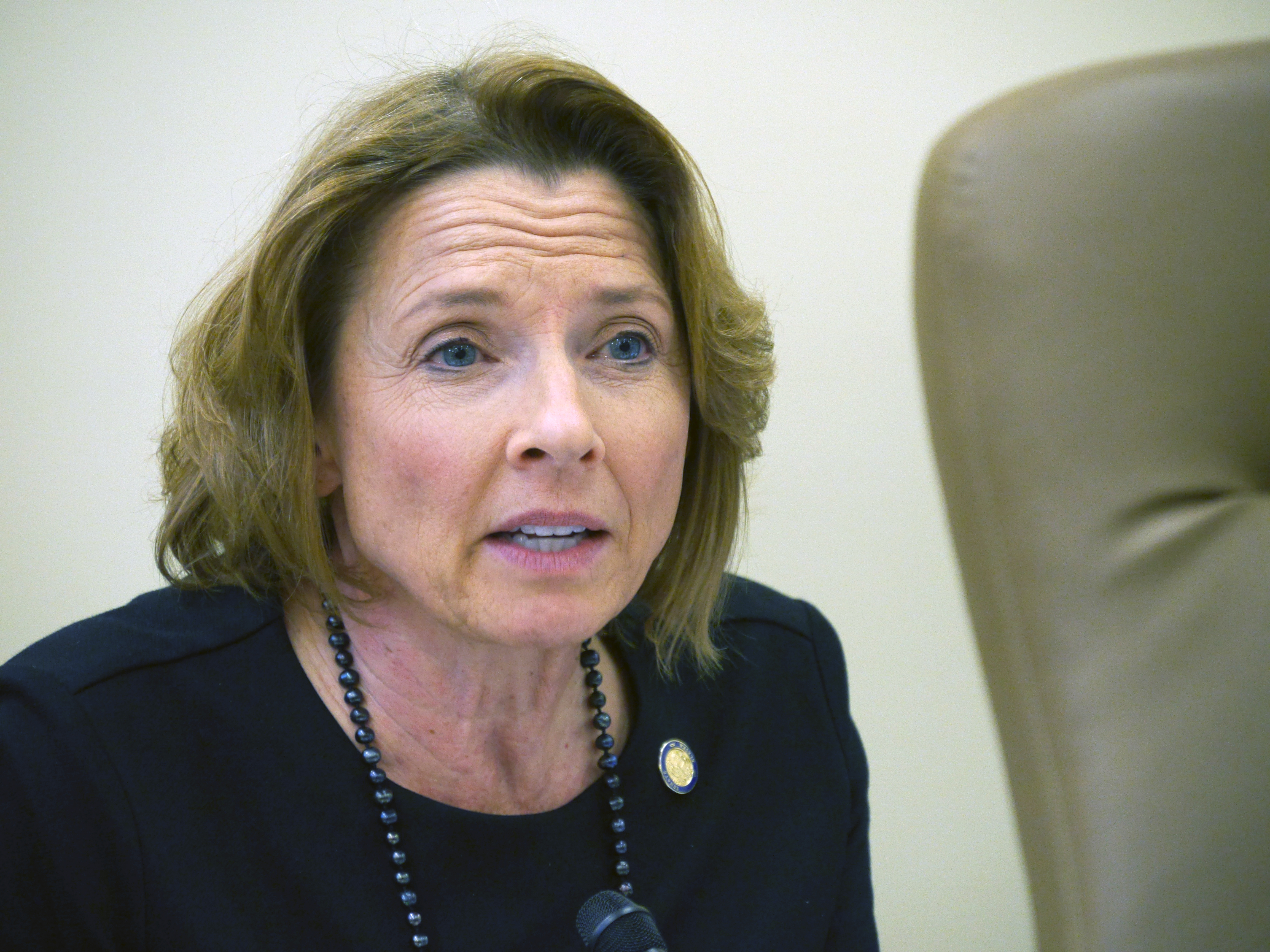
Sen. Cathy Giessel, R-Anchorage, speaks at a Senate Majority press availability, February 13, 2017. She has proposed a bill to sharply increase state fees for studded tires. (Photo by Skip Gray/360 North)
A proposed bill would increase the fee Alaskans pay to the state when they buy studded tires by 1,500 percent.
The rutted lanes on the Glenn Highway in Anchorage’s Eagle River section have helped prompt the new legislation.
Anchorage Republican Senator Cathy Giessel drives on the highway each week to pick up her grandchildren.
“The deep ruts there are a significant safety hazard,” Giessel said. “Cars get stuck in them during the winter trying to change lanes, lose control. In the summer they fill with water, increasing the chance of hydroplaning and, again, losing control.”
It would cost an additional $280 for four studded tires under the bill. (Creative Commons photo by Sunny)
Giessel has identified studded tires as at least partially the culprit in causing the ruts.
She’s introduced Senate Bill 50, which would increase the state fee for studded tires from $5 per tire to $75 per tire. That’s on top of a $2.50 fee for all new tires.
She said the money will help pay for road repairs, which can cost $1 million per mile on a two-lane highway. She sees it as a kind of user fee for drivers.
“They can choose studded tires or the new technology tires,” Giessel said. “But if they’re going to choose studded tires – which do result in the rutting of the roads, the damage to the roads, then we need to have some way to repair those roads, for everyone’s safety.”
State records show about 50,000 studded tires were purchased or commercially installed in 2015.
Alaska Department of Transportation and Public Facilities spokeswoman Shannon McCarthy said studded tires do cause more damage than winter tires that don’t have studs.
“The very fact that they’re designed with a metal pin – that does … take a chip out of the surface that they’re driving in,” McCarthy said.
McCarthy noted other things damage pavement, include vehicles’ weight. That’s why the state puts weight restrictions on roads when the ground is thawing.
Alaska also limits use of studded tires, from Sept. 15 through April 30 north of the 60th parallel and from October 1 to April 15 south of the 60th parallel.
The department recently started a research project with the University of Alaska Anchorage to look at the impact of studded tires in Alaska.
Giessel said she’s had a positive experience with non-studded winter tires making the drive to her house in Anchorage’s Hillside neighborhood.
“We have a very steep and actually slightly curving driveway, so it’s a very low-velocity climb,” Giessel said. “And, boy, that new-technology tire climbed right up on slippery days. I was very impressed.”
A Washington state study found that studded tires perform slightly better in starts and stops than nonstudded tires on smooth ice. But nonstudded tires otherwise perform equal to or better than studded tires in winter driving conditions.
Giessel is looking forward to hearings on the bill. She said she’s started to hear reactions from tire sellers.
“It’s been mixed,” she said. “There are folks that sell tires that say, ‘Yeah, you’re right, these are the best thing.’ There’s other folks that say, ‘If you take away studded tire – If you put this kind of fee on studded tires, I’ll lose a lot of business, because I sell studded tires.’ ”
A hearing date for the bill in the Senate Transportation Committee hasn’t been announced.
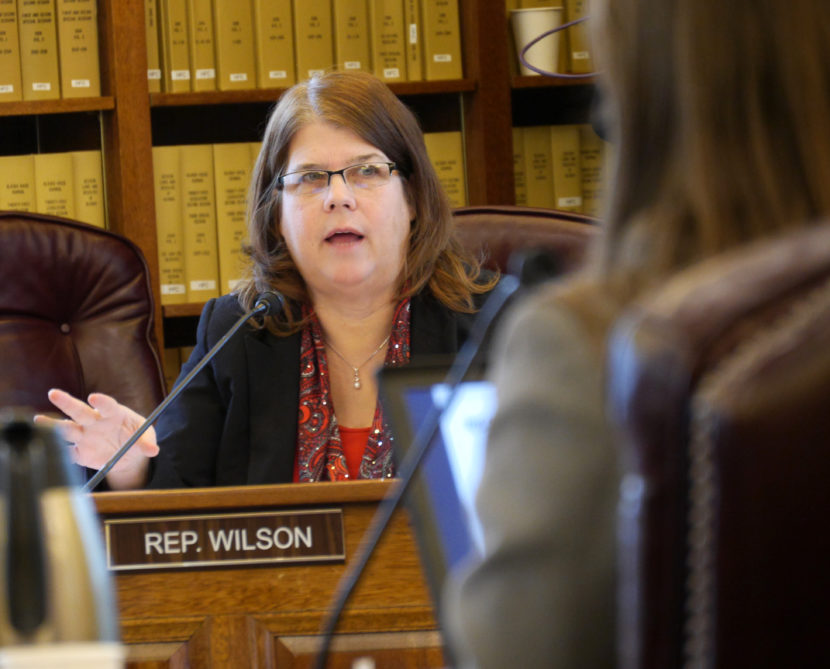
Rep. Tammie Wilson, R- North Pole, during a discussion about HB 115 in the House Finance Committee on Monday. (Photo by Skip Gray/360 North)
Under a proposed statewide income tax bill in the Capitol, Alaskans would have a choice when they apply for their annual Permanent Fund dividend: whether or not to set aside money to pay for their next year’s state income tax liability.
Employers could deduct state income tax payments from workers’ paychecks. But if workers prefer to pay with PFDs, they could ask their employers to deduct less money each pay period.
Alaskans who pay income taxes to other states would receive a credit to reduce their Alaska taxes.
Some minority-caucus Republicans expressed displeasure with House Bill 115’s details in a Senate Finance Committee meeting Monday.
North Pole Rep. Tammie Wilson told a Department of Revenue official it will be difficult for spouses who file their federal tax return jointly, but who pay state income taxes in different states.
“First of all, all of what you just said is a nightmare,” she said of the filing process. “I’ve done that with states before. And when you’re trying to figure out who to credit whom — luckily, they have H&R Block online.”
There could be two main new taxes passed this year. The income tax would be 15 percent of federal liability. A couple with two children and $150,000 in gross income would pay about $20,000 in federal income tax after deductions, and $3,000 in state taxes. And a separate 10 percent tax would be applied on all capital gains, such as the sale of stocks and bonds.
Anchorage Democratic Rep. Les Gara said residents should be clear that the income tax rate under the bill isn’t applied on their overall income.
“Fifteen percent of a 25 percent federal tax is a 3.75 percent tax,” Gara said. “I just don’t want anyone walking around saying that this is a 15 percent tax, when it’s not.”
Anchorage Republican Rep. Lance Pruitt expressed concern about the complexity of the bill. The legislation would also draw money from the Permanent Fund to pay for part of the state government budget.
“This is complex,” he said. “If I’m asking questions, you can understand what the public’s going to ask.”
Bill supporters say it would bring stability to the state’s budget and economy. The House Finance Committee will hold more hearings on the bill this week.
Rep. Paul Seaton, co-chair, House Finance Committee, discusses House Bill 115 with Alaska Public Media and KTOO reporter Andrew Kitchenman following the House floor session Friday. The bill creates a state income tax, draws money from the Permanent Fund for the state budget, and introduces a new formula for setting the amount of the Permanent Fund dividend. (Photo by Skip Gray/360 North)
Alaskans would pay a tax on income for the first time since 1980 under a bill introduced in the Legislature on Friday.
The bill also would draw money from the Permanent Fund to pay for the state government’s budget. And it would set a new formula for Permanent Fund dividends.
The new bill is the biggest visible sign yet of the shift in the majority of the state House of Representatives.
Income tax proposals went no further than committee hearings under the previous, Republican-led House majority.
But the new, mostly Democratic majority may advance the bill quickly.
Homer Rep. Paul Seaton is one of three Republicans who switched caucuses. He also helped write the new legislation, House Bill 115.
“The basic question is: ‘What kind of Alaska do you want to live in?’,” Seaton said. “Our constituents have told us that they want to see an Alaska that has a thriving economy, that has good schools, that has troopers and the court system running well. And without some kind of deficit reduction, broad-based, comprehensive plan, we don’t get that.”
The bill would set the income tax rate at 15 percent of federal liability. For example, a couple with taxable income of $75,000 would pay about $10,000 in federal taxes and $1,500 in state taxes.
The bill would give Alaskans the option of using some or all of their Permanent Fund dividends to pay the tax.
The bill would draw 4.75 percent annually from the Permanent Fund from the fund’s earnings account. That’s a little less than the 5.25 percent draw that Gov. Bill Walker has proposed. One-third of that money would go to PFDs. That would allow dividends to be $1,100 this year, more than the $1,000 Walker proposed.
“The majority caucus in the House formed around the principle of passing a comprehensive, sustainable fiscal plan, and so, that’s what we have,” Seaton said.
Seaton said the bill includes three of the pillars of the new House majority – including new revenue, a draw on the Permanent Fund, and changing Permanent Fund dividends. The fourth element is budget cuts and changes to the oil and gas tax system.
He said the income tax provides balance by requiring higher-income residents to contribute, while the PFD cut affects lower-income residents more.
“So this plan balances those two aspects, so that all families across Alaska are participants and have skin in the game,” Seaton said.
The bill would also tax capital gains at 10 percent. Seaton said his goal was to tax the sale of stocks and bonds at a similar rate as income.
The bill drew swift opposition from minority-caucus Republicans.
Anchorage Rep. Lance Pruitt objected to the bill being sponsored by the House Finance Committee. He said it would be wrong to add an income tax during a recession.
“Now you understand why I don’t want my name associated with this,” Pruitt said. “Now you understand why I don’t want anything to do with a bill that’s going to look — at a time when people are struggling — to say: ‘We need more money from you.’ ”
Wasilla Republican Rep. Cathy Tilton said House Finance Committee Co-chairmen Seaton and Nome Democratic Rep. Neal Foster shouldn’t have used their authority to introduce the bill as committee-sponsored legislation.
“Just because you can, doesn’t mean you should,” Tilton said. “Regardless of what’s been done in the past, (that) does not preclude a new standard of decorum.”
Senate leaders, including Fairbanks Republican Senate President Pete Kelly, have also said they’re opposed to an income tax.
The Senate majority supports $750 million in cuts over three years, and a constitutional limit on spending.
But Seaton said the public is willing to pay a tax to avoid deep cuts to government that he says would harm the economy.
He noted that Alaskans paid 16 percent of federal liability before the income tax was abolished. And he pointed to a Senate majority poll that found support for a broad-based tax.
“People are saying, yes, they want to see the Alaska they want to live in and they’re willing to pay an income tax like they used to for that privilege of living here and growing old here,” Seaton said.
The bill is scheduled for hearings on Monday, Tuesday, and Wednesday, and for public testimony Friday, Feb. 17.
Close
Update notification options
Subscribe to notifications
Subscribe
Get notifications about news related to the topics you care about. You can unsubscribe anytime.