Andrew Kitchenman

State Government Reporter, Alaska Public Media & KTOO

State government plays an outsized role in the life of Alaskans. As the state continues to go through the painful process of deciding what its priorities are, I bring Alaskans to the scene of a government in transition.

Reluctant to comply with REAL ID, Alaska faces possible barrier to flying

Sen. Bill Wielechowski, D-Anchorage, after a floor session in July. He sponsored the 2008 law barring the state from spending money to comply with the federal REAL ID Act. (Photo by Rashah McChesney/KTOO)

Alaska law bars the state government from spending money to comply with the federal REAL ID Act. Starting next January, the federal government will require Alaska residents boarding commercial flights to have ID cards that meet REAL ID standards.

Under House Bill 74 and Senate Bill 34, Alaska residents would be able to choose one of two driver’s licenses: one that complies with REAL ID, and one that doesn’t. The bills also would allow the state to spend money to comply with REAL ID, and to charge residents $5 to offset the costs.

The information on REAL ID-compliant licenses would be in a new database that’s shared with other states.

Sen. Bill Wielechowski, an Anchorage Democrat, sponsored the 2008 law that blocks Alaska from spending money on REAL ID. He said the federal government should bear the costs, and shouldn’t punish Alaskans by denying them access to military bases and flights.

“I think that’s offensive. I think it’s heavy handed. I think it will cost the state millions to implement,” Wielechowski said. “And I hope our federal delegation can – and the Trump administration will – put an end to that practice.”

Twenty-six states offer driver’s licenses that comply with the federal law. Alaska is one of 19 that received extensions as a result of legislation that would put it in compliance. Five states aren’t complying. On Jan. 30, some federal facilities began denying access to those states’ residents who don’t have passports or other IDs that comply with REAL ID.
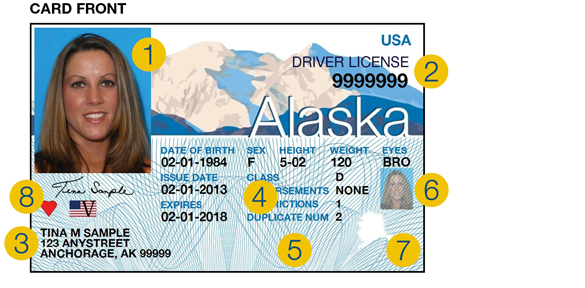
Alaska rolled out updated driver's license and ID cards in June 2014. They are not REAL ID-compliant.
Alaska rolled out updated driver’s license and ID cards in June 2014. They are not REAL ID-compliant. (Courtesy Alaska Division of Motor Vehicles)

Alaskans who only have driver’s licenses that don’t comply with REAL ID won’t be able to enter military bases and other federal buildings on June 7. They won’t be able to board commercial flights next January, unless the state passes the bill. If it does pass the bill, Alaskans will have until October 2020 to get REAL ID-compliant cards.

Congress passed REAL ID in 2005. It included provisions aimed at making it more difficult for people in the country illegally to get driver’s licenses, and to make boarding aircraft more secure after the Sept. 11 attacks.

At a House State Affairs Committee meeting on Tuesday, representatives from both parties expressed opposition to the federal law. Anchorage Republican Gabrielle LeDoux says the federal law could actually make identity fraud more likely.

“To the extent that it is there to prevent identity fraud, I would think that having everybody’s information in a database is more likely to cause identity fraud,” LeDoux said.

State officials noted that personal information on the state’s current driver’s licenses already is available to officials in other states. No more information would be available through the REAL ID licenses.

LeDoux says the federal government has put the state in a difficult position. She compared the database to those with credit card information that have been hacked.

“It makes me uncomfortable. And yet at the same time, you got to be able to fly,” she said.

Gov. Bill Walker proposed the bills. State Department of Administration Deputy Commissioner Leslie Ridle says the bills are intended to give Alaskans options. She says many people who aren’t paying attention to the issue may be affected.

“They’re going to want to jump on a plane for a vacation and not have a passport or any of these other types of IDs that will allow them to fly,” Ridle said.

The committee didn’t take action on the bill. The Senate bill was referred to the Senate State Affairs Committee.
Chief justice urges lawmakers to collaborate and compromise

State Supreme Court Chief Justice Craig Stowers said Alaska’s courts are leading the way in cutting costs in a way that doesn’t threaten vital services.

In the annual State of the Judiciary address Stowers gave Wednesday, he told lawmakers this Legislature has a chance to be remembered by history for addressing the state’s fiscal crisis. He said much is similar to the options they faced last year.

“But things are different today in the sense that you have – Alaska has – less time to find the way forward to an effective and fair solution to the financial challenges we face,” he said.

Stowers said it’s not his place to advise legislators on how to address the state’s budget. But he urged them to collaborate and compromise.

“The stark reality is that Alaska is quickly depleting its savings; new revenue is going to be very difficult to generate; relying solely on cutting state government will not solve the problem; postponing hard decisions will needlessly squander what time remains; and there is great controversy about all of the options that you face,” he said.

The court has proposed cutting its $105 million budget by $3.6 million dollars. Combined with cuts this year and last, it would have reduced costs by $11 million over three years.

“It is doable and will not inflict long-term damage or disruption to the court’s core functions,” Stowers said. “Our strategy is to make careful, incremental reductions over time; these kinds of reductions are more manageable; and they allow for greater predictability and continuity of core court operations.”

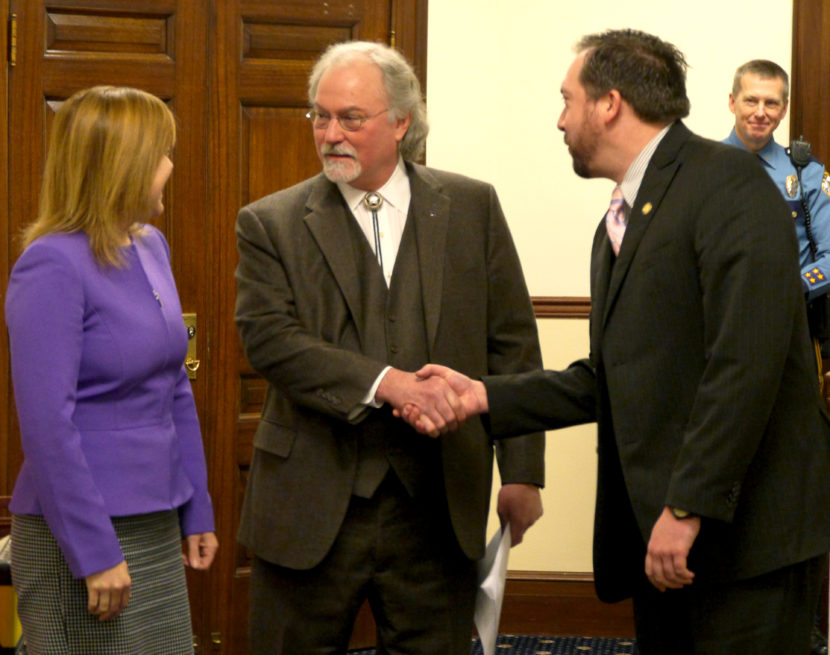
Sen. Mia Costello prepares to escort Chief Justice Craig Stowers with Rep. Zach Fansler into the House Chambers on Feb. 8, 2017, for the annual State of the Judiciary Address. (Photo by Skip Gray/360 North)
Sen. Mia Costello prepares to escort Chief Justice Craig Stowers with
Rep. Zach Fansler into the House Chambers on Feb. 8, 2017, for the annual State of the Judiciary Address. (Photo by Skip Gray/360 North)

Stowers said the courts plan to leave 10 of 690 positions unfilled this year. And the courts aren’t filling vacant magistrate judge positions in rural courts. Stowers noted these rural courts are the face of state government in some communities. But he says the judges have “very small” case loads compared with other courts.

The cases would be heard either by a judge who will periodically travel to rural areas, or at a different court, with parties appearing by phone or video-link if they can’t attend in person.

Court workers took a 4-percent pay cut last year, when the courts began closing on Friday afternoons.

Stowers said he’s concerned about the effect of those cuts.

“This salary reduction, when added to the upcoming significant increase in employee contributions to health care coverage, is a true hardship that those earning more may not appreciate,” Stowers said. “Many of our employees are clerical employees at or near the bottom of the state government pay scale; some have to work several jobs to make ends meet for their families.”

The chief justice noted some areas where the courts have expanded services, including training workers and lawyers on the overhaul of the state’s criminal justice system.

Motor fuel tax would triple under bill, but remain below national average

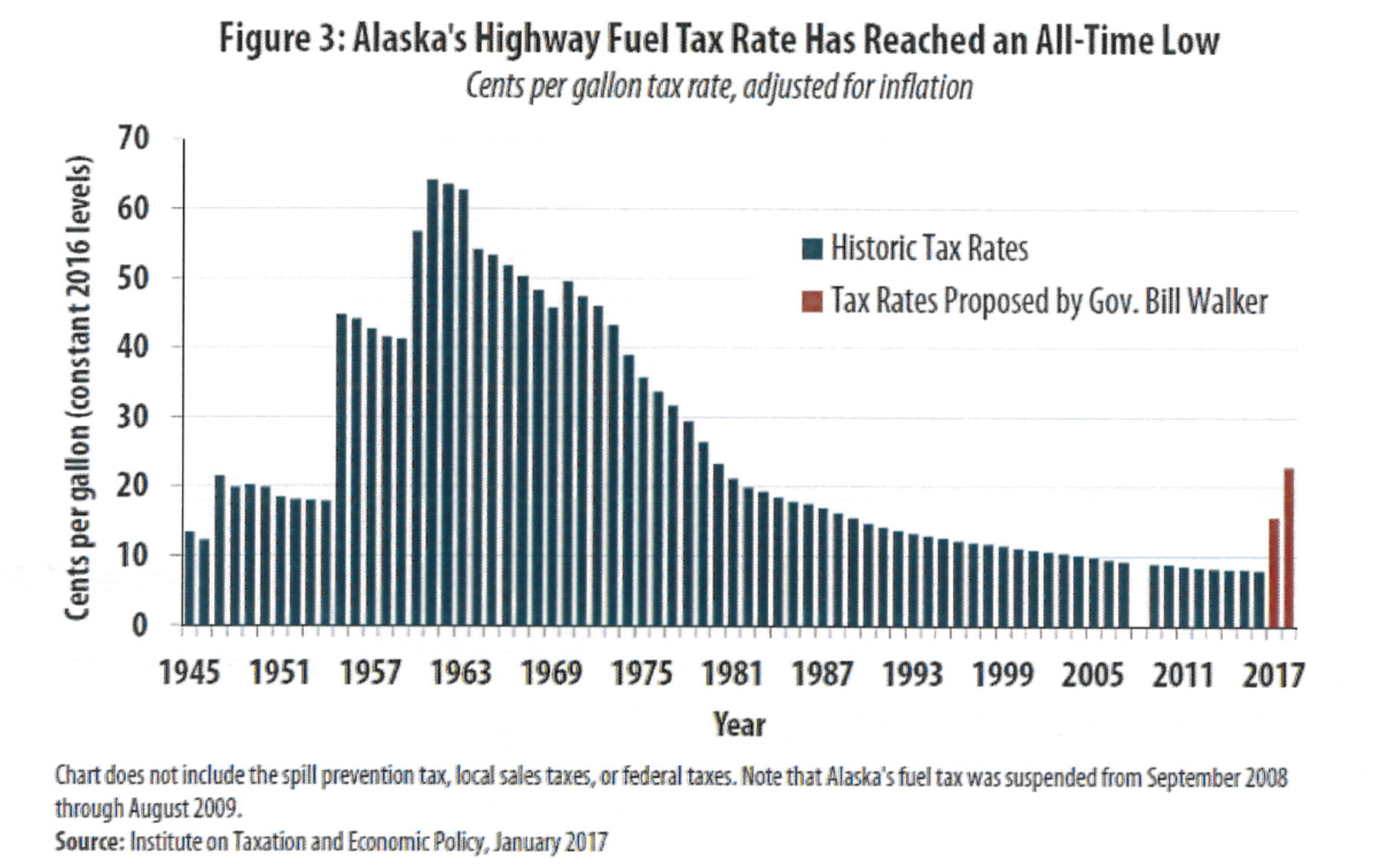
If enacted, Alaska's motor fuel tax would triple, but remain less than half of its inflation-adjusted high. (Screen capture of Institute of Taxation and Economic Policy report).
If enacted, Alaska’s motor fuel tax would triple, but remain less than half of its inflation-adjusted high. (Screen capture of Institute of Taxation and Economic Policy report).

Lawmakers are considering tripling the state’s motor fuels tax over the next two years. A bill would raise the tax from a national low of 8 cents per gallon to 16 cents in July, then 24 cents per gallon in July 2018.

The money raised by House Bill 60 would be designated to maintain the state’s roads, as well as airports and ferries.

Transportation Commissioner Marc Luiken told the House Transportation Committee on Jan. 31 the state would spend the money carefully.

“My commitment to you is, is that … we will be accountable to Alaskans, to you as our investors, for these funds that you’re investing in this department,” Luiken said.

While the Legislature opposed all tax increases last year, some powerful lawmakers have signaled an openness to considering raising the motor-fuel tax for the first time since 1970. They include Senate President Pete Kelly, a Fairbanks Republican.

“I don’t mind having the lowest in the nation, but certainly we need to update it from time to time,” said Kelly, who described the tax as a “user fee.”

Adjusted for inflation, the 8-cent-per-gallon tax in 1970 would equal 50 cents today. If the tax is raised to 24 cents, it would still remain below the national average.

Some lawmakers who represent Matanuska-Susitna Borough residents expressed concern that the tax would be a burden on those with long commutes.

Wasilla Rep. Colleen Sullivan-Leonard, a Republican, was among those expressing concern about the tax.

“Who’s going to be affected? And it’s going to be my residents and it will be significant,” Sullivan-Leonard said. “Every penny, I think, is very detrimental.”

Anchorage Rep. Matt Claman, a Democrat, noted that the people who benefit the most from using the roads would pay the tax.

“Even though those that buy more fuel and (are) driving on the roads are actually using the roads more, they’re getting the very much benefit of what they’re spending,” he said. “Because they’re getting roads that get maintained.”

Representatives of airlines and other businesses that use fuel are scheduled to testify regarding the bill in the House Transportation Committee on Thursday.

Privatization could save some money at API, not at youth centers

brains
(Creative Commons photo by Neil Conway)

Alaska’s state government can save money by privatizing some services at the Alaska Psychiatric Institute, or API. But it doesn’t look like it would save if it privatized all services.

Consultants who studied the privatization for the state found that management of the institute, as well as operating the state’s juvenile justice detention centers, are better done by the state.

Savings depend on how many patients are at the psychiatric institute, said Coy Jones, senior consultant for Public Consulting Group.

“We definitely made some recommendations where there are some limited cases of privatization that we would recommend implementing,” Jones said. “They’re easy to do, and they will generate some cost savings.”

For example, the consultants recommend there could be savings in privatizing the institute’s communication center.

But a different consultant that looked at youth detention centers couldn’t find any opportunities for privatization.

Consultant Carl Becker of CGL – a consulting company that specializes in corrections — said local organizations operate juvenile facilities in other parts of the country. But local organizations weren’t interested in operating the facilities in Kenai, Nome and Palmer.

We found basically no private or governmental in any of these regions that had either the interest or the capability to operate standalone detention facilities for these youth,” Becker said.

The state also couldn’t find savings in privatizing pharmacy services at Pioneer Homes.

The state studied privatizing services as a result of a new law that overhauled Medicaid in Alaska. The Senate Health and Social Services Committee held a hearing on the studies Monday.

New proposal could split Permanent Fund draw between PFDs, state budget

Sen. Bert Stedman, R-Sitka, argues against Senate Bill 6, which would eliminate daylight saving time in Alaska, during an Alaska Senate floor session, March 11, 2015. The Senate passed it 16-4. (Photo by Skip Gray/360 North)
Sen. Bert Stedman, R-Sitka, speaks on the Senate floor in 2015. He has proposed a bill to draw money from the Permanent Fund. (Photo by Skip Gray/360 North)

The amount residents receive in Permanent Fund dividends would be the same as the amount available for the state budget, under a new proposal.

It’s one of two Permanent Fund plans lawmakers are considering, although more may be on the way.

Using Permanent Fund earnings for anything but dividends was long considered untouchable in Alaska politics. But this legislative session, all but a few lawmakers are talking about different ways to use fund earnings to pay for part of the state budget.

The latest proposal is Senate Bill 21, sponsored by Sen. Bert Stedman. The Sitka Republican wants to draw 4.5 percent from the $55 billion fund each year. At least half of the draw would go to dividends. And Stedman said the rest of the draw could be spent on the budget.

“We’re all in it together – Republicans, Democrats, independents, urban, rural – it doesn’t matter,” Stedman said. “We’re all in the same ship – and the ship’s sinking, financially. And it’s sinking pretty fast.”

In the first year, Stedman’s bill would bring in $1.1 billion to the state budget. That’s about $700 million less than Gov. Bill Walker’s Permanent Fund bill. Stedman’s bill would provide for larger PFDs – about $1,700 compared with $1,000 under Walker’s proposal. The governor’s bill is based on legislation the Senate passed, but failed in the House last year. Walker ended up vetoing half of 2016’s payout.

Stedman said his goal is to protect the Permanent Fund into the future.

“I don’t want to see us have huge appropriations that are unsustainable into the earnings reserve of the Permanent Fund,” Stedman said. “And the only way to do that is to block the legislative ability of the good-intended Legislature.”

The senator kept the bill simple, drawing on the current Permanent Fund law. He said other ideas that would put the state’s budget into long-term balance could be added as amendments to the measure.

“This would be a framework that we would put or bolt on or attach other solutions to,” Stedman said. “There’ll be discussions of spending caps or spending limits. There’ll be discussions on taxes – income tax, property tax, if you name the tax, it’s under discussion in the building – and budget reductions.”

Stedman has brought the idea to members of Walker’s administration. Revenue Commissioner Randall Hoffbeck said devoting more money to the budget – and drawing more from Permanent Fund earnings – will make it easier to close the $2.7 billion gap between state spending and the amount the state raises in oil royalties, taxes and fees.

“We don’t think that it uses our financial assets to their fullest potential – that it’s leaving money on the table,” Hoffbeck said. “And by leaving money on the table, it makes other solutions more difficult.”

Stedman said the state could phase in elements of his bill over time. But he said it’s important that it doesn’t draw so much from Permanent Fund earnings that it would affect the fund’s health. And he said that if dividends are much lower, then voters may not accept the changes.

Legislature eyes limit on state government spending

Sen. Pete Kelly, R-Fairbanks, in February 2016.  He supports having a new limit on state government spending. (Photo by Skip Gray/360 North)

Some state legislators want to write into law a new limit on how much the state can spend each year. But policy experts say it’s a difficult strategy to put into effect. And Alaska already has a limit – one that critics say hasn’t worked.

In 1982, Alaska voters amended the constitution to say that the state would never spend more than two and a half billion dollars – adjusted for inflation and population growth.

But a drop in oil revenue in the following years, combined with inflation and population growth, made sure that the state rarely got close to the limit.

Lawmakers in the Republican-led Senate majority – as well as the House minority – want a new limit. They say they’d like it in state law as soon as this year – as well as a new constitutional limit in two to three years.

Eagle River Republican Sen. Anna MacKinnon said it’s important that the Legislature pick the right amount to base future spending limits on.

“Having the right base number is the primary conversation that we’re having right now in the statutory consideration,” MacKinnon said.

An amendment to the constitution proposed in the House – as well as House Bill 92 – would base the spending limit on the previous year’s spending. If the state’s economy were to grow faster than inflation and population, then government’s share of the state’s economy would shrink over time.

Senate President Pete Kelly of Fairbanks, a Republican, sees this as a potential benefit of the limit.

“Honestly, most people believe government’s too big, and if you have something like that, that would probably be a good thing,” Kelly said. “And I think as we go forward, if there are flaws in that – before it reaches the constitution – we should know about them and we will have had many discussions.”

At least 30 states have some form of spending limit. And many of them have faced practical problems, like Alaska.

Benjamin Zycher of the American Enterprise Institute said state spending limits aren’t effective.

“The same sort of political pressures and interest group demands and all the rest that lead to fiscal irresponsibility – however that’s defined in the first place – tend to reassert themselves,” Zycher said.

Iris Lav works for the Center on Budget and Policy Priorities, which supports federal and state policies designed to reduce inequality. Lav noted that if state spending were to fall sharply one year due to drops in oil revenue, it would ratchet down future spending (if it was based on the previous year’s spending).

“In Colorado, the business community banded together to get rid of the ratchet, because they felt that public services were really being hurt when the recession had cut revenues,” Lav said.

She said that if a state decides it needs to limit spending, it should set the limit based on an amount – like Alaska did in its constitution.

House Majority Leader Chris Tuck, an Anchorage Democrat, opposes a change. He said the Legislature can impose its own informal limit on spending by being fiscally responsible.

“I don’t think it’s necessary, because we have capped our spending – self-imposed,” Tuck said.

A Senate version of a spending limit bill hasn’t been introduced yet.

Site notifications
Update notification options
Subscribe to notifications