Andrew Kitchenman

State Government Reporter, Alaska Public Media & KTOO

State government plays an outsized role in the life of Alaskans. As the state continues to go through the painful process of deciding what its priorities are, I bring Alaskans to the scene of a government in transition.

ACA repeal could complicate Medicaid reforms

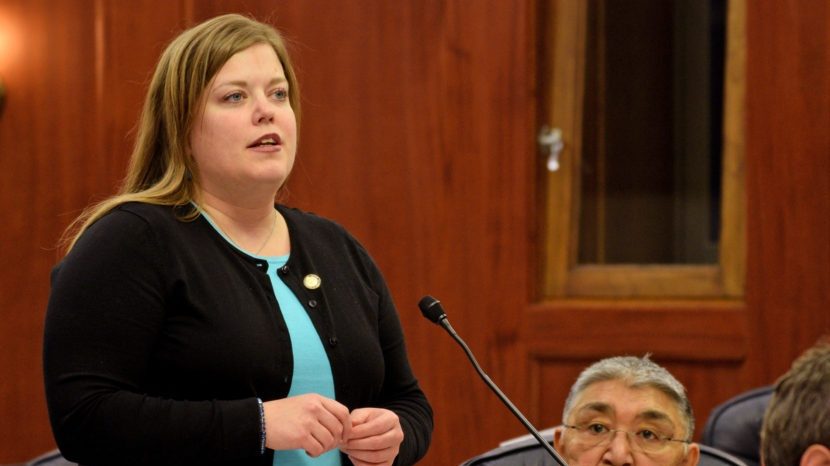
Valerie Davidson, commissioner designee of Alaska’s Department of Health and Social Services listens to the State of the State Address, Jan. 21, 2015. (Photo by Skip Gray/360 North)
Valerie Davidson, commissioner of Alaska’s Department of Health and Social Services in 2015. She’s concerned about the effect of an Affordable Care Act repeal. (Photo by Skip Gray/360 North)

State health leaders say a federal repeal of the Affordable Care Act could make it difficult to implement reforms to Medicaid. That could cost the state the tens of millions of dollars that lawmakers are counting on.

Many of the reforms the Legislature included in the Medicaid law it passed last year depend on parts of the Affordable Care Act.

State Health Commissioner Valerie “Nurr’araaluk” Davidson says medical providers have told her they hope to receive federal funding that was included in the law.

“If Medicaid expansion went away, if that authority went away, that would really impact their ability to participate in some of those reform opportunities, because it provides them with a little bit of cushion for them to be able to do things creatively,” she said.

A state plan to increase the amount of services that people with disabilities receive in their homes and communities depends on a part of the federal law. And a Division of Insurance reinsurance program that’s gained national attention also depends on the ACA.

Some members of Congress have discussed replacing the current system that guarantees federal payments for Medicaid to one where states receive a set amount of money each year, known as “block grants.”

Davidson said these proposals favor states with lower medical costs and low transportation costs.

“We really see the block grants as really a mechanism to be able to shift that federal responsibility to states,” Davidson said. “The proposals that we have seen so far to do Medicaid block grants do things that do not favor Alaska.”

More than 27,000 Alaskans receive Medicaid due to an expansion that Gov. Bill Walker supported. Another 18,000 residents receive health insurance through the ACA’s individual and family marketplace.

Senate Health and Social Services Committee Chairman David Wilson asked Davidson if she’s preparing for a repeal of the Medicaid expansion.

“Has the administration or the department come up with contingency plans for those type of scenarios, those worst-case scenarios?” asked Wilson, a Wasilla Republican.

Davidson said the department is trying to plan, but the proposals could affect the state in hundreds of ways. She’s asked members of the state’s congressional delegation to ask for long-term estimates of state expenses for proposals to repeal the federal health law.

Gov. Walker said on Talk of Alaska on Tuesday that if the federal government stops funding the Medicaid expansion, it still would have benefited Alaskans.

“If we can’t afford to fund the federal portion – which I think would be very, very difficult given our fiscal situation – we’ll just have to be pleased with those whose lives were improved, those lives that were saved as a result of taking that step to expand Medicaid,” Walker said.

Republican U.S. Sen. Lisa Murkowski has said Congress should replace the Affordable Care Act at the same time it repeals the law.
Walker criticizes Trump’s handling of refugee issue

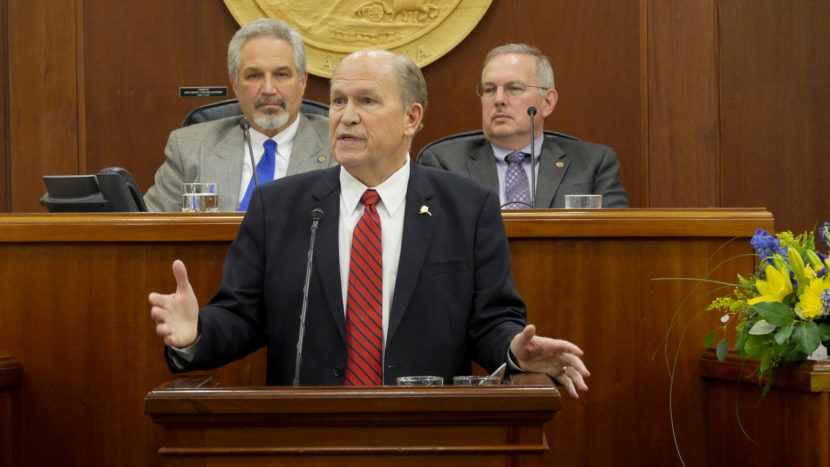
Gov. Bill Walker delivers his State of the State address to the Alaska Legislature, January 18, 2017. Behind him, left to right, are Senate President Pete Kelly (R-Fairbanks) and Bryce Edgmon (R- Dillingham), Speaker of the House.
Gov. Bill Walker delivers his State of the State Address to the Alaska Legislature on Jan. 17. On Tuesday, he criticized President Donald Trump’s handling of an order restricting refugees and some immigrants.  (Photo by Skip Gray/360 North)

Gov. Bill Walker criticized President Donald Trump’s order that halted immigration from seven heavily Muslim countries, indefinitely banned Syrian refugees and temporarily banned all other refugees.

During Tuesday’s Talk of Alaska, Walker said his experience in local government taught him to focus on the process used to reach decisions. He said the Trump administration didn’t appropriately handle the process for issuing the order.

“I think that changes of this magnitude — to not be done without any sort of process involved — I think it catches people off-guard,” Walker said. “I think it frightens people … because some things just aren’t well thought out. And, so, I think this is one of them.”

Walker noted that diversity is an important issue in the state, which by one measure has 19 of the 20 most diverse schools in the country.

“I didn’t join the efforts to close our borders, because I don’t follow the crowd,” Walker said. “I do what I think is best for Alaska. So I look at everything that happens in Washington through my Alaska lens, and see how it impacts Alaska.”

Walker noted he decided against joining 30 other governors in 2015 when they asked then-President Barack Obama to stop allowing Syrian refugees into the country.

Sweeping criminal justice overhaul under fire — and revision

John Coghill State of the State response
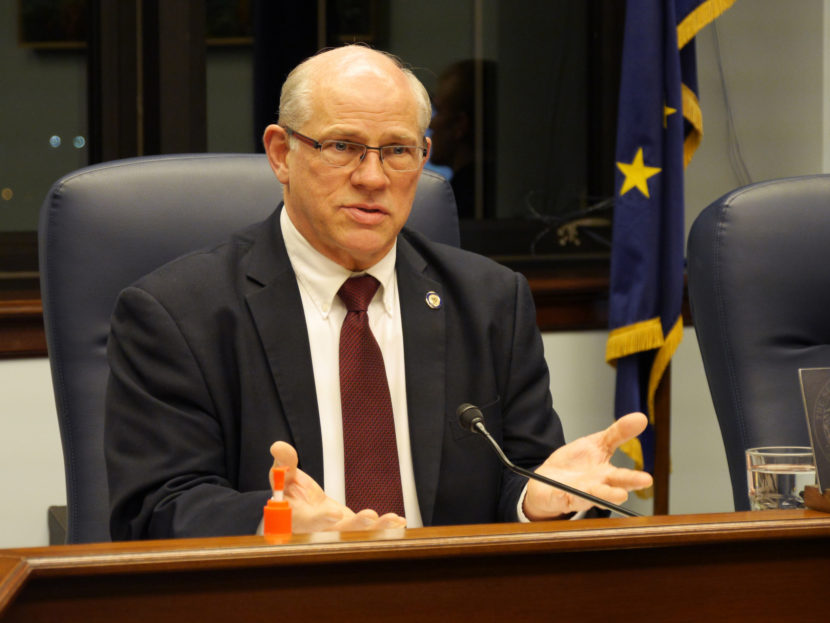
Sen. John Coghill, R-North Pole, is working on revisions to the criminal justice overhaul he helped write. This photo is from January 2016. (Photo by Skip Gray/360 North)

Legislators are considering changes to a seven-month-old law that overhauled the criminal justice system. The commission that helped shape the law has recommended 14 changes to it.

The law allowed some low-risk offenders to avoid jail time. And it made other changes in sentencing, bail and probation that are aimed at reducing the number of repeat offenders.

Critics say the law is allowing some people charged with serious crimes to be released the same day they’re arrested.

The Alaska Criminal Justice Commission recommended a series of changes Monday. It suggested that some felony convictions currently receiving suspended sentences should instead lead to up to 90 days in jail.

Sen. John Coghill helped write the law. The North Pole Republican said the Senate Judiciary Committee is trying to strike a balance in revising the law.

“I think we’re going to drill down pretty well in our committee, find what is the real public safety problem,” Coghill said. “Can we give the police tools, can we give the law tools to actually hold people accountable — so that when, whatever society dishes up, we can hold people accountable?”

Other recommendations in the report include correcting what the commission called an “apparent oversight” that eliminated a legal provision requiring sex offenders to serve probation. The commission recommended requiring mandatory probation for sex offenders.

The commission reached a consensus on the recommendations that became the basis for the law last year. But that consensus has been tough to find this year, with some commission members calling for restoring tougher penalties than most commission members recommend. The only time they reached a consensus this year was a recommendation to make technical changes to the law.

Anchorage Sen. Kevin Meyer, a Republican, said the recommendation on giving 90 days to Class C felons appears to be too soft.

“I think we have to keep in mind the victim,” Meyer said. “I know if someone was threatening me with a gun, I wouldn’t want just a slap on the wrist.”

Critics of the law have linked it to a rise in some crimes in parts of the state.

But Coghill said the sweeping nature of the law has focused public attention on it.

“So it’s not surprising that people would blame that when there was a failure in public safety or our ability to hold people accountable,” Coghill said. “But it just simply isn’t true that it’s the cause of all failures in our system.”

Anchorage Sen. Bill Wielechowski, a Democrat, said he doesn’t want to amend the law based on what he says may be “knee-jerk” reactions. He said any changes should be based on evidence from Alaska and other states.

“If just the penalties we have in the bill work and people are getting rehabilitated, then that’s certainly something I’d want to know,” Wielechowski said. “And by the same token, if it’s not working, if people are getting off and committing other crimes, then I certainly want to know that as well.

Coghill said some of the pushback to law was political, while other concerns were due to unrelated factors that predated the law, such as the ongoing opioid addiction epidemic. He said tight budgets in the Department of Law and local police departments also have caused problems, as has a separate change in bail schedules made by the court system.

“Yes, there’s been pushback,” Coghill said. “So what we tried to do is we tried to figure out what pushback is political, what is misinformation, what is a timeline problem, and what is a real public safety problem.”

Coghill is a nonvoting member of the commission. He plans to use the commission’s recommendations to draft potential changes to the law, which the Senate Judiciary Committee will discuss in the coming weeks.

Bill seeks to prevent lawmakers from easily voting to financially benefit themselves

Rep. Jason Grenn, (I-Anchorage) testifies before the House Judiciary Committee on January 27, 2017. Rep. Grenn testified on his sponsored HCR 1 and HB 44 which, if passed, would redefine when a legislator with a conflict of interest can and should abstain from voting. (Photo by Skip Gray/360 North)
Rep. Jason Grenn, I-Anchorage, testifies before the House Judiciary Committee on Jan. 27, 2017. Grenn testified on his sponsored HCR 1 and HB 44 which, if passed, would redefine when a legislator with a conflict of interest can and should abstain from voting. (Photo by Skip Gray/360 North)

When Alaska legislators or their immediate family members financially benefit from bills, the lawmakers declare they have a conflict of interest.

But as long as one other legislator objects, the person with the conflict is still required to vote.

Anchorage Rep. Jason Grenn wants to change that to requiring a majority of members to agree to the objection.

He’s proposed two bills that would make it harder for people to vote on issues that might financially benefit themselves.

“There’s no target with this bill outside of wanting to build public trust and add transparency to what we do as 60 members of the Legislature,” Grenn said.

Grenn is an independent who caucuses with the mostly Democratic House majority.

He said Alaska is the only state in the country that makes it so easy for lawmakers with conflicts of interest to vote.

Grenn said he’s sensitive to conflicts of interest because he resigned as manager of Alaska Community Foundation’s Pick.Click.Give. program — due to a perceived conflict of interest — after he was elected.

Republicans have met the bills with skepticism, saying it unfairly targets legislators who work for oil and gas companies.

Eagle River Rep. Lora Reinbold noted that some members of the House majority want to change oil and gas tax policies in a way that would require the companies to pay more.

She asked Grenn about that during a House Judiciary Committee hearing Friday.

“Is there motivation in any way to alienate or target anyone associated with the oil and gas industry?” Reinbold asked.

Grenn replied he was motivated by increasing transparency.

The League of Women Voters supported the bills.

League President Pat Redmond issued a statement in support.

“We often hear supporters of the current practice say that to not vote is to deprive district of its voice,” she said. “The answer to that is that a vote cast under a cloud also deprives voters of knowing that the vote was cast for the benefit of the district and the state.”

Former lawmaker Mike Bradner helped write the rule that allows those with conflicts of interest to vote.

He said the new bills present practical challenges.

“I consider my senator obligated to vote, whether I like his vote or note. Now, at election time, I may take a different view,” Bradner said.

Bradner would like to see the rules stay like they are: Members declare their conflicts. They are allowed to vote. And those conflicts are covered by the news media.

One of Grenn’s bills, House Bill 44, would change the law, while the other, House Concurrent Resolution 1, would change House rules.

The bills could be discussed by the Judiciary Committee again as soon as Monday.

State leaders seek business input on effort to develop economy

Department of Commerce, Community and Economic Development Division Director Britteny Cioni-Haywood, Development Manager Ethan Tyler, and Commissioner Chris Hladick (Left to right) deliver a presentation to the Senate Labor and Commerce Committee on economic development strategy. January 26, 2017. (Photo by Skip Gray/360 North)
Department of Commerce’s Britteny Cioni-Haywood, left, director of Community and Economic Development Division, Development Manager Ethan Tyler and Commissioner Chris Hladick deliver a presentation on economic development strategy on Jan. 26. (Photo by Skip Gray/360 North)

Business and community leaders have told state officials they’d like to see new sources of money to finance economic development.

That was among the early findings of a state effort to build a comprehensive strategy to develop Alaska’s economy.

Chris Hladick, state commissioner of Commerce, Community and Economic Development said the strategy could lead to a summit of business leaders, and a long-term effort to build a partnership between the state and the private sector.

“You need to build this from the bottom up,” Hladick said. “You have to have industry and private enterprise involved in the process. And we’re talking about a decade if not longer, is what you really need to do to see results.”

Northern Opportunity is the state’s name for its comprehensive economic development strategy.

A draft strategy will be prepared this year, but state leaders expect it will take much longer for the strategy to improve the business climate.

State officials says there’s interest in expanding the use of micro-financing and crowd-funding, as well as expanding state financing.

They’re drawing on the experience of regional economic development organizations. The Senate Labor and Commerce Committee heard testimony from regional leaders Thursday.

Anchorage Economic Development Corporation President and CEO Bill Popp said research points to opportunities for pharmaceutical companies to expand operations in the state.

“We have by no means proven that this is a slam-dunk opportunity,” Popp said. “But it’s a great first indicator that we’ve got something to work with here, if we can just sort out the other things related to the cost of doing business here.”

Southeast Conference completed a five-year strategic plan for the region last year.

Economic Development Planner Meilani Schijvens said job losses in the state government are putting a drag on Southeast Alaska’s economy.

“The real question, of course, is how the impact of the state fiscal crisis will impact the regional economy,” Schijvens said.

Hladick noted past economic development efforts have ended when new administrations take office. So, he said, it’s important that the private sector take a lead role in any future strategy.

Bill would allow judges to order gun owners to forfeit weapons if found to be threat

Rep. Geran Tarr addresses the Alaska House of Representatives on April 7, 2014. Tarr and Andy Josephson will replace Benjamin Nageak (seated) and David Talerico as the co-chairs of the House Resources Committee. (Photo by Skip Gray/360 North)
Rep. Geran Tarr addresses the Alaska House of Representatives on April 7, 2014. Tarr has introduced a measure that would allow judges to issue protective orders against Alaskans who are deemed a threat to themselves or others, and would make them temporarily surrender their firearms. (Photo by Skip Gray/360 North)

Alaskans can have firearms even when family or law enforcement officers believe they are a threat to themselves or others.

But a new bill would allow judges to issue protective orders making them temporarily surrender their guns.

Bill sponsor Rep. Geran Tarr said the measure’s scope is limited.

“I’m not interested in taking guns from anyone,” she said. “I’m really interesting in helping someone in a crisis situation, who’s experiencing mental illness – and hoping that we can do something that prevents an innocent person from being killed.”

Tarr, an Anchorage Democrat, says she planned to introduce the bill before Anchorage resident Esteban Santiago allegedly killed five people in Fort Lauderdale, after he had been prosecuted for domestic violence.

Tarr said the bill’s timing is unrelated to the mass shooting, but she said she’s heard more interest in the idea since the incident.

The bill would allow an immediate family member or peace officer to petition a judge for a protective order.

A hearing would be held within 10 days, and if the judge finds clear-and-convincing evidence that a person is a danger to themselves or others, the judge could prohibit the person from owning or buying a gun.

Rep. David Eastman, a Wasilla Republican, is concerned about the proposal.

“As a military veteran, I would definitely be cautious before coming into a situation where another veteran might lose their Second Amendment rights,” Eastman said. “I would be also concerned if this type of legislation would have the effect of discouraging people from seeking help.”

Tarr’s said she’s interested in working with those concerned about the bill.

“We had record numbers of shootings last year in Anchorage,” she said. “So what are the other ideas? Let’s at least have a thoughtful conversation.”

The legislation, House Bill 75, was introduced on Monday.

Its next stop is the House Judiciary Committee, where it hasn’t been scheduled for a hearing.

Site notifications
Update notification options
Subscribe to notifications