Andrew Kitchenman

State Government Reporter, Alaska Public Media & KTOO

State government plays an outsized role in the life of Alaskans. As the state continues to go through the painful process of deciding what its priorities are, I bring Alaskans to the scene of a government in transition.

New House majority takes over on first day of session

Rep. Bryce Edgmon was in his office shortly before being sworn in as the first Alaska House speaker of Alaska Native heritage.Jan. 17, 2017.
Rep. Bryce Edgmon was in his office shortly before being sworn in as the first Alaska House speaker of Alaska Native heritage. (Photo by Andrew Kitchenman/KTOO and APRN)

The 30th Alaska State Legislature was sworn into office today. It faces a fiscal crisis that’s grown over the past four years, as oil revenue declined.

For the first time in 24 years, there will be a new House majority. A coalition of 17 Democrats, three Republicans and two independents took over from the longtime Republican-led majority.

Lt. Gov. Byron Mallott gaveled in the session.

Dillingham Democrat Bryce Edgmon was elected speaker. New Anchorage Republican Rep. David Eastman was the only vote against Edgmon.

“We stand here in a moment of time, knowing that Alaska’s facing a fiscal crisis unlike any other times in its short history,” Edgmon said.

Alaska’s state government is still spending more than $3 billion more than it’s raising in oil revenue, taxes and fees. And it’s not clear yet if the state will have enough money to fund services like schools at current levels, or whether it will make changes to the Permanent Fund dividend.

The House majority came together with a goal of reaching a budget plan that will include both new taxes and spending cuts.

Edgmon said that while nothing is off of the table for budget cuts, the fiscal solution can’t depend on deep cuts to schools and health and social services.

“Our caucus doesn’t believe we have room to make those major reductions. We’ve already made a lot of reduction heretofore,  and that the next step is to tackle those very different choices when it comes towards generating new revenues,” he said.

Edgmon said he’ll face a challenge in steering legislation through.

“With the narrow margin that we have in the House of Representatives – it’s a 22-18 majority-minority split – that the speaker’s role might be more pronounced this session than perhaps at times in the past,” he said.

House Minority Leader Charisse Millett faces her own challenge. Eight of the 18 members of the Republican caucus are new to the Legislature. But the Anchorage Republican said they’re ready to work.

“Our new caucus is fantastic,” she said. “The eight members just bring added experience – there’s a lot of municipal government experience.”

While Edgmon said the majority looks forward to working with Gov. Bill Walker’s administration to close an $890 million hole in the budget, Millett was sharply critical of the gap that Walker left in his spending plan.

“For me, (it) was a little disingenuous,” she said. “He is the leader. He’s the governor. He’s supposed to put forward a budget. We’re supposed to review it.”

Today also marked a historic moment that Edgmon noted in his remarks.

“It’s certainly not lost on me, as profound as this moment is for personally, that this is also a moment in history for – I sit here as the first speaker of the House of Representatives of Alaska Native heritage,” he said.

Edgmon has Aleut heritage. He said he hopes he’s the first in a long line of Alaska Native House  speakers.
Alaska’s House majority weighs whether to hold open caucus meetings

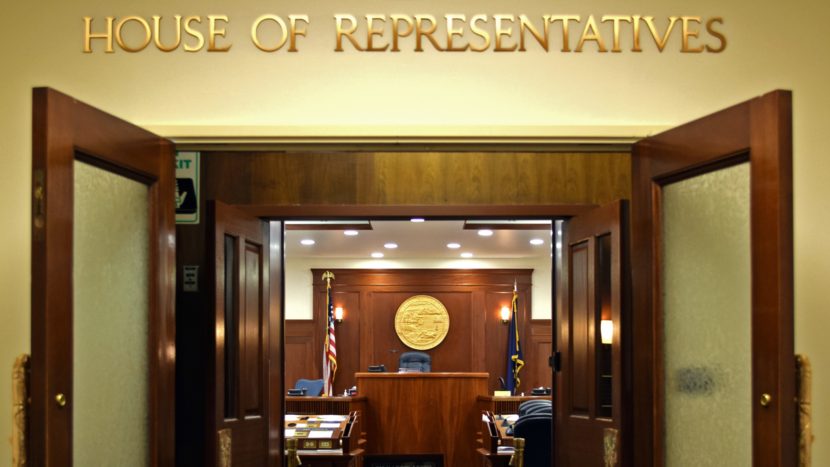
The Alaska House of Representatives entrance in the Capitol in Juneau, Feb. 6, 2015. (Photo by Skip Gray/360 North)

Last year, when most Democrats were in the minority in the Alaska House of Representatives, they held regular caucus meetings that were open to the public before voting in sessions on the House floor.

Most of the Democrats who were out of power last year will be in the majority this year. But it’s not clear whether the majority caucus will hold these pre-session open meetings.

Rep. Paul Seaton is a Republican who was in the majority last year and remains in the majority after he switched caucuses this year. He said the new majority will have an open approach.

“The majority generally doesn’t hold pre-session caucus” meetings, he said. “If a smaller group of legislators want to get together and talk, that’s one thing. But the majority should have their discussion in public on the floor of the House.”

The new majority caucus includes 17 Democrats, three Republicans and two independents. Coalition spokesman Mike Mason said it plans to meet in the coming days to decide whether it will hold open caucus meetings.

Seaton said early Wednesday that he does not expect the new majority to hold pre-session open meetings. Later in the day, Mason said the caucus hadn’t decided yet.

After being told Seaton’s remarks (but before Mason amended them), incoming House Minority Leader Charisse Millett said she sees a contrast between what the Democrats did in the minority and what Seaton said the new majority would do.

“The Democrats are the ones that actually screamed the loudest about it … being a violation of the closed caucus,” Millett said.

Millett, an Anchorage Republican, said the last year’s Republican-led majority held weekly meetings to discuss strategy, but they didn’t decide the outcomes of votes. Millett said that means they didn’t violate the Open Meetings Act.

In fact, the Alaska Supreme Court ruled that state’s Open Meetings Act doesn’t apply to the Legislature, and in 1994, the Legislature added an explicit exemption for itself.

Millett doesn’t oppose closed caucus meetings, but she said it would raise concerns if the Democrats changed course.

“They’ve done a lot of philosophical bending so they can be in the majority and hold power,” Millett said. “Any time that you have a group of people willing to compromise their core beliefs to get power, I just don’t see a real good outcome of that.”

Juneau Democrat Beth Kerttula led open caucus meetings when she was House minority leader from 2007 to 2014. She said it fit in with the state’s traditions.

“It’s a hallmark of the Alaska Legislature, that actually, its business is done in public and so much of it is transparent … compared to other states,” Kerttula said.

Kerttula added that closed meetings are appropriate on rare occasions.

She said the majority caucus members are “finding their way.”

Neither caucus has decided whether their caucus meetings will be open or closed. Millett said the Republican minority would discuss it at a retreat this weekend.

Clarification: A previous headline that referred to House Democrats has been clarified. The majority is comprised of mostly Democrat representatives.

Insurance for law enforcement and firefighters’ survivors among early bills

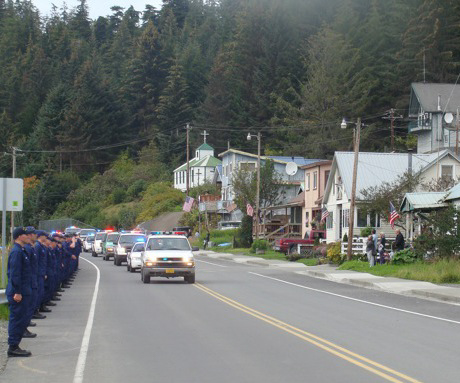
The funeral procession for slain police officers Matt Tokuoka and Tony Wallace moves through downtown Hoonah in 2010. (Photo by Casey Kelly/KTOO)

Lawmakers couldn’t agree last year whether to permanently provide health insurance to the survivors of police officers and firefighters who die in the line of duty. Starting next week, they’ll have another chance.

A bill to provide survivors with insurance was among the first bills filed ahead of the legislative session, starting on Jan. 17. Some surviving families have received state-funded insurance in recent years, but it isn’t enshrined in state law.

Rep. Andy Josephson, an Anchorage Democrat, is sponsoring the bill, HB23, and said filing the bill early makes it more likely to be enacted.

“These are folks that feel duty-bound – and have, many of them, since their youth – to participate in high-risk activity for the benefit of the public,” Josephson said. “And they shouldn’t be asked to sacrifice health care for their families, when they’ve made the greatest sacrifice.”

Incoming House Minority Leader Charisse Millett, an Anchorage Republican, introduced an identical bill.

Other bills filed ahead of the session include a measure by Sen. Mike Dunleavy, a Wasilla Republican, that would restore full funding to Permanent Fund dividends, and make another PFD payment of about one thousand dollars. And Sen. Bill Wielechowski, an Anchorage Democrat, is seeking to add dividend payments to the state constitution.

Another of Wielechowski’s bills would punish lawmakers who fail to pass a state budget within the first 90 days of the session by denying them salaries and the payments they receive for daily expenses. They could receive their salaries and per diem payments once they passed the budget. It was not clear whether the legislators would receive back payments, and Wielechowski could not be reached for comment.

And Rep. Matt Claman, an Anchorage Democrat, introduced a constitutional amendment to limit the session to 90 days. While state law says sessions last 90 days, the constitution sets the limit at 121 days.

Josephson also introduced a bill to prohibit the state or municipalities from helping the federal government create a registry based on people’s race or religion. He said he’s concerned that President-elect Donald Trump will seek to register Muslims and deport unauthorized immigrants based on their race.

“My view is, this is one of those important moments where somebody has to say, ‘No. No, that is not what we’re going to do.’”

Another round of pre-filed bills will be released on Friday.

Supreme Court to decide on dividend amount after appeal

Sen. Bill Wielechowski fields a question from a reporter during a Senate Minority press availability, Jan. 28, 2015. (Photo by Skip Gray/360 North)
Sen. Bill Wielechowski fields a question from a reporter during a Senate Minority press availability in 2015. Wielechowski appealed a Superior Court judge’s ruling against him and two former lawmakers affecting Permanent Fund dividends’ amount. (Photo by Skip Gray/360 North)

The state Supreme Court will decide if Alaskans’ Permanent Fund dividends this year were the right amount.

That’s after Sen. Bill Wielechowski, an Anchorage Democrat, and two former lawmakers filed an appeal Tuesday asking the court to overrule a Superior Court judge.

Wielechowski, Rick Halford and Clem Tillion argued that the Permanent Fund Corporation should have transferred the full amount for PFDs, which would have yielded checks worth more than $2,000.

But the corporation only transferred half, after Gov. Bill Walker vetoed the other half. The dividends in October were $1,022.

Anchorage Superior Court Judge William Morse ruled in November that Walker had the authority to veto the money.

Alaska saw record-high number of suicides in 2015

eyeball
(Creative Commons photo by Alex)

More Alaskans killed themselves in 2015 than in any previous year since at least 1978. Two hundred people died by suicide in the state, 28 more than the previous record set in 2013.

Need help?

Alaskans can get support at carelinealaska.com or by calling 1-877-266-4357.

Experts said it’s difficult to determine the causes for the high number of suicides.

Kate Burkhart, the executive director of the Statewide Suicide Prevention Council, said inconsistent access to behavioral health care contributes to the state’s high suicide level.

“We have very high incidences of adverse childhood experiences, interpersonal violence and domestic violence, substance abuse, and depression and other mental-health disorders,” she said. “And so we have that constellation of risk factors present pretty much throughout the state. Access to health care though, is not consistent throughout the state.”

Burkhart said one factor that may have increased the number of suicides in 2015 was two events that gained a high profile. A cluster of suicides in the Southwest Alaska village of Hooper Bay and a suicide at the Alaska Federation of Natives convention may have prompted other deaths.

“Suicides that receive a great deal of coverage in the media, for someone who’s already at risk, it can increase that risk,” she said.

The suicide prevention council worked with AFN on prevention programs at this year’s convention.

The suicide total includes 67 deaths of Alaska Natives. Among Alaska Native men, the age-adjusted rate was 80 suicides per 100,000, more than six times the rate for all American adults.

Barbara Franks is a board member of the Statewide Suicide Prevention Council. Her son Ron died by suicide in 1997 when he was 23. Franks, who is Tlingit, said focusing on ethnicity can detract from understanding the individual causes of suicide.

“I stopped the categorizing when they say a young male from Alaska,” she said. “You get to find that people will become more sensitive of how they’re categorized than to (finding) out why or what happened.”

Franks said the downturn in the state’s economy likely contributed to the high number of suicides last year. It’s too early to say whether the number has dropped this year, since 2016 statistics aren’t compiled until next year.

The Statewide Suicide Prevention Council, schools and other suicide prevention programs receive $1.6 million annually.

Burkhart said it’s difficult to compare the 2015 suicide total to past data. That’s because the stigma surrounding suicide discourages reporting, and that stigma has changed over time.

“As we get better and better at tracking the data, and as people are less reluctant to say, ‘Yes, my loved one died by suicide,’ we are going to see an increase in the numbers,” Burkhart said. “It happens with other things like domestic violence and other issues where stigma has prevented a good picture being painted.”

Public health experts say that if people notice warning signs of suicidal behavior, such as talking about it or ways to do it, they should seek advice on treatment. The volume of calls to the state’s suicide prevention careline have increased more than 60 percent in the last two years.

Gov. Bill Walker’s new budget proposal increases funding for a programs that include suicide prevention.

Walker seeks Permanent Fund earnings for budget, but leaves gap

Lt. Gov. Byron Mallott & Gov. Bill Walker - budget vetoes 2
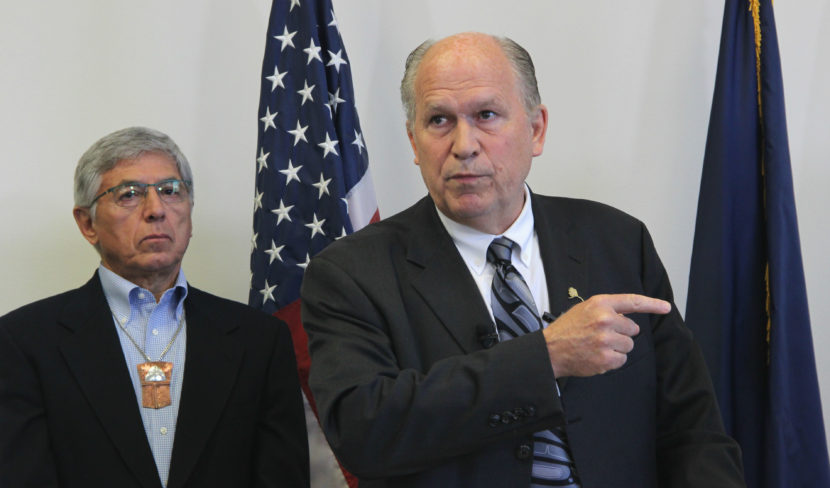
Gov. Bill Walker spoke to reporters in June, announcing $1.29 billion in budget vetoes, including a $1,000 cap on the PFD. Lt. Gov. Byron Mallott is on the left. He aimed to enshrine changes to the Permanent Fund in state law through his new budget proposal. (Photo by Rachel Waldholz/Alaska’s Energy Desk)

Gov. Bill Walker proposed a state budget that again seeks to draw nearly $2 billion from Permanent Fund earnings, and cap Permanent Fund dividends. But Walker left an $890 million budget gap, saying he wants to work with lawmakers to close it.

The proposal also cuts the number of state workers by 400.

Walker’s proposed spending plan totals $10.4 billion for the fiscal year starting on July 1, but much of that is federal funding. The budget includes $4.3 billion for the part of the budget directly controlled by the legislature.

The amount of money raised through taxes and fees is projected to increase by $177.4 million. But that still leaves a large gap that Walker would like to close. State Revenue Commissioner Randall Hoffbeck said Walker decided to leave an $890 million gap between state spending and the taxes and fees it collects because he wants to work with the legislature.

“I think it really is a recognition that the administration and the legislature are in this together,” Hoffbeck said. “Last year, we proposed a slate of bills that would get us to the finish line. Some were received more openly than others. And so what we felt like is that this year we would go in with a little bit more of an open-ended plan.”

Walker wants to close most of the budget gap with legislation that would draw $1.87 billion from Permanent Fund earnings, and keep dividends at $1,000 per person. That’s about the same level residents received this year, after Walker vetoed half of dividend funding.

Walker is proposing the same Permanent Fund bill the Senate passed in the summer, but the House didn’t act on. Hoffbeck said that approach may save time and effort.

“I think it’s more pragmatic than anything else,” Hoffbeck said. “The Senate has already weighed in on this and were willing to pass this particular version of the plan. So rather than trying to start all over again, we already got half the battle won.”

The incoming House majority caucus will be different than this year. This year, the majority was led by Republicans. In the coming year, it will be predominantly Democratic.

The proposed budget includes a $123 million cut in spending by state agencies. The cuts are offset by higher payments on state debt, oil and gas tax credits, and capital projects, leaving the total budget reduction at $28 million.

State Budget Director Pat Pitney said preparing the budget was difficult.

“We’re trying to find savings out of a very small segment” of the budget, she said. “When you have the statutory required programs, whether it be oil and gas tax credits, whether it’s Medicaid, whether it’s Base Student Allocation” that forms the basis of state funding for schools.

Further budget changes could include introducing a personal income tax and/or a sales tax or another tax on consumption.

Pitney says the legislative changes made this year could phase in new money over a year or two.

Walker is focused on adding a personal income tax, but Hoffbeck said some legislators are working on a statewide consumption tax. He said this could include a value added tax, in which taxes are applied at each stage of production of a good or service. Or it could be a gross receipts tax, which would be applied to a business’s total sales.

The proposed budget includes the minimum amount of oil and gas tax credits under state law. That means nearly $1 billion in credits that energy companies are due wouldn’t be paid out in the coming year. Pitney said Walker would support making those payments if the legislature makes further changes to the oil and gas tax system that Walker proposed last year and provides funding for the credits.

There was one tax increase Walker’s plan did spell out – increasing the motor fuel tax from the current level of 8 cents per gallon to 16 cents in July, and adding another 8 cents the following year.  Hoffbeck said it’s a prudent approach.

“It would ultimately top out at 24 cents a gallon, which is about the national average motor fuel tax,” she said.

Walker’s proposal received a mixed response. Eagle River Republican Sen. Anna MacKinnon said she’s disappointed the administration didn’t “take their job more seriously and identify areas that should be cut, trimmed or eliminated.”

Democratic House Speaker Bryce Edgmon said there is no question Walker is willing to address the state’s fiscal challenge head on and he   said the new House majority coalition would give Walker’s proposals a fair hearing.

Site notifications
Update notification options
Subscribe to notifications