State Government Reporter, Alaska Public Media & KTOO
State government plays an outsized role in the life of Alaskans. As the state continues to go through the painful process of deciding what its priorities are, I bring Alaskans to the scene of a government in transition.
Rep. Chris Tuck, D-Anchorage, introduced a bill that would allow private employers to have a hiring preference for veterans. This photograph was from May 2016. (Photo by Rashah McChesney/KTOO)
When business owners seek to advertise that they want to hire military veterans, they face an obstacle. People who aren’t veterans can sue them for discrimination.
State Rep. Chris Tuck wants to change that.
The Anchorage Democrat has introduced House Bill 2, which would allow private employers to openly use a veteran hire preference if they choose to.
“Employers know that when military people are discharged, they come with some great skills and abilities through their training,” Tuck said.
The federal Civil Rights Act provides that states can allow public and private employers to legally prefer to hire veterans.
While all 50 states allow the veterans preference for public employers, Alaska is one of 13 states that hasn’t allowed it for private employers.
Tuck said business owners’ concerns are valid.
“Employers have been brought to trial because they had a hiring preference for a veteran, other than another civilian,” Tuck said.
Russ Ball owns ACB Solutions, an Anchorage small business that provides computer repair and other computer services statewide.
He said he’s worried about a discrimination suit from an unsuccessful applicant. Ball supports Tuck’s bill.
“We find the military, or the veterans, to be good workers, to be skilled workers,” Ball said. “We also see it as a way of saying ‘thank you’ for their service.”
The House Military and Veterans Affairs Committee discussed the bill on Tuesday. Tuck, the committee chairman, said he would bring the legislation up again in a future meeting.
Officials with the U.S. Defense Department and the state Department of Military and Veterans Affairs support the bill.
Rep. Tammie Wilson, R-North Pole, speaks in January 2016. She has introduced a bill that would set rules restricting civil asset forfeiture. (Photo by Skip Gray/360 North.)
Lawmakers are seeking to prevent law enforcement from requiring those accused of crimes – and their family members or associates — to forfeit their property before they’re convicted.
Bill sponsor North Pole Rep. Tammie Wilson said she wants to set up a legal process that will make it easier for people to keep their possessions.
“This has to do with the belongings that are taken,” Wilson said. “They still can be seized. But now there will be a process for those who were not involved to be able to get their items back without a lengthy proceeding and (having) to get an attorney to be able to do that.”
Wilson gave an example of what the law is trying to prevent: a case where a person lends their car to a roommate, who then uses it to rob a liquor store.
Wilson said the state could take the car under current law.
But the bill would put the burden on the state to show that the car owner was aware that it could be used in a crime.
John Skidmore, who directs the Department of Law’s Criminal Division, said the state would benefit from making the rules for forfeiting assets more uniform. But, he said, the bill goes too far in affecting cases where forfeiture would be appropriate.
“The example that I’ve heard most frequently is the example of a flophouse or an abandoned boat someplace,” Skidmore said. “The state has to actually take possession of it in order to remove from what it is as that nuisance.”
Skidmore said he’ll work with Wilson on the bill, which has attracted sponsors from both parties.
The Drug Policy Alliance, a national group that advocates for easing drug laws, and the Resident Hunters of Alaska support the bill.
Rep. Sam Kito lll addresses the Alaska House of Representatives in 2014. He and other Southeast lawmakers oppose cutting school funding. (Photo by Skip Gray/360 North)
Southeast Alaska lawmakers express skepticism that the Legislature should look to school funding to cut the state’s budget. In fact, some legislators would like to see spending increase in some education areas.
School funding makes up one of the largest pieces of the state budget. But as the Legislature looks to close a nearly $3 billion gap between state spending and revenue, Southeast lawmakers say school funding shouldn’t be cut further.
Rep. Sam Kito III said the foundation formula funding that makes up the bulk of state school spending should be taken off of the table for cuts. The Juneau Democrat is one of the legislators who said if anything, he’d like to increase funding.
“I do think that right now, we are not providing an adequate education in some areas of the state,” Kito said.
Kito said schools serving communities with large Alaska Native populations, as well as those with high poverty levels, have the highest need for funds.
“That could actually end up requiring additional funding for education. That’s why we do need to look at the services we’re providing, and then figure out how we’re going to pay for those services,” Kito said.
Kito also said the Legislature should weigh how to support the costs of building and maintaining schools. The state program to reimburse school districts for construction bonds was suspended in 2015 for five years.
“There are definitely areas where the program could have been fixed to save the state some money, but without it being there, the state is actually increasing our deferred maintenance of schools, which means school-repair costs in the future are going to be higher,” Kito said.
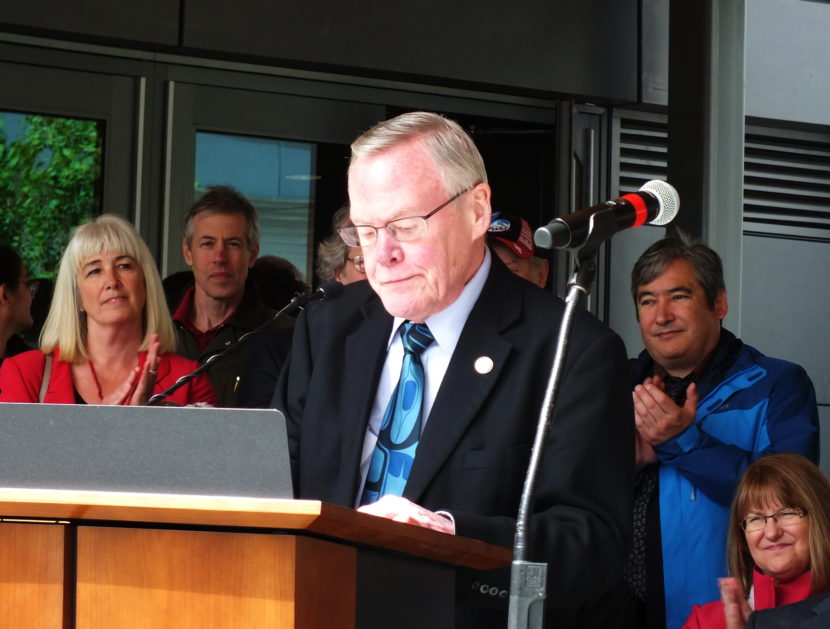
Juneau Sen. Dennis Egan addresses a crowd during grand opening of the Father Andrew P. Kashevaroff Library, Archives and Museum on June 6, 2016. (Photo by Matt Miller/KTOO)
Juneau Sen. Dennis Egan, a Democrat, said he wants to avoid a repeat of last summer when Gov. Bill Walker vetoed school debt reimbursement.
“It was a big blow to Juneau,” Egan said. “And we had to come up with … local funding. I mean, somebody’s got to pay. And it was done after municipalities had passed their budget.”
Juneau Rep. Justin Parish is Southeast’s newest lawmaker. A para-educator, the Democrat is a member of the House Education Committee. He joined Kito and Egan in opposing school funding cuts.
“I recognize that education is the largest component of our budget,” Parish said. “However, it is arguably the most vital for the long-term viability of our state.”
In higher education, the Southeast legislators want to give the University of Alaska more time to put into place its reorganization plan, aimed in part at cutting costs.
Rep. Justin Parish (Photo courtesy Justin Parish for House http://www.justinforjuneau.com/)
Parish said he’s eager to see how the plan affects students.
“I think that while an organization is trying to make cuts intelligently, it’s a little unwise to impose cuts from outside,” he said.
Kito said he’d like to see the university review whether it needs all of its buildings. And he’d like to see it refocus on meeting student needs.
“How can our university system generate graduates that can enter into the workforce in Alaska and be productive members of our state?” Kito said. “And that’s perspective I think they need to be taking.”
And the lawmakers said the state should look to close the roughly $6 billion gap between its pension obligations to retired teachers and other public workers and the assets it has to pay pensions.
Instead of cuts, Egan offered an alternative to the current retirement system. Instead of limiting public workers to the current defined contribution retirement system, Egan would like to offer them the chance to choose between traditional defined benefit pensions and the current system.
“Defined benefits allows people in the system to gain a better retirement if you want to stay here in Juneau, raise a family, pay property taxes, and contribute to the economy of the state,” Egan said.
Egan said defined contribution plans work better for workers who only plan to spend a few years in the state.
Ed Schoenfeld in Douglas and Quinton Chandler in Juneau contributed to this report.
Gov. Walker proposed freezing the pay of state workers who aren’t covered by union contracts for two years. (Creative Commons photo by daryl_mitchell)
Gov. Bill Walker has proposed freezing state workers’ pay for two years in part because other Alaskans are being asked to make sacrifices, including cuts to Permanent Fund dividends.
That’s according to state Commissioner of Administration Sheldon Fisher, whose department is responsible for negotiating union contracts and administering the state payroll.
“This is something that we’re starting with the non-covered (by union contracts) employees, but we’ll be working toward similar results with all of the employees,” Fisher said.
Fisher said Walker’s instructed him to negotiate similar terms to the pay freeze with unionized workers.
Walker’s pay freeze bills, Senate Bill 31 and House Bill 71, would affect employees of the executive and legislative branches, as well as the University of Alaska who are not covered by union contracts.
Lawmakers from both parties said there were fairness issues with the proposal.
Sen. Mike Dunleavy said he’d like to see broad-based reductions in the size of government that don’t fall disproportionately on any one group. The Wasilla Republican wants workers who aren’t represented by unions, as well as unionized workers, to be treated the same.
“I’m not sure that that’s really fair, to be honest with you,” Dunleavy said. “I think we are all going to share in the pain to get this ship righted and sailing in the right direction. I don’t think certain groups should be singled out.”
Democratic Sen. Berta Gardner says she’s willing to listen to the proposal. But the Anchorage senator also has doubts about treating unionized and non-unionized state workers in different ways.
“I just think it’s bad public policy to separate out, some people treated in some ways, some people treated in other ways,” Gardner said.
If the Legislature passes the bill, the pay freeze would start on July 1 and last until June 2019. Walker has cut his own pay by one-third.
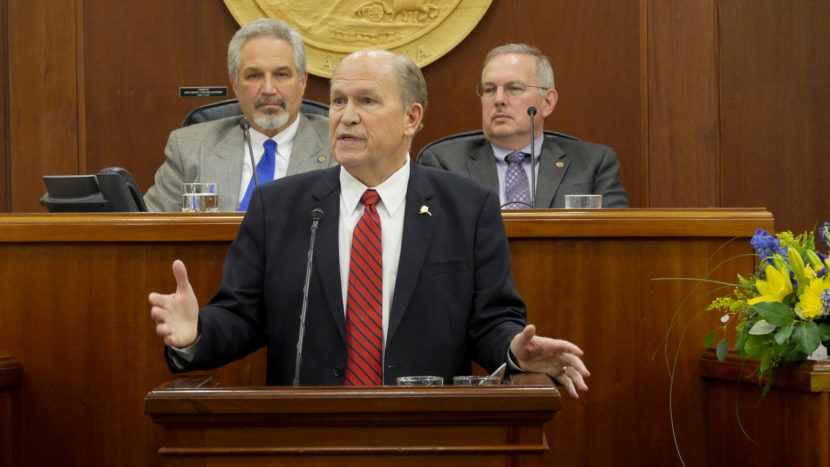
Gov. Bill Walker delivers his State of the State Address to the Alaska Legislature on Wednesday. Behind him, left to right, are Senate President Pete Kelly, R-Fairbanks, and House Speaker Bryce Edgmon, D-Dillingham. (Photo by Skip Gray/360 North)
Same concepts, new Legislature.
In his annual State of the State Address on Wednesday, Gov. Bill Walker pushed a lot of the same ideas and proposals for solving the state’s budget crisis as last year.
Walker said the state government risks spending all of its savings if it denies there’s a problem and hopes for oil prices to rise.
“Here’s the hard truth: Denial doesn’t make the problem go away. Hope doesn’t pay the bills,” Walker said. “We need to pass a plan to stabilize our fiscal future and we need to do it now.”
The gap between state spending and the money it brings in from oil, as well as other taxes and fees, is roughly $3 billion.
Walker renewed his call for a series of measures he proposed last year. They include drawing money for the budget from Permanent Fund earnings. Walker also wants to introduce an income tax. Walker said relying heavily on spending cuts would hurt the state’s economy.
“Whatever your plan may be, put it out there,” Walker said. “And let’s get to work to find a solution. But if your plan does not close the fiscal gap, be sure to also identify the amount from our dwindling savings it’ll take each year to cover the gap under your plan.”
Walker said the state Board of Education is taking a series of steps to improve schools.
And he called for more efforts to reduce deaths from heroin and prescription opioids, by limiting the number of opioids in prescriptions, and strengthening a database used to track opioids.
Walker said the state government will seek to involve every sector of the state to address climate change.
“It is one of the greatest challenges of our era,” Walker said. “We look forward to working with you to create a legacy of timely response.”
Walker’s speech touched on other topics. He called for oil drilling in the part of the Arctic National Wildlife Refuge. And he said he’ll continue efforts to build a natural gas pipeline.
Lawmakers from both houses say they’ll offer more details on their budget plans in the coming weeks.
Sen. Pete Kelly, R-Fairbanks, answers a question from a member of the press corps during a Senate Majority press availability on Tuesday Jan. 17, 2016 in Juneau, Alaska.
The state Senate is generating ideas to make significant cuts to the state budget. They’d like to lock in lower spending levels into the future.
The Republican-led Senate majority is more focused on cutting spending to close the state’s budget deficit than the new mostly Democratic House majority or independent Gov. Bill Walker.
The Senate majority is looking for $750 million in cuts over the next three years. New Senate President Pete Kelly says departments that make up the largest share of spending will see cuts.
“Well, there’s no question about it,” Kelly said. “There are some large cost drivers. We’ve discussed these year after year; health and social services, education, the university. So those will not be beyond scrutiny, and as a matter of fact, we’ll be looking very closely at those.”
The Senate majority is looking to cut 5 percent of the entire budget this year, then 4 percent and 3 percent the next two years.
Kelly, a Fairbanks Republican, said he expects the budget-writing Senate Finance Committee to act fast and decisively.
“It’s like Willie Sutton, the old bank robber, when they asked him, ‘Willie, why do you rob banks?’ He said, ‘That’s where the money is.’ Well, the money is in those three big agencies,” Kelly said.
The Senate majority also is preparing to propose a new state law that would limit how much state government can spend. Kelly said he prefers that voters decide state spending by who they elect, but he says this hasn’t worked during the rise in oil prices in the past decade, before prices fell.
“That seems to have gotten out of hand between about 2006 and 2013 and government got pretty big,” Kelly said. “I think we have to take some extra measures to make sure that once we get spending under control — and we’ve done a pretty good job of doing that to this point, at least a good job of reducing — we want to make sure it doesn’t just pop up again.”
As far as ways to raise more money, Kelly said the Senate is likely to again pass a bill that would draw money from Permanent Fund earnings and reduce dividends. But he said the Senate majority currently doesn’t favor an income tax.
Senate Minority Leader Berta Gardner said all parts of the state budget deserve scrutiny, but the first place she’d look for spending cuts is a reduction in oil and gas tax credits.
Gardner, an Anchorage Democrat, doesn’t want to turn to reducing dividends first.
“If that’s going to happen, first of all, we have to look at oil tax credits. And we’ve said this for, I think, four years, (and) say, ‘what is our return on our huge investment,’” Gardner said.
Gardner opposes putting a limit on spending, saying she wouldn’t want to tie the hands of future legislatures when future needs aren’t known.
Kelly has described this session as reflecting a battle between capitalism and socialism. Gardner sees it differently.
“What we really need to do is be listening to each other,” Gardner said. “And it doesn’t have to be a battle. It can be a discussion. I hope everyone’s willing to compromise a little bit to get there.”
The Senate Finance Committee meets Thursday to hear about the state’s forecast for revenues.
Close
Update notification options
Subscribe to notifications
Subscribe
Get notifications about news related to the topics you care about. You can unsubscribe anytime.