Anna Canny

Local News Reporter

Alaskans invited to tell Congress what climate change means for them

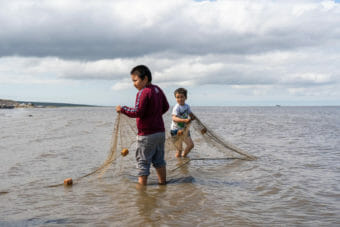
Two children fish along the banks of Baird Inlet on July 20, 2020 in Mertarvik, Alaska. Residents of Newtok have been slowly relocating to Mertarvik as coastal erosion makes Newtok unsafe. (Photo by Katie Basile/KYUK)

Across Southeast Alaska, heavier rains, changing snowfall, warming waters and ocean acidification are making profound changes to the environment.

In the Alaska chapter of the upcoming National Climate Assessment, a team of scientists, educators, and community leaders from across the state are asking what those changes mean for people. Until Jan. 27, they’re inviting Alaskans to help answer that question by submitting feedback on a draft of the assessment.

Alyssa Quintyne, a community organizer with the Alaska Center and one of the co-authors of the Alaska chapter, said it’s a way to draw attention to the everyday impacts of climate change.

“It’s an opportunity for us regular-degular people to essentially tell the story of what is happening in our own state, to other states and to Congress. So it’s a pretty big deal,” she said.

The National Climate Assessment is a congressionally mandated research report organized by the U.S. Global Change Research Program. It doesn’t mandate any specific actions, but Quintyne says it will help guide people working on climate solutions.

“Lawmakers who are looking at this assessment and thinking about, ‘Oh, wow, I didn’t know that was happening in my seat. What are actions that I could possibly take?’ Researchers who say, ‘Oh, hey, there’s a gap in something that we are not studying.’ So we can come up with some real solutions, and services,” she said.

Henry Huntington, a researcher with the Ocean Conservancy and the report’s lead author, said this version of the assessment focuses on humans more than ever before.

“Our charge, our assignment, has been altered a bit, which is to focus more on the society side. And what does this mean for people? What does this mean for people around Alaska, rather than, you know, getting into the details of the biophysical system,” he said.

The draft will go through a peer-review process, where researchers will help to refine and add to the climate assessment, but Huntington says he hopes that a more diverse group of Alaskans will submit their feedback this time around.

“What the public comment can do that the academic review can’t do is to tell us, are we making sense? Are we speaking to a wider audience?” he said. “We’d like this to be a report that has some relevance and speaks to people who it affects through livelihoods, through their recreation, through their interests.”

Huntington says the draft chapter moves beyond the natural environment to include discussions of COVID-19, housing discrimination, healthcare, crisis response and even internet access.

He says it’s important to highlight these new topics because climate change doesn’t happen in isolation. He hopes that the assessment will show how the changing environment could make existing social vulnerability and inequality worse.

“It’s that idea that climate change is happening within the broader social context that’s already there. And it’s going to add more stress to what we’re already experiencing,” he said.

Quintyne hopes that the comments submitted this month will help make the climate assessment the most useful resource it can be.

“We’re doing it for education, we’re doing it for awareness, but we’re also doing it for empowerment,” she said. “So people can make the best informed decisions moving forward, whether they be someone like me, whether they be the president, whether they be a fisher out on the Yukon.”

Alaskans who wish to review the draft submit comments can do so online. Comments are due by Jan. 27 at 8 p.m.

Juneau city manager resolves to adopt new hazard maps in the new year

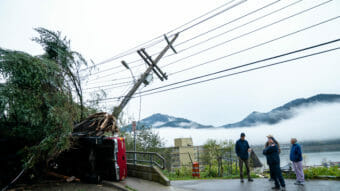
Residents survey the impacts of a landslide on Gastineau Avenue in Juneau on Sept. 27, 2022. (Photo by Paige Sparks/KTOO)

The Juneau Assembly will broach the discussion of adopting new hazard maps again next year after making little progress in 2022. City Manager Rorie Watt said there has been disagreement on one central topic.

“Fundamentally, the question is, how much do we know about risk,” he said. 

Both city officials and residents have been hesitant to adopt the new hazard maps since their introduction in the spring of 2021. What the maps said came as a shock to some. 
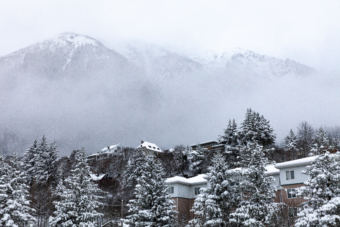
“We started the hazard mapping update very innocently, right? We had old bad maps, we got a FEMA grant, let’s do new maps,” Watt said. “And then they came back with new mapping information that doesn’t square up with the common person’s assessment of risk.”

The new maps were developed to replace the city’s current maps, which were adopted in 1987. They place about half the buildings in downtown Juneau at a moderate-to-severe threat of damage or destruction from avalanches, landslides or both. 

They also make a distinction between avalanche zones and landslide zones. The old maps combined the two, while the new maps introduce four categories for landslide hazard: low, moderate, high and severe.

The new maps are much more detailed — the study’s authors developed them using a combination of geologic mapping, analysis of historical events and fieldwork. For some neighborhoods, they outline landslide hazards for the first time.

In Starr Hill, for instance, some properties went from no slide hazard to severe slide hazard. Others were upgraded from moderate to severe. Those changes have been tough to understand for many downtown homeowners. 

That’s partly because hazard mapping can’t tell people when landslides will happen. Instead, they describe factors that make a given area more prone to landslides — things like steepness, geology and historical activity. Those factors are hard for individuals to observe, and many exist far upslope rather than on or near an at-risk property. 

The report’s authors also stress that human lifespans don’t line up with the timescales of avalanches and landslides. In moderate zones, for instance, landslides might happen every 10 to 100 years, which means someone could live in their home for decades without seeing one.

Watt says the lack of more specific information about the likelihood and consequences of landslides presents a particular challenge from a municipal policy perspective. 

“What’s our rational basis as a municipal government to tell somebody, you’re, you know, high, medium, low, severe — but we can’t tell you about the probability of that,” Watt said. “We’re going to be fundamentally telling people, you know, you can or can’t develop, more and less, depending on these maps.”

Juneau’s land use code limits development in severe zones to single family homes, and property owners are not allowed to increase density. Watt says there’s also concern that updating the maps could have a negative impact on financing, property values and insurance. 

“I don’t think it would result in the inability to get financing or insurance. But I think it could be harder,” Watt said.

Watt hopes that the city planning commission can draft new building codes over the next six to eight months, but he believes prioritizing public engagement in the coming months will be key.

“And hope that process results in something where most people say, okay, it’s an imperfect world, it’s complicated, but this seems like a reasonable way forward.”

In a memo to the Assembly last month, Watt recommended a full adoption of avalanche hazard zones and a partial adoption for landslides, by only restricting development in severe zones. He also hopes to open up avenues for residents to suggest changes to the maps.

A snowy weekend starts in Juneau as Seattle ice storm disrupts holiday travel

Snow blankets downtown on Friday, January 1, 2019, in Juneau, Alaska. The first significant snow storm of 2022 started just as people were trying to leave town for the holiday weekend. (Photo by Rashah McChesney/KTOO)

Winter weather will ramp up over Southeast Alaska this weekend, and stormy conditions across the Lower 48 have already disrupted holiday travel plans for many trying to fly out of Juneau. 

Alaska Airlines canceled around 550 flights on Friday. Alaska and Horizon flights in and out of Seattle were delayed and canceled throughout the day, and flights in and out of Portland were canceled entirely due to icy conditions and freezing rain.

Freezing rain in Seattle caused all three runways to close early Friday morning, which contributed to cancellations. A spokesperson for the Seattle-Tacoma International Airport told the Seattle Times that it was an “unprecedented” scenario.

One runway reopened just before 7 a.m., but Alaska Airlines said they anticipate additional cancellations and delays.

Additional Friday flights out of the Ted Stevens Anchorage International airport were cancelled due to high wind.

In a written statement, Alaska Airlines said they will offer a flexible travel policy for passengers to rebook travel for those flying to, from or through Seattle or Portland. But they cautioned that flights are very full throughout the holiday weekend, and wait times for service will be high.

The airline is encouraging travelers to reassess their travel plans for the holiday. 

In Juneau, high winds and snowfall began Friday morning. Meteorologist Aaron Jacobs with the National Weather Service says heavy snow is expected to pick up throughout the holiday weekend.

“We’re going to probably see heavy snow start developing overnight tonight,” he said on Friday. “We’ll see a little lull tomorrow [Saturday] morning, with another band coming through to drop another significant amount of snow tomorrow afternoon.”

The National Weather Service has issued a winter storm warning starting at 9 a.m. Friday through 9 p.m. Saturday evening, with accumulations of 10 – 15 inches of snow possible. Wind gusts of up to 60 mph are possible in downtown Juneau. 

Snowfall will be relatively light on Friday, but drivers should be aware of hazardous road conditions, low visibility and the potential for blowing snow in the evening.

This snowfall follows a cold snap across the Southeast. Temperatures are expected to rise steadily throughout the weekend and into next week. In Juneau, temperatures will stay below freezing until early next week, with the potential for snowfall through Sunday.

Jacobs says it may be wetter for those south of Juneau.

“Potentially for the folks down in the southern panhandle, you’re going to see some snow turned to more of a mixture of rain through tomorrow [Saturday] morning,” he said.

The impacts of local weather on flight plans for the rest of the weekend are still unknown, but freezing rain conditions are usually more hazardous for air travel than snow. 

This is a developing story. Check back for updates.

With a snowy weekend ahead, Juneau’s urban avalanche forecasting begins

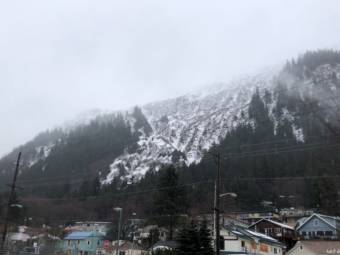
The Behrends avalanche path on Mt. Juneau, taken from Glacier Avenue on Feb. 27, 2021. (Photo by Jennifer Pemberton/KTOO)

As heavy snowfall hits Southeast Alaska this weekend, Juneau’s urban avalanche forecast will be up and running for the first time this season. 

Tom Mattice is Juneau’s emergency programs manager. He says he’ll keep an eye on the mountains as the avalanche cycle begins this weekend.

“In the backcountry in the high mountains, there’s gonna be pretty big avalanches,” he said. “I don’t necessarily see it coming into the urban environment just yet. But things are gonna change a tremendous amount over the next few days.”

Mattice says the recent cold snap, combined with this weekend’s forecast, will create ideal conditions for avalanches in the high mountains. 
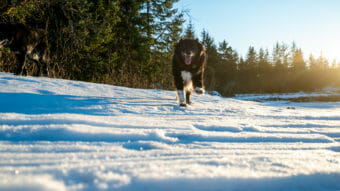
“We’ll see several feet of snow over several days. And during that time, it’s warming up, and towards the end of that it’ll even see some rain at sea level. So all of that is trending in a bad direction,” he said.

The incoming snow may not bond well with the existing snowpack, which would increase avalanche risk.

“We’re going to see an upside down snowpack where we’re going to put heavier, denser snow on lighter, looser snow,” he said.

Juneau faces greater urban avalanche risk than any U.S. city, with avalanche paths threatening multiple neighborhoods and roads. Mattice updates the urban avalanche advisory at 8 a.m. daily throughout the season, with ratings on a danger scale that runs from 1 to 5. Updates will be live starting this Saturday.

Juneau’s Emergency Program Manager Tom Mattice checking avalanche conditions in Juneau’s backcountry. (Photo by Andres Camacho / KTOO)

Forecasting avalanches can be complex. Mattice monitors snow accumulation over the season and keeps close track of daily weather forecasts. He also measures the snowpack with frequent field trips to look for weak snow layers.

Many of Mattice’s considerations are centered around what makes snow layers bond together.

“It starts with what’s on the ground in the mountains,” Mattice said. 

This winter, there haven’t been many days of heavy snow in Juneau. That means rough terrain with trees, rocks, bushes and shrubs is still exposed, which helps to anchor snow. That will start to change this weekend as snow accumulates.

“As we start seeing more and more snow in the terrain, those things start getting buried, and the more they get buried, and the wider areas you’d have, that are smooth and flat, the bigger your starting zones become,” Mattice said. 

Over the course of the winter, the risk depends less on the amount of snow and more on the consistency of the weather. Even winters with tremendous amounts of snow can be relatively safe if that snow falls steadily throughout the season. That tends to build a stable snowpack in the mountains. But weak layers form when snow storms come between long breaks of sun, wind or rain. That makes the snowpack unstable. 

The city only forecasts for urban avalanche risk, but Mattice said that can be a good proxy for people venturing out into the backcountry, or even on the Flume Trail and Upper Perseverance Trail near downtown. When urban avalanche risk is high, backcountry risk will be even more extreme. 

Mattice will update his forecasts daily.  He encourages people to stay informed as conditions change throughout the winter. 

“People have to make their own educated decisions,” he said. “But you go through periods of time that are quite safe. And then you know overnight, you can have a situation that changes and things get very dangerous.”

Mattice encourages anyone who does go out into the backcountry to submit avalanche observations to the Alaska Coastal Avalanche Center. 

Arctic front brings extreme cold, high winds to Juneau this week

The sun appears as temperatures drop to potential record breaking lows, Dec. 16, 2022 near the Mendenhall Glacier in Juneau. (Photo by Paige Sparks/KTOO)

A cold snap is settling over Southeast Alaska starting this weekend into early next week, with high winds and cold temperatures with record-breaking potential. 

As the Arctic front arrived in Juneau Friday morning, National Weather Service Meteorologist Nicole Ferrin outlined the coming days on Facebook live. Temperatures will get progressively colder each day through the start of next week, with prolonged sub-zero temperatures anticipated. Monday’s high is predicted to be just 4 degrees Fahrenheit. 

“Make those kids put on a coat when they’re going to the bus stop,” she said in the livestream. “You know, for your teenager, a hoodie is not going to cut it on Monday.” 

A high pressure system in the Yukon will continue to drive cold air and strong wind across the panhandle, with the potential for Taku wind activity in Skagway and downtown Juneau. A high wind watch is effective Friday evening through Saturday, with wind speeds of 30 to 40 mph, and gusts reaching 60 mph. 

“And we’re going to be keeping a very close eye on that over the weekend to see if we need to upgrade those to warnings,” Ferrin said.

Winds could damage trees and powerlines, and they will increase risk for drivers, especially on the Klondike Highway. 

Jack the dog runs through icy snow as temperatures drop to potential record lows in Juneau. Dec. 16, 2022. (Photo by Paige Sparks/KTOO)

Highs in the single digits with negative temperatures throughout the day are expected. With windchill, it will feel closer to twenty below zero in downtown Juneau. 

“These are some of the coldest temperatures I’ve seen working here for 10 years, so if your pipes haven’t frozen before, this might be the first time, ” Ferrin said. 

Residents should take precautions to protect their pipes, especially those living in mobile homes. 

Joel Mitchell, a plumber and owner of American Home Service in Juneau, says the best thing homeowners can do to prevent freezing pipes is keep the water flowing. He recommends running a cold water tap in both the front and the back of the home for the duration of the cold snap.

“Just trickle it right? So it doesn’t, it doesn’t stop flowing. Once the water stops flowing is when it has a problem with freezing,” Mitchell said. 

Mitchell says insulating your pipes with foam is a good preventative measure too. He also recommends opening the cabinets under kitchen and bathroom sinks to allow warm airflow. 

If your pipes do freeze and split, Mitchell says it’s important to shut off your water right away to prevent further flooding.

“A lot of people don’t know where their main shutoff valve into their home is. So if something does freeze and split, and it’s spraying water, knowing where that valve is to turn the water off, is really, really important,” Mitchell said.

Mitchell explained that shut off valves are typically attached to the main water pipe, which comes out of the ground towards the entrance of your home. Often it’s found in the garage or crawlspace.

Boat owners should also check their vessels before the start of the weekend, with heavy freezing sprays expected in the harbor.

The city’s cold weather emergency shelter at Resurrection Lutheran Church will be operating all weekend with cots and blankets for anyone who needs a warm place to sleep. 

The shelter typically opens at 10:30 p.m., but with temperatures below twenty degrees it will operate from 9 p.m. to 7 a.m. daily for the next several days. It’s located at the corner of Glacier Avenue and 10th Street. 

“Anyone can come in,” said shelter manager Brad Perkins. “We serve them, you know, a simple dinner and breakfast, and then they are out by 7 o’clock.” 

Even after the cold snap lifts, the shelter will be open every night through the Christmas holiday. Perkins says shelter staff are prepared to welcome dozens of patrons in the coming days.

“I expect it will be pretty full this next week. When it gets really cold, people need a place to stay,” he said.

This year’s Arctic Report Card highlights Indigenous perspectives, but is it enough?

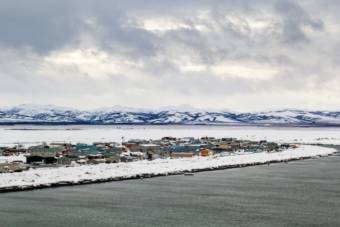
An aerial view of Unalakleet in 2019, with open water along the coast. (Photo by Zachariah Hughes/Alaska Public Media)

NOAA’s annual Arctic Report Card, released on Tuesday, shows the changes brought by a rapidly warming Arctic — more rainfall, shorter periods of snow cover, shrinking sea ice and shifting seasons. 

But this year’s report card has something new: a chapter on the consequences of climate change for people who live in the Arctic. It’s a collaboration between scientists, Indigenous knowledge holders and decision makers across Arctic communities in Alaska.

Athena Copenhaver is the executive director of the Study of Environmental Arctic Change. (Photo courtesy of Athena Cophenhaver)

Athena Copenhaver, executive director of the Study for Environmental Arctic Change, said the chapter highlights highlights a different perspective for what is largely a scientific publication.

“It brings in Indigenous knowledge and features the impacts to Indigenous people first and foremost,” she said.

The chapter includes a video, an oral history by the Ahtna Dine’ storyteller Wilson Justin. He describes his experience living with climate change. In the video, he says climate change in the Arctic has already happened, and he reflects on the need for collaboration between scientists and Indigenous knowledge holders going forward.

“The trainwreck already happened. We’re just going to have to figure out how to speak to each other in terms of, not only how we are rebuilding, but what it is we are going to rebuild,” Justin says in the video.

‘We live on that thread of hope’

Indigenous food systems in the Arctic are intimately tied to a cold, icy environment, but the science in this year’s report card shows that those conditions are becoming harder to rely on. In a host of different ways, more rain and less ice are making food sources scarcer and harder to get to. 

The report warns that some climate models predict a shift from a snow-dominated to a rain-dominated Arctic, possible by the end of the century. This year was the third wettest year on record for the Arctic, and precipitation has been increasing across all seasons. Freezing rain is also getting more and more common, even in winter months.

Jackie Qatalina Schaeffer is Iñupiaq from Kotzebue and is the director of climate initiatives at the Alaska Native Tribal Health Consortium. (Photo courtesy of Jackie Qatalina Schaeffer)

Co-author Jackie Qatalina Schaeffer is Iñupiaq from Kotzebue and the director of climate initiatives at the Alaska Native Tribal Health Consortium. She said winter rain events will have a profound effect on Indigenous food security, in part because of their impact on animal foraging. 

“When you have freezing rain in the fall, or in the middle of winter, and it disrupts the food access for caribou, it’s a ripple effect,” Schaeffer said. “It impacts people, it impacts their traditional lifestyle. And then it impacts what’s coming next season.”

Schaeffer believes freezing rain could impact other food sources too.

“It could disrupt the berry season. Or it could disrupt the bird migration because they can’t access food,” she said. 

Five caribou seen up close, with snowy mountains behind them. Three of the caribou are looking straight at the camera.
A group of Western Arctic Herd caribou pause in front of mountains in Kobuk Valley National Park during fall migration in 2016. The Western Arctic herd, one of the largest in the world, has been in decline for the past two decades. The 2022 census shows that the decline is continuing. (Photo by Kyle Joly/National Park Service)

A report this fall cited winter rainfall as one of the causes of the Western Arctic Caribou Herd’s decline.

Sea ice is also changing rapidly, with less in the summer and later formation in the fall. Vera Kingeekuk Metcalf is Yup’ik, originally from St. Lawrence Island, and the executive director of the Eskimo Walrus Commission. She says sea ice — siku in Yup’ik — characterizes the seasons in the Arctic.

Vera Kingeekuk Metcalf, executive director of the Eskimo Walrus Commission, poses in front a map of St. Lawrence Island, where she was born and raised. Metcalf, who is an Yup’ik, now lives in Nome. (Photo courtesy of Vera Metcalf)

“It’s a very powerful presence in our relationship with our world. Here in the Arctic, it really defines our seasons and activities,” Metcalf said. “And right now, here in Nome, we don’t have sea ice yet. And it’s the middle of December.”

Metcalf is also a co-author on the new section. She says changes to the ice are already altering hunting and foraging practices. 

“We’re experiencing more and more sea ice that is weaker. It affects our traditional hunting seasons, which seem to be dissolving and blending together,” Metcalf said.

The report emphasizes an increase in fatal falls through sea, lake and river ice.

“Our hunters are traveling further with less sea ice and what seems more like disruptive stormy weather during some of our hunting trips, ” Metcalf said.

And in some instances, the absence of ice leaves communities more vulnerable to extreme weather events. Lack of sea ice contributed to greater damage across Western Alaska when the remnants of Typhoon Merbok, which was fueled by warmer ocean temperatures, lashed the coast with 50-foot waves and hurricane force winds this September.

Metcalf witnessed the damage to subsistence camps around Nome.

“That just made, you know, devastated coastal camping areas and just changed the environment in a way that we didn’t expect it to happen,” she said.

Two buildings at a fish camp, one badly damaged and the other knocked over
A fish camp in the Nome area, seen on Sept. 24, shows damages wreaked by the remnants of Typhoon Merbok. (Photo by Jeremy Edwards/FEMA)

The storm also caused severe flooding for communities on the coast of the Bering Sea. Power outages caused losses of meat already gathered, boats and equipment were wiped out, and fall hunts were delayed. 

The report also highlights changes that aren’t yet well understood, like the years-long seabird die-off in the Bering Strait region. Many species of ducks, puffins, shearwaters and auklets — important food sources and vital indicators of overall ocean health — have been hit hard by starvation despite their different diets.

Six dead seabirds on a beach. "Nome, 8/16/19" is written in the sand.
A few species of dead seabirds near Nome, Alaska, Aug. 2019. (Photo courtesy of Sara Germain, Alaska Department of Fish & Game)

Despite these profound changes in the Arctic, both Metcalf and Schaeffer said Indigenous values around food prevail despite unpredictable seasons and conditions.

“We don’t say — and we definitely don’t think it and put it out into the universe — that there’s not going to be any berries,” Schaeffer said.  “We hope. We live on that thread of hope that there’s going to be berries, whether they show up or not.” 

‘Living the environment’

For Schaeffer, the addition of this new chapter to the Arctic Report Card, and the work of the Study of Environmental Arctic Change in general, is a way to infuse more of that hope into conversations about climate change in the Arctic. 

“The narrative, if you just focus on the science and the monitoring, could be very scary,” she said. “And we don’t want people to be scared.”

This year’s report card is a step towards integrating Indigenous knowledge with science. But Metcalf says that doing so is challenging.

“How this actually happens can be complicated because Indigenous knowledge and science should not be used, for example, to verify each other,” she said.

But Metcalf says more on-the-ground observations from Indigenous knowledge holders will only strengthen the science. 

“Our own experts are living the environment, or they’re seeing the changes happening in our waters and our lands, often are the first to report these unusual changes to this environment,” Metcalf said. “The longtime people that have been there are experiencing these changes for many years.”

Metcalf sees the new chapter as an encouraging step towards exchanging more information across different knowledge systems.  

“The Arctic is our home. And it’s very eternal and very sacred to us, for those of us that live here,” she said. “Perhaps, collaborating on co-production of knowledge and research is simply another way that we are adapting.”

Site notifications
Update notification options
Subscribe to notifications