Anna Canny

Local News Reporter

Snow turns to rain as another wet front passes over Southeast Alaska

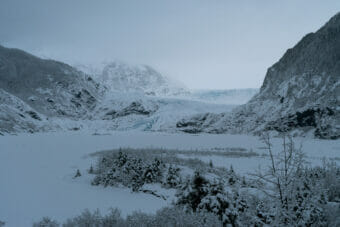
The Mendenhall Glacier as seen from the visitor center after snowfall on Feb. 13, 2023. (Photo by Andrés Javier Camacho/KTOO)

After a bout of heavy snow early this week, rainier weather is expected across the panhandle, with another wet front approaching before the weekend.

Snow piled up across much of the region early in the week, but National Weather Service meteorologist Pete Boyd says the winter weather is expected to lighten up as new fronts take over in the region.

“At this point, no accumulation as high as we saw with this last front, but enough to keep some steady shoveling going,” he said.

This last winter front brought heavy snowfall across parts of Southeast, with 4 to 10 inches in Juneau and up to seventeen inches in nearby Haines.

A waterfall near Mendenhall Lake after snowfall on Feb. 13, 2023. (Photo by Andrés Javier Camacho/KTOO)

Weaker, drier fronts will move in later in the week, along with warming temperatures.

“The other thing we’re getting is a lot more mixing within the precipitation,” Boyd said.

Flurries of rain and possible snow will turn to light snowfall as temperatures drop at night. Boyd says it won’t be enough snowfall to cause major impacts at sea level, but fluctuating temperatures could cause icy conditions on roads and sidewalks over the next few days.

According to the urban avalanche forecast, wetter, heavier snow in the coming days will bury the loose, lighter snow from earlier this week, which will increase the potential for avalanches.

The current urban avalanche advisory says the hazard is “considerable,” but the forecast for the rest of the week predicts low snowfall overall, which will likely prevent the advisory from climbing any higher.

Juneau’s Denise Koch tapped to represent Alaska on EPA Advisory Committee

Denise Koch, Juneau’s deputy director of Public Works, will represent Juneau and Alaska on the EPA’s Local Government Advisory Committee. (Photo by Anna Canny/KTOO)

Denise Koch, Juneau’s public works deputy director, will represent the city as a new member of the Environmental Protection Agency’s Local Government Advisory Committee.

The committee is made up of representatives from across the country and gathers feedback on the ways environmental issues impact local governments.

“This is like a very nerdy, wonky thing to be a part of, and to be excited about. But, I am really excited,” she said.

Last year, the passage of the Biden Administration’s Inflation Reduction Act and Bipartisan Infrastructure Package made billions of dollars available for things like clean energy and pollution reduction. Much of that funding will be distributed to cities and towns, leaving small governments to take the lead for climate action.

But Koch says navigating the complicated landscape of federal programs takes time and expertise that local governments may not have, which makes it hard for communities like Juneau to compete.

“Basically, it takes resources to chase resources,” Koch said.

She says the committee aims to make climate and environmental action more accessible by connecting local governments to EPA administrators. Koch and Sophie Swope, a city council member in Bethel, are the first representatives of Alaska communities to serve on the committee since 2010.

Koch began as the city’s deputy director of public works in 2021 and spent more than six years working on air quality and pollution control for the Alaska Department of Environmental Conservation. She says her team is already working to secure some of the newly available federal money.

To scale up composting efforts, Juneau is applying for a solid waste infrastructure grant program. The city got $2.5 million in federal money for composting last year, but Koch says more is needed to establish a permanent city facility.

Another pending grant application would help to fortify Juneau’s wastewater processing. Koch says that high levels of food, fats, oils and grease in Juneau’s wastewater make it difficult to treat, but federal money will help the city make strides for cleaner water.

Koch says that’s just the beginning.

“We’re going to start to see more and more grant opportunities being released by the federal government in the next few months,” she said.

Koch hopes her feedback will help the EPA to better understand the needs of small communities when rolling out future programs, both for federal funding and federal pollution standards.

When the EPA tightens federal standards on things like water quality and ambient air quality, she says it can be cost-prohibitive for small communities to comply.

“The reality is, everyone in America wants healthy communities and a good sense of public health,” Koch said. “But sometimes those rules are really geared towards larger communities, and implementing them in smaller communities can be a little bit more challenging.”

Koch says she hopes to draw attention to Alaska’s unique logistical challenges too.

“When you’re in a national group, you know, many people haven’t even been to Alaska, and they can’t even fathom the sort of unique challenges we address up here,” she said.

She says representing Juneau before the EPA is an exciting next step — one she hopes will help her realize local aspirations for climate action, too. In the Infrastructure Package alone, $369 billion is designated for climate and energy initiatives.

“I’m really lucky that ever since I was a little kid, I wanted to work on these sorts of issues,” Koch said. “And I feel really lucky that I wound up in a community that values sustainability and the environment.”

By participating in the advisory committee, she hopes to learn how to keep track of upcoming federal climate action grants.

“And then we’ll put our resources into chasing those and being competitive and hopefully bringing some of that federal money back home to Juneau,” she said.

From Juneau to Fairbanks, new Toyostoves are malfunctioning in cold weather

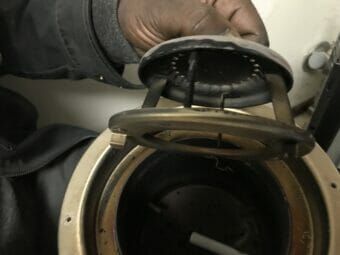
Stove technician Steve Sanders shows black carbon build-up in a Toyo Laser 531/532 (Photo Courtesy of Sam Trivette)

David Quisenberry swears by his Toyostove. He’s used it to heat his home in Juneau for nearly a decade, with few malfunctions. But during Juneau’s first cold snap of the winter, that changed.

“We had single-digit temperatures, and my stove went out,” he said. “I had my niece staying here. And she called and said there’s a code on it, and the code says it’s not getting any fuel.”

Luckily, Quisenberry had a backup heater to keep the house from freezing up. Still, he was perplexed. The stove, a Toyo Laser 531/532, was nearly new. He’d had it installed in August to replace a larger Toyo he’d relied on for eight winters.

But when the stove repairman arrived, Quinsenberry saw the problem right away.

“He opened the stove up, and there’s a little burner assembly. And the fuel nozzle was all carbon, backed up with black crud,” Quinesberry said.

Toyostoves, from the Japanese brand Toyotami, are a popular heating system across Alaska, especially in rural areas. They burn efficiently on stove oil, heating cabins and houses in places where temperatures regularly drop well below zero.

But stove technicians say Toyo’s mid-sized stoves are failing in cold weather, and there’s no consensus about why it’s happening.
Crashing in colder temperatures

Sam Trivette, another long-time Toyostove owner in Juneau, says he saw the same build-up on the fuel nozzle when his stove died in the mid-December freeze.

“I’ve never seen anything caked up like that before,” he said. “These stoves are so well designed, they burn so cleanly, that to have it malfunction within a month, obviously there’s a problem.”

His stove was also a Laser 531/532, even newer than Quisenberry’s. When the cold weather came, he had an older Toyo 700 series stove running too, using the same fuel.

“The one upstairs that we’ve had for about 11 years stayed functioning fine, when the new one failed,” he said.

Local stove technician Steve Sanders, of S&S Toyo Repair, said he’d never seen a Toyostove that had problems running in the cold.

“I’ve been going for 15 years. I haven’t seen it,” he said. “I’ve seen the build-up, if they use bad fuel. But not new heaters, and not this many at one time.”

In the wake of the cold snap, he found himself scrambling to service around 20 Toyostoves, all in the mid-sized range. He said there were a couple of OM23s — the predecessors to the Laser 530 series — but most were new Laser 531/532s. The two models use most of the same technology.

All had gone out during the same cold weekend, with the same error codes and the same carbon build-up around the fuel nozzle.

Sanders kept a record of each one he repaired.

“All of the photos look the same,” he said. “And you don’t need to be a technician to see that it was something happening with the fuel.”

After the carbon is scrubbed away, the stoves run again. But Sanders says he’s still scratching his head about the root cause.

“I know how to fix it,” he said. “But what caused it, I’m still not exactly sure.”

He thinks it could have been a problem with a bad batch of fuel, but he’s waiting on answers from the state’s sole Toyostove distributor, Rural Energy Enterprises in Anchorage.

Rural Energy told KTOO that any potential fuel studies would be conducted privately.

No clear cause

James Altom, a technician with Arctic Technical Services in Fairbanks, says he believes the problem is not the fuel itself, but the way this model of Toyostove processes it. He says he’s been quietly servicing Laser 531/532 outages in even colder temperatures.

“We’ve been dealing with this for a good two years now. And it’s just, it’s terrible,” he said. “They will shut down. I mean, brand new ones, right out of the box, three months later.”

Altom says that most of the Laser 530 series units they’ve installed malfunction with the same carbon build-up.

“And it really happens when it gets cold. And my boss and I have investigated it. We’ve done tests on it. And we think it has something to do with cold fuel in cold air,” Altom said.

The problem is, they don’t know for sure. Altom says the local technicians don’t have a deep knowledge about the Toyostoves’ manufacturing or programming, which makes it hard to find a long-term solution.

“We contact Rural Energy all the time about it. And they don’t seem to have an answer for it, either,” he said. “And they’re trying to say, ‘Oh, this is only happening in Fairbanks and Barrow. And it doesn’t happen in Anchorage or anywhere else. And I’m like, ‘that’s kind of odd,’” he said.

Like Sanders, Altom says he’s been told the problem is related to fuel supplies, but he’s skeptical. He says he repaired Toyostoves across Fairbanks and Barrow that were serviced by several different fuel companies. The one commonality is the kind of unit.

“It is strictly the 530 series unit that is having the issue,” he said.

Rural Energy told KTOO that they don’t believe there is a widespread issue with any of the Toyostoves they distribute.

What happens when it gets cold again

Sanders, the Juneau repairman, says there’s no long-term solution. But all the repairs were covered under warranty, and he was able to make repairs quickly so no one was left in the cold for long.

Toyostove owners like Quisenberry say that doesn’t give them peace of mind.

“He says ‘don’t worry about it. I’ll come back and fix it.’ And I’m like, well, when it gets cold, that’s when I need my stove to work,” he said. “But jeez. I lived in Fairbanks for a long time. And I know that there’s lots of people up north that use it. So this is … not a joke.”

In Fairbanks, Altom and Arctic Technical Services say that without an explanation for the malfunction, they have few options for responding to unhappy customers. They’ve gone so far as to buy back defunct 530 stoves at a discount and replace them with the larger 700 series. Altom estimates that they’ve lost thousands of dollars in the process.

And he says they’ve tried to steer new customers away from the Laser 531/532 series altogether.

“People that come in to buy them, I really tried to talk them out of it,” he said. “Because until they fix this problem, you know, I don’t like to sell a product that I can’t stand behind.”

Responders work hours to rescue injured Juneau skier near Eaglecrest

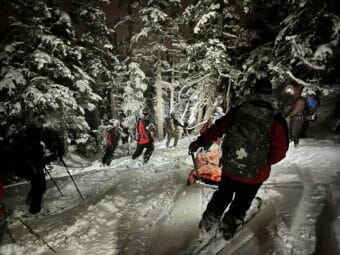
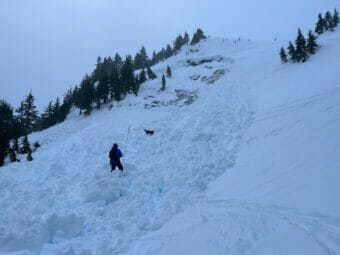
Rescuers prepare to bring an injured skier down the mountain on the evening of Feb. 4, 2023 (Photo Courtesy of Juneau Mountain Rescue)

It took dozens of rescuers several hours to retrieve a skier who broke his leg after venturing beyond the Eaglecrest Ski Area with two friends on Saturday.
Jackie Ebert, Operations Chief for Juneau Mountain Rescue, says they were able to mobilize quickly thanks to the timing of the accident.

“A lot of our team, you know, we all ski for fun. So we were kind of in the area,” she said.

Still, Ebert says it was a complicated rescue. Douglas skier Patrick Millard, 37, had broken his leg in the backcountry area near the north face of Fish Creek Knob. Rescuers had to negotiate heavy snow, avalanche zones, thick brush and steep terrain before securing Millard in a rescue sled.

“Navigation teams to establish the best route to get the person out of the field, trail clearing crews, a technical team in case we needed to get any sort of rope systems involved,” Ebert said. “All said and done, I think it took about eight hours. And we had folks in the field for about six.”

The rescue team made it to the Eaglecrest Lodge just after 10 pm, where Capital City Fire and Rescue transported Millard to Bartlett Regional Hospital.

Douglas Island second crossing faces opposition to proposed routes through Mendenhall Wetlands

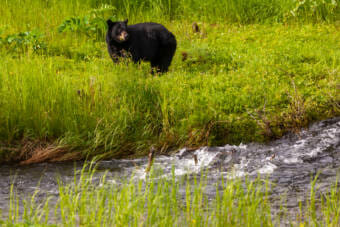
A female black bear eats as her two cubs play nearby on June 19, 2021, at the Mendenhall Wetlands State Game Refuge in Juneau, Alaska. (Photo by Rashah McChesney/KTOO)

Juneau’s Mendenhall Wetlands make up the third largest tidal salt marsh area in Southeast Alaska. The wetlands are considered key habitat for hundreds of species of shorebirds and migratory waterfowl, and an essential spawning ground for salmon and other fish.

“It’s an extraordinarily important piece of habitat that we often take for granted,” said Matt Robus, a longtime Juneau resident and retired director of wildlife conservation for the Alaska Department of Fish and Game. “Because it’s right in the middle of our town.” 

Now, scientists and local conservation groups are raising concerns about possible threats to the wetlands from the long-discussed second crossing to Douglas Island. A study for the project outlined eight possible locations for the crossing, and half of them pass through the Mendenhall Wetlands State Game Refuge. 
Juneau Douglas second crossing project area map
A map of the project area for the possible second crossing between Juneau and Douglas Island. (Image courtesy of Alaska Department of Transportation and Public Facilities and DOWL)

The second crossing has garnered widespread community support, but Robus says he’s been unhappy with route planning so far. 

“There has not been, in this first stage of the process, a lot of display or consideration of these biological values,” he said.

Robus belongs to a new Mendenhall Wetlands study group, made up of about 20 local scientists and naturalists. The group aims to protect the wetlands, which have already lost around 40% of their original expanse, from further development. 

“There’s already pressure on this habitat, and there aren’t other habitats around like it to replace it,” Robus said. “Our concern is that it really shouldn’t be subjected to another significant negative impact. And these crossings have at least the potential to do that.” 

Some of the possible crossing locations could reverse mitigation efforts tied to existing development around the wetlands. The Southeast Alaska Land Trust owns more than a dozen parcels of wetlands that were conserved to offset the airport expansion. Two of the proposed alternatives either border those parcels or cut through them. 

Krista Garret, the land trust’s conservation director, says they’re not opposed to the idea of a second crossing, but they believe it’s possible to build a route that won’t disturb the wetlands.

“As the study moves forward, we encourage a focus on alternatives that are outside of the refuge boundaries,” she said.

The existing alternatives provide three options further out in Gastineau Channel, closer to the existing Douglas Bridge. Those routes would avoid the refuge.

An infusion of federal money and an omnibus spending package approved earlier this month will fund further studies on the possible environmental impacts, as well some of the project’s preliminary engineering.

From there, the preliminary study will continue to narrow down alternatives, with a final recommendation sometime next year. If the city decides to proceed with crossing, those recommended routes would go through a more robust environmental review under the National Environmental Policy Act.

The public comment period for the preliminary crossing alternatives ends Feb. 3. Comments can be submitted online.

Fluctuating winter weather in Juneau set the stage for an avalanche at Eaglecrest

Eaglecrest ski patrol surveyed the East Bowl Chutes following a large avalanche on Jan. 26th, 2023. (Photo courtesy Dave Scanlan)

The upper-mountain at Eaglecrest ski area in Juneau was closed on Friday following a large avalanche Thursday morning. No one was hurt, but the area above the Hooter lift will remain closed as the ski patrol works to address potential hazards.

The slide dropped about 6 to 7 feet of snow over a 100 yard swath in the East Bowl Chutes.

“It’s very rare, actually, that we have this size of an avalanche occur within our boundaries,” said Eaglecrest General Manager Dave Scanlan.

At the time of the slide, the area was closed, along with many of the mountain’s steeper, avalanche-prone slopes. The slide wasn’t human-caused, but Scanlan says there are some die-hard backcountry skiers who still venture out into closed areas.

Alaska SEADOGS, Juneau Mountain Rescue and the Alaska State Troopers were called to assess the scene, and confirmed that there wasn’t anyone in the debris. Poor conditions have kept many skiers off the mountain this week.

“We didn’t see any evidence of skiers coming in and out,” said Scanlan. “But it’s a great training opportunity and kind of a standard protocol within the ski industry.”

He added that ski patrol would be out on the mountain again Friday to mitigate ongoing slide hazards. They’ll examine the snow layers and deploy avalanche explosives to create smaller slides that will stabilize the snowpack.

Avalanche conditions change rapidly depending on changing temperature, moisture or winds. A week of active weather set the stage for the slide.

Heavy snow last week was followed by a tropical front that brought several days of warmer weather and heavy rains. That added significant weight to the existing snowpack, and weakened the bond between snow layers. Eaglecrest closed altogether this past Wednesday due to rainy conditions, and the upper mountain terrain remained closed to allow that extra moisture to drain.

But Scanlan says it’s not just this week. Frequent fluctuations between warm, rainy weather and colder, snowy weather this winter have created a relatively weak snowpack at Eaglecrest, and across the urban slide zones too.

Each storm creates a different layer in the snowpack, and the frequent freeze-melt cycles this year have created thinner, weaker, less defined layers, especially lower in the snowpack. This makes them more unstable and prone to slides.

Scanlan says it’s raised concerns for slides of all kinds this winter.

“All the avalanche professionals are talking about this,” he said. “It’s a little more uncommon. Typically our region has a much more cohesive total snowpack with less layering in it.”

He says that colder temperatures heading into the weekend will help to stabilize the snowpack and lower avalanche risk. Groomers will be out to prepare trails today, and they’re expecting to re-open some of the upper mountain trails on Saturday.

Site notifications
Update notification options
Subscribe to notifications