Anna Canny

Local News Reporter

Juneau residents join national demonstrations against banks who finance fossil fuels

Bob Schroeder with 350 Juneau saws a model Wells Fargo credit card in half outside of the bank’s downtown Juneau branch on the national “Stop Dirty Banks Day of Action” on March 21, 2023. (Photo by Anna Canny/KTOO)


The buzz of a chainsaw and a low, steady drum beat drew attention to the Wells Fargo bank in downtown Juneau on Tuesday, where about two dozen demonstrators lined the sidewalk.

On the bed of a pickup truck, Bob Schroeder stood before a plywood model of an Alaska Airlines credit card. 

“What do we say?” Juneau organizer Doug Woodby called out. “Cut it out or we’ll …”

“Cut it up!” the crowd responded.

Schroeder revved the chainsaw over an intensifying drumbeat and then sliced the card in two, tossing the pieces onto the street. 

What organizers called the “Great Alaska Credit Card Chainsaw Massacre” was one of more than 100 protests on Tuesday for the national “Stop Dirty Banks Day of Action.” Demonstrators aimed to draw attention to the connection between the fossil fuel industry and big banks like Wells Fargo, CitiBank, Chase Bank and Bank of America, the owner of the popular Alaska Airlines credit card. 

The protests called on the banks to end their investments in oil and gas expansion. Together, those four banks have invested more than a trillion dollars in fossil fuels since 2016. 

“That’s a lot of money,” Woodby said after the demonstration. “And I think that a lot of people probably don’t realize just how integral big banks are to funding the climate chaos experience.”

Retirees lead the way

That was true for many of the protestors in Juneau. Sally Wilson has had a Wells Fargo account for more than 30 years. She said she’s been satisfied with it, but after learning about where her money is being invested, she’s reconsidering her choices.

“I had separated the two things,” Wilson said. “My money management is one part of my life. My concern about climate change is another part of it. And this is linking the two.”

Kate Troll agreed. She said she’s already made conscious choices about her financial portfolio, deciding to move money to things like renewable energy investments. The next step, she said, might be ditching her Alaska Airlines credit card.  

“We love the miles,” she said. “But I think we have to think about the greater trade off.”

Both Wilson and Troll are retirees, along with many of the nation’s demonstrators yesterday. The protests were organized by Third Act, an activist group for older adults founded by climate journalist and advocate Bill McKibben. 

That demographic is well-suited to lead the charge against banks. Seventy percent of U.S. wealth is held by Americans over 55.

Woodby says that appealing to big banks is a more promising avenue than pleading with oil companies directly. 

“We’re customers. They listen to us, hopefully. And they know that they depend on us,” he said. “They have a choice. The banks can loan for other uses, like renewable energy.”

Willow Project a rallying point

Alaska was at the center of a national debate on fossil fuel expansion earlier this month, when the Biden Administration approved the Willow Project, a major ConocoPhillips oil drilling project on Alaska’s North Slope.

Organizers with 350 Juneau joined national demonstrations to draw attention to big banks’ investments in fossil fuel expansion on March 21, 2023. (Photo by Anna Canny/KTOO)

The project, which received bipartisan support from state legislators, will emit more than 287 million metric tons of carbon dioxide over its 30-year operation — the emissions equivalent of more than 70 coal fired power plants. 

And much of the project’s financing will likely come from huge banks. ConocoPhillips has received $10 billion from these four banks since the signing of the Paris Agreements. 

Wanda Kashudoha Loescher Culp, an Alaska Native activist with Women’s Earth and Climate Action Network, spoke at the event, reminding demonstrators that the history of bank-funded resource extraction in Alaska dates back before the fossil fuel industry moved in.

“Our ancestors witnessed first explorers and then the expeditions taking our resources for business. All of this was bank funded,” she said.

And while moving away from fossil fuel expansion will be challenging in a state that relies on it so heavily, she said it’s an issue of environmental justice. She believes the state has prioritized resource extraction over the environment and human health. 

“Alaska has never been a government of the people, it’s always been corporate oriented,” Culp said. “And we need to change that.”

Woodby and national Third Act leaders encouraged demonstrators to sign a pledge to close their accounts if banks don’t commit to end their oil and gas investments. Before Tuesday’s day of action, the pledge had over 17,000 signatures nationally.

Southeast humpback populations are improving, but the fallout of the Pacific marine heat wave lingers

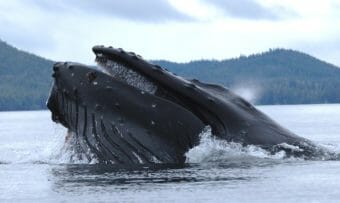
A humpback feeding
A humpback whale strains krill in the waters of Southeast Alaska. (Photo provided by NOAA)

The 2014 to 2016 Pacific marine heat wave, nicknamed “the Blob,” devastated Alaska’s marine ecosystem.

It turned seastars to goo and caused dead seabirds to wash up on beaches. Researchers also believe it killed almost half the resident humpback whales in Glacier Bay and Icy Strait.

But wildlife biologist Janet Neilson with Glacier Bay National Park says things are looking up for Southeast Alaska’s humpback whales.

“The good news is that whales are very resilient,” Neilson said. “They are really capable of rebounding.”

Glacier Bay and Icy Strait are an essential feeding ground for humpback whales. They fuel up before migrating to winter breeding grounds in Hawaii and Mexico. During the heat wave, cold-water fish and plankton species declined, causing what Neilson calls an “underwater famine.”

In the years since, almost 50% of humpback regulars in Glacier Bay and Icy Strait have gone missing — and they haven’t been located anywhere else. Most are presumed to have died because of the heat wave.

Though temperatures cooled down after 2019, Neilson says that for several years, her team kept seeing devastating survey results.

“We almost call it like the hangover of the heat wave,” Neilson said. “Things actually got worse after the heat wave ended before they started to get better.”

But the 2022 update, which was released last week, shows sure signs of improvement. Whales are fattening up again, and they’re staying longer in Glacier Bay and Icy Strait than they did during the heat wave — which points to a much-needed improvement in feeding conditions.

“We’re seeing less emaciated whales. Less skinny whales,” Neilson said.

Southeast humpbacks are also reproducing more successfully, with fewer sudden calf deaths. But birth rates still have not returned to pre-heat wave levels. Scientists don’t know the exact cause, but Neilson says that may mean female whales have not recovered enough nutrition to support pregnancies.

“A lot of females that we would expect to have calves. They’re just not coming back with calves,” Neilson said. “We’re not sure what’s the problem there.”

And for adult whales, the threat of vessel strikes still looms. 2022’s survey documented at least one death of an adult female whale near Angoon. The survey found only 165 adult humpbacks total in Glacier Bay and Icy Strait, so one death can matter a lot.

As the ratio of whale watching boats to individual whales in Southeast is increasing, researchers fear the risk of disturbances is rising too. Too much boat activity can stress humpbacks, which makes proper feeding even more difficult.

Neilson says that avoiding extra stress and deaths for humpbacks will be especially important as climate change increases the chance of future marine heat waves. But for now, she says Southeast’s humpbacks are on a good track.

“Things definitely are still not back to where they were,” Neilson. “But there are positive signs.”

Juneau teams sweep at statewide ocean sciences competition

The Juneau Douglas ocean science bowl team visited the Alaska Sea Life Center in Seward during the “Tsunami Bowl” in March 2023. (Photo Courtesy of Shannon Easterly & Shelby Surdyk)

After school, empty pizza boxes lay stacked on a lab bench in Shelby Surdyk’s science classroom. The smell lingered as Juneau Douglas High School’s ocean science bowl team waited for coach Shannon Easterly’s next question.

“What is the most endangered cetacean?” she asked.

One student fired off a series of wrong answers.

“Blue whale, sperm whale, bowhead whale.”

Easterly stopped him.

“It’s a teeny, tiny porpoise called the vaquita,” she said. “We don’t know for sure, but there are less than 20 individuals.”

“Oh, I hate it,” said Peyton Edmonds, one of the students, showing her teammates a vaquita on her phone. “That’s not cute.”

The team practices here three times a week, but Tuesday was their first meeting since their win at Alaska’s “Tsunami Bowl” earlier this month. It’s a statewide ocean science competition. This year, in Seward, the school swept the buzzer-style competition — the third year in a row that Juneau has won.

“Rest-A-Shored (left)” and “Free Radicals (right)” competed in the final round of 2023’s “Tsunami Bowl. (Photo Courtesy of Shannon Easterly & Shelby Surdyk)

The freshman team, “Yeah, Buoy,” won first place in their division, while A-team “Free Radicals” and B-team “Rest-A-Shored” faced off in the final round to win first and second place, respectively.

Carson Carrlee, captain of Yeah-Buoy, was surprised. He said competing in Seward felt different from practices.

“Right after school, when you’re very tired and you have the A-team sitting right there, you’re barely buzzing in. So it can feel kind of like you don’t know anything,” he said.

In the heat of the competition, that changed.

“It really shows that you’re actually learning stuff,” he said. “You’re actually starting to become, like, kind of a scientist-ish.”

The Tsunami Bowl, which was hosted by the University of Alaska Fairbanks College of Fisheries and Ocean sciences, is more than a competition. It’s a crash course in all things ocean science, with researchers and professionals from around the state.

The Juneau teams visited a boat simulator at the Alaska Maritime Training Center, tried a tsunami evacuation drill and went behind the scenes at the Alaska Sea Life Center.

The A and B-teams also participated in the research portion of the competition, where teams presented original research papers and oral presentations. This year’s theme was mariculture in Alaska.

Juneau’s students focused on the farming of geoducks, sea cucumbers and oysters. Easterly said the student research efforts are her favorite part of the competition.

“The buzzer is fun,” she said. “But that paper writing and then the opportunity to actually practice public speaking and present your own research — to a crowd of not just your peers, but adults from all over the state — is really valuable.”

The Juneau Douglas “Free Radicals” will go on to compete at the National Ocean Sciences Bowl in 2024. (Photo Courtesy of Shannon Easterly & Shelby Surdyk)

Surdyk joined as a coach last year. She said that the competition attracts students who might not have an interest in ocean science initially. Some join because their friends join. Others join for a small bribe — extra credit in science class.

“Even if they don’t feel motivated by the competition, just to enjoy the process of learning and discover that they love science, I think is a huge reward,” Surdyk said.

Carlee, a first year student, says he’ll definitely be back next year.

“I love all my other clubs,” Carlee said. “But NOSB. You really feel like you’re smart. And you’re learning stuff.”

And the ocean science bowl gets students to stick with STEM education, Easterly says. Tuesday’s practice was proof.

“We didn’t even tell them there would be pizza. And they came anyway,” she said.

Next year, Easterly will take the Free Radicals A-team to the National Ocean Sciences Bowl competition, where they’ll compete against the winning teams from across the country.

Heavy rains in Juneau cause flood risk, increase avalanche potential

A car drives through floodwater and mud on Glacier Highway near Wire Street on Wednesday, Dec. 2, 2020, in Juneau, Alaska. (Photo by Rashah McChesney/KTOO)

Rainy weather on Thursday is melting the snowpack across Juneau which will increase the risk of flooding and avalanches.

Meredith Thatcher, public information officer for the City and Borough of Juneau, says residents should look out for slow drainage in their neighborhoods.

“You have these ditches that have been packed with snow and drains that are still covered with snow. And so water is just moving more slowly than it normally does,” she said. 

People should avoid parking near storm drains as the rain continues into Thursday evening. Rains will continue with scattered showers on Friday and temperatures in the mid-40s. Winds will be calmer.

The current urban avalanche advisory is “high.” 

“All this snow up high is getting additional weight. And with additional warming it’s getting weaker,” said Tom Mattice, emergency programs manager for the city. 

He says the chance for wet, loose avalanches will continue to rise until the warming peaks Thursday evening.

The heaviest rain is expected to let up heading into the weekend, with drier conditions returning on Saturday. 
Draft ordinance on city hazard maps seeks balance between property rights and public safety

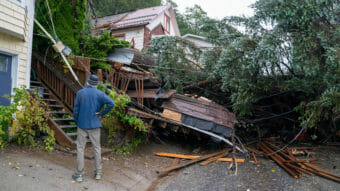
Juneau resident Bret Schmiege assesses the damage from a severe landslide on Gastineau Avenue in Juneau on Sept. 27, 2022. (Photo by Paige Sparks/KTOO)

After more than a year, Juneau has resumed discussion of landslide and avalanche hazard zones with the introduction of a new draft ordinance.
The proposed land use code considers the adoption of new hazard maps and possible limits on development in hazard zones. 

In a planning commission work session on Tuesday, Jill Maclean, the city’s director of community development and one of the authors of the ordinance, laid out its central challenge. 

“It’s the balance over property rights and life,” Maclean said. “And you and the Assembly have the responsibility of trying to find that balance. And I frankly don’t envy you.”

The debate over what the city should do to address avalanche and landslide hazards downtown has spanned several decades. But the introduction of new hazard maps in 2021 brought the topic to light again.

Those maps, which were commissioned to replace the city’s maps from the 1970s, place half of the structures downtown in moderate to severe hazard zones. 

Now, the city assembly will have to decide how to regulate the new zones. The draft ordinance at this stage only considers the “severe” zones – the areas with the most imminent risk of an avalanche or landslide event.

The new ordinance differs from the existing land use code in some key ways. For one, it proposes new disclosure requirements, which would require property owners to provide a written notice of hazards to renters or new potential buyers.  

During Tuesday night’s meeting, some doubted whether it should be the city’s role to inform specific buyers or renters. Others, including planning commissioner David Epstein, expressed support. 

“I think we have a duty to inform,” Epstein said. “We have an obligation to let people know, hey, this property is a severe landslide or avalanche area. Period.” 

Even if the disclosure requirements stick, Maclean said the city has no plan to make that code enforceable. 

One major sticking point of the new ordinance will be the distinctions between avalanche and landslide zones. While the city’s older maps combine the two, despite their different risk factors, the new maps separate them.

That sparked debate about whether to regulate severe landslides and severe avalanche zones in a similar way. Much of that discussion focused on expanding properties to fit more people. 

Avalanche events are generally more predictable, while landslides can happen sporadically, over long timescales. And they have a wide variety of causes. Maclean said that makes them harder to regulate. 

“It’s difficult. I think it’s probably one of the most difficult ordinances in the land use code,” she said. “Given the sort of infrequency or frequency, however you choose to look at it, of these types of events.”

In many ways, the scope of the new maps is limited. They outline the zones where landslides are possible, even likely, but they cannot give an idea of the timing or magnitude of events. And because of that uncertainty, deputy chair of the planning commission Mandy Cole said the city should hesitate to limit property rights. 

“We don’t totally understand risk yet,” she said. “And so the idea that we could then make policy decisions that will impact homeowners now and in the future, feels perhaps presumptive.”

The city has no plans to expand research on avalanches and landslides locally. 

The debate over the new ordinance will continue in the next committee meeting before it is presented for public comment later this spring.

Correction: A previous version of the story misidentified the deputy chair of the planning commission. 

Winter weather returns to Southeast Alaska after a prolonged dry spell

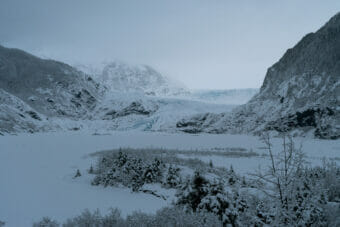
Mendenhall glacier as seen from the visitor center after snowfall on Feb. 13, 2023. (Andrés Javier Camacho/KTOO)

The National Weather Service has issued a winter storm advisory for Juneau and other communities across the Northern Panhandle from late Tuesday evening through Thursday morning.

Juneau has enjoyed more than a week of dry conditions and sunny skies, but the forecast predicts that that will come to an end as several low pressure fronts coming in off the Gulf of Alaska dump a mix of snow and rain across Southeast. 

NWS Meteorologist Grant Smith explained the outlook for the coming days in a YouTube video Monday night.

“The biggest impacts will be in the middle of the week, that Wednesday, Thursday timeframe,” Smith said. “Moderate snow, then switching over to rain.”

Communities in the Northern Panhandle, where temperatures will remain cooler, could see more snow. The forecast predicts 4 to 8 inches in the Icy Strait corridor and more than a foot in Haines and Skagway. 

In Juneau, sunny days have come with cold temperatures, with a record low recorded at the airport early this week. Warming temperatures will bring a switch from snow to rain, especially in the Southern panhandle.

It’s not clear yet exactly how the wet front will coincide with warming temperatures. That timing could affect how much snow falls.

“A difference of timing in when that switchover happens as little as two, three hours, could mean an inch and a half of extra snow or less snow,” Smith said in the video.  

Regardless, wet weather is expected through the end of the week and into the weekend.

The urban avalanche advisory for Juneau has been low, but storms that combine heavy precipitation with warming temperatures can increase avalanche risk significantly. People who live in avalanche zones should continue to consult the advisory as the front passes through.

This story has been updated to reflect that the winter storm watch was upgraded to a winter storm advisory. 

Site notifications
Update notification options
Subscribe to notifications