Anna Canny

Local News Reporter

Forest Service extends public comment for Hecla Greens Creek Mine expansion 

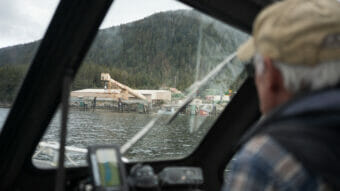
Greens Creek Mine facilities seen from Hawk Inlet on May 2, 2021. (Courtesy of Andrés Javier Camacho)

The U.S. Forest Service has extended its public comment period for a proposed expansion of the Hecla Greens Creek mine until May 23 after public calls for more time. 

The agency plans to dedicate more time to hearing concerns about the mine’s potential threat to subsistence activities around Admiralty Island, where it operates. 

Public comment started back in March after the Forest Service released a draft environmental impact statement on four different plans to expand the mine’s waste storage facility. Hecla says it needs more storage space to keep operating the mine beyond 2031.  

Matthew Reece is the project’s manager. He says the Forest Service won’t begin their official review of comments until the end of the month, but public response so far has been mixed. 

“Both in support, and in — not necessarily opposition, but some kind of conditional support,” he said. “And based on some public comments and concerns that we received, we decided to have an additional subsistence hearing.”

Some of the most prominent concerns have focused on the potential for heavy metal contamination in the surrounding forests and in Hawk Inlet, an important hunting and fishing ground near the mine’s existing waste storage facility. 

The community of Angoon in particular relies on subsistence activities near the mine

Last week, the Forest Service announced and then quickly postponed a hearing for testimony related to subsistence near Greens Creek. 

Reece says they had hoped to hold that meeting before the comment period ended, but federal regulations require a 30-day public notice. He said the Forest Service is working with officials in Angoon to schedule a new date.

Testimony from that hearing will be considered along with the feedback received through the formal public comment process.

The agency will also hold an open-ended discussion on activities in and around Angoon this Friday, May 12. Though the mine’s potential expansion is sure to be a major topic, the discussion may also include some of the ongoing development projects in the region, like the city’s proposed hydropower facility and efforts to grow ecotourism in the region. 

Michael Downs is the Forest Service District Ranger for Admiralty Island National Monument. He says the main goal of the meeting is to rebuild relationships between the agency and the community after recent turnover in Angoon’s tribal and city leadership.

“They want to see the Forest Service more out there,” Downs said. “So we’re trying to make more trips, trying to make sure that they’re being heard, trying to be responsive.”

Representatives from Greens Creek will attend the meeting.

The agency’s final decision on the proposed expansion is expected to come in December.

Public comments can be submitted online, by fax at 907-586-8809 or in-person at the Forest Service Ranger’s station in Juneau through May 23.


Correction: A previous version of this story said the upcoming meeting in Angoon would be held Saturday, May 12. It will be held on Friday May 12.

A drone’s eye view could make Juneau’s avalanche monitoring faster and more precise

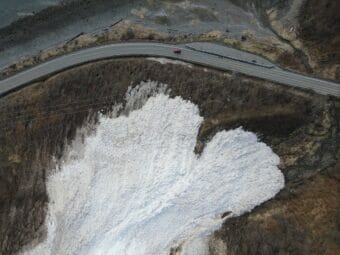
Drone imagery captures an avalanche that stopped just short of Thane Road in Juneau. (Photo Courtesy of Pat Dryer/Alaska Department of Transportation)


In the mountains above Thane Road, every snow storm, wind event or man-made explosion moves snow around. That means the snowpack — and the potential for avalanches — is constantly changing, too.

Avalanche specialist Pat Dryer with the Alaska Department of Transportation monitors those changes. But when he’s looking up the slopes from sea level, there’s a lot he can’t see.

“What other hazards are up there that aren’t visible from the ground?” Dryer said. “The ability to essentially fly to the top of the slope and figure that out would help.”

With drone technology, he can do just that. This winter, the state Department of Transportation launched a new project to use drones for faster, more precise avalanche monitoring along Thane Road.

Dryer and his team started experimenting with occasional drone missions last winter, and they do fieldwork trips often. But those methods are like snapshots. They capture a moment in time, and they examine just a fraction of the avalanche zone.

The robotic DJI drone dock houses the drone in between flight missions. It’s equipped with charging technology and data collection to upload photos to the cloud remotely. (Photo courtesy of Pat Dryer/Alaska Department of Transportation)

The new project, which is a collaboration with drone manufacturer DJI, will try to get a bigger picture with more frequent, automated drone flights.

“You can think about it kind of like a lawn mower mowing the lawn,” said Grant Hosticka, a DJI engineer who helped to launch the project. Lawnmowers cut the grass with multiple passes across the yard, patch by patch. “And drones kind of do that. But by taking photos that overlap as it goes.”

All of those photos can help avalanche specialists like Dryer map and model the snowpack using a process called photogrammetry.

“That’s taking a lot of photos and stitching them together to make a new aerial image,” Dryer said. “What we’re doing is creating a digital elevation model from the photo. In this case, it would be the total height of the snow.”

By doing this again and again over the snow season, they can understand how much snow is accumulating in avalanche start zones. That could help to estimate the size of potential avalanches, and it could inform the scheduling of the man-made avalanches that happen along Thane Road each winter.

The drone missions will be launched automatically from a new drone dock that was installed near Thane Road last month. The dock is a sleek white box — essentially a high tech parking spot for the drone — with hook-ups for charging and remote data collection between flights.

The major advantage of the dock is that it would allow drones to take off and land without a human operator on the ground. But for now, the department of transportation and the drone manufacturers are monitoring test flights closely to work out the kinks. The goal is to learn more about the drones’ battery life, data storage and resilience to Juneau’s weather.

DJI team member Sunxu Xu powers on the drone on the DJI robotic dock. The dock is equipped with charging technology and data collection to upload photos  to the cloud remotely. (Photo courtesy of Pat Dryer/Alaska Department of Transportation)

Only a handful of these DJI docks have been deployed in North America. Hosticka says Juneau is a great place to refine the technology.

“To be in Alaska and experience some of the tough weather, for instance,” he said. “So that the team is able to verify how it’s holding up in these conditions.”

And there are still regulatory roadblocks to overcome. The Federal Aviation Administration has not fully updated regulations for unmanned drone missions. Juneau’s avalanche specialists are working to get the permits that would allow these drone flights can be truly automatic.

Though avalanche season is wrapping up for the urban environment, Dryer said there will be plenty of time this spring to keep refining the technology.

“There’s still likely to be avalanches in the mountains for months to come,” he said. “So we’ll still use the technology and test it as best we can to learn as much as we can about it.”

By the time next year’s snow starts falling, drone missions could change the way avalanche specialists see the snowpack.

Public comment for Hecla Greens Creek Mine expansion still open, as environmentalists call for more monitoring

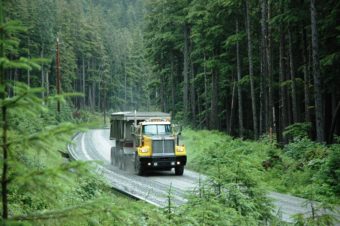
What’s called a “max haul” truck drives the Greens Creek road. (Photo by Mike Satre/Hecla Greens Creek Mine)

A proposal to expand the waste storage facility for Hecla Greens Creek mine on Admiralty Island is open to public comment for two more weeks. 

Some environmentalists say the expansion shouldn’t move forward without more research to prove that toxic metals from mine waste haven’t damaged natural resources in the Tongass National Forest, where the mine operates. 

“Are these metals bioaccumulating up the food chain?” said Guy Archibald, a contract environmental scientist with the nonprofit Friends of Admiralty Island. “We measure fugitive dust out in the environment. But is that being taken up by the plants, then in turn being concentrated through the deer? And the eagles ?”

Extending the life of the mine

Greens Creek is the nation’s largest silver producer. They mine gold, zinc and lead too. They’re also one of Juneau’s more prominent and profitable private employers.

The waste facility in question stores tailings — ground rock that is left over from the extraction of valuable metals. It’s stored and managed in piles on the mine’s grounds. Tailings are the source of what’s called fugitive dust — fine particles that have the potential to deposit toxic metals like lead in the environment. 

This would be the third expansion of the waste facility since Greens Creek opened in 1989. The last one, which was approved in 2014, was smaller than the mine had hoped, which is why it lasted just 10 years.

From the mine’s perspective, the latest proposed expansion is routine. 
“It’s really just a continuation of managing our tailings facility the way we always have,” said Mike Satre, manager of government and community relations for the mine. “But simply letting us add a little bit more space.” 

Without it, the mine could run out of space by 2025. But if the expansion is approved, it would extend the mine’s operation for up to 40 years. 

“What we really want to do here is not have to come back every 10 or 12 years to permit an expansion on an existing facility that’s been managed responsibly for decades now,” Satre said.

A baseline of pristine conditions 

Though there are few outright opponents to the mine’s continued operation, nonprofit groups like Friends of Admiralty Island the and the Southeast Alaska Conservation Council feel that there is a need to take a step back. They want the U.S. Forest Service to replicate the original environmental studies that were done to record the “pristine” conditions before the mine opened. 

“We need more baseline information that compares the existing situation to what it was before the mine started,” said John Neary, a retired Forest Service employee and President of Friends of Admiralty Island. 

Greens Creek operates within the Admiralty Island National Monument in the Tongass National Forest, which requires higher environmental standards and oversight. They regularly monitor water quality, sediment and tissue samples from some marine animals like mussels, clams and sea worms in Hawk Inlet. 

But Neary says that monitoring doesn’t do enough to ensure the health of subsistence resources in the inlet. Regular monitoring does not extend to things like deer, seal or some other food sources. 

“One of our top concerns is that there are people that eat whatever occurs in the marine environment,” said Neary. “There are crabs and clams and halibut, so it needs to be safe enough for human consumption.” 

The health of Hawk Inlet

Whether conditions in nearby Hawk Inlet are really uncontaminated is the question Archibald posed in a peer-reviewed study of clam shells he released last month with Friends of Admiralty Island. 

It compared the shells of live clams collected from the inlet to shells from Young Bay, which is further away from the mine. The study found a 50% increase in lead levels in the Hawk Inlet shells and concluded that the lead came from the mine’s tailings facility. 

Archibald’s study came out just before an environment impact report from the Forest Service, which considers four proposed plans to expand the tailings facilities. Contrary to Archibald’s study, that report said that marine conditions in Hawk Inlet remain unchanged from pre-mining conditions. 

And both the mine and the state echoed that sentiment. In a recent press release, the Alaska Department of Environmental Conservation called the clam shell study “misleading,” citing their own studies on clam tissue in the same areas. 

“So there’s an overall conclusion that the mine is not significantly impacting Hawk Inlet,” Satre said

But Archibald says he’s not convinced by the tissue studies. He said he hopes the mine, along with the state and federal agencies, will conduct a more robust marine population study to assess the health of the inlet.

“This is the most profitable silver mine, I believe, in the United States,” said Archibald.  “They need to be able to do a better job here.”

Future plans for fugitive dust 

The Forest Service report acknowledges that some concerns about heavy metal pollution are legitimate. Fugitive dust has already been linked to contamination in nearby watersheds. Tributary Creek, which runs close to the existing tailings facility, was designated as an “impaired water body” by the state last year due to elevated levels of lead levels caused by the mine. 

All of the proposed expansion alternatives have the potential to further spread fugitive dust. To address this, the Forest Service report calls for plans to further mitigate dust as the expansion moves forward.

Satre said Greens Creek has a good track record of meeting environmental quality standards, and he said the mine has already met with concerned stakeholders since the Forest Service report was released. 

“We understand that there are stakeholders who are concerned,” Satre said. “We want to make sure that we’re responding to any of our agency and stakeholder concerns moving forward.” 

Joe Zuboff is one of those stakeholders. He lives in Juneau but grew up in Angoon, where he returns each year for hunting and fishing.

“I’m not against mining, but I am against damage to the ecosystem,” he said during a public meeting held at the Forest Service Ranger Station in Juneau earlier this month. “And Angoon is just barely surviving. They depend on that ecosystem.” 

He recalled a seal that was harvested in Angoon in 2016, which showed high levels of mercury contamination. The state said those elevated mercury levels could not be definitively linked to mining activities, but Zuboff still feels there is not enough environmental monitoring to address his concerns. 

Public comments can be submitted online, by fax at 907-586-8809 or in-person at the Forest Service Ranger’s station in Juneau through May 8.

Correction: A previous version of this story identified Guy Archibald as an environmental scientist with the Southeast Alaska Conservation Council. He is a contract scientist for Friends of Admiralty Island.  

City and cruise lines agree to future limits on tourism as first ship of the season docks in Juneau

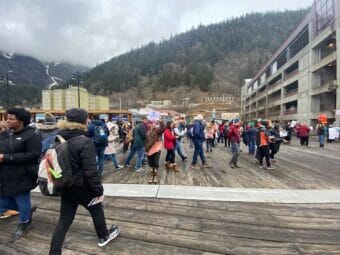
The Norwegian Bliss, a 4,000 passenger cruise ship out of Seattle, kicked off Juneau’s 2023 cruise season when it docked on April 17. (Photo by Anna Canny/KTOO)

On a misty Monday afternoon in Juneau, a small welcoming committee gathered at the Alaska Steam dock, in front of the towering Norwegian Bliss. The 4,000 passenger ship was the first of the 2023 season. 

A steady stream of people made their way up the ship’s ramp and onto shore, where they were greeted with applause, maps, tour advertisements and a smiling whale mascot ready for photo ops. 

“Welcome to Juneau everybody,” said longtime resident Tom Sullivan, who stood at the top of the ramp. “Have a great time. Glad you’re here.”

Not everyone is glad. Just before the Norwegian Bliss docked, major cruise lines finalized an agreement with the City and Borough of Juneau to observe a five-ship daily limit, starting in 2024. Some community members say that doesn’t go far enough. 
Sue Schrader and Pat White showed up with a small group of protesters as visitors arrived on the docks Monday. They’re calling for the city to impose stricter limits on visitor volume. (Photo by Anna Canny/KTOO)

Sue Schrader was among a small group of protesters at the dock. They stood with picket signs and one massive banner that was made to be visible from the cruise decks. It read, “Communities Against Cruise Pollution.”

“Cruising has consequences,” Schrader said. “We don’t like to annoy the passengers, but they need to know.”

The protesters worry that the five-ship limit is too little, too late. They feel Juneau’s visitor volume has grown too much already. And the 2023 season is expected to break records, with 30% more cruise passengers than in 2019. 

“There still seems to be unlimited growth,” Schrader said. “And we’re asking our elected officials or city leaders to get serious about the issue.”

Five ships is a busy day — but it’s possible that stopping at five is the most Juneau can do. The limit is the result of a long-negotiated agreement between the city and Cruise Lines International Association, a trade group that represents most of the world’s major cruise lines. It’s one of only a few such agreements worldwide.

The daily limit is not enforceable — it’s a good faith agreement. And it doesn’t limit passenger numbers, as ship capacity is increasing across the industry. 

During the course of negotiations, some community members called for an even stricter cap on ships — between three and four ships per day. But Assembly member Maria Gladziszewski recently said the city “would be in litigation immediately” after such a move. In 2016, the cruise industry filed a lawsuit against the city for its use of marine passenger fees, and some city officials have raised concerns about further litigation. 

The agreement does represent the city taking a more active role in managing visitor numbers than ever before, which could give them more breathing room to establish new attractions and infrastructure for a growing number of visitors. 

“This agreement provides our community with the assurance we need to plan for the future,” city Tourism Manager Alexandra Pierce wrote in the press release. “It’s essential we preserve the things that make Juneau an incredible place to live and to visit.”

Juneau has long been divided on whether cruise ship tourism benefits or harms the community. Most people fall somewhere in between. But Sullivan, who came out to meet the Norwegian Bliss, said he was honored to welcome so many visitors to the place he’s called home for 40 years. 

“It’s a very important economic driver in our community,” he said. “But more importantly, I think it’s really special that a million and a half people want to come to the little town of 30,000 that I live in because of its beauty.”

In the season ahead, Tuesday’s visit will seem quiet by comparison. On some days, Juneau’s port will welcome as many as six ships.

Juneau’s urban avalanche forecast ends for the season, but avalanche potential remains

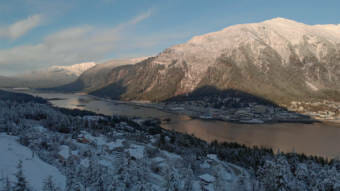
A view of Mt. Juneau from across the channel shows the Behrends avalanche path as a treeless swath on the side of the mountain. (Photo by David Purdy / KTOO)

Juneau’s urban avalanche advisory has ended for the winter. 

The urban avalanche advisory gets updated every morning during snow season. But as spring comes to Juneau, the city will no longer post daily advisories. 

The city’s Emergency Programs Manager Tom Mattice says he’ll keep watching conditions until most of the winter snowpack has receded, and he would put out a special alert if an unusual spring storm raised avalanche danger to extreme levels. 

“If we do get some sort of huge, anomalous event I will go to the extra effort to communicate with the public through all of the avenues available,” he said in an interview.

That means alerts would come through additional channels, including radio alerts and a statement from the National Weather Service. 

In his final post, Mattice warned that ending the advisory does not mean the end of avalanche danger. 

“If there is still snow in the mountains, avalanches remain possible,” he wrote. 

The potential for avalanche activity on the Flume and Perseverance trails will rise as temperatures warm, especially during the late morning and afternoon.
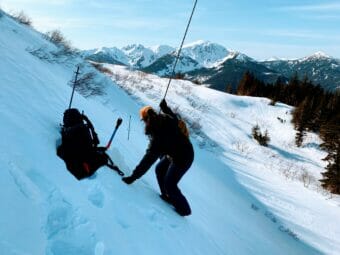
Juneau’s avalanche advisory only serves urban areas, but Mattice’s final advisory also encouraged backcountry travelers to remain cautious. Spring storms can quickly increase avalanche potential at higher elevations. 

New winter internship brings Juneau high school student to the slopes while learning about snow science

STEAM intern Jossline Aranda-Jackson (center) uses a snow probe with sensors to read the layers of snowpack while working in the field with intern hosts Mike Janes and Kanaan Bausler from AEL&P and STEAM mentor Ellen Bradley. (Photo courtesy of Sealaska Heritage Institute)

On a sunny day on top of Mount Roberts, Mike Janes pulled a snow probe out of his backpack. He snapped its segments together like a tent pole until it stood about 9 feet tall, then he handed it to Jossline Aranda-Jackson, who plunged it into the snowpack.

“You feel the different layers,” Janes said. “There might be hard crusts, there might be soft layers, or might be wet layers. You can actually feel a lot of that.” 

Aranda-Jackson looked back at Janes as she hit a stubborn layer. 

“My guess is that that’s the January layer, where there was a whole bunch of rain,” she said.

“Give that another tap,” Janes said. “I’m wondering.”

Suddenly the probe plunged deeper, until the whole thing was buried. Aranda-Jackson’s smile widened in surprise as she knelt down to read the measurement.

The many sensors of snow science

Aranda-Jackson is the first snow science and avalanche forecasting intern for Sealaska Heritage Institute. She has spent the winter learning how to interpret each layer of snowpack.

The program is a new addition to an existing suite of summer internships that aim to introduce Alaska Native and Native American high school students to careers in science, technology, engineering, art and math through paid work experience.

Mike Janes and Jossline Aranda-Jackson examine a fresh crust of snow in front the weather station at the top of Mount Roberts, in Juneau (Photo by Anna Canny/KTOO)

A focus on avalanche forecasting makes sense for Juneau, which is one of the most avalanche-prone cities in the United States. Alaska Electric Light & Power runs a regular avalanche forecasting program to monitor and protect local electric utilities. Janes in a part of that program. 

During her free periods at school, Aranda-Jackson heads out into snowy terrain with Janes and other members of the AEL&P team to learn the complicated process of avalanche forecasting. It starts with an extensive data collection. 

After they finished measuring snow depth with the probe, Janes and Aranda-Jackson turned their attention to a tall metal weather tower just a few feet ahead of them. It holds all kinds of sensors that measure the key factors that shape avalanche events. 

A mounted bucket melts and measures the snowfall to give an idea of total precipitation. A sensor that looks like a string of white beads buried in the snow reads the temperature at each layer in the snowpack. A ribbed metal box measures humidity and temperature. 

Jossline Aranda-Jackson uses a snow probe to measure the depth of the snowpack on a steep slope near the peak of Mount Roberts. (Photo by Anna Canny/KTOO)

“And you can actually feed this weather data into a snowpack model, and it will build what it thinks the snowpack should look like,” Janes said. 

Past summer interns have worked with the Alaska Department of Fish and Game, NOAA Fisheries and AEL&P, where Janes works as an avalanche forecaster. 

Mike Janes and Jossline Aranda-Jackson perform a “column test” to predict how an avalanche might spread across the slope (Photo by Anna Canny/KTOO).

When he approached Sealaska Heritage Institute about adding a winter internship, the program coordinators said they had the perfect candidate in mind.

Aranda-Jackson is a senior at Juneau-Douglas High School: Yadaa.at Kalé and an alumna of SHI’s science summer camps. Over the years, the program coordinators caught on to her preference for winter. 

“I was always talking about how I really — I’d rather be skiing,” Aranda-Jackson said. “Kind of like, my mind was elsewhere.”

The opportunity to ski is what first drew her to the internship. Aranda-Jackson has been skiing at Eaglecrest Ski Area since she was a kid. She says she’s always been aware of avalanches, but doing fieldwork this winter has made her think more deeply about them. 

“Back when I had no fieldwork in avalanche work, it was more like, ‘Oh, it’s just an avalanche. Like, okay, cool,’” she said. “But there’s so many different tools that can help you predict them, snow coverage and all that kind of stuff.”

Beyond the data

One of Aranda-Jackson’s major objectives is to learn how to collect and interpret that data. But SHI’s approach aims to go beyond data collection, to break down barriers between Western science and Indigenous knowledge and identity. 

That’s where the program’s mentorship component can help. Aranda-Jackson’s mentor is Ellen Bradley, a Lingít climate scientist and semi-professional skier.

“A lot of our mentorship meetings have been out in the field while we’re working on her internship, which means a lot of it is skiing,” Bradley said. “I think that’s the most ideal way for me to be a mentor.” 

SHI’s science programming aims to help students to build a deeper understanding of and commitment to their Indigenous perspectives before entering Western academic settings. 

Bradley says she feels she could have benefited from something like this when she first started her education in climate science. 

“I wish that was something that I would have had access to when I was in high school,” she said. “I think it would have really helped me center myself and my identity in the work that I do within STEM.” 

The program also aims to remove economic barriers for pursuing physical sciences. That’s especially important for avalanche science, which demands expensive equipment like backcountry gear and high-tech snow probes — things that most students couldn’t get in their standard high school science programs.

“So I think that that’s such a cool element of this internship is that our youth are getting access to these kinds of activities in a safe and affordable way,” Bradley said. 

In the fall, Aranda-Jackson will head to the University of Montana to hit new ski slopes and study glaciology. She first got interested in the field after watching the Mendenhall Glacier, and it offers the possibility for skiing in the summertime. 

But with the success of the first SHI avalanche and snow science internship, another student will likely take over next winter. 

Site notifications
Update notification options
Subscribe to notifications