Anna Canny

Local News Reporter

Plans for the Juneau-Douglas second crossing gain momentum with new federal funding

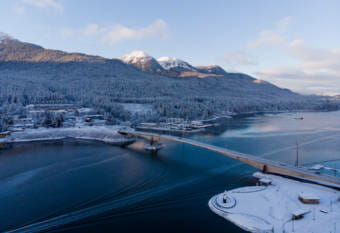
Douglas Bridge in Juneau in December 2018. (Photo by David Purdy/KTOO)

The City and Borough of Juneau has received $16.5 million in federal funding to complete final designs for a second Juneau-Douglas crossing.

Katie Koester, Juneau’s director of engineering and public works, said that boost will carry the project through the planning phase. 

“This is enough money to bring it all the way through the environmental analysis, through the design process, to get it construction-ready,” she said.

The proposed crossing would create a new route between Juneau and Douglas to supplement the existing bridge. According to the city, the project would create an easier commute for more than 5,000 residents that live on Douglas Island while opening access to undeveloped city and tribal land on North Douglas. 

The city and the Alaska Department of Transportation have been studying five possible routes for the crossing, at Mendenhall Peninsula, Sunny Point, Vanderbilt Hill Road, Twin Lakes and Salmon Creek. 

According to Koester, it will take a year or more to narrow down those options.

“Great progress has been made, great momentum, but the project is far from a sure thing,” she said. “And we’ll need a lot of public engagement to get it there.” 

The five routes will be presented and discussed at public meetings over the next year before a final design will be considered.

Once a preferred route is selected, the new federal money will fund the development of final design plans and an environmental review, which is required under the National Environmental Policy Act. 

The funding — which was awarded through the Rebuilding American Infrastructure with Sustainability and Equity grant — will supplement $7 million in federal funds awarded for the project earlier this year. 

The funding will not cover any of the construction costs, and the project is still far from breaking ground. The idea of a second crossing has been in discussion since the 1980s, without much progress. But in 2020, city and state transportation officials began planning again. 

The new funding comes from a larger pot of money — $27.8 million — that was awarded through the Bipartisan Infrastructure Law mainly for roads for rural Alaska communities. Those include road improvements for Kake and Petersburg and more than 100 miles of new roads to connect villages near Bristol Bay.

Southeast troll fishermen help study a warming ocean: ‘Fishermen are natural scientists’

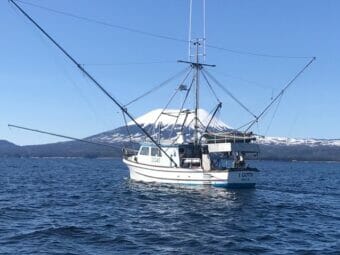
A troll fishing boat near Sitka. (Photo courtesy of Eric Jordan)


Eric Jordan’s life on the ocean began more than 70 years ago, when his parents started taking him out on the family’s troller. At 73, Jordan still fishes regularly. But he says a lot has changed in the waters of Southeast Alaska.

“I was out there, the last two weekends at the Derby weigh station, seeing things that are truly dystopian. The lack of birds, the lack of fish,” Jordan said. “Those of us who are out there on the water, we are seeing the changes. And I’ll tell you it’s pretty spooky.” 

Jordan started his own operation in 1978, trolling for coho and chinook salmon across Southeast Alaska and catching hundreds of fish a day. But today, the marine environment seems less abundant. Most species of Southeast salmon have had record low harvests in recent years, and the devastation from “the Blob” — a Pacific heat wave that caused massive die-offs of marine species — lingers. 

Scientists expect a future with warmer oceans and more marine heat waves. But there’s a lack of data to explain how climate change is shaping Southeast fisheries. Now, two new citizen science projects from Alaska Sea Grant and the Alaska Trollers Association will help longtime troll fishermen like Jordan take the lead to gather data about how the waters they depend on are changing. 
Checking the ocean’s pulse

Tyler Hennon, an oceanographer at the University of Alaska Fairbanks, describes temperature and salinity as foundational to most research in the marine environment. 

“I kind of think of it as the heartbeat of the ocean,” Hennon said.  “If you don’t know the temperature and salinity, you don’t know much of anything.”

Knowing temperature and salinity is important because they shape ocean mixing, a natural process where warmer surface water mixes with cold, nutrient-rich water from further down in the water column. That process triggers spring phytoplankton blooms.

“Which of course, are the base of the food chain,” Hennon said. “They set off all the production for all the higher trophic levels and fishing and all the things that we love in Southeast Alaska.”

Electronic sensors on troll fishing lines measure salinity, temperature and depth. (Photo courtesy of Jim Moore)

To know what salmon and other marine animals are eating — and when they’re not getting enough to eat — scientists need information on temperature and salinity. But there are major data gaps in central Southeast Alaska, especially in the summer months.

To fill those gaps, Hennon’s project relies on the people who are already out on the water — fishermen who will take regular measurements at different depths near their fishing grounds using electronic sensors on their fishing lines.

The data they gather will provide a baseline for biologists and oceanographers as climate change continues to shape the Gulf of Alaska. That’s crucial for determining what marine conditions that are “normal,” as opposed to conditions that might be caused by climate change.   

Sitka fisherman Jim Moore, who serves on the Alaska Trollers Association board, says the data will also help fishermen make sense of decades of observations out on the water. 

“People talk about ‘Oh, my goodness, I’ve never seen that before.’ Well, I’ve been fishing for 53 years. I saw that back in 1979,” Moore said. “The long-term data set is what’s really valuable.” 

An old salmon counting program, rebooted

Moore is no stranger to doing science from a troll boat. As a commercial troll fisherman back in the 1970s, he participated in a logbook program where fishermen studied salmon populations in the Gulf of Alaska. 

Fishermen will open up the stomach of select fish to record data on salmon diets. (Photo courtesy of Eric Jordan)

That program ended in the early ’90s. But this spring, Moore and a select group of Southeast troll fishermen relaunched the program electronically. Using a tablet-based logbook, fishermen will record things like the species and quantity of salmon they’re catching, where they catch them, the size of the fish and their stomach contents.

The earlier logbook program informed major management decisions for Pacific salmon stocks, including the development of the Pacific Salmon Treaty in 1985. Moore said he hopes reviving the program will give fisheries managers more data to inform salmon conservation under climate change. 

Eric Jordan has been a commercial troll fisherman in Southeast Alaska for more than 50 years (Photo Courtesy of Eric Jordan)

Management of Southeast salmon fisheries was the center of a legal battle this spring, after a federal judge ordered the closure of the Southeast chinook fishery. Last week, a higher court ruled that the fishery could remain open this summer. 

Moore said the new logbook program could give fishermen a more solid legal defense against future lawsuits.

“Fishermen are natural scientists,” Moore said. “And the trust built between management and scientists and the fisherman is a good thing. We’re all working on it together.”

Jordan— who’s piloting the logbook program this summer — said collaborating with scientists is a long game for fishermen.   

“Trollers have a long history of standing up for salmon. And we are going to do that,” Jordan said. 

With science, Southeast troll fishermen can further solidify their role as environmental stewards, while building common ground with researchers and wildlife managers. 


Correction: A previous version of this story misstated Eric Jordan’s last name. 

Curious Juneau: What caused the jumble of fallen trees near the ferry terminal?

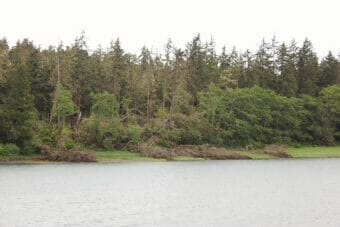
A jumble of fallen trees at Auke Nu Cove caught the attention of a Curious Juneau listener (Photo by Anna Canny/KTOO)


If you look across Auke Nu Cove from the parking lot at the Juneau ferry terminal, there’s a strange patch of fallen trees — about a dozen — that are splayed out in all directions.

Jesse Escamilla drives by on his evening commute every day. He’s used to seeing the occasional downed tree around his Lena Point home, but the fallen trees at Auke Nu Cove seemed mysterious and distinct.

“It looked odd, like it was isolated,” he said. “I remember it almost looking like someone with a bulldozer went and purposefully flattened that whole area.”

Escamilla grew up in Texas, and the pattern reminded him of the mark tornados leave. That became one of his two working theories.

“Option one would be Godzilla, and option two would be a tornado,” he said. “Both of those are viable, in my opinion.”

National Weather Service Meteorologist Rick Fritsch says the fan of fallen trees could be evidence of one of Juneau’s weirdest wind phenomena.
“To me, that sounds a whole lot like a microburst,” Fristch said.

The Southeast Alaska Land Trust manages the wetlands by the trees. Their conservation staff said the trees came down during a major wind storm that happened in October 2021.

That storm blew down dozens of trees across town. They hit houses and crushed cars, and in some neighborhoods they caused days-long power outages. It took days to clean up the mess of scattered trunks and branches.

The strong winds spread across all of Juneau. But in the small area around Auke Nu Cove, the wind may have generated a microburst, which can cause distinctive damage.

Fritsch says a microburst starts with a really strong gust of wind that blows straight down from the sky.

“And it comes down on the ground and it hits and goes out in every direction,” Fristch said.

As the winds gush outwards, they can exceed 100 mph — typically causing a lot of damage in a very small area. Just like what Escamilla noticed at Auke Nu Cove.

Elsewhere, microbursts are often associated with thunderstorms. When a thunderstorm forms, a swell of warm air rises to create clouds, which get heavy as they fill with rain or hail. If they get too heavy, they can release a strong gust of air that speeds toward the ground. That’s a microburst.

But thunderstorms are rare in Juneau, and that’s not what happened in the October storm. The alternative is even more interesting. It has to do with how wind interacts with Juneau’s coastal mountains.

“We in the business talk about straight-line winds, microburst winds and cyclonic winds, which are more associated with tornadoes. Basically circular,” Fritsch said.

Wind has basic, somewhat predictable directions, too. During a high pressure system — the kind that’s associated with clear skies — winds spiral clockwise and outwards to form gentle breezes. When a stormy, low-pressure system forms, winds spiral counterclockwise and inwards, building speed as they turn.

Those are the basics, but they’re not enough to predict exactly how the wind will behave.

“How do you get these winds flowing the way they do?” Fritsch said. “The topography on the inside is everything.”

Wind — like all weather in Southeast Alaska — is heavily influenced by topography.

Take straight-line winds. They’re strong storm winds that blow in just one direction. In stormy weather, they race down Gastineau Channel.

“So there’s sea level there. And then we got 3,000 feet on this side and 2,500 feet on this side,” Fristch said, pointing to downtown Juneau and Douglas on a map. “And that just acts like a natural funnel.”

That funnel directs strong gusts across Mendenhall Peninsula and up the runway at Juneau International Airport — in the case of that October storm, for nearly 24 hours. It kept planes on the ground, and it pushed many of the trees at the end of the runway to their breaking point.

Straight-line winds caused most of the tree falls during the storm, but the mystery treefall at Auke Nue Cove can probably be linked to what’s called the mountain wave phenomenon.

When wind hits a mountain, it’s forced upward. Then it hits a mass of stable air high in the sky, which pushes it back down. Those opposing forces make the wind move in an up-and-down wave motion.

When there are really strong winds and a stable air mass around Gastineau Channel, that wave action creates the famed Taku Winds in downtown Juneau.

But mountain waves can also cause microbursts. In some cases, clouds form under the mountain waves. When the windy waves pass over the top of a cloud, the friction can cause the cloud to start turning.

“You can’t necessarily see it spinning, like a sideways tornado,” Fritsch said. “But it is rotating. That’s the rotor cloud.”

On the side of the rotor cloud by the mountain, there are strong updrafts; on the far side, strong downdrafts. As gusts come over the mountains, they can get caught in those rotor clouds, spiraling and speeding up into the downdraft side of the cloud. And that downdraft can break away and come down as a microburst.

When that happens, it has the potential to cause Godzilla-sized damage. Fritsch isn’t sure that’s what took down the trees at Auke Nu Cove, but he says it’s the natural explanation.

“It may have been that you had this air that hit the Mendenhall Peninsula, and it rose, and it got trapped in a rotor,” Fritsch said. “And on the far side of the rotor, it went straight down.”

Fritsch said the wind is leaving its mark on Alaska’s landscape every day.

“Somewhere, there will be some kind of wind anomaly in the great, huge, awesome state of Alaska that will probably go unnoticed,” he said. “Because there’s nobody there to see it.”


Curious Juneau

Are you curious about Juneau, its history, places and people? Or if you just like to ask questions, then ask away!

EPA fines Hecla Greens Creek Mine for mishandling hazardous waste on Admiralty Island

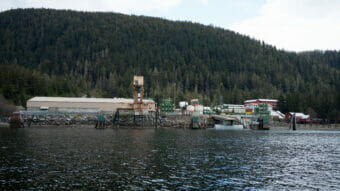
Greens Creek Mine facilities seen from Hawk Inlet on May 2, 2021. (Courtesy of Andrés Javier Camacho)

The Environmental Protection Agency has fined Hecla Mining Company $143,000 for improper disposal and management of hazardous waste at their mine on Admiralty Island.

The settlement agreement cited five violations in 2019 at Greens Creek Mine, a silver mine in the Tongass National Forest. Most were related to lead contamination.
“The company operates in a relatively remote and pristine area in Alaska, underscoring their obligation to prevent pollution from entering public lands surrounding the mine,” regional EPA Enforcement and Compliance Assurance Director Ed Kowalski said in a press release.

Inspectors discovered lead contamination around the perimeter of a storage building that was improperly sealed during a 2019 inspection. A gap between the building’s walls and its foundation allowed dust with lead in it to seep out into the soil.

That same inspection revealed improper disposal of other materials containing high levels of lead, including air filtration bags from the mine’s laboratory and tools used to process metal ore.

The mining tools, which are made of clay, were discarded inside the mine’s tailings storage, an outdoor area where leftover rock and other waste materials are stored. Greens Creek claimed that they processed the used tools to recover lead, but the EPA inspection still found hazardous levels of lead in the discarded materials.

The remaining violations were procedural — a week of missed inspections and a mislabeled oil container.

Hecla Mining’s Director of Government Affairs Mike Satre said the company has fixed the violations in the years since the 2019 inspection, and the contaminated soil around that storage building has been removed and shipped off to a hazardous waste facility.

“We’re just doing some ongoing sampling to make sure that we’ve collected all of it,” Satre said. “And we’ve redone the sheathing on the building. We’ve redone the insulation on the building, to ensure that it won’t leak through again.”

He added that Greens Creek has introduced new policies and training to improve the mine’s oversight and labeling of hazardous waste. And contaminated mining tools and air filter bags are now shipped off site to a dedicated hazardous waste dump.

The EPA settlement requires that the company continue cleanup and monitoring efforts under the supervision of the Alaska Department of Environmental Conservation.

A shortage of heat pump installers is slowing climate action in Southeast Alaska

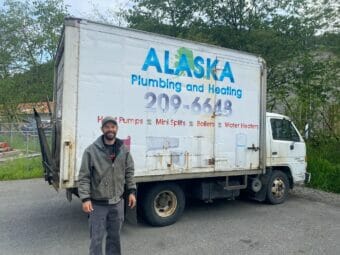
Sonny Ashby, owner of Alaska Plumbing and Heating, has been installing heat pumps in Juneau since 2012. He says demand for heat pumps has increased rapidly in recent years. (Photo by Anna Canny/KTOO)

Most people aren’t thinking about home heating in mid-June. But Andy Romanoff, executive director of Alaska Heat Smart, thinks more people should. 

“You don’t want to wait until it gets cold and you think, ‘Oh, it’s cold, I should get a heat pump,’” Romanoff said. “Then you end up getting one in the spring because you had to wait all winter to get through the line.”

Swapping out oil-based heating systems for heat pumps is one of the best ways for homeowners to shrink their carbon footprints. And climate experts say nationwide demand for electric heat pumps is higher than ever. But in communities like Juneau, Ketchikan and Sitka, heat pump installers are struggling to keep up. 
Homeowners swap fossil fuels for clean electricity 

Phil Joy’s new Daikin heat pump was installed on his home in Juneau after a wait time of nearly six months. (Photo by Anna Canny/KTOO)

New financing opportunities and a growing community buzz have led more homeowners across Southeast Alaska to consider heat pumps.

Phil Joy is one of them. He started thinking about it when he moved to Juneau from Fairbanks in 2021. Then, in 2022, the Biden Administration introduced major rebates and tax incentives for homeowners purchasing heat pumps. That gave Joy the push he needed. 

“When they passed the Inflation Reduction Act, I was like ‘Oh, maybe I can make this work financially,” Joy said. 

National climate policy favors heat pumps because they’re an efficient electric alternative to heating systems that rely on fossil fuels. The fact that they run on electricity means they can be hooked up to renewable energy — which means they cut greenhouse gas emissions in places that have cheap hydropower like Juneau, Ketchikan and Sitka. 

For Joy, ditching his oil furnace felt like a good way to take action. 

“You know, I’m concerned about climate change,” Joy said. “And this was a way (to take action), especially with our electricity being almost 100% renewable.” 

But it took Joy nearly six months to get a heat pump installed. And that wait time is typical. 

An unsustainable pace

Sonny Ashby, owner of Alaska Plumbing and Heating, says that even with those long wait times, many installers are working at an unsustainable pace.

“Because they’re still doing all their normal demands. And then you add a whole new industry,” he said. “And that’s essentially what the heat pumps are.”

Heat pump installers are rarely dedicated to heat pumps alone. Most are plumbers, sheet metal specialists or refrigeration technicians, too. Having well-rounded employees makes a lot of sense for shops in small communities. 

Gary Smith owns Schmolck Mechanical Contractors, with branches in Juneau, Sitka and Ketchikan. He said his employees have to juggle a wide variety of jobs from week to week.

“If the heat pump installation market is just trickling, you can’t justify having a guy doing nothing but that,” Smith said. 

But now the market has stopped trickling, and both Ashby and Smith said heat pumps are a much bigger share of their workloads. 

There’s a lot of people putting in a heat pump, replacing a perfectly good heating system, just because they want that energy savings,” Smith said. 

Nonprofits grow demand, installers wait for a tipping point

Ashby attributes much of that shift to promotion by nonprofits.

Nonprofits like Juneau-based Alaska Heat Smart and the Tlingit and Haida Regional Housing Authority have made a major push for heat pumps in Southeast Alaska, educating homeowners and helping them to secure funding. 

“They want to see a much faster growth than what’s already organically happening,” Ashby said.

In Juneau, about a quarter of all households are already heated by renewable electricity, according to the 2018 Juneau Renewable Energy Strategy. But some local climate activists say Southeast Alaska needs to work to cut greenhouse gas emissions even faster, which would mean picking up the pace for heat pump installation. 

Romanoff with Alaska Heat Smart has a list of close to 100 people hoping to get heat pumps. Getting through that list could take more than a year — and it’s just a fraction of the eligible households. 

“We’re just not sure how to speed things up,” he said.

The obvious solution might be hiring more installers, but both Ashby and Smith said they’ve had trouble finding people. A workforce shortage for people in the skilled trades is a nationwide problem.

Introducing more local education and training programs for heat pump installers could help. 

“But it’s a long-term solution to the problem, which is right here, right now,” Romanoff said.

Meanwhile, installers say they could pick up the pace by having one trained technician who is solely dedicated to heat pump installation. 

“Our kind of plan moving forward is we need to get maybe a person in each town that installs heat pumps,” Smith said. “Their van is set up with heat pumps and we have the heat pump stocked.” 

But before they make that transition, Smith and others say they’re waiting for a moment when demand for heat pumps reaches some sort of tipping point. 

In the meantime, Romanoff says all he can do is ask people to be patient. He says managing expectations about long waits has become a big part of his job.

A high-stakes egg drop onto the Juneau Icefield could lead to better monitoring of Antarctic ice

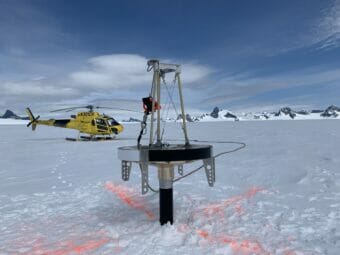
The “ice penetrator,” developed by researchers at MIT”s Haystack Observatory, was dropped from 5,000 feet above the Juneau Ice Field (Photo courtesy of Chester Ruszczyk, Jeff Hoffman, and Parker Steen of MIT)

Earlier this month, engineers from MIT teamed up with Coastal Helicopter and the Juneau Ice Research Program to pull off a high-stakes egg drop. It’s just like the ones you did in school, except the egg is a very fragile, very expensive seismometer. And the drop point is 5,000 feet above the Juneau Ice Field. 

The dropping device looks like a six-foot lawn dart, and it’s called the “ice penetrator.” Eventually, they’ll be used to place seismometers in the ice sheets of Antarctica to help scientists understand climate change. But before that, MIT’s team will have to figure out if their design can keep the metaphorical egg from breaking. 

Dr. Chester Ruszczyk leads the project, and he joined KTOO’s Anna Canny to talk about how it went.

Listen:

This interview has been edited for length and clarity.

Chet Rusczyk: It looks like a, basically, a six foot lawn dart with an antenna on top — a mast. The top part is much wider — it’s like a disc. It stays on the top because the mast has to be up above the ice and snow for communications. But the piece that holds the sensors and the batteries to provide power continues going into the ice shelf itself. 

Really, the main thing is, it has to have enough speed so the two pieces can separate. But it also has with it the electronic cables to provide connection between your antennas and the actual receivers that need to get data to and from it. 

Anna Canny: And the goal eventually will be to drop the ice penetrator from a helicopter to deposit seismometers in Antarctica to measure changing ice. Can you explain to me why that is such a difficult feat?

Chet Rusczyk: Because the seismometer is so sensitive. Usually they’re only meant to be dropped out of the back of a pickup truck. So when you tell them, yeah, we’re going to drop it from 5,000 feet above the ice shelf, they tend to freak out. So the goal of this was to get accelerometers inside the system, do a few drops. And then from the drops, we would be able to go to the seismometer people and say, this is what we expect that you have to survive. 


Anna Canny: And the reason for putting accelerometers in there is to measure force, basically? Like the amount of force that these seismometers will eventually have to endure?

Chet Rusczyk: Correct. 

Anna Canny: This prototype is sort of a dummy version. It doesn’t have those really fragile seismometers in it yet. But when it does, they’ll measure motion in the ice shelf in Antarctica. Why is that so important?

Dr. Chet Rusczyk retrieves the “ice penetrator” prototype after it’s inaugural drop (Photo courtesy of Chester Ruszczyk, Jeff Hoffman, and Parker Steen of MIT.)

Chet Rusczyk: Well, it’s climate change. Because if large chunks of the ice shelf break off, you get seawater rise, sea level rise. So part of this is really to look at, how do you predict this a little better? So think of the Ross Ice Shelf as suspended on a layer of water. So you’re gonna have impacts from the water underneath it, but you’re gonna have waves coming in at the front of it, and then you’re gonna have atmospheric conditions pushing down on it. So what the seismometer is really looking for is, how is the ice responding to all three of these different type of waves? 

Anna Canny: Are there any other factors you’re considering, in terms of successfully deploying the ice penetrator?

Chet Rusczyk:  So it really wants to go straight in. Because what happens is, with the seismometer, there’s a gyroscope that can only straighten it out if the tilt is so many degrees. So, um, there was a whole slew of things that could have gone wrong, but it actually worked out okay. 

Anna Canny: And why is remote deployment so important? Why is the ability to be able to drop the sensors from a helicopter like this useful? 

Chet Rusczyk: So one of the things is, a few of my colleagues have worked with people in the Arctic and Antarctica, and people’s lives — scientists’ lives — have been lost there. So this kind of mitigates that problem by removing that from the equation and making it a little bit simple. And they do have sensors out there that were manually placed. But it’s not enough. So being able to just throw a bunch out of the back of a helicopter or the back of a plane is a lot easier.

Anna Canny: Well, thanks for joining me, and it’s pretty exciting that Juneau got to play a little role in this really cool science.

Chet Rusczyk: Juneau was very important to us having success in Antarctica. So that was good.

Site notifications
Update notification options
Subscribe to notifications