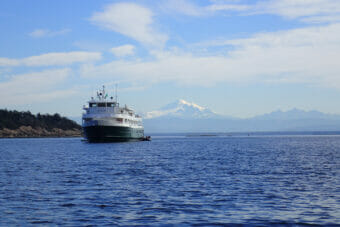
A lifeboat from the Sapphire Princess alongside the Wilderness Discoverer on June 5, 2023 in Glacier Bay. (Courtesy of Chandra Murphy)
Nearly 70 passengers and crew were evacuated from a small cruise ship on Monday morning after an engine room fire disabled UnCruise’s Wilderness Discoverer in Glacier Bay.
The fire was reported to the U.S. Coast Guard around 7:30 a.m.
“By the time we got there, they had put the fire out,” Coast Guard Petty Officer Ian Gray said. “All of the passengers were taken off and were in good health.”
The Sapphire Princess, a larger Princess Cruises ship that was sailing nearby, responded to radio calls from the Wilderness Discoverer and used one of its lifeboats to bring over the 51 passengers and 16 crew members. A handful of crew members stayed behind on the ship, which is being towed to a shipyard in Ketchikan.
Local and federal authorities will examine the damage in the coming days.
“Once it’s moored up at the pier, we’ll start the investigation process,” Gray said. “We’ll get Coast Guard personnel aboard and probably more than likely the Alaska State Troopers.”
A different UnCruise ship picked up the Wilderness Discoverer’s passengers and brought them back to the company’s headquarters in Juneau on Monday afternoon. UnCruise representatives said all of the passengers would get full refunds.
Correction: 51 passengers and 16 crew members were taken off the Wilderness Discoverer.
This is a developing story. Check back for updates.
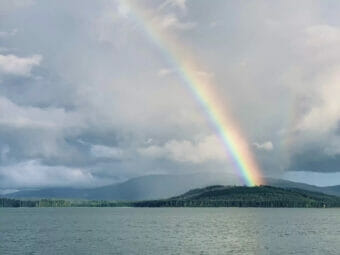
Rainbow near the Wrangell Narrows. (Photo by Angela Denning/CoastAlaska)
Imagine the sound of wind chimes. It’s pretty — but it’s more than that.
“The wind chime is a really interesting translation, and musicification or a sonification of an unseen environmental phenomenon,” said Oregon State University researcher Chet Udell. “It’s giving me information that could be useful if I’m curious about how windy it is outside. And it also is aesthetically pleasing.”
Udell’s lab unites engineers and environmental researchers to design environmental sensors. Wind chimes were the inspiration for one of the newest instruments, called WeatherChimes, which collects weather data and turns it into music. Now the technology will get used for projects across Southeast Alaska, starting in Sitka and Hoonah.
Scientists often express changes in the environment with things like graphs and charts — but what does that mean to a non-scientist?
“They show you the data and wiggles on a graph, but they don’t usually go too deep into having the person, like, translate that into meaning,” Udell said. “How do you get those people to empathize with environmental data?”
The WeatherChimes sensor collects real-time environmental data and transmits it via Wi-Fi. That data can then be used to compose music (Photo courtesy of the OPEnS Lab at University of Oregon).
Udell and his team tried to build an environmental sensor that would be intuitive, emotional and creative. Like wind chimes, the WeatherChimes hardware is installed outside. It gathers data on things like light, temperature, humidity and soil moisture. Then it uses Wi-Fi to send that data into a program where it can be set to different keys, scales and instruments.
Humidity, for instance, could be a marimba playing a C major scale. By listening to those musical translations, you can hear weather patterns. Around sunrise and sunset, there’s a symphony of the world warming up and drying out. And throughout the day, there are melodies and countermelodies.
“There’s this thing in composition — Beethoven uses a lot, Bach uses a lot — called contrary motion,” Udell said. “Like, when one voice goes in one direction and another voice goes in a different direction.”
The WeatherChimes show the same thing happening in nature. Temperature and humidity, for instance, have an inverse relationship.
“And there’s a certain satisfaction in putting those kinds of natural things together, and seeing how patterns that exist naturally are the same ones that make this music fun,” Udell said.
Fun is one of the major goals. But as an educational tool, WeatherChimes could also help students think more deeply and personally about weather.
When there’s a particularly rainy period, is that good news or bad news? Udell hopes students can ponder questions like that through music.
“Should I make a happy melody or a sad melody? Should I make something that goes fast or slow?” he said. “Like, what does this mean to me?”
Educators at the Sitka Sound Science Center and Sitka High School’s Traditional Ecological Knowledge program will use WeatherChimes in classrooms and educational workshops over the coming year.
And Udell and his lab will work with the Sitka Sound Science Center, the Hoonah Indian Association and Alaska Youth Stewards to install more WeatherChimes for community-designed projects, including yellow cedar monitoring in Sitka and salmon stream monitoring in Hoonah.
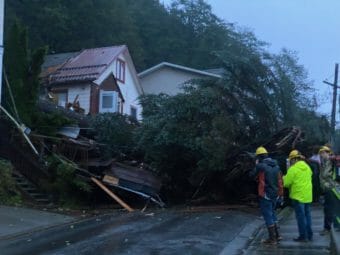
A landslide on Gastineau Avenue in Juneau, Alaska on Sept. 26, 2022. (Photo by Claire Stremple/KTOO)
Juneau’s planning commission has recommended that the Assembly nix a proposed ordinance to regulate property development in areas of downtown Juneau that are prone to avalanches or landslides.
Residents who testified at Tuesday night’s meeting overwhelmingly opposed the policy, saying it could create new financial burdens for homeowners.
“Does it make me a little sleepless at night that there’s a possibility that there could be an avalanche or landslide? Of course,” said Deputy Planning Chair Mandy Cole. “But I don’t know that I have enough to outweigh all of those concerns on the other side.”
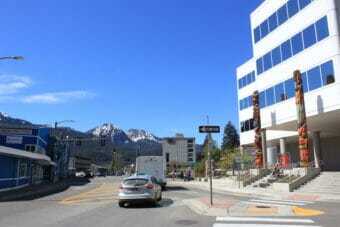
Nearly half the properties in downtown Juneau are vulnerable to avalanche or landslide disasters. Policymakers have wrestled with the problem for decades, but the city hasn’t updated land use code for those hazard zones since the 1980s.
The proposed ordinance was written to update the code using hazard maps from 2021, which were made with more advanced technology.
The ordinance doesn’t prohibit new property development, but it does make it harder. Property owners in moderate or severe avalanche zones could build new single family homes. But additions, like an in-law apartment, or bigger buildings, like an apartment building, would not be allowed.
In severe landslide zones, all new development, including single family homes, would be prohibited. That distinction was made because avalanches are generally considered more predictable.
But the ordinance has ways to get around those prohibitions. Property owners could appeal to the city to alter the map’s boundaries or get a special permit.
Those channels were designed to create some middle ground between all-out prohibition and a complete lack of regulation. But residents like Mary Alice McKeen questioned whether they would be realistic. Appeals would require outside consultation with a civil engineer, which can be costly.
“The city is taking the burden, the financial burden, of providing site-specific analysis and putting it on the property owner,” she said.
Other commenters were afraid that adoption of the new ordinance could make lending institutions more hesitant to refinance or dole out loans.
“My Westridge condo is my home, my retirement and my life investment. Adopting the map will price me out of my home, and possibly Juneau,” said Mary Ellen Duffy.
Much of the discussion centered around what commenters perceived as the map’s limitations. They lay out hazards by neighborhood rather than individual property. Many felt that the risk to their own homes did not match what the maps showed for their neighborhoods.
Only one resident showed up to support the ordinance and the maps. Albert Shaw made loss of life his central argument. He recalled the 1936 mudslide that killed 15 people on South Franklin Street.
“I’m one of the last people standing who saw the mud against the cold storage in 1936,” Shaw said. “It killed people.”
Shaw said he made his own failed attempt at policymaking as a member of the city council after the 1962 avalanche in the Behrends neighborhood. He urged the commission to take the hazard more seriously.
“Just because nothing’s happened in 60 years doesn’t mean something won’t happen soon,” he said.
Ultimately, the commission felt that concerns from the ordinance’s opponents outweighed its potential benefit for public safety.
“We have talked about safety, risk, hazard housing, crisis, individual hardship, mitigation strategies. What’s available? What’s affordable?” Cole said. “There’s no map that adequately answers the safety question for me at the expense of all of those other concerns.”
The discussion largely bypassed new language in the ordinance that would require a written disclosure of hazard for would-be buyers or renters. The commission may recommend hazard disclosure to the Assembly as a separate consideration.
The Assembly will have the final say on the proposed policy. They will consider the planning commission’s recommendation at a future meeting.
Correction: A previous version of this story did not specify that the proposed ordinance would not apply to all hazard zones. It targets moderate and severe avalanche zones and severe landslide zones.
An unusually warm day in Juneau on May 16, 2023. (Katie Anastas/KTOO)
Juneau’s greenhouse gas emissions have dropped by nearly 30% in the last decade, according to a new report. That meets a goal set in 2011 to cut local carbon emissions — but a lot has changed since then.
Denise Koch, the city’s deputy director of public works, said the report — which analyzes Juneau’s greenhouse gas emissions from 2021 — is essential for planning local climate action.
“I see it as a foundational document,” Koch said. “Once you know where your emissions are coming from, then you can make decisions.”
It’s nearly impossible to track progress toward climate goals without data. And Juneau’s data is sparse — the new report is the first time the city has taken stock of energy use and emissions in more than a decade. It shows that the community is using more renewable energy and emitting less greenhouse gas, but it can’t show where those improvements came from.
Steve Behnke, energy chair for the Juneau Commission on Sustainability, says there is no single action that would cut emissions enough.
“There really just aren’t any silver bullets,” Behnke said. “You really have to make incremental gains on a whole bunch of different fronts.”
What the report does offer is a better understanding of where those fronts stand now. Juneau’s most emissions-intensive sectors are transportation and buildings, which emit 47% and 25% of local greenhouse gasses respectively. Most of that comes from the use of diesel or heating fuels.
In Juneau, the availability of cheap, renewable hydropower is a readily available, carbon-cutting alternative.
“That’s a real asset for the community,” Koch said. “So as we move and continue to electrify transportation and buildings, that’s really going to move us towards that net zero future.”
Many major city and community-led climate actions are focused on switching over to renewable energy.
Capital Transit, for instance, has ordered seven new electric buses, which will join the city fleet next summer. That could replace thousands of gallons of diesel fuel with clean electricity. And local non-profits like Alaska Heat Smart and Tlingit and Haida Regional Housing Authority have improved energy efficiency and installed electric heat pumps in thousands of local homes, reducing or eliminating the need for heating oil.
Those actions seem to have moved the needle, but a lot of the decisions about future actions will come down to the Assembly.
“Our idea is to give them, you know, the big picture of what is going on in the community, what’s been successful, and what the upcoming opportunities are,” Behnke said. “And also to raise this question about the goals.”
In other words, the report could start a conversation about introducing more ambitious local emissions reductions targets, to keep pace with national and international goals. Based on the report, Benke said the Juneau Commission on Sustainability will submit new climate policy recommendations to the Juneau Assembly this summer.
The report could also inform priorities when it comes to federal funding. The Bipartisan Infrastructure Law and the Inflation Reduction Act promise money for a wide variety of climate projects, and understanding where local emissions come from could help to narrow in on what would do the most good.
“I think that we will make a lot of progress in five years as we aggressively apply for grants,” Koch said. “Hopefully some of that major federal funding will move us towards a lower carbon future.”
The city is already pursuing federal funding to establish a municipal compost facility and to expand electric vehicle charging and fueling infrastructure.
In the short-term, the inventory establishes a baseline of local climate data, with significant caveats. The COVID-19 pandemic likely affected how much energy Juneau used and where — emissions in schools and other buildings likely went up due to new ventilation demands, and transportation emissions may have been lower as tourists and many workers stayed home.
New, annual reports should give a clearer picture in the coming years, but for now, Koch is cautiously optimistic.
“It’s good news, Juneau is doing well,” she said. “Reducing emissions is something that is a community value. And we’re moving in the right direction.”
An unusually warm day in Juneau on May 16, 2023. (Katie Anastas/KTOO)
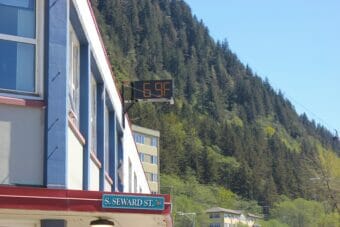
With the sun shining bright in Juneau this week, the conditions are right for the first 70 degree day of the year.
Meteorologist Edward Liske with the National Weather Service says the weather is expected to remain warm and sunny until Friday. The summery weather is a brief respite before rain returns heading into the weekend.
“Enjoy it while you can,” Liske said. “You got three days of this.”
Temperatures have been rising across the panhandle this week because of the combination of a high pressure system to the south and a flow of dry, warm air coming from the Interior.
“That actually allows our skies to clear out and gives us the sunny days that we have,” Liske said. “And the sun is so high in the sky and it’s out for so long that we can warm up really quickly now.”
The rapid warm-up comes after an especially cold spring. Temperatures for both March and April were below average for much of the panhandle.
The recorded temperature at the Juneau airport has hovered just below 70 degrees all week, but other communities nearby have already hit the balmy threshold.
Klawock led the way with the first recorded 70 degree day of the season on Sunday. Temperatures in Haines climbed into the mid-70s on Tuesday. And Tuesday high in Sitka, though more mild at 63 degrees, tied a daily temperature record set back in 1969.
According to NWS, the temperature not only made it above 70 degrees at the airport on Wednesday, it also broke the daily record high at 73 degrees. The same thing happened at several other locations.
Several new daily high temps were set yesterday! Using active stations that have at least 30 years of data, 5 stations broke records and 3 stations tied their records: (These numbers are as of 8AM Thursday, May 18.) pic.twitter.com/slL5HWGYF6
Meteorologist Peter Chan during a broadcast of Alaska Weather TV from May 13, 2023. (Screenshot from Alaska Weather TV)
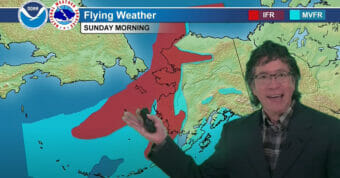
The public television program Alaska Weather will end this summer after 47 years on the air.
The 30-minute daily broadcast, which is produced by Alaska Public Media and the National Weather Service, covers things like incoming storms, sea ice and big picture climate trends like glacial retreat. It reaches some of the most remote places in Alaska.
But Alaska Public Media has decided to end production, citing financial constraints. As a result, meteorologists and emergency managers fear they’re losing a vital way of reaching people.
“That TV option exists in way more places than any other single form of media,” said Carrie Haisley, chief of emergency services for the National Weather Service in Anchorage.
“A business decision”
For Alaska Public Media, the decision came down to cost.
“It’s been on the air for decades. We didn’t want to end that legacy,” said Linda Wei, the chief content officer for Alaska Public Media. “Ultimately, it was a business decision.”
She said assembling the show required significant time and funding. In an emailed statement, President and CEO of Alaska Public Media Ed Ulman said production of Alaska Weather requires two to three hours of editing time each day, with a cost of around $200,000 annually.
And Alaska Public Media received no outside funding to produce the program.
“We have been assembling and distributing the show unsupported for at least the last six years,” Wei said. “It just wasn’t sustainable anymore.”
“Notable large gaps”
After a finalbroadcast on June 30, the show will transition to a YouTube-only format. But that change may not work for everyone who relies on the program. Many in Alaska still don’t have access to reliable, high speed internet.
Through the Alaska Public Media partnership, the weather service was able to tap into a wide broadcast network via public TV channels like KTOO 360TV in Juneau and KUAC TV in Fairbanks and through the Alaska Rural Communications System, a free state-owned satellite system that broadcasts to more than 200 rural and tribal communities.
There are other ways the weather service reaches people, but they all have serious limitations. There’s a 24-hour phone line that people can call for weather information, but that option doesn’t reach people in emergency situations.
When there is an emergency event like a major storm warning, NOAA Radio is an option. It’s a transmission of weather updates that comes from National Weather Service offices. Radio stations automatically tap into it to broadcast emergency messages.
“But it doesn’t cover the whole state,” Haisley said. “In fact, there are notable large gaps.”
And though broadband internet and cell service have spread rapidly since Alaska Weather TV started in 1976, Don Moore, the director of the Alaska Environmental Science and Service Integration Center, said the internet is not yet a replacement for television.
“We have to consider the costs of data. You know, the internet does not come free,” Moore said. “When there’s a TV show that they can watch, they’re not having to use their internet to do that.”
“Opportunity in chaos”
Without the TV show, the weather service is left to take stock.
“We are disappointed, but there’s opportunity in chaos,” Haisley said. “Hopefully, we are able to take this and modify what we do in a way that helps people.”
It’s not clear exactly how many Alaskans rely on television to get their weather. None of the stations that broadcast the program track ratings, so no one really knows how many people are tuning in each day.
But Haisley believes the loss of TV will be a chance to better understand the ever-evolving options for public communication.
“We do recognize that as people change the way they consume media, that we need to change the way we deliver information,” she said. “We want to try to reach more people through new ways that people are gravitating towards with the changes in technology.”
One of the most recent developments is the growing importance of social media. During Typhoon Merbok, for instance, communities used sites like Twitter and Facebook to share critical weather updates.
The weather service hopes to better tap into those networks by introducing more graphics and short-form content.
“More bite-sized, elevator-speech kind of updates on what the weather’s doing,” Moore said.
When Alaska weather moves to YouTube, the 30-minute program will likely be broken down into three separate segments including a public forecast, an aviation forecast and a marine forecast.
Those short videos will demand less time and money as the weather service moves to produce Alaska Weather on their own. But they’re also better suited for social media, and they may be more convenient for TV stations that can broadcast quick updates between other programs.
For the weather service, the end of Alaska Weather highlights an urgent need for more information about how people get their weather. To start, they’ve launched an outreach campaign to gather comments on how people across the state access their weather.