Anna Canny

Local News Reporter

A flood warning is in effect for Mendenhall Lake and River as Juneau’s annual jökulhlaup begins

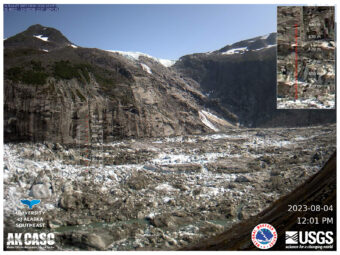
An image from the camera at Suicide Basin taken on Aug. 4, 2023. The camera is placed at the basin entrance and faces northeast, into the basin. (Image courtesy of the National Weather Service)

Editor’s note: The glacial outburst flood that began on Aug. 4 rapidly intensified in the afternoon and evening of Aug. 5, leading to record flooding along the Mendenhall River.

The National Weather Service has issued a flood warning through Sunday morning for Mendenhall Lake and Mendenhall River after Suicide Basin began draining earlier this week. 

Flood waters are expected to crest sometime on Saturday evening, with a four-to-six foot increase for Mendenhall Lake. That could cause flooding for Mendenhall Lake campground and Skater’s Cabin Road, along with some potential for erosion and tree falls along the Mendenhall River.

National Weather Service hydrologist Aaron Jacobs said glacial outburst flooding happens gradually.

“It’s not like a flash flood event, or like a wall of water,” Jacobs said. “Usually it will take about two days, give or take.”

A webcam above the basin recorded a significant drop in water levels on Friday morning. Gauges in Mendenhall Lake confirmed that water levels are rising downstream.

Glacial outburst flooding — also known as jökulhlaups — have been an annual summer phenomenon since 2011. Thinning ice in the mountains above the terminus of Mendenhall Glacier created an ice dam, which traps water in an area known as Suicide Basin.

The dam traps rain and meltwater in the basin, which fills up throughout the spring and summer. This year, it filled all the way up, surpassing levels recorded in 2021 and 2022. 

But Jacobs says that higher water levels in the basin do not always mean there will be high flood waters downstream. Water from the basin travels under Mendenhall Glacier through cracks in the ice, which can grow in unpredictable ways that affect how fast the basin drains.

“So, the more efficiently that water can get from the Basin to the face of Mendenhall Glacier and into the lake, the higher the peak [flooding] can be,” Jacobs said.

Jacobs said that meteorologists will keep monitoring downstream water gauges and updating the flood information throughout the weekend. 

On its last day in business, Juneau staple J&J Deli draws a nostalgic lunch rush

Alma Doogan served up her final sandwich orders on Monday, July 31, after 13 years behind the deli counter (Photo by Andrés Javier Camacho/KTOO)

For George Montero Jr., Monday’s lunch break at Juneau’s J&J Deli marked the end of an era.

“Forty-three years of being a customer,” he said. “I knew this day was coming, so I’m here.” 

The deli, a Juneau staple, closed for good on Monday. Montero said the place has remained much the same since his time as a high school student at Juneau-Douglas High School: Yadaa.at Kalé down the road. 

“I’d grab my Bubblicious bubble gum from right over here. Walk around, grab my Coca Cola, grab my corn chips, order my sandwich,” Montero said. “And then I’d head out the door with the rest of the teenagers.” 

During Monday’s nostalgia-fueled lunch rush, the shelves were picked over. There was no Bubbalicious or Coca Cola left, but owners Neil and Alma Doogan served up sandwiches all day long.

Dozens of customers lined up to order their favorite sandwiches on J&J Deli and Asian Mart’s final day (Photo by Andrés Javier Camacho/KTOO)

“We went up until we started running out of food,” Neil Doogan said. “We ran out of lettuce, tomatoes and bread.”

The Doogans ran the store for 13 years, with Alma Doogan manning the counter solo on most days. They decided to shut down so they could focus on Alma’s health.

“But it’s not a relief,” she said. “For me, it’s a sad and a happy thing.”

The Doogans started looking for a new owner back in 2019, but the pandemic deterred potential buyers. Up until last year, they were committed to finding someone who would maintain the deli counter. 

It’s not clear yet what the new owners — who will take over in September — have planned for the place. But they will put an end to the classic sandwiches. That will be the first significant menu change since the shop’s original owners, Susan and Jack Woods, introduced their line up of sandwiches back in 1978. 

The Woods sold the shop to the Doogans about 13 years ago. 

“Susan wouldn’t just sell to anybody. You had to come in and work with her,” Neil said. “But her and Alma hit it off pretty good. And you know, we ended up with the store.”

Shortly after, they started stocking Asian groceries too. 

For Alma, Monday was a reminder of her longstanding commitment to the community. 

“I’m so thankful,” she said. “Some of the old folks here, too, they stopped by to give me some cards and flowers.” 

But Neil thinks the high school kids that visited each day are perhaps the biggest loss for Alma. He said her relationships with those students kept her going, despite her health challenges. 

“She becomes like their mother at times. So she has a real attachment to the kids,” he said. “Alma recognizes them even when they’re out of high school, when they come back from college.”

She tends to remember their sandwich orders too.

Travis See waited more than 40 minutes to get a turkey sandwich on Monday (Photo by Andrés Javier Camacho/KTOO)

For Montero, it was the number 8 — roast beef with the works. He says he’ll find a new place for lunch, but it won’t be the same.   

“There’s nothing like that sandwich,” he said. 

Alma’s favorite — a turkey sandwich — is the most popular order. It’s so good that construction worker Travis See waited more than 40 minutes to get his last one. 

“It’s going to be sad,” he said. “I’ll just try not to eat it too fast, and I’ll savor every bite.”

After Monday’s closure, Alma said she plans to sell the remaining grocery stock to her regular customers on a case-by-case basis. 

Two humpback whales freed after entanglements near Juneau

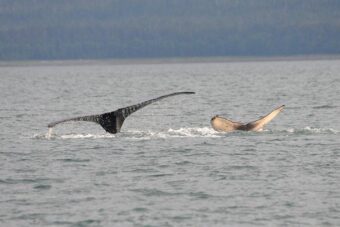
Humpback whales Juneauite on the left and Herbert, the entangled calf, on the right (Photo courtesy of NOAA Fisheries/Suzie Teerlink, NMFS Permit #24359)

Whale experts with NOAA Fisheries have successfully freed two humpback whales, including a well-known calf called “Herbert” that became entangled in fishing gear near Juneau last week.

Herbert’s was the third reported humpback whale entanglement in the area this month. 

Sadie Wright is the coordinator for NOAA’s large whale entanglement response program. She said her team had fielded more entanglement reports than usual for July.

“We’re definitely above average this year for large whale entanglements in Alaska, and in the Southeast,” she said.

Herbert’s entanglement in a recreational crab pot line was reported by a researcher at Auke Bay Laboratories early last week. 

A NOAA team member makes cuts to the fishing line to free Herbert, a humpback calf. (Photo courtesy of NOAA Fisheries/David Gann, NMFS Permit # 24359)

A local whale watching company shuttled NOAA biologists out to Herbert and his mother, Juneauite, while the whales fed near Favorite Reef. The biologists were able to cut loose most of the fishing gear from their boat. Drone footage later confirmed that the calf shook off what was left.

Juneauite is often seen outside of Juneau. This was the second entanglement for one of her calves, following a similar incident in 2016.

Wright also confirmed that another resident humpback whale, nicknamed Manu, was able to free himself after an entanglement in crab pot gear around Fritz Cove earlier this month. The response team tracked the gear using a satellite tag.

“All of the gear that he was entangled in is accounted for,” Wright said. “But we’re interested to see if he has injuries or if he is able to forage properly.” 

The team is asking for recreational boaters, whale watch tour managers and researchers to keep an eye out for Manu around Frederick Sound.

A third, unidentified whale that was entangled in a gill net earlier this month has not been spotted since.

Entanglement in fishing gear can be life-threatening for whales. Heavy, floating gear can cause exhaustion and limit feeding. The risk of entanglement is higher for free floating lines. 

Wright said fishermen can reduce the risk of entanglement by using weighted lines and removing fishing gear when it’s not in use.

Aparna Palmer begins her tenure as UAS chancellor: ‘We don’t want to be a hidden gem’

Aparna Palmer has been named chancellor of the University of Alaska Southeast. (Photo courtesy of Aparna Palmer)

Dr. Aparna Palmer took over as chancellor for the University of Alaska Southeast earlier this month. Palmer will manage Southeast campuses in Juneau, Sitka and Ketchikan.

Palmer outlined her goals during an appearance on Juneau afternoon. She said she hopes to increase the visibility of UAS after the pandemic, with a focus on student recruitment. 
“We don’t want to be a hidden gem,” she said. “We want to be that visible, shining gem that is present in the minds’ of all Alaskans, and also has a presence in the Lower 48.” 

Palmer pointed to world-class faculty and small class sizes as draws for recruiting new students.

Palmer also said she hopes to promote student retention across the spectrum of university programing, from training and certifications in the skilled trades to bachelor’s and master’s programs. 

“When they’re here at UAS, I want to make sure that they feel like the barriers to completion are lower,” she said. “No matter who you are, I want to be that institution that helps people to overcome those barriers.” 

University of Alaska President Pat Pitney appointed Palmer earlier this year to take over after the retirement of former Chancellor Karen Carey. 

Palmer was previously the vice president of Front Range Community College in Colorado. Before that, she was the assistant vice president for academic affairs at Colorado Mesa University, where she taught biology.

Allen Marine Tours asks visitors to consider the cost of their emissions

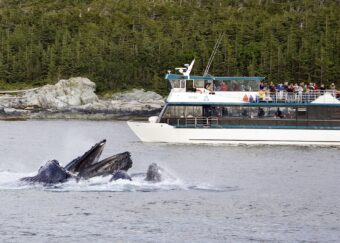
An Allen Marine Tours whale watching boat witnesses humpback whales bubble net feeding. The tour company will collect carbon offset donations on their boat tours throughout Southeast Alaska. (Photo courtesy of Allen Marine Tours)

From shuttle buses to whale watching catamarans, tourism in Southeast Alaska largely runs on diesel. That means each tour releases greenhouse gas emissions that contribute to climate change. 

To counteract that, Sitka-based Allen Marine Tours launched a new partnership with Renewable Juneau’s Carbon Offset Fund last month. The goal is to pay for heat pumps in the communities where Allen Marine operates.

Electric heat pumps help homeowners swap fossil fuel for renewable energy. To spread heat pumps across the region, Allen Marine is collecting small donations from thousands of visitors that pass through Juneau, Sitka and Ketchikan on their whale watching and glacier tours each year.

Allen Marine’s Director of Guest Experience Caitlyn Ellis says they hope the program will eventually generate thousands of dollars in donations. 

“That’s a lot of heat pumps. That is a big chunk of our community that could reassess how our buildings are heated in a sustainable and renewable way,” Ellis said. 

Allen Marine is one of the region’s largest tour companies, with hundreds of boat tours throughout Southeast Alaska each season. And they’re one of the largest tour companies in the region to adopt a carbon offset program. 
Carbon offset is the idea that a person or company can make up for their CO2 emissions in one area by paying to reduce emissions elsewhere. In this case, heat pumps run on renewable hydroelectricity instead of heating oil. So installing them cuts down on the use of fossil fuel in local homes to make up for the fossil fuel burned by Allen Marine tours. 

Carbon offset programs like the one at Juneau Carbon Offset put a price on carbon emissions. Though it isn’t an exact science, the goal is to figure out how much money is needed to eliminate a unit of CO2 from the atmosphere. For Allen Marine, that’s about $2 per visitor. 

“So, if every person donated $2, it would make up for the carbon footprint on board,” Ellis said. 

All visitor donations up to $25,000 will then be matched by Allen Marine. But despite the program’s lofty goals, it’s only raised about $3,000 since it launched last month. That’s because not every visitor makes a donation. 

The money is collected two ways. The first is an “opt-out” program. For independent travelers who book online, the donation is the default option at check-out. 

The second option happens on board. On every Allen Marine boat, there’s a kiosk with a local snack selection and complimentary coffee. There’s a small poster there that reads “Ready to reduce your carbon impact?”

“It’s kind of similar to a grocery store round up,” Ellis said. 

But instead of donating to a food pantry or an animal shelter, visitors donate to Juneau Carbon Offset, a program of Renewable Juneau that focuses on funding heat pumps for low income families. 

In the short time that the program has been up and running, the opt-out approach is bringing in more money. But the vast majority of tourists don’t book independently. Instead, they book through cruise lines. That means much of the program’s success will rely on their on board advertising. 

And for Allen Marine, the new challenge is bringing up climate change and greenhouse emissions without negatively impacting guest experiences.

“We don’t want to overwhelm them with information while they’re having a great time,” Ellis said. 

For some tour guides, talking to guests about the price of fuel, rather than emissions, feels more effective.  

“We’re in communities where all of our fuel gets shipped in,” Ellis said. “And that is something that a guest can understand.”

Ellis said marketing for the program will be refined during recruitment and training for tour guides in future years. And Allen Marine hopes to pursue negotiations with cruise lines to expand their opt-out donation approach.

Though money is trickling in so far, Ellis said the company is confident that they’ll be able to front the cost of at least one heat pump – about $7,000 — this year.

Temperatures could approach 80 in Juneau this weekend

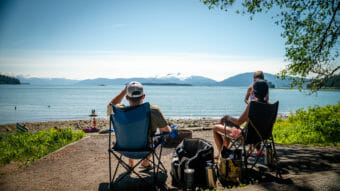
A couple, seen from behind, sitting on lawn chairs at the beach on a sunny day
Families hanging out in the sunshine at Auke Rec, June 1, 2022 in Juneau, AK. (Photo by Paige Sparks/KTOO)

Temperatures in Juneau could climb to highs near 80 degrees on Friday, as a weekend heat wave brings clear skies and intense sun to Southeast Alaska. 

National Weather Service meteorologist Kimberly Vaughn said a ridge of high pressure is bringing the heat by getting rid of Southeast’s typical cloud cover. 

“The high pressure is pushing things down and away,” she said. “That’s why a lot of times, you’ll see the clear skies.” 

Normal temperatures for the first week of July have generally hovered in the low 60s. Of course, there are always exceptions. The heat wave is forecast for the anniversary of Juneau’s hottest recorded day, when thermometers hit 90 degrees on July 7, 1975. 

Despite a week of record-breaking heat across the nation and the globe, local meteorologists don’t expect any records in Southeast. 

But the term heat wave is relative. 

“Our heat wave is in the 80s,” Vaughn said. “You know, places like Texas, that’s not going to be as exciting for them.”

Meteorologists will keep an eye on the marine layer, which could bring in cloud cover and sea breezes to keep extreme temperatures at bay, especially for the outer coast.

Last month, the National Oceanic and Atmospheric Administration declared the arrival of El Niño, a period of warmer-than-average ocean temperatures in the Pacific, which happens naturally every 2 to 7 years. 

El Niño sets the stage for higher-than-average temperatures, but it is just one of the many factors that forecasters consider. And El Niños reach their full strength in the winter, which means that warmer weather is more likely to come next summer. 

This weekend, the high temperatures and dry conditions will increase the risk of fire. 

And heat-related injuries are possible, especially for pets, children and older adults. People should be sure to drink plenty of water and take breaks after long periods outdoors. 

Site notifications
Update notification options
Subscribe to notifications