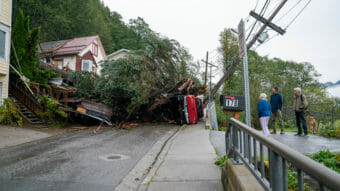
Residents examine the aftermath of a landslide on Gastineau Avenue in Juneau on Sept. 27, 2022. (Photo by Paige Sparks/KTOO)
The Juneau Assembly may repeal existing hazard maps and development restrictions that have been in place since the 1980s as the debate about how the city should address landslide and avalanche dangers in downtown Juneau continues.
“Everybody seems to agree that those current maps are not as good as they should be,” said Deputy Mayor Maria Gladziszewski. “The question is — what responsibility does CBJ have to regulate development in those places that are hazards?”
The new proposal is a departure from previous attempts to adopt new, more precise hazard maps that would expand land use restrictions to more downtown homes. Instead, the proposal presented in Monday night’s committee of the whole meeting would abandon existing land use restrictions for hazard zones altogether.
The committee will continue the discussion in their next meeting. But some members of the Assembly, including Michelle Hale, objected to the proposal, citing the need for more expert testimony to understand the complexity of avalanche and landslide zones.
“It feels like we’re flailing around, trying to do something,” Hale said. “But we don’t understand this very well.”
Efforts to update hazard zones in downtown Juneau have stalled since the city commissioned new hazard maps — made with more advanced science — more than two years ago. The new maps, which designate more than twice as many properties in severe hazard zones than the existing maps, have caused widespread concern from both policymakers and homeowners.
The new maps are different because they treat landslide and avalanche zones separately. The old maps lump them together, even though they’re distinct hazards with different risk factors.
The severe avalanche areas are quite similar between the maps, and the committee’s proposal does leave room for reintroducing development restrictions on avalanche zones.
The bigger challenge is figuring out what to do about landslides. The new maps added or upgraded some neighborhoods to a severe hazard designation because of their landslide potential. That’s led many homeowners to oppose the adoption of the new maps and the accompanying ordinance, believing it might restrict their ability to get loans or insurance on their property in the future.
Gladziszewski, who authored the new proposal, said she has not formally consulted with lending agencies or insurance agents to corroborate those concerns.
Member Wade Bryson expressed his support for repealing existing development restrictions, saying that the city should leave it up to developers and property owners to avoid hazard zones.
“The concern that we’ll have a whole bunch of people building in hazard zones because we don’t have a hazard or an avalanche zone labeled, I think that would be mistaken thinking,” Bryson said.
The proposal attempts to respond to public testimony by not adopting new landslide maps.
But it would adopt the new avalanche maps — which are similar to the old ones — and enact an updated land use code for avalanche zones only. The details of that updated code have not yet been outlined.
Some members of the committee expressed hesitation about ignoring landslide hazards.
“The public does not yet know how serious the risk of landslides are in Juneau,” said member Christine Woll. “And that they’re getting worse with climate change.”
According to the Juneau Climate Change Report, landslides are expected to increase as climate change brings more extreme rainstorms to Southeast Alaska.
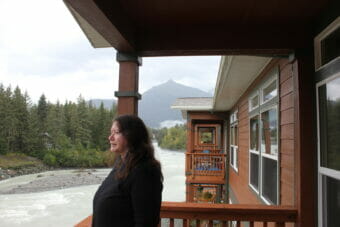
Amy Ballard stands on the balcony of her condo, overlooking Mendenhall River. Ballard hasn’t felt safe in her unit since the glacial outburst flood on August 5, 2023 forced her to evacuate. (Photo by Anna Canny/KTOO)
The sound of the nearby Mendenhall River filled the room as Amy Ballard sat down in her condo for the first time since evacuating last month.
Six weeks ago, Juneau’s record breaking glacial outburst flood threatened to send her home into the river, along with the rest of her condo building on Riverside Drive. But on the inside, Ballard’s unit still looked untouched and cozy.
Amy Ballard’s twins on the day of the glacial outburst flood. (Photo courtesy of Amy Ballard)
There was a clutter of high chairs, baby books and a small pile of unfolded onesies in an armchair by the front hall. The wall was decorated with photos from her trips to Jamaica, Monaco and France over the years. But this condo had always been her home base.
“I’ve loved this place,” Ballard said. “And I’m saying this in past tense. Because it feels weird now.”
Ballard can’t bring herself to sleep here. For her, and many who were affected by the flood, the fear feels fresh.
And six weeks out, recovery is just beginning. Some homeowners are figuring out how to rebuild. Others, who don’t have a home to return to, are reassessing completely.
Ballard moved into her unit five years ago as a first-time homeowner.
“It was a big, big deal for me to own my own place,” Ballard said.
She had hoped the place would be home to her growing family. On the day of the flood, she celebrated her twins turning seven months old.
But later that night, she had just 15 minutes to grab the twins and some essentials as the enormous force of the water rapidly eroded the riverbank beneath part of her building.
The building is still standing, but what used to be a huge backyard is now just a strip of grass — about five feet wide — with yellow caution tape propped up along the edge.
The day after the flood, Ballard’s building and the neighboring building were condemned by the city. Her building was then quickly deemed safe again, after rock fill was installed to stabilize the riverbank. Though many of her neighbors have moved back in, Ballard has been hesitant.
The enormous force of the flooded Mendenhall River sloughed away the land under Amy Ballard’s condo building. The building has been deemed safe by the city, but Ballard is hesitant to move back in (Photo by Anna Canny/KTOO)
For now, she and the babies are keeping cramped quarters with her parents, who live in a condo across the parking lot.
“Life feels transient and not settled,” Ballard said. “And I don’t think it’s gonna feel settled until I have a new place.”
But she’s in financial limbo. Like many of her neighbors, Ballard was denied a payout from her insurance company. State disaster assistance may provide some money, but she hasn’t heard any official word on her application since she submitted it last month.
Meanwhile, she’s still paying a mortgage, property taxes and homeowner association dues for a home she no longer feels safe in.
“I don’t have money to put down in another place,” Ballard said. “I mean, most people do not have money to just dump into fixing their places after a natural disaster.”
Ballard, along with every member of the Riverside Condominiums Homeowners Association, is also on the hook for $20,000 to continue repairs on the still-condemned building and to armor the riverbank. The goal is to fortify the property against future glacial outburst flooding.
Ballard said it won’t be enough to keep her there. When she bought her third floor unit, with a balcony overlooking the river, it felt too good to be true. But when the construction work is done, she hopes to sell it and move on.
“There’s just too much trauma for me,” Ballard said. “I think my perception has changed. You can’t fight nature. Nature’s gonna win. Right?”
Rebuilding land by hand
All along the Mendenhall River, restoration work has begun. A crew of river rafters cleared downed trees from the water below Ballard’s balcony. And on the opposite bank, a truck dumped massive boulders on the river’s edge.
Upstream, a long stretch of the riverbank in Joe Pagenkopf’s neighborhood is now lined with rip rap. On Pagenkopf’s River Road property, gravel and 150 dump trucks-worth of sand are piled up around the foundation of his house.
Property owners have already installed tons of rock to fortify the bank along River Road, just downstream from Mendenhall River Bridge. (Photo by Anna Canny/KTOO)
Pagenkopf had just finished paying off the mortgage when the flood eroded away his back yard.
“We had all these plans to landscape. And I’m glad we didn’t,” Pagenkopf said. “We’re giving our lawnmower away. No more lawn to mow.”
As the water subsided, about a third of the house was left hanging off the bank. He and his wife considered it a total loss until a contractor told them it might be salvageable. They started the work right away.
Joe Pagenkopf, 64, spend about four hours a day packing sand to rebuild the land under his house. (Photo by Anna Canny/KTOO)
“I’m a task-oriented person. So I focused on the task,” Pagenkopf. “I don’t think I’ve taken more than about a 24-hour period off, working on the house. And it’s been mind-bogglingly hard.”
Contractors put in a new wall and a set of pilings, which stabilized the building enough for the Pagenkopfs to move back in. But the bank is only partially restored. It sits much lower than it used to, and their house is still suspended.
So Pagenkopf has been rebuilding the land by hand. He crawls under the house each day with a small shovel.
“This is my sandbox,” he said, while hunched over under the house in a space that’s less than four feet tall. One side is filled with a firm mound of sand that Pagenkopf just finished building.
“Bit by bit, I’m shoveling over there and packing it in and then just moving my way this way.”
For hours each day, Pagenkopf kneels under the house, shoveling sand, wetting it down and packing it tight to fill in the space. It’s grueling work for the 64 year old.
“It takes me a while to stand up straight,” he said. “I’m vaguely hominid when I come out.”
Even though he’s taking on much of the work himself, the cost for contractors and materials is staggering. Pagenkopf had to cash in on his retirement savings to foot the bill, which he estimates will come out to around $150,000.
The restoration is far from over. It’ll take at least two more weeks to finish the fill. And Pagenkopf said the real test will come with next year’s glacial outburst flood.
“The one thing this jökulhlaup proved is that there is no complete,” he said. “There is no certainty.”
But for now, Pagenkopf said he’s grateful that he was able to save his home.
Joe Pagenkopf’s yard is filled with sand that he’s using to rebuild the land he lost in the glacial outburst flood on August 5, 2023. (Photo by Anna Canny/KTOO)
A waiting game
For Elizabeth Kent, there’s nothing left to save. Her home on Riverside Drive is the one that thousands saw collapsing into the river in a viral video.
Kent wasn’t home when the house went in. She’d been renting out the house, and those renters were out of town when it came down.
Meanwhile, Kent and her husband were thousands of miles away. She’s been working as a teacher in Nicaragua, on sabbatical from her teaching job in Juneau. Her coworkers saw the video on Nicaraguan news channels.
The flood destroyed the house and everything in it. For Kent, the days immediately after were chaotic and filled with grief.
“And it also was very hard to find, like, what you’re even supposed to do,” Kent said.
Kent and her neighbors along the riverbank helped each other t0 figure out what numbers to call. Kent spent her free time calling her insurance company, her mortgage broker, the city and the state. Many of those calls left her frustrated.
Elizabeth Kent’s garage still stands on the edge of the riverbank. She and her family lost nearly all of their possessions when their home collapsed into the Mendenhall River on August 5, 2023. (Photo courtesy of Elizabeth Kent)
“I think all of the different agencies I’ve called, probably like half of them, I ended up breaking down crying,” Kent said. “And once you’ve exhausted all the numbers, then you’re in a waiting game.”
Her insurance company has denied her claim, and her mortgage company has not given her any clear answers as she continues to make payments on a house that’s no longer standing.
There’s also no clarity about how much assistance she’ll get from the state. Kent says several officials have told her to hold out for FEMA, but she says she’s not holding her breath for federal aid. FEMA is facing a funding shortage after devastating disasters like the deadly wildfire in Maui and Hurricane Idalia in Florida last month.
Kent’s been spending a lot of her time thinking about how people in those places will be able to recover.
“It does make me realize that, oh my gosh, all the disasters I’ve ever heard about — this is what happened to those people afterwards,” she said.
For now, Kent is still in Nicaragua. She’s not yet sure when or how she’ll rebuild back in Juneau.
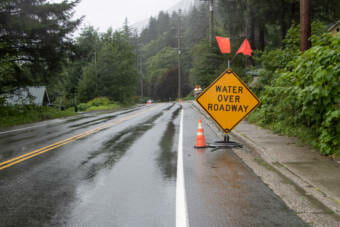
Water over roadway sign on Glacier Highway on August 13, 2021 in Juneau Alaska. (Photo by Lyndsey Brollini/KTOO)
Heavy rainstorms beginning Wednesday night may trigger flooding and landslides for some neighborhoods around Juneau. The National Weather Service has issued a flood watch from Thursday morning through Friday morning.
NWS Meteorologist Andrew Park said that communities across the panhandle, including Sitka, Petersburg and Juneau, should expect 2 to 4 inches, with the heaviest showers coming Thursday afternoon.
“This atmospheric river is going to push multiple rounds of precipitation from now through Saturday,” Park said.
Park said that kind of rainfall typically happens every two to five years, and it’s enough to raise water levels in small creeks and streams. In Juneau, neighborhoods around Lemon Creek, Montana Creek and Jordan Creek should be wary of minor flooding on roads and low-lying areas.
The rainfall is unlikely to cause flooding for the Mendenhall River.
Park said heavy rains could also trigger small, isolated landslides in neighborhoods with steep terrain across Sitka, Kake and Juneau.
Park said the weather service does not have a formal warning system for landslide events, but people in those neighborhoods should keep a close eye on further communications from the city.
Mariners should also be wary, as the storms will bring strong, gale force winds to areas like Icy Strait and Hawk Inlet.
“Before you get on the water, check the current conditions and check the forecast,” Park said.
Though the heaviest rainfall is expected to subside by early Friday, showers will continue through the weekend.
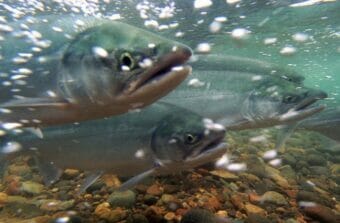
Chum salmon migration. (USFWS/Togiak National Wildlife Refuge)
In 2013, researcher Chris Sergeant was doing some routine water quality monitoring in Sitka’s Indian River when he noticed something strange on the oxygen monitor.
“It was getting close to zero — really, really low,” Sergeant said. “And there were fish dying off. Juvenile coho and cutthroat trout. And a high percentage of the adult salmon were hatchery strays.”
The stream was choked, filled with too many fish that couldn’t get enough oxygen. Salmon die-offs like that have been documented for at least a century, but their causes have not been well-understood. Now, a new study by Sergeant and his research team suggests that a booming population of hatchery-raised salmon in Southeast Alaska could put pressure on thousands of miles of salmon streams that are already vulnerable due to climate change.
“We have too many salmon breathing too much oxygen,” Sergeant said. “It’s an unnaturally high population.”
The water in rivers and streams has dissolved oxygen in it, which salmon and other fish breathe through their gills. When those fish can’t get enough oxygen, it’s known as hypoxia. They can suffocate. Or, in less extreme cases, low oxygen can slow salmon down on their strenuous trip upstream.
“They may not make those spawning grounds in time or have enough time to spawn,” Sergeant said. “So there’s a lot of really subtle effects in addition to just massive die-offs.”
Scientists have long-warned that hatchery salmon can compete with wild fish for resources, including oxygen. And for more than half a century, hatchery production across Alaska has boomed, especially for pink and chum salmon.
Those populations are supposed to return to their hatchery when they spawn, but they commonly stray into wild streams. According to the study’s authors, that could put wild salmon — including more desirable species like chinook, coho and sockeye — at a higher risk of smothering.
The study maps more than 10,000 miles of wild salmon habitat in Southeast Alaska that are close to hatchery release sites, creating the potential for overcrowded streams.
And salmon’s risk of hypoxia is made worse by human-caused climate change. Rising water temperatures across the region have been linked to salmon die-offs in recent years, and warm water holds less oxygen.
When hot temperatures are accompanied by drought, salmon streams are even more primed for hypoxia. That’s because an ideal salmon habitat is rough and fast-flowing. That kind of water is oxygen rich.
“The more the water tumbles and foams, like a rapid, the more opportunity it has to exchange with the atmosphere,” Sergeant said. “That tumbling motion of the water is basically injecting oxygen.”
Climate change is expected to bring more precipitation to Southeast Alaska overall, but the region still faces a growing risk of drought. Extreme rainstorms are likely to be punctuated by longer dry periods, especially in summer. And declining snowpack in the mountains could also cause drought.
According to Ryan Bellmore, a US Forest Service researcher who co-authored the study, snowpack is like a bank account for the watershed.
“And we’re more likely to go into the red,” Bellmore said.
Water is saved in the high mountains in the winter and then melts gradually throughout spring and summer, feeding the rivers and streams. Without it, salmon streams could dry up and slow down in the summer heat, which could lead to low oxygen levels.
And as climate change puts pressure on Southeast Alaskan watersheds, cramped conditions may continue to strangle wild salmon.
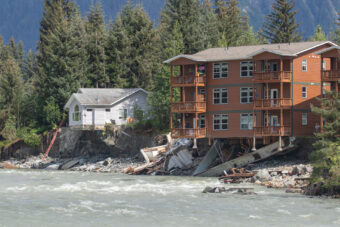
A house and condo buildings in the 4400 block of Riverside Drive hang precariously over the Mendenhall River on August 6, 2023. Molly Barnes and Kris Dorsey lived in units on the building’s left side. Though the riverbank has been partially restored since the flood, their building is still condemned (Mikko Wilson / KTOO)
One of the worst days of Molly Barnes’ life went viral.
As the Mendenhall River carved the land out from under her condo building during August’s glacial outburst flood, videos of the destruction flooded the internet.
“I haven’t even been able to watch. I’ve tried twice, but it makes me physically sick,” Barnes said. “I’m definitely still affected by it.”
A month later, the loss is still surreal, and heartbreaking.
Margaret Wellberg, a Red Cross therapist who has taken on clients affected by the Juneau flood, said many people who experience a disaster feel a grief that lasts for weeks, months and even years.
“We’re hearing the guilt, the anger over the damage and loss,” Wellberg said. “And then, there’s sometimes a real hopelessness that can be overwhelming.”
As a volunteer counselor for the Red Cross’s mental health disaster response team, Wellberg has provided free therapy after hurricanes in Florida and Puerto Rico, Typhoon Merbok in western Alaska and the 2018 Anchorage earthquake.
She said that often, navigating heavy emotions is a neglected part of disaster recovery.
“There’s so much of an immediate need for physical response,” Wellberg said. “And it’s hard to take care of yourself.”
Barnes and many of her neighbors cannot return home. Their condo building was condemned. As those displaced families navigate the challenges of financing repairs and finding new places to live, they’re also still dealing with fear, shock and grief after losing their homes.
The Red Cross offers free counseling services in the first few weeks after a disaster. Wellberg said she believes that care helps people prepare for long-term recovery.
“There’s really a need to have a safe place to cry, and to be upset and to really feel that loss,” Wellberg said. “Doing some of that immediate steam-release helps them to see a direction forward.”
Kris Dorsey, Barnes’ downstairs neighbor, sought out mental health care soon after the flood. Dorsey said she found it hard to function.
“This mental health side of it is more severe than I think people are aware of,” she said. “I’m having nightmares. I have this startle response to things.”
She said her home is unrecognizable. The yard where her family used to play with their dog, the cottonwood trees on the riverbank that Dorsey used to paint — they’re both gone now.
“It’s just disorienting to be in this place where you don’t recognize it anymore,” she said.
Dorsey said her grief has come in waves. She’s been able to regroup while staying with her mother in town, but there have been many sleepless nights over the last month.
“Our homes are our safety and our comfort,” Dorsey said. “When you’re processing something that’s so traumatic — you can have family members help and you can have friends help, but it’s not the same as going to your own bed at night.”
One of the most surprising responses, she said, is a new tendency to catastrophize. While driving around Juneau, Dorsey has found herself making note of potential hazards — homes at the bottom of the mountains that might be vulnerable to landslides or mudslides, or homes near the water that could be taken out by the next flood.
Dorsey said she was able to process some of that fear with a Red Cross therapist. She said swimming and talking with friends and her neighbors has helped, too. Still, it’s hard to cope with the loss of her home.
But additional therapy through the Red Cross won’t be an option. The organization wrapped up its disaster response in Juneau just over a week ago, and Dorsey said paying for sessions at a private practice is too expensive.
And finding private mental health care in Juneau can be time-consuming too. The demand for therapists is high, and the number of providers is limited. New patients often face long wait times for an appointment.
Barnes, Dorsey’s neighbor, said she found it difficult to prioritize her mental health even before the flood. The emotional vulnerability brought on by losing her home has been an adjustment.
“Twenty-eight days later. I think this is the first day I haven’t cried,” Barnes said. “I’ve always been so resilient. But right now, this is hard.”
Still, she thinks it will be too hard to find the time for more therapy. Both she and her husband work full-time as teachers. The school year started just days after the flood.
The bill passed the state House and Senate by a wide margin, but the governor quietly vetoed it over the weekend. The bill’s co-sponsor, Democratic Senator Jesse Kiehl of Juneau, said the veto came as a shock.
“I’m not sure which stage of grief I’m in, exactly. But I’m not past anger,” Kiehl said.
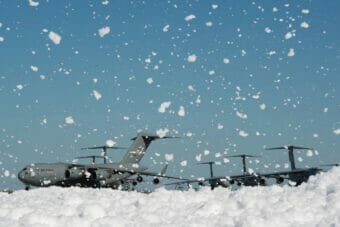
In his veto letter, Gov. Dunleavy cited concerns about a lack of alternatives to the foams, which are used to fight fuel fires, often at airports.
In Alaska, firefighting foams are believed to be the singlest biggest source of PFAS contamination, which has been linked to higher risks of various cancers and other health problems.
PFAS are called “forever chemicals” because they don’t break down, which can lead to persistent pollution of water and soil.
Earlier this year, the U.S. Environmental Protection Agency proposed new national standards to limit PFAS in drinking water. Alaska does not regulate PFAS, but if the federal regulations take effect, the state will be responsible for cleaning PFAS-contaminated water.
Kiehl said the bill aimed to prevent further pollution ahead of the expensive and complicated task of removing the chemicals from water.
“Without state legislative action, the message from the Dunleavy Administration is, only the federal government can be counted on to get poison out of Alaskans’ water,” Kiehl said. “I don’t believe that’s right.”
Kiehl said the Governor’s office was unresponsive to his requests to meet in the weeks leading up to the veto.
Gov. Dunleavy has not yet responded to requests for comment.
Adam Ortega is a representative for Alaska Community Action on Toxics, an Anchorage-based nonprofit that has been lobbying for statewide PFAS regulation for more than a decade.
He said the Legislature’s near-unanimous approval of the bill earlier this year was a major milestone for PFAS regulation at the state level. He said the veto was extremely disappointing.
“It’s super counterintuitive,” Ortega said. “Dunleavy does not seem to care about his constituents, which is frustrating.”
According to Ortega, the limited scope of the bill, with a focus on just firefighting foam, still falls short of the regulations needed to prevent significant health impacts.
“It’s the bare minimum. It’s been scaled back so many times,” Ortega said. “This bill, it’s the bottom of the barrel. But we’re still fighting to get it passed.
Kiehl has proposed various limitations on PFAS chemicals throughout his time in office, including more comprehensive bills to regulate PFAS in drinking water that ultimately failed.
Now, the only chance for his latest bill to pass is if lawmakers vote to override the veto with 40 votes from the 60-person Legislature. Vetoes are rarely overridden, but Kiehl said he hopes to try during next year’s legislative session.
Close
Update notification options
Subscribe to notifications
Subscribe
Get notifications about news related to the topics you care about. You can unsubscribe anytime.