Anna Canny

Local News Reporter

Federal loans are available for Juneau homeowners, businesses affected by August flooding

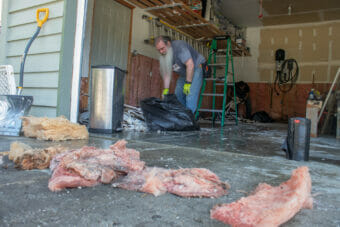
Daniel “Dune” Rothman helps homeowner Sam Hatch remove wet drywall and insulation from their garage on Meander Way on Sunday, Aug. 6. The flooded Mendenhall River brought almost a foot of water into some houses in the neighborhood. (Mikko Wilson/KTOO)

Juneau homeowners, businesses and nonprofits that were affected by glacial outburst flooding in August may qualify for federal aid in the form of a low-interest federal loan from the U.S. Small Business Administration.

The agency stepped in after the Federal Emergency Management Agency denied requests for disaster aid in late September. Public Information Officer Garth MacDonald said the agency’s loan program can help people or businesses affected by disasters that might not meet FEMA criteria.

“Our low interest loans are really the primary federal recovery dollars for long-term recovery,” MacDonald said. “And our goal is to try to help people get as close to the pre-disaster condition as possible.”

The agency has opened a temporary disaster loan outreach center at the Dimond Park Aquatic Center, where a customer service team will be available to answer questions and help with applications until Oct. 24.

Businesses or nonprofits are eligible for a loan of up to $2 million to replace damaged or destroyed property and business inventory, while homeowners and renters are eligible for up to $500,000 and $100,000 respectively to rebuild or repair their homes or replace belongings that were lost in the flood.

Eligibility for those loans is subject to some credit requirements, but interest rates are low — between 2.5% and 4% — with terms of up to 30 years. Those who qualify for loans will be exempt from making payments and accruing interest for a year after they receive their funds.

According to MacDonald, this kind of loan is often more flexible than insurance payouts or other forms of federal and state disaster aid. For instance, a percentage of the loan can be used for mitigation work to protect properties from future floods. So, while loans can’t be used to rebuild land, bank stabilization and fortification work may qualify.

Many people have already poured money into repair work, but the loans can still provide relief. Money from the loans may be used to pay off a private loan or another line of credit with a higher interest rate.

“Don’t assume you’re not going to get what you want. Don’t assume that you’re going to be denied,” MacDonald said. “Apply, apply, apply.”

People who wish to apply can also find more information at disasterloanassistance.sba.gov or via SBA’s customer service line: (800) 659-2955.

The application deadline for loans to cover individual property damage is Dec. 5, 2023. Businesses or nonprofits can apply until July 8, 2024.

Post-mortem shows that a local humpback calf was killed by a large boat

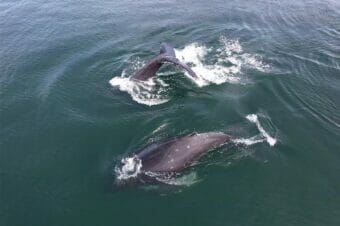
An aerial photo of Tango, and his mother Sasha, from a NOAA permitted drone assessment on July 20, 2023 – approximately one month before Tango died (Photo by Jacek Maselko, NOAA Permit #24359)

A humpback whale calf known as Tango that washed up dead near Auke Bay earlier this summer was killed by a large boat, according to the post-mortem exam. 

The fatal injuries included deep lacerations on the calf’s body and pectoral fin, likely caused by a propeller. And according to NOAA Marine Mammal Specialist Suzie Teerlink, Tango also had scarring from past injuries caused by smaller boats. 
“This calf had interactions with several vessels during the course of its short life,” Teerlink said. “We see these sub-lethal interactions unfortunately pretty frequently.” 

Tango was born this year to Sasha, a well-known whale that returns to the Juneau-area annually. Sasha herself is easily recognizable due to a distinct scar from entanglement in fishing gear.  

“That’s I think a testament that they can survive lots of these human interactions,” Teerlink said. “But there’s a lot of risks out there.”

NOAA does not keep a formal record of vessel strikes or entanglement incidents in the region, but Teerlink said the area where Sasha and her calves tend to feed has high boat traffic. And she added that both the whale population and the number of boats in the Juneau area have been increasing in recent years, which could cause more injuries. 

“There sometimes can be a misconception that whales know where boats are at all times,” Teerlink said. “They do pay attention to their surroundings. But you know, it’s not foolproof.” 

Teerlink said the best way to keep whales safe is to reduce speeds. That gives whales more time to adjust and gives mariners more time to take a look around the area. NOAA guidelines also call for vessels to stay at least 100 yards away from whales. 

Tlingit and Haida, Forest Service plans to expand cultural education at Mendenhall Glacier

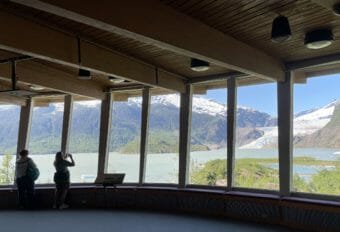
Visitors take images of Mendenhall Glacier near Juneau in summer 2022 from inside the Mendenhall Glacier Visitor Center. (Photo by Ned Rozell.)

The Central Council of the Tlingit and Haida Indian Tribes of Alaska and the U.S. Forest Service will collaborate on managing the Mendenhall Glacier Recreation Area going forward, with plans to better educate visitors on Alaska Native culture. 

Tlingit and Haida President Richard Chalyee Éesh Peterson said the Tribe is excited to share more cultural history with the nearly one million tourists who pass through the Mendenhall Glacier Visitor Center each year. 

“The people who go there want to learn about the glacier. They also want to learn about the people,” Peterson said. “And if you know anything about Lingít culture, we have songs, stories, history about migrating over, under and through the glaciers.”

The Forest Service and Tlingit & Haida signed a memorandum of understanding last week, which outlines a mutual commitment to collaborating on resource management and planning in the recreation area. 

Kevin Hood, the regional tribal relations programs manager for the Forest Service, said the agreement builds on the agency’s commitment to strengthening federal and tribal cooperation across the region

“We are overdue for having better representation of the Alaskan Native perspective,” Hood said. “It’s part of upholding our nation to nation relationship with these sovereign Tribal nations.”

At the glacier, the first priority will be including more Lingít culture, history and language in the recreation area’s programming. That will likely include updating signs and displays on trails and in the visitor center. But according to Hood, the memorandum of understanding could also pave the way for collaboration on trail maintenance, watershed restoration and caring for the fish and wildlife in the area. 

In the short term, the agreement calls for the Forest Service to hire Tribal citizens to work as educators and guides.

“Who better to tell our stories than us?” Peterson said. “Aak’w Kwáan people talking about Aak’w Kwáan, you know?”

Scammers posing as a local contractor are targeting Juneau flood victims

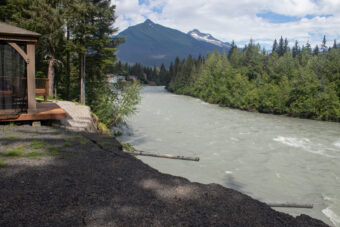
The Mendenhall River eroded about 50 feet of bank in just a few hours, stopping barely short of a house on River Drive in Juneau, Alaska following a glacial outburst flood on Saturday August 5th, 2023. (Mikko Wilson / KTOO)
The Mendenhall River eroded about 50 feet of bank in just a few hours during a glacial outburst flood on Saturday, Aug. 5, 2023.(Mikko Wilson/KTOO)

Scammers are targeting Juneau homeowners as they deal with property damage from August’s record glacial outburst flood along the Mendenhall River.

At least one person in the Marion Drive neighborhood has lost more than $50,000 after paying fraudulent bills sent by someone posing as a local contractor, according to documents shared with KTOO. 

Dave McKenna — who also lives on Marion Drive — didn’t fall for the scam, but he said it was convincing at first. McKenna hired a local contractor to rebuild eroded land and armor the riverbank on his property. When the work was nearly complete, he and his wife got an emailed invoice from someone claiming to be their contractor.

“And there was just enough detail for things to be really plausible,” McKenna said. “None of it was really raising super red flags.”

McKenna later realized it was an imposter. According to the Federal Emergency Management Agency, these kinds of scams are more common after disasters, as bad actors impersonate contractors, building inspectors or state and federal agents offering aid. 

And that’s been true after the flood. The Juneau Police Department confirmed to KTOO that it’s received several reports of fake invoices that were sent to homeowners dealing with flood damage.

Scammers stole more than $50,000

One homeowner found the invoices plausible enough to pay some of them. The resident did not want their name published and did not want to be quoted, but they shared emails and receipts with KTOO that show how the scam worked.

The imposter contractor exchanged emails with that homeowner for several weeks, answering questions about the work being done and pushing for quick payments. 

The first request was for an advance of $10,500. The imposter claimed that payments via check would not be possible and asked for payment via three different payment systems — Zelle, then Venmo and ultimately a direct wire transfer.

The homeowner wired the $10,500 payment to an out-of-state bank. 

The second payment request, for $43,810, came with a fake invoice that was marked with the real contractor’s address and logo. This time, the homeowner wired the money in two payments to a local Wells Fargo account under the name J&J Ventures. 

The emails show that the fraudster then sent a second invoice listing services like landscaping and permitting — work that the real contractor hadn’t done. The homeowner stopped making payments, but by then, they had lost $54,310.

Ways to spot a scam 

Lieutenant Krag Campbell with the Juneau Police Department confirmed that there is at least one open investigation into flood repair scams. And the department posted a warning about scam attempts on their Facebook page late last month. 

Though imposter scams or phishing attempts come in many forms, Campbell says they have one major thing in common. 

“Generally, for scams, people will want you to make quick decisions. They have like a sense of urgency on it,” Campbell said. “In those cases, it’s always best just to slow down and talk to a trusted person.”

And according to the Federal Trade Commission, payment requests via wire transfer are a giveaway for scam activity. 

Lieutenant Campbell declined to share details on the local flood repair scam investigation, but he said people who suspect scam activity should call the Juneau Police Department. 

Alerting the neighborhood

According to McKenna, at least nine of his neighbors on Marion Drive got emails from the imposter. In his case, the timing of the invoice and the amount requested closely matched the real work being done on their property. 

McKenna says the request for a wire transfer raised his suspicions because that differed from the payment method he had discussed with the real contractor, in-person. But with online payment methods like PayPal, Venmo and Zelle becoming more common, he didn’t think much of it.

What ultimately tipped McKenna off was the language of the email. McKenna is a personal friend of the real local contractor, and he said the message just didn’t sound right. 

“He’s always been kind of a man of few words,” McKenna said. “And when we got a request for payment from the fake imposter, we realized that, you know, that’s a really wordy message.” 

McKenna called the contractor, who said he hadn’t sent out any invoices yet. After that, he alerted the neighborhood — along with the local branch of the FBI.

Mud pies and ‘Molly of Denali’ could strengthen STEM education in rural Alaska

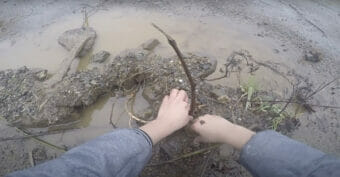
A GoPro camera captures a child’s point of view as they make mud pies in Hoonah. Videos like this will help researchers and educators to design new environmental science programming in rural Alaska Native elementary schools. (Screenshot courtesy of Carie Green)


Making mud pies may not seem scientific. But in a sodden school yard in Hoonah, kids discern between different materials and tools for building by gathering the best sticks, rocks or pinecones. Or they modify those materials by wetting down dirt to make more mud for sculpting. 

Education researchers Angela Lunda and Carie Green call that “mud science.” And they say that kind of experimentation in the natural world can help young children develop an interest in environmental science.
For Alaska Native children, activities in the natural world are also an important foundation for cultural identity.  

“The children are already stewards of the environment, right? They already see themselves that way,” said Lunda, who is Lingít and teaches at the University of Alaska Southeast. “And that really is what defines us as Indigenous people.”

Lunda and Green’s research — known as the Molly Community Science Project — focuses on strengthening STEM programming in rural Alaska schools. 

The project’s namesake comes from the popular PBS Kids program “Molly of Denali”, an educational animated series which features an Alaska Native main character. The goal is to build on the show’s success by developing “Molly of Denali”-themed multimedia resources with Indigenous students in mind. It’s a collaboration funded by the National Science Foundation. 

Lunda says Alaska Native communities inherently possess a depth of environmental knowledge and skills. But Alaska Native students are underrepresented in  science, technology, engineering and math fields, and traditional programs don’t make space for Indigenous identity. 

“So it’s really important for us to be aware of that and to be actively working to try to change,” Lunda said. “That happens when we build on their world, their worldview. What they see, what they do.”

Their research design takes that literally, by outfitting Alaska Native elementary school children with GoPro cameras, which they wear as they play and explore outside. 

Green — a professor of early childhood education at South Dakota State University —  developed the research method during her previous work studying children’s relationships with the environment. She said kids will often forget that they’re wearing the cameras. 

“And so they’ll tell you how they’re feeling, they’ll sing songs, they’ll narrate what they’re doing,” Green said. “All that sort of self-talk is really insightful.” 

In one video, a child compares different crab shells on the beach, to figure out which ones are occupied and which ones are left over from molting. In another, a child tells her friends how to safely handle S’áxt, or Devil’s Club. And in yet another, a child goes fishing with their mother, and the clip captures them cheering as they reel in their catch. 

“Yes! See? This is how you fish, because I caught something,” the child says. “Now put it in the water so it lives to get bigger.” 

A child practices catch and release while fishing in Hoonah (Screenshot courtesy of Carie Green)

By examining those videos, Lunda and Green can identify activities that foster the empathy, knowledge and confidence kids need to act responsibly towards the environment. The research also incorporates interviews with elders, families and educators in Bethel, Hoonah and Northway, a village in the Interior. 

Amelia Wilson is the project’s community liaison in Hoonah. She said much of the existing STEM programming for Alaska Native students targets older students.  

But she hopes that the Molly project’s focus on elementary children will help to nurture cultural identity early on, to teach Alaska Native students that their Indigenous perspectives can make them stronger scientists. 

“Respect for our environment, you know, that’s a cultural value that has always been,” Wilson said. “So how powerful would it be to have these children be those scientists that are making policies, making the decisions for our environment.”

She said Alaska Native representation in STEM is especially important as rural Alaska Native communities, including Hoonah, work to adapt to climate change. 

For now, the researcher team is still working to analyze the videos and interviews. But they’ll begin to design and test “Molly of Denali’s” science programming in partner elementary schools over the next year.

Flood warning in effect for some Juneau neighborhoods as atmospheric river dumps rain

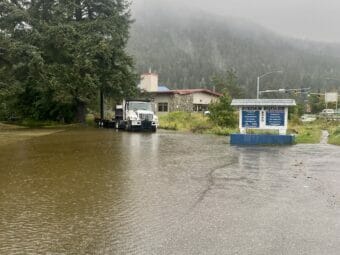
Water pools in the parking lot of Jordan Creek Center after heavy rainstorms on September 21, 2023 (Photo by Anna Canny/KTOO)

The National Weather Service in Juneau has issued a flood warning for areas around Jordan Creek, Montana Creek and Auke Lake through early Friday morning as rainstorms remain stalled out over Juneau. 

“We are already seeing minor impacts along Jordan Creek right now,” said meteorologist Nathan Compton. “We are just about approaching moderate flood levels. If you are anywhere near Jordan Creek, you should be taking some sort of action.”

An atmospheric river that reached the panhandle on Wednesday afternoon has already dumped several inches of rain over the region, with another 1 to 2 inches expected throughout Thursday afternoon and evening. 

Up to one foot of flooding is possible for homes close to the banks, as water will continue to rise through the afternoon and evening. Pooling on roadways around Jordan Creek and some sections of Glacier Highway could create dangerous conditions. 

The rain also has the potential to swamp boats. Boat owners should ensure that their bilge pumps are working properly. 

Compton said that heavy rainstorms like this are typical for the early fall. 

“September is our stormy period, it is typically when we see these higher rainfall amounts,” Compton said. “Wouldn’t say this is a top tier atmospheric river, but we are seeing some impacts.” 

The heaviest rain is expected to let up by midnight on Friday morning, with flood waters cresting shortly after. 

Site notifications
Update notification options
Subscribe to notifications