Anna Canny

Local News Reporter

Search and rescue efforts continue after deadly Wrangell landslide

A Nov. 21, 2023 view of the Wrangell landslide looking north. (Courtesy Calib Purviance via State of Alaska)

A massive landslide took out three homes on a highway outside of Wrangell late Monday. Three people were found dead as of Tuesday night, and search and rescue efforts continue for the three people who remain missing.

KTOO’s Anna Canny is in Wrangell. She says there’s a huge effort underway not only to search for the missing, but to evacuate or bring supplies to the many residents whose homes were cut off by the slide.

Listen:

This interview has been lightly edited for length and clarity.

Anna Canny: So right now, we still don’t know any of those names that have been released publicly. But we do know that at least one minor and two adults have been found dead. One adult woman was rescued, and she was on the top floor of the house, a house on the upper part of the hillside, which helped her survive, and we’re hearing that she’s in good condition.

Meanwhile, the search and rescue efforts are continuing. And we know at different points throughout the day, there have been helicopters and drones doing aerial surveys, looking for those three missing people. There are folks in the slide area working through the mud and downed trees, crews with chainsaws out there, and there are search and rescue dogs on the ground, as well. And those crews were working all day yesterday and today. Community members have been delivering food out the highway to them to help those first responders.

A helicopter arrives near ground searchers and search dogs at the Wrangell landslide. (From State of Alaska)

But as of this afternoon, we still have no official word on those who are missing, though we do know that it’s believed to be one adult and two children. We’re told they won’t start clearing that road until those people are found. And then even after they start clearing, it’s not certain how long that will take. It’s a huge amount of debris that’s crossing this highway. And so for the time being, one of Wrangell’s main arteries is blocked off. And we’re hoping folks will be found in the coming days. But it has created a huge blockage here in Wrangell.

Wesley Early: How is that highway blockage disrupting things, if at all?

Anna Canny: Yeah, so the slide, as I mentioned, came down across this big highway called Zimovia Highway. And the layout of Wrangell is such that, there’s the town, where KSTK (radio) is, on the north end. And then there’s this long highway that snakes to the south along the bottom of these really, really steep slopes, which is where the slide came down. That highway is about 14 miles long. And this massive slide, which we’re now getting estimates is about 500 feet wide, came down somewhere past the eleventh mile. So now, obviously no one can drive out there.

And when the slide came down, it also took down power and took down landlines along the highway. As of today, some of that power has been restored from the town center, here on the north side, up to Mile 9 of the highway. But that means that there’s still a bunch of households on either side of the slide that don’t have power or phone lines.

The path of the landslide on Wrangell’s Zimovia Highway, photographed from a Forest Service boat on Wednesday afternoon, Nov. 22, 2023. (Anna Canny/KTOO)

We know Tlingit and Haida helped to set up some internet connections, so people are able to stay in touch to some extent. But now that area to the south of the slide is only accessible by boat. So there’s a bunch of households that are essentially cut off from the main town.

Wesley Early: Wow. How are the people on the road doing? What do we know about their status?

Anna Canny: So we know at least some households have evacuated. They either evacuated the night of — some people heard the slide coming down, got in contact with firefighters and got out by boat that night — and then there’s been ongoing evacuations throughout the course of the day, yesterday and today. There have been boats going back and forth between the town in the north and the cutoff area in the south. We know there’s one hotel here, the Stikine Inn, that’s hosting evacuees, and some of our reporters here talked to at least one evacuee today. And the innkeepers, they’re expecting more are coming in.

And then there are some families that are staying out there, sticking to their homes. And so there have been efforts to bring them supplies to keep them afloat out there since they can’t drive in or access the town without a boat. Water, food and fuel is a big one, because as I mentioned, the power’s out and those that did stay out there are running on generators. So it’s been an all hands on deck effort to deliver those supplies.

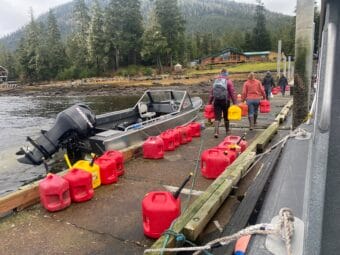
Angie Flickinger, whose home is south of the landslide on Zimovia Highway, and Tory Houser, a recreation planner with the Forest Service, deliver fuel on Nov. 22, 2023 to power generators in households that lost power after the Nov. 20 landslide. (Anna Canny/KTOO)

We know there was a boat manned by the city of Wrangell that went out several times today to drop off things. And then there are a bunch of independent boats. There are summer tourism boats that went out, fishing boats, I saw a gillnet boat out there today. And then I myself went out with the Forest Service crew on a fuel run this afternoon. They told me that all the local agencies here are pitching in what they can, and so the Forest Service, they had boats, and so they stepped up to use those boats. And as I mentioned, most of these are fuel deliveries. When I was out there today, we delivered about two dozen canisters of fuel that are going to be used to run those generators.

And a lot of donations are coming in to pay for that fuel. I’m told thousands of dollars of donations have come in so far. A bank here has set up an account specifically for that and communities from Ketchikan to Petersburg, and of course, folks here in Wrangell are sending money for those fuel supplies.

So, yeah, the Forest Service did one run yesterday and they plan to resume their daily rounds on Friday again, and between all of those agencies, they’re kind of keeping those households that are stranded out there well-stocked. But yeah, as I mentioned, it’s still a search and rescue effort, and efforts to clear the road have not started. We still don’t have a clear answer on when all that power will be restored. So for right now, all those families on the other side of the slide are stranded.

Storm update: Snow tapering off through the night, slick conditions likely Tuesday

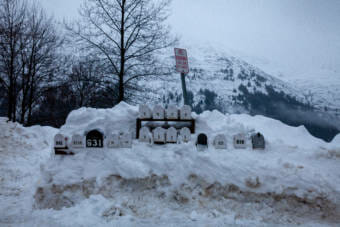
Strong winds kick up snow at the intersection for Main St. and Front St. in downtown Juneau. (Anna Canny/KTOO)

Update, 5:30 p.m.

Strong winds of up to 60 miles an hour will continue to blow snow in Juneau before tapering off in the early hours on Tuesday. The strongest gust Monday — at a speed of 103 miles — was recorded at the junction of Chatham, Icy Strait and Lynn Canal.

By Tuesday morning, temperatures will warm slightly and snow will start to mix with rains. Commutes will likely be less hazardous, but conditions will remain slick.

Snowfall totals varied throughout Southeast. In Juneau, there were accumulations between 4 and 6 inches by Monday afternoon. Haines and Skagway saw up to 8 inches and Hoonah reported 21 inches. 

More snowfall tonight could push those totals up by several inches.

Original story:

A blizzard warning is in effect for Juneau until Tuesday morning. The storm could bring 9 to 14 inches of snow. Strong winds — with gusts up to 60 mph — will kick up snow and make travel hazardous.

Meteorologist Andrew Park with the National Weather Service office in Juneau said people should avoid travel on Monday if possible.  

“Take it slow, leave plenty of space,” Park said. “But this evening is definitely your window. Tomorrow it could get pretty wild out there.”

On Monday morning, NWS meteorologist Sean Jones said the storm was progressing as forecasted, and the weather would intensify through mid-day.

“Conditions are going to ramp up,” Jones said. “The worst of the snow hasn’t reached Juneau proper yet.”

Downtown Juneau and Thane lost power around 8:30 a.m. Monday. Alaska Electric Light and Power Company spokesperson Deb Driscoll said the outage was linked to the Second Street power station, and crews were responding, but there could be more outages throughout the day as the storm intensifies.

“I expect we’ll have many more today,” Driscoll said.

Schools and offices closing early

News of closures came in rapidly Monday morning as the storm worsened.

Around 10:30 a.m., the city announced it was closing downtown offices and facilities at 11 a.m. due to hazardous condition. The closures include the downtown branch of the Juneau Public Library, the Juneau-Douglas City Museum, the Treadwell Arena, the Permit Center and Zach Gordon Youth Center.

Juneau schools are closing early after opening as usual on Monday morning. A statement from the school district said that parents are welcome to pick their students up, and buses would begin bringing children home after lunch. Elementary schools will close at 1:00 p.m., middle schools at 1:30 p.m. and high schools at 2:15 p.m.

All after-school activities and the RALLY program are cancelled.

The University of Alaska Southeast also announced campus buildings would close at 1 p.m. Monday. They expect to reopen Tuesday.

City buses in Juneau will be on modified winter routes at least through Monday. Capital Transit posted on their website that all riders should expect delays, and there is no service on Cordova St., Franklin St. and Fourth St.

State offices in Juneau are closed as well.

By Tuesday morning in Juneau, the snow should begin to mix with rain, which could create icy conditions that will persist through the week. 

Gustavus, Haines and Skagway could also see snowfall in the double digits, starting on Monday morning. A winter storm warning is in effect for those communities, but milder winds will make blizzard hazards less likely.  

For the southern panhandle, from Ketchikan to Prince of Wales Island, major snowfall is less likely, but strong winds could pose a threat. There’s the potential for power outages, downed trees and damage to boats that are not secured properly.

As of 10 a.m. Monday, the strongest wind reported was an 82 mph gust at Cape Spencer.


The National Weather Service will continue to update their forecasts as the storm picks up.

Editor’s note: We will keep updating this story as the storm progresses.

Communities must adapt as climate change transforms Alaska, federal report says

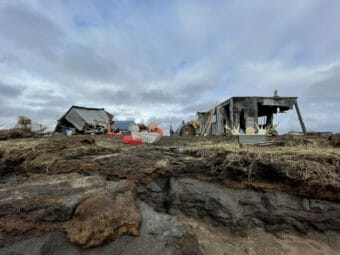
The Nunalleq dig site located just off the coast of the Bering Sea, close to Quinhagak. A portion of the site already eroded into the sea.  (Photo by Katie Basile/KYUK)

Declining sea ice, thinning snowpack, thawing permafrost and other climate-driven changes are threatening the health, livelihoods and cultural practices of Alaskans across the state, according to a major new federal report.

“Choose any societal issue you want — climate change is having an effect,” said Henry Huntington, Arctic Science Director at the Ocean Conservancy and lead author for the report’s Alaska chapter. “And I would bet not a good one.”

The National Climate Assessment, produced every four years, is the federal government’s most exhaustive account of how climate change is affecting the U.S.
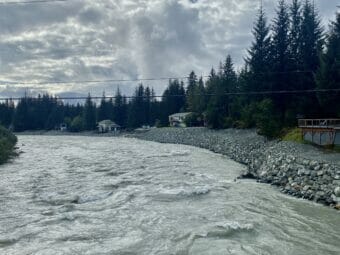
It finds that human-caused climate change, driven primarily by the burning of fossil fuels, is already affecting Alaska communities. The state is warming two to three times faster than the rest of the world, and many places across the state have already experienced climate-driven catastrophes like storms, floods and wildfires.

While plans to adapt and build climate resilience are already underway across the state, the report finds these efforts will need significantly more funding, support and coordination to be effective. 

“Climate change continues to be a serious problem,” Huntington said. “We’ve got to act. But there are things that we can do.”

Here are three key takeaways for Alaska:

1. More public health challenges, especially in rural communities. 

Two buildings at a fish camp, one badly damaged and the other knocked over
A fish camp in the Nome area, seen on Sept. 24, shows damages wreaked by the remnants of Typhoon Merbok. (Photo by Jeremy Edwards/FEMA)

Villages across the state already face public health challenges like inadequate sanitation and overcrowded homes amid a severe housing shortage. Climate change will make those problems worse, the report finds. 

An estimated 3,300 households across the state lack access to running water and sewer systems, and according to the report a lack of indoor plumbing can contribute to the spread of disease, like the high incidence of COVID-19 cases among tribal communities nationwide. 

Eighty percent of the state sits on permafrost, which is thawing rapidly. Along with erosion, stronger storms and flooding linked to climate change, melting permafrost can undermine existing infrastructure. It can warp fragile water lines or compromise drinking water sources and sewage lagoons. Those same hazards can make it difficult to build new sanitation systems.

A photo of a coastal area showing several flooded buildings
A massive storm battering Western Alaska brought floodwaters to the steps of the local school in Golovin on Saturday. (Photo courtesy of Josephine Daniels)

The report highlights some innovative temporary solutions, like the Portable Arctic Sanitation System, a modular unit developed by the Alaska Native Tribal Health Consortium that includes treated drinking water, a handwashing sink and a waterless toilet. This system, which has been piloted in five rural communities so far, can stop-gap when existing systems are damaged by climate hazards. But the authors highlight the need for more permanent solutions. 

Many rural communities also have severely limited housing stocks, which are being squeezed by climate hazards. Structural damage from floods or storms like ex-Typhoon Merbok can displace families, who face enormous repair costs and few alternative housing options in their villages. And more slow-moving disasters, like collapsing land caused by permafrost thaw or erosion, can further damage housing. In the worst cases, that’s forcing communities to relocate major infrastructure or even, as in the case of Newtok, more permanently.

Altogether, the report finds that Alaska Native communities face nearly $5 billion in climate-related infrastructure costs over the next 50 years. But the loss is not just monetary. 

“These effects, including a profound loss of connection to a landscape altered by climate change, can increase instances of mental illness and spiritual grief in affected populations,” the report says.

2. Threats to traditional foods and cultural practices. 

Daren Jennings loads up his skiff to deliver Bristol Bay salmon to Lower Yukon River communities. (Photo by Olivia Ebertz/KYUK)

As climate change transforms ecosystems across the state, it is also disrupting Alaskans’ food security. The report catalogs numerous ways in which warming temperatures are threatening subsistence hunting and fishing and livelihoods statewide.

Stronger storms and the decline of sea ice in Arctic and sub-Arctic communities are making hunting more dangerous, the report notes. Warming is disrupting food webs for sea birds and shifting habitats or migration patterns for species like moose and caribou.

Changing weather conditions have made subsistence foods like wild berry harvests more unreliable. Both commercial and subsistence fisheries have faced collapse and closures in recent years linked to climate change. Warming waters have contributed to declines in king salmon on the Yukon and Kuskokwim Rivers and snow crab in the Bering Sea. 

""
More than 10 billion Bering Sea snow crabs disappeared in Alaska between 2018 and 2022 (Photo courtesy of Corey Arnold/Alaska Bering Sea Crabbers)

For commercial harvesters, those changes threaten thousands of jobs and billions of dollars in revenue, the report finds.

For the state’s rural, predominantly Alaska Native communities, the threat is even more serious. Grocery prices in the state’s villages may already be more than twice as high as in its cities, and the report notes that 95% of rural residents rely at least in part on subsistence hunting and fishing for their food supply.

It’s becoming harder to harvest food, as thinning Arctic sea ice makes whale and seal hunting seasons shorter and more dangerous, and warming waters, especially around the Chukchi Sea, trigger harmful algal blooms that can make shellfish toxic. 

Even after harvest, climate change is threatening traditional ways of processing and storing food, as wetter weather makes it more difficult to dry fish and meats, and flood and melting permafrost compromise the traditional ice cellars in which many Alaskans store food

These changes to traditional foods and subsistence practices represent an especially profound cultural loss for many Alaska Native communities. 

3. Communities are planning for adaptation. Indigenous leadership, more funding and support can help put those plans into action.

Students in Anchorage rally in solidarity with the global climate strike.
Students in Anchorage rally in solidarity with the global climate strike, March 15, 2019. (Photo by Wesley Early/Alaska Public Media)

But the report doesn’t just list climate impacts – it also highlights examples where Alaskans are taking action. Many municipal and tribal governments are already making plans to deal with Alaska’s changing climate, the authors write, and communities could make significant progress with more funding and support. 

At least four municipalities — Anchorage, Homer, Sitka and Juneau — and seven tribal governments, from the Nome Eskimo Community to the Central Council of the Tlingit and Haida Indian Tribes of Alaska, have developed local climate adaptation plans. More rural communities across the state are developing their own plans.

The climate assessment is meant, in part, to be a resource for people developing or improving upon those plans.

But putting those plans into action can be challenging, the report says, especially for smaller communities. In rural Alaska villages, local governments often lack the funding, expertise or staff to plan for climate impacts. And the same societal challenges that are made worse by climate change — things like food and water insecurity, substandard housing and limited health care — can often limit a community’s ability to pursue climate adaptation. 

“But these aren’t in isolation. It’s not that we have to choose climate change or something else,”  Huntington said. “A lot of the things that we want to do can have many benefits in addition to helping make us more climate ready.”

Successful adaptation planning, the report emphasizes, involves a holistic approach, one that takes a includes collaboration between Western scientific approaches and Indigenous traditional knowledge holders. The authors highlight the Alaska Arctic Observatory and Knowledge Hub, which includes Inupiaq experts in climate research and environmental monitoring, as an example of how to do this. 

Still, political will can be a limitation for climate adaptation. “Support for climate adaptation varies among communities,” the report says. “And adaptation has not been a consistent priority for the state government.” 

Gov. Mike Dunleavy has long questioned the scientific consensus that human-caused carbon emissions are driving climate change, and disbanded a climate change task force convened by his predecessor. 

And while the federal government is dedicating more and more funding toward addressing climate change, the report finds that Alaska communities struggle to access that money, in part because they often compete with bigger communities across the nation.

But the report says securing more money and increasing collaboration and coordination between many different governments and agencies is the only way to create a brighter future for the state. 

“Together, these efforts address climate change and intersecting societal challenges in ways that begin to lay a foundation for a just and prosperous Alaska,” the report reads. 

City seeks public testimony on flood mitigation along Mendenhall River

Property owners have already installed tons of rock to fortify the bank along River Road, just downstream the Brotherhood Bridge (Photo by Anna Canny/KTOO)

The Juneau Assembly will discuss flood mitigation along the Mendenhall River at a meeting of the committee of the whole on Monday. 

In August, a severe glacial outburst flood eroded large swaths of the riverbank, destroying two homes and damaging dozens more. It was the worst outburst flood in Juneau’s history. And scientists say future floods could be even more severe.  

Many residents have already set to work rebuilding eroded land and armoring the riverbank on their own. But now, the city will consider stepping in to help with bank stabilization.

The committee will present different federal funding opportunities that could help cover the cost of more bank stabilization work to protect riverside homes from future flooding. 

Residents are encouraged to attend to ask questions or offer public testimony. 

The meeting will take place at 6 p.m. Monday in person at City Hall and remotely via Zoom.

Mga Kuwento, Ep. 5: Reconnecting with culture in Juneau’s Filipino community

Members of Juneau’s Alitaptap Folkloric Dance group pose in traditional costumes. (Photo courtesy of Filipino Community, Inc.)

In its heyday, the Alitaptap Folkloric Dance group was a spectacle of Filipino culture both in Juneau and across Alaska.

Filipinos, from elementary schoolers to elders, learned and shared the story of Filipino history through dance. But it’s been more than a decade since those dancers took the stage.
Kaye Roldan doesn’t really recall joining the group with intention. 

“When I joined, it was like we didn’t really get the full picture of what we were actually doing,” she says. “I just did it because my mom told me to.”

Many Filipinos who grew up in Juneau had a similar experience. But years later, they can appreciate the chance they had to connect with the culture their parents and grandparents came from before arriving in Alaska.

In the fifth and final episode of Mga Kuwento, Anna Canny brings us the story of those who once danced under the careful instruction of their elders, who are now searching for spaces to reconnect and pass down Filipino culture.

Members of Juneau’s Alitaptap Folkloric Dance group pose in traditional costumes. (Photo courtesy of Filipino Community, Inc.)

Artist captures climate change in his brushstrokes for new Alaska State Museum showcase

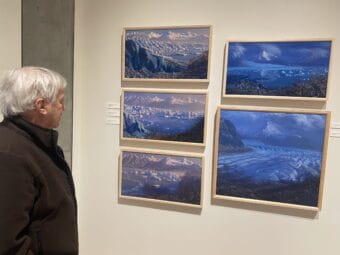
Painter David Rosenthal stands before a series of paintings of Sheridan Glacier outside of Cordova. Each painting captures the glacier during different time periods. (Photo by Anna Canny/KTOO)

When painter David Rosenthal came to Alaska nearly 50 years ago, he was captivated by the expansive glory of the icy landscapes. Over his career he’s painted ice, snow and glaciers in Alaska, the North Pole, Greenland and even Antarctica, inadvertently capturing climate change in his brushstrokes.

The Cordova-based artist’s showcase, “Painting at the End of the Ice Age”, is a retrospective which places his paintings in the context of human-caused warming and glacial retreat, seamlessly blending science and art. It opens Friday, Nov. 3 at the Alaska State Museum, followed by a lecture from Rosenthal.

He sat down with KTOO’s Anna Canny to talk about his experiences capturing the last remnants of Alaska’s glaciers.

This interview has been edited for length and clarity.

Anna Canny:  So you’ve been a painter for decades, and you’ve always painted landscapes. But as this exhibit showcases, you have an affinity for icier landscapes. Can you kind of tell me how you found that focus? 

David Rosenthal: I grew up in Maine, the Ice Age was over.  But we used to always hear about it, because, you know, we’d be driving by a field with these boulders everywhere and my parents would go ‘Oh, the glacier left those,’ you know? And it was really something that I used to think about and was fascinated by. And, you know, I was in Maine, doodling and, you know, doing these paintings. And some of them were pretty good, but I barely sold anything. I had just graduated with an interdisciplinary degree, which doesn’t prepare you for anything. So just by chance, I got this job at a cannery up in Cordova, thinking oh I’ll just go up there for a job. Because, you know, compared to Maine it sounded like a lot of money. So, I go up to South central coast, Alaska, basically, which is surrounded by some of the remnants of the Ice Age. They’re all these glaciers and icefields, you know, some, this is some of the biggest glaciation in North America. And this is where basically, this is my playground for years. And so that’s how I, I mean, all during this time, I did other things, besides ice. But I just, ice, glaciers are just so, the colors and the way the light hits them. I mean, they’re just a beautiful subject for painting. 

Anna Canny: What were some of your earliest glacier paintings?

David Rosenthal: Well, in Cordova, we have these glaciers, Childs and Miles, about, oh, 52 miles out of town. And when I first saw it in ‘77, there was a little area in this brush and you could just kind of sit there and watch, the face of this, the active face, was about a mile long and it was about 300 feet high in places. And you just go out there for the afternoon and watch these calving chunks, you know, 300 feet high and 200 yards wide and it would actually throw waves across the river. You had to be careful, you had to run sometimes. It was just the wonder of the world. 

David Rosenthal’s showcase of oil paintings features glaciers and ice fields from across Alaska and the globe (Photo by Anna Canny/KTOO)

Anna Canny: So you’ve been painting these landscapes, obviously, for years, you’ve been painting ice for years. But when did you realize that taken altogether, these paintings say something about climate change?

David Rosenthal: It was funny because I’d see everywhere, these exhibits and journalists writing about climate change, you know? And a lot of them were ‘Oh yeah, I’m so and so, I have five years on the ice, you know, or studying this ice and, this one glacier has retreated 100 meters,’ you know, that sort of thing. And I’m thinking, wait a second, I’m living around for the last 40 years, glaciers that have retreated 15, 16 miles. And, so I’ve never been any kind of activist, but there was a lot of times that I would think about what I was doing, and, well, you know, you’ve spent your life making pretty pictures, you know? What good is that, you know? And so then it dawned on me, well, wait a second, this is my chance to give back something. 

Anna Canny: I mean, and one thing this exhibit really drives home is that we’re seeing change happening so fast, that in one painter’s lifetime you can catch all of this. 

David Rosenthal: Yeah,  yeah, you know this, uh in geological time my, well now it’s almost 47 years painting glaciers — in geologic time, that’s nothing. But with glaciers, you get significant changes. So it’s one of the best ways to illustrate these changes. And it’s sad like, uh for my first years in Cordova I used to just go up for the summer, but in ‘81 I moved there full time. And one winter day some friends invited me to go out to the Saddlebag Glacier. It’s a relatively small one. But that memory is etched in my head. Because you come around this corner in the stream and you just like, there was just this wall of ice. And it was around the solstice. So the yellow sun even at noon time made the ice look this incredible emerald green. And then in 2018, there’s not even ice, it’s just gravel in this canyon. And it’s so sad to see these young people, like, you used to just drive out and watch it calve or you could hike up for miles. And you can’t do it anymore. 

Site notifications
Update notification options
Subscribe to notifications