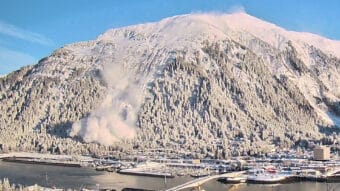
Anna Canny

Local News Reporter

How wind causes avalanches, even after the snow stops falling

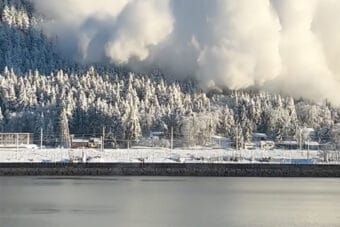
Still from a video of an avalanche in Juneau, Alaska on Jan. 16, 2024. (Courtesy of Tempest Smith-Marshall)

A winter storm over the holiday weekend dropped more than 30 inches of snow on the mountains that surround Juneau. A fresh dump of snow like that can set the stage for avalanches.

“The snow piles up, and it can’t quite stick to the sides of the slopes. So it can avalanche during a storm,” said Wendy Wagner, director of the Chugach National Forest Avalanche Information Center.

But Juneau’s recent avalanches came down well after the snow had stopped falling. On Tuesday morning, people captured dramatic videos of an avalanche on the Behrends Path on Mt. Juneau coming down under bright, clear skies. Wednesday night, another Behrends slide left cars and houses dusted in up to two inches of snow. 

Wagner said these kinds of sunny-day snow slides happen often — because snowfall isn’t the only ingredient in an avalanche. 

“The winds can actually create their own avalanche cycle,” she said. 

When wind blows across a ridge, it moves snow around, picking it up from the windward side and dropping it on the leeward side, where it forms thicker, heavier drifts. 

And it doesn’t take a strong wind to start moving the snow. 

“If you have, say, a foot or two feet of nice, loose powder, it’ll only take maybe 20 mile an hour or less winds to pick up that snow and put it somewhere else and pile it up,” Wagner said. “The wind can basically create its own snowstorm on a slope.”

And the right kind of wind storm can actually deposit snow faster — up to 10 times faster — than a real snow storm, where snow falls from the sky. 

“So you can have winds for a few hours,” Wagner said. “And if they’re just right, they can make an avalanche problem pretty quickly.”

Juneau’s recent storm left a lot of cold, dry powder that was easy to blow around. And after the storm subsided, strong winds followed. 

Moderate winds on Tuesday loaded up the avalanche paths on Mt. Juneau. Then, on Wednesday and Thursday, the winds got even stronger. The National Weather Service issued a high wind warning, predicting winds between 40 and 55 mph and gusts up to 70 mph.

Winds that fast move a lot of snow around. And strong winds change the quality of the snowflakes, too. 

“Snow grains often get broken up, just because they’re colliding with each other,” Wagner said. “They’re a little bit smaller, and so they can pack tighter.”

All those tiny particles bond closely together and form a dense layer of snow known as a wind slab, which puts pressure on the existing snowpack, 

“All of the sudden, you have this kind of more dense layer of wind drifting off snow that’s sitting on a less dense, more un-cohesive layer,” Wagner said.  “And that’s the perfect recipe for an avalanche.”

But Juneau residents know that an avalanche doesn’t happen every time a strong wind blows. Mike Janes, an avalanche forecaster with Alaska Electric Light and Power, said this week’s avalanches were also caused by problems deep in the snowpack.

“The main reason is that we have kind of a series of these weak layers, with crusts and sugary snow between them,” he said.

Mike Janes and Jossline Aranda-Jackson head out to perform avalanche tests near the top of Mount Roberts in April 2023. (Anna Canny/KTOO)

In the middle of this weekend’s snowstorm, a spell of freezing rain formed a crust of ice on the snowpack, Janes said. And even deeper down, Juneau’s snowpack has layers of sugar snow,  a type of large, angular snow grain that doesn’t stick well with the grains around it. That led to weaker bonds in the snowpack.

So when the wind built a heavy slab in the Behrends path, it tested those bonds. And it broke them, triggering an avalanche.

Wind is a major factor shaping avalanche risk, but Janes said it’s extremely hard to monitor. In Juneau, though, avalanche forecasters can use the National Weather Service’s Juneau Airport Wind System to get wind speed measurements for the ridges of Mt. Roberts, Eaglecrest and Sheep Mountain to refine their forecasts. 

Avalanche control above Thane Road on March 18, 2021 in Juneau, Alaska. (Photo by Rashah McChesney/KTOO)
A helicopter used for avalanche control above Thane Road on March 18, 2021 in Juneau, Alaska. (Photo by Rashah McChesney/KTOO)

Janes says that’s critical because wind’s role in avalanche’s really depends on its speed, which varies widely across Juneau’s microclimates. Winds between 40 and 60 mph are ideal for building wind slabs, but stronger winds, like the 80 to 100 mph Taku winds that happen along Gastineau Channel, can actually push snow off the ridge. Sometimes, the snow even sublimates back into the atmosphere. 

“So like sometimes Thane Road’s more of a wind tunnel,” Janes said. “And a lot of times that will reduce avalanche activity, in some ways, because it’s doing so much stripping.”

Farther up the channel, Mt. Juneau is more sheltered. The winds are more likely to stay in a 40 to 60 mph range, which moves the snow around without blowing it off the mountain.

And that puts Mt. Juneau in the sweet spot for wind-driven avalanches.

Avalanche danger remains high in Juneau as slide dusts downtown neighborhood

A snow cloud over the Behrends neighborhood during an avalanche on Tuesday, Jan. 16, 2024 (Photo courtesy of Jennifer Whitcomb)

After more than 30 inches of snow fell over the holiday weekend, avalanche activity in Juneau is high. A Monday evening avalanche has blocked Thane Road, and a Tuesday morning avalanche dusted homes in the Behrends neighborhood. But no damage has been reported.

Emily Osborn was in her house on Glacier Highway when the Behrends slide came down.

“I think it was more dramatic since it was so sunny and a bluebird day outside,” she said. “All of the sudden, the lighting in my living room just kind of changed — it all the sudden went from bright sunshine to more of a dark golden color. And I looked out the window, and all I could see was snow.”

Osborn, who has lived in the house since 2019, said this is the first time she’s witnessed an avalanche come down. 

“It probably lasted for about 30 seconds. And it was just like a blizzard outside,” she said. 

The Behrends Path above Glacier Highway, where a small snow slide came down on Tuesday, Jan. 16, 2024 (Clarise Larson/KTOO)

The storm gave way to clear skies and cold temperatures Tuesday that are expected to persist until the weekend.

Juneau’s emergency programs manager Tom Mattice said it will take a few days for the weekend’s snow to bond with the existing snowpack. In the meantime, strong winds over the ridges could trigger more avalanches. 

“The area that slid on Behrends this morning was a very small piece of a much bigger avalanche path,” Mattice said. “So there is still danger up there. But I don’t believe that the depth [of snow] is enough to hit houses.”

It’s possible the neighborhood will get dusted again. Mattice said those smaller snow slides reduce the overall avalanche danger.

“The bottom line is the more snow there is, the farther it travels and the more destructive power it has,” Mattice said. “So it’s good to see some of that snow come off the hill, it reduces some of the concern.”

There was little visible evidence on Behrends Avenue of Tuesday morning’s avalanche, which came down after 30 inches of snow over the holiday weekend buried Juneau and pushed the urban avalanche advisory to “high.” (Clarise Larson/KTOO)

Juneau’s urban avalanche advisory was “high” as of Tuesday morning. The “extreme” level is typically reserved for scenarios that could damage houses. 

But Mattice said avalanche country should be avoided, especially the Flume Trail and the entirety of Gold Creek Basin and Perseverance Basin. 

And Thane Road reopened Tuesday afternoon after two natural avalanches on Monday evening brought down trees and at least two feet of snow that blocked the road. The Alaska Department of Transportation cautions drivers not to stop while passing through the avalanche zone.

This post has been updated to reflect that Thane Road has reopened.

Juneau’s avalanche danger is high, and Thane Rd. is closed after multiple slides

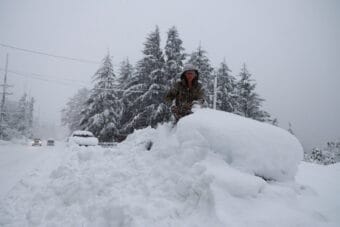
Sam Cagle digs her car out of the snow on Douglas Highway on Monday, Jan. 15, 2024. (Clarise Larson/KTOO)

Update: Jan. 15, 7:30 p.m.

Thane Road is closed to all but emergency access after a number of slides came down on Monday afternoon and evening. Between 1.5 and 2 feet of snow are covering the road in the avalanche area, according to the city.

Alaska Department of Transportation spokesperson Sam Dapcevich said the department sent a plow truck through to create a lane for emergency access, but the rest of the road is closed through at least Monday night. 

“We don’t want our crews down there while the risk is still high and when we can’t see what’s going on up above,” Dapcevich said.

The department plans to do additional avalanche mitigation from noon to 2 p.m. on Tuesday. Thane Road’s avalanche gates will be closed during that time.

“If we feel like the risk is low enough, we would reopen the road until the mitigation work takes place,” Dapcevich said.

Original story

Juneau’s urban avalanche advisory is “high” on Monday, as a winter storm that dumped more than 20 inches of snow over the weekend is expected to continue through the evening.

The advisory says that avalanche activity is likely, with the potential for large snow slides. Avalanche country should be avoided for the next several days. But Tom Mattice, the city’s emergency programs manager, says avalanches are not likely to hit houses for now. 

“It could get into the urban perimeter. We could see powder clouds come through the neighborhood, we could see a random avalanche get out,” Mattice said. “But in general, I think that we’re still safe in the urban environment.”

According to the advisory, the snowfall came with warming temperatures. That created an “upside down” snowpack, with very cold, light snow on the bottom and heavier snow on top. And that snowfall came after a cold snap that created icy crusts on the existing snowpack.

Light, cold snow typically doesn’t bond well with the existing snowpack, which means it could give way and trigger an avalanche. 

“Right now, we have a couple of icy layers down deep in the snowpack — just really weak snow crystals,” Mattice said. “Now we’ve loaded them to a tremendous degree over the last couple of days. And the question is, how much can they take?”

The advisory said avalanche danger will likely decrease after the storm wraps up, and colder temperatures should help stabilize the mountain snowpack — but that people living in avalanche zones should keep checking the urban avalanche advisory web page for updates.

Katie Anastas contributed reporting.

This post has been updated.

Juneau’s deadliest landslide tore through downtown like a ‘mighty grinder.’ Now it’s a fading memory

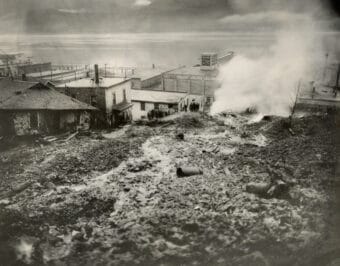
The 1936 landslide buried four buildings on South Franklin Street and killed 15 people, making it the deadliest natural disaster in Juneau’s history. To the left, plumes of smoke billow up from underground fires that broke out in a crushed apartment building. (International News Photos/Public domain)

Editor’s note: This story was originally written for the Nov. 22 anniversary of the 1936 landslide. We delayed publication after a deadly landslide struck Wrangell on Nov. 20.

Nearly a day after Juneau’s deadliest landslide, rescue crews had given up hope of finding any more survivors. But they kept working, shoveling muck from atop the 20-foot heap of debris that covered what is now South Franklin Street.

Plumes of steam and smoke billowed from under the jumble of mud, boulders and broken trees. Early that morning, an underground explosion in a buried apartment building had sparked fires that would burn for hours.

Cascades of water poured down Mount Roberts as people sloshed through flooded streets, calling out for loved ones.

A little voice cried out from somewhere beneath the mud. One of the rescuers, an AJ Mine employee named Ernest Mattielli, recognized it as the voice of 3-year-old Lorraine Vanali, the daughter of his friend Joe.

“I’m tired,” she said. “Why don’t you come and get me.

Rescue crews work to dig out Lorraine Vaneli. (Trevor Davis/Alaska State Library Historical Collection)

‘Everything went dark’

Nov. 22, 1936 was a quiet Sunday evening in Juneau. It was raining. It had been for weeks. 

That night, Lorraine and her parents braved the downpour on their way to a dinner party. As they set out, Albert Shaw was at his grandfather’s house a few blocks away.

“We were reading, my brothers and I —  well, I was probably looking at a picture book, at six years of age, ” Shaw said in an interview in November 2023. “All of the sudden, the lights go out — everything went dark.”

Shaw — who has lived in Juneau for all of his 94 years — is perhaps the only living person who remembers that night. But at the time, he didn’t know what was going on. 

The 1936 slide path as seen upslope near Gastineau Avenue, November 1936. (Trevor Davis/Alaska State Library Historical Collection)

The lights flickered out at the Matson Boarding House, too, on what is now South Franklin Street. V.A. Babcock, a miner, was finishing up a bath when he heard a loud rumbling. The walls of his bedroom began to twist and tilt. 

He covered himself and bolted for the front door only to see the building’s porch get swept away in an enormous flow of mud that roared down from Mount Roberts. He turned back and made a narrow escape by jumping out a window.

Nearly naked in the rain, he stood and watched as the boarding house careened down the hill. 

On the street below, a Mrs. J. Wilson made her own narrow escape when “turning around she saw a great concrete building following her, which she described as a huge pile driver, just ready to strike.” Two men pulled her out of the way just in time, the Alaska Daily Empire reported.  

Rescue crews work by the light of headlamps on the night of Sunday, Nov. 22, 1936. The slide knocked out power lines, casting much of the city into darkness. (Frederick K. Ordway/Alaska State Library Historical Collection)

Albert Persson and his family didn’t have the time to escape when their apartment on the third floor of the Nickovich Apartment Building started shaking. 

“I knew it was a slide. There had been so many before,” Persson wrote in an account published by the International News Service.

He and his wife huddled around their two young children as plaster rained down on them. Then the ceiling and the walls collapsed.

“It was sort of a funny feeling,” Persson wrote. “Like being inside an egg when something smashed it.”

The entire Persson family was rescued alive from the wreckage.

The slide engulfed the Matson House, the Nickovich building and two other buildings. The great pile of debris — about 20 feet deep and 75 feet wide — came to a halt against the Juneau Cold Storage building, which stood across from the modern-day cruise ship terminal. 

Along the way the slide took down telephone cables and power lines, throwing the city into darkness. 

“The mighty cascade of dirt and rock roared down the mountainside on its mission of death, sweeping all before it,” the Empire wrote.

A blaze amid the landslide debris in the early morning hours on Nov. 23, 1936. (Photo by Trevor Davis/Alaska State Library Historical Collection)

Shaw’s father, a volunteer fireman, joined dozens of men who formed the rescue crews — city officials, police officers, U.S. Forest Service employees and sailors from the U.S. Coast Guard cutter Tallapoosa, which was docked in town.

“They put some of the miners to work, shoveling the muck, because that’s what it took,” Shaw said. “This took several days to get it cleaned up.” 

Babcock was among them. He borrowed clothes from a friend and returned to the scene of his near-death. The crews set to work by the light of headlamps and headlights from cars and fire engines, which illuminated a gruesome scene. Live wires sparked fires, and heavy rain kept pouring down as rescue crews started digging. 

The slide crushed four buildings and buried 23 people. (Trevor Davis/Alaska State Library Historical Collection)

Twenty-three people were caught in the slide. Some escaped with minor cuts and bruises, others with deeper wounds or broken bones. Gust Erickson, who lost his home, survived “slightly crushed” after his stove slid across the room and pinned him against the wall, the Empire reported.

His wife, Cora, was buried beneath the house’s toppling chimney. She was the first slide victim discovered that evening.

“Tragedy has struck the city,” read a column in the Empire the next morning. “The forces of nature with which we must always battle for existence have overwhelmed the puny human efforts for a moment.”

The front page of the Alaska Daily Empire reported the tragedy on the morning of Nov. 23, 1936. (Alaska State Library microfilm collection)

Fifteen funerals

Fifteen people died in the landslide. It was national news. The Associated Press, the New York Times and local papers from California to New England wrote stories about the destruction.

In the light of day on Monday, people found that other, non-fatal slides had come down across town, one on Glacier Highway and another in front of the Salmon Creek Bridge. The debris snarled traffic for days.

Men stand atop a pile of landslide debris against the Juneau Cold Storage Building on what is now called South Franklin Street. (Trevor Davis/Alaska State Library Historical Collection)

The threat of more slides continued in the unrelenting rain. Hillside homes along Franklin Street and Gastineau Avenue were almost completely abandoned.

It took the makeshift search and rescue crews hours to reach the first slide victims — most were buried deep. The more they dug, the higher the death toll rose. 

“All the bodies were cut, bruised and discolored, as if hurled through a mighty grinder,” the Empire reported.

A wisp of a red dress led them to the body of Lucia Hoag, who had been attending a dinner party at the Nickovich Apartments with her family. Hours later, rescue crews discovered the bodies of her husband, James, and her fourteen-year-old son, Forrest.

Later that day, crews reached a gray-haired couple wearing pajamas. They were Hugo and Hilja Peterson, a couple who apparently had been crushed in their sleep.

A view of the landslide from South Franklin Street on Nov. 23, 1936. (Frederick K. Ordway/Alaska State Library Historical Collection)

It took five days to recover all of the victims. Most, it seemed, were killed instantly by the enormous force of the slide.

Local churches held 15 funerals that weekend. After the victims were laid to rest, the clean-up took weeks. Pickup trucks, dwarfed by the massive debris piles, lined up to carry the mud off to different parts of town, or to dump it in Gastineau Channel. 

Men shovel mud from the slide into pick up trucks on South Franklin Street, Nov. 23, 1936. (Frederick K. Ordway/Alaska State Library Historical Collection)

The rain was unrelenting for the rest of the year. A week after the first slide, a much smaller slide came down, leading crews to pause their efforts for the winter.

They cleared the remaining debris in the spring, but the mark of the slide was prominent for decades — a wide gash in the hillside where one cabin, which had been narrowly missed by the mud flow, stood alone.

The scar of the 1936 landslide was prominent for decades after it happened. It can be seen in this undated photo of the Juneau Cold Storage Building, taken sometime between 1939 and 1959. (Alaska State Library Historical Collection)

“That cabin was still there, I want to say, into the 50s, maybe into the 60s,” Shaw said. “And for years, there was no basic development. There were areas along Franklin, South Franklin, where there were no buildings.”

Today, the street is fully redeveloped. The area where the Cold Storage Building stood is a vacant lot, but the stretch of South Franklin Street opposite that lot is the heart of Juneau’s tourist district. On any given summer day, hundreds or thousands of cruise ship visitors wander in and out of gift shops that line the street. Some of those gift shops have apartments upstairs.

Today, the path of the 1936 slide is largely grown over. (Clarisse Larson/KTOO)

‘Juneau is built against a hill’

“Juneau is built against a hill, not just a rolling land but a gigantic mountain of hard rock covered in shale and loose dirt,” wrote Juneau resident George L. Webb, in a December 1936 letter to his family. “The rainfall last month was over 25 inches, which is a great deal for any century.”

According to Sonia Nagorski, a professor of geology at the University of Alaska Southeast, Webb’s letter describes the basic ingredients that trigger a landslide — a heavy bout of rain on a steep slope covered in loose sediment. 

“In Juneau, we’ve built up, you know, numerous houses right along the edge of these slopes,” Nagorski said. 

In 1936, the stretch of South Franklin Street at the base of Mount Roberts was one of Juneau’s most densely populated neighborhoods. A remarkable amount of rain saturated the mountain slopes that November. More than two feet — 25.87 inches — fell in the course of the month.

“First one record is broken, then another, until finally all the records are broken,” the Daily Alaska Empire reported a week after the landslide. “Now the meteorologist has put away his record book.”

A clipping from the Alaska Daily Empire on Jan. 14. 1937 (Alaska State Library microfilm collection)

Southeast Alaska’s geology is well-suited for heavy rains. Most of the time, the soils can drain the water fast. But if the drenching passes a certain point, water pressure starts to build up under the soil, and the solid earth is transformed into a slurry of soil and water.

That can trigger a debris flow — the most common kind of destructive landslide in Southeast Alaska — where viscous earth mixes with boulders, trees and other debris as it flows rapidly down a slope. 

Nearly four inches of rain fell in the 24 hours leading up to the 1936 slide. 

“It’s those heavy rain events — on top of conditions that were already rainy for a while — that seem to be the most hazardous,” Nagorski said. 

In Wrangell, the storm that led up to the fatal Nov. 20 landslide dumped three inches of rain in 24 hours. More than one inch fell in just six hours before the slide. 

And human-caused climate change is making heavy rain more common. Most of the heaviest, most prolonged rainfall in Southeast Alaska comes in tropical fronts known as atmospheric rivers, which are becoming more frequent.

Other deadly landslides in recent memory — the 2015 Kramer slide in Sitka and the 2020 Beach Road slide in Haines — happened during record rainfall events brought on by atmospheric rivers. 

So as the region gets wetter, landslides may become more common, too. But they have always happened in Southeast Alaska, and in Juneau.  

Today, South Franklin Street is lined with tourist shops, and a few apartment buildings. The open lot to the left is the place where the Juneau Cold Storage Building once stood. (Clarise Larson/KTOO)

In 1920, a debris flow came down on Gastineau Avenue, destroying 16 buildings including a boarding house, three homes and a dozen small cabins. It killed four people. 

A clipping from the Alaska Daily Empire on Nov. 23., 1936 (Alaska State Library microfilm)

Another Gastineau Avenue slide destroyed a house in 1929.

And just weeks before the Nov. 22, 1936 slide, a debris flow came down Mount Roberts and across Gastineau Avenue, breaking through the back of the Alaska Hotel, damaging two houses and burying one woman, who ultimately survived.

A series of slides downtown

Some blamed those slides on the AJ Mine, which cleared trees and operated its mill on the slopes of Mount Roberts.

In 1920, the AJ Flume overflowed just before the deadly slide. But that overflow came on top of snowmelt and nearly 2 inches of heavy rain over 24 hours. Geologists would later say that overflow from the mine did not cause the slide by itself. 

Gust Erickson and two other men who lost their wives and homes in the November 1936 slide filed lawsuits against AJ Mine, claiming that the company neglected to maintain the hillside. A deep crack in the ground beneath the flume was noted around the time of the slide. That may have contributed, but geologists would later determine that the slide began much further up the ridge.  

And even after the mine closed in 1944, slides off Mount Roberts kept happening. In October 1952, three more slides came down across Gastineau Avenue and South Franklin Street after a rapid burst of heavy rain. They destroyed two houses, and they came down within — or extremely close to — the same paths as the 1920 and 1936 slides.

A view of the vacant lot where the Juneau Cold Storage Building once stood, taken from Gastineau Avenue. (Photo by Clarise Larson/KTOO)

Albert Shaw said he’s tracked landslides and avalanches in Juneau closely throughout his life, ever since he first saw the carnage on South Franklin Street in 1936.

“Stuff has come off the hillside repeatedly. Now, it’s apparently slowed down. But that gives you a false sense of security,” Shaw said. 

Though Juneau hasn’t had a fatal slide since 1936, Shaw feels that’s just luck. He’s spoken out at city meetings on hazard mapping in recent months, urging the city to enforce stronger precautions for development in slide zones.  

Albert Shaw was at the cornerstone laying ceremony at the Shrine of St. Therese Chapel on October 30, 1938. (Photo by Lisa Phu/KTOO)
Albert Shaw in 2013. (Lisa Phu/KTOO)

Just last month, the Juneau Assembly voted to repeal hazard maps and development restrictions in landslide zones.

Nagorski, the geologist, said we can’t know when the next disastrous slide will happen.

“They don’t necessarily follow some regular temporal pattern, like a regular interval,” Nagorwski said. “It’s possible that a slope might not fail for the next several 100 years, or it might fail in the next atmospheric river.”

On the night of Nov. 22, 1936, this section of South Franklin Street was buried in a pile of debris 20 feet deep and 75 feet wide. (Clarise Larson/KTOO)

But the most likely locations for a major slide, she added, are known. 

When a landslide happens, it changes the slope, the vegetation and the way water flows down a hillside. That can make the slope susceptible to more landslides. And when a slide comes down, the debris flow can exploit natural gullies that funnel it down the hill. Or it can tap into channels that were carved by slides that came before it. 

“So the places around downtown — or anywhere in Juneau — that you would expect debris flow would be where they’ve happened before,” Nagorski said.

‘And the little spark of life went out’

For the men searching the rubble in 1936, the sound of Lorraine’s pleading voice felt too good to be true after nearly 48 hours of digging in the rain and mainly finding crushed bodies. Dozens of shocked and frantic rescue workers set to work digging her out.

“Faster, faster, flew the shovels,” wrote the Empire. “Hardened, calloused men who have often flirted with death were whipped into frenzied heights of energy as they heard that plaintive little voice call out ‘mother.’” 

By this time, the body of Lorraine’s mother, Delia Vanali, had already been recovered. Her father Joe would be found dead a few days later. 

It took rescue crews more than three hours to reach the toddler. She was huddled about 10 feet down in a small air pocket in the wreckage of the Nickovich apartment building — just a few hundred yards from where the downtown Juneau library stands today. 


Workmen after the rescue of Lorraine Vanali on Nov. 24, 1936. (Frederick K. Ordway/Alaska State Library Historical Collection)

Lorraine was alive and responsive, but she’d been pinned face down for almost two days, and she was badly bruised. A wooden chest had fallen on top of her. Her left hand was crushed, stuck beneath a fallen beam. Her legs were blistered and burned from the underground fires. 

She wore a jacket and a pair of ski pants that kept her warm from the November chill, and underneath, a pink silk dress and a string of gold beads she’d been dressed in for the dinner party. As Mattielli carried her out, Lorraine pushed her mop of curly brown hair away from her face, revealing wide brown eyes. She didn’t cry, the paper reported. 

She was rushed to nearby St. Ann’s Hospital, where doctors tried to warm her up and tend to her wounds. But she died less than two hours later. 

“The exposure and shock of being under the slide was more than was possible for the three-year-old to endure,” the Empire wrote. “And the little spark of life went out.”

The following Juneau residents died in the 1936 landslide

  • Forrest Beaudin, 14 years. A student at Juneau High school and the son of Lucia Hoag.
  • Pete Battello, 54. Owner of the North Transfer Company.
  • Cora Erickson, 64.
  • James Hoag, 40.
  • Lucia Hoag, 42.
  • Callie Lee, 38.
  • Lena Peterson, 48. A seamstress at Snow White Laundry in Juneau.
  • Hilja Peterson, 47. Store owner.
  • Hugo Peterson, 46. Long-time miner and carpenter for the Alaska Juneau Mine. Proprietor of the Peterson Boarding House
  • Pauline Lott (Latt), 55. A dressmaker.
  • Oscar Laito, 65. From Sitka.
  • Marie Mattson, 58. Proprietor of the Mattson Boarding House and wife of jeweler Fred Mattson.
  • Delia Vanali (Giovanele), age unknown.
  • Lorraine Vanali (Giovanele), 3.
  • Joe Vanali (Giovanele), 30. Electrician and maintenance man at the Gastineau Hotel.

Correction: This story has been updated with new information about Hugo Peterson’s occupation and about a building destroyed in the slide. Peterson was not a member of the Coast Guard. Malin Babcock, his granddaughter, reached out to say that Peterson was a carpenter and long-time employee of the Alaska Juneau Mine. She also told KTOO that the Peterson Building was a boarding house.

Freezing temperatures, wind chill coming to Southeast this week

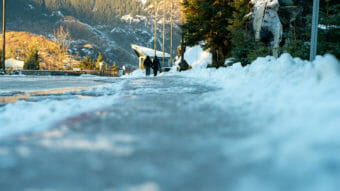
Ice covers roads and trails as temperatures drop to potential record breaking lows, December 16th 2022, Mendenhall Glacier, Juneau Alaska. (Photo by Paige Sparks/KTOO)

People in Southeast should brace for high winds and extreme low temperatures through the end of the week.

The National Weather Service issued a high wind warning for downtown Juneau and Douglas through tomorrow Thursday afternoon, and a special weather advisory warns of extreme low temperatures and wind chill across the region.

Temperatures are expected to start dropping rapidly Wednesday night and will continue to get colder through at least Friday morning.
Lows will be in the teens for most of the Panhandle. At higher elevations along the Haines and Klondike Highways, temperatures could reach 10 degrees below zero.

The strong winds will push temperatures even lower, especially in downtown Juneau and Douglas, where wind speeds could reach 25-30 mph with gusts of up to 60 mph.

Boats or loose property that might blow around should be secured. And residents should take precautions to prevent pipes from freezing or bursting.

Salmon compete with mining companies as melting glaciers reveal new habitat

Jonathan Moore of Simon Fraser University studies sockeye salmon in a formerly glaciated river within the Taku watershed in British Columbia, Canada. (Photo courtesy of Mark Connor)

The Gitanyow nation of British Columbia has long relied on two productive salmon streams, known as the Hanna-Tintina creeks, which flow in the Nass watershed. 

But back in 2016, a tribal fisheries report revealed that salmon were changing their spawning habits. 

“We learned that Strohn Creek — which is called Xsik’alaa’n in our language — was actually really productive,” said Naxginkw Tara Marsden, Sustainability Director of the Gitanyow Hereditary Chiefs. “Over 40% of the spawners were in this creek, which historically had not been a producer.”

The nearby creek had not been a salmon habitat because 100 years ago, most of it was covered by a glacier. 

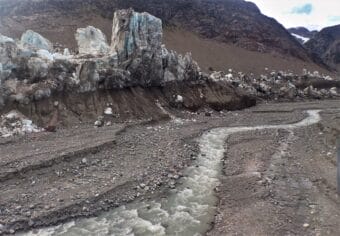
But climate change is rapidly transforming the landscapes of western Canada and Southeast Alaska. With warming fueled by the burning of fossil fuels, many of the region’s glaciers could melt away by the end of the century.

In their wake, they’ll leave thousands of miles of brand new salmon streams. But according to a recent study published in the journal Science last November, those streams may be threatened by resource extraction before the fish even get there. 

A river flowing through a deglaciating landscape in the Taku watershed in British Columbia, Canada. (Photo courtesy of Jonathan Moore)

By the time salmon were discovered in Xsik’alaa’n, mining companies had already staked claims in the surrounding hillside. And the study finds that much of the region’s new salmon habitat overlaps with a mining hotspot where dozens of claims have already been staked on newly melted land. 

“So we have a choice as to how we steward those nascent ecosystems,” said Jonathan Moore, a researcher at Simon Fraser University who led the study. “Are we going to protect them for future salmon habitat? Or are they going to be mined?”

Moore, Marsden and collaborators from the University of Montana and the Taku River Tlingit First Nation compared maps of glacial retreat and future salmon habitat in the transboundary region of Alaska and Canada against mining claims within a three-mile radius. 

Out of 114 watersheds, they identified 25 watersheds where half the future salmon habitat overlapped with mining claims, and 17 watersheds with more than 90%. 

That’s largely because many of the region’s fast-melting glaciers are within the “Golden Triangle,” a mining hotspot in Canada’s western Stikine region. As the name implies, most of the mining activity there is focused on gold.

And this modern day gold rush is facilitated by the Mineral Tenure Act, a colonial mining law that allows mining companies to get the rights for exploration and development with little consultation and a nominal fee. 

Under this law, mining companies have been able to stake claims on top of glaciers that are still frozen, and on the unceded First Nations land.

If a mining claim develops into a more permanent mine, it’s subject to various environmental assessments and regulations under the Mineral Tenure Act. But those environmental laws do not mandate the consideration of climate change or future habitat. 

“That’s not surprising, given how fast the world is changing and how hard it is to change policy,” Moore said. “But I think there’s an urgent need for environmental laws to look to the future and ask whether they’re protecting future habitats and not just current habitats.”

According to a recent decision by the Supreme Court of British Columbia, the Mineral Tenure Act violates Indigenous constitutional rights to stewardship too.

“The hurdle that gets created when [mining companies] stake their claims, is that then they’re owed something,” Marsden said. “We’ve stewarded these lands for tens of thousands of years, and we’re not owed anything.”

According to the court decision, the mining claims staked under the Mineral Tenure Act undermine the Canadian government’s duty to consult with Tribal nations before approving environmental permits. The province has 18 months to rewrite the Act.

Tribal governments like the Gitanyow Hereditary Chiefs hope that the province will follow their lead. In Gitanyow territory, mining in around the Hanna-Tintina creeks was already banned by the Gitanyow Lax’yip Land Use Plan in 2012.

And in 2021, they extended the same protections to Xsik’alaa’n, Strohn Creek through the declaration of the Wilp Wii Litsxw Meziadin Indigenous Protected Area. 

Though Tribal governments have led the way, the study notes that it’s possible for federal or provincial governments to establish proactive protections too. In the summer of 2023, the U.S. Forest Service established a ban on mining in areas around the retreating Mendenhall Glacier in Juneau. 

Site notifications
Update notification options
Subscribe to notifications