Anna Canny

Local News Reporter

A pair of earthquakes near Glacier Bay shook Southeast Alaska on Friday

A pair of earthquakes on Friday, Oct. 27, 2023 originated from a strip of land between the Denali Fault to the northeast and the Fairweather Fault to the southwest (Alaska Earthquake Center map)

Southeast communities felt the shudder of two earthquakes on Friday evening. 

A pair of quakes — first a magnitude 5.1 and then a magnitude 5.3 — happened about 45 minutes apart near Glacier Bay National Park. They were felt lightly in communities as far away as Juneau and Whitehorse. Smaller aftershocks continued through the weekend — about 40 so far. 

Senior scientist Natalia Ruppert with the Alaska Earthquake Center said moderately sized quakes like these are not surprising for the region. 

“These are common, although they are infrequent,” Ruppert said. “Maybe once every three or four years. So it kind of fades away from people’s minds.” 

Smaller aftershocks continued through the weekend, following the initial magnitude 5-plus quakes on the evening on Friday, Oct. 27, 2023 (Alaska Earthquake Center graph)

Over the past decade, a few significant quakes have shaken Southeast Alaska. In 2017, a pair of magnitude 6-plus quakes near Haines caused some damage in Whitehorse. And in 2013, a magnitude 7.5 earthquake near Craig was felt as far away as Seattle.

Back in 1958, a magnitude 7.8 quake damaged docks and bridges in Yakutat and triggered a landslide that generated a deadly tsunami in Lituya Bay — the highest ever recorded. 

Quakes in Southeast Alaska often happen near two faults — the Denali Fault, which extends south from the Alaska Range through Southeast Alaska, and the Fairweather Fault, which runs along the coast. In this case, the quakes originated from a strip of land between the two. 

Both are strike-slip faults, which are fractures between two different pieces of earth that move horizontally. The earth on either side of the fault moves at different rates. Ruppert said it’s like two cars driving at slightly different speeds in parallel lanes on the highway.

“If you put a rubber band around those two cars, it would keep stretching, stretching,” Ruppert said. “And that’s how the pressure builds up.” 

When the rubber band breaks, pressure is released. That’s when a quake happens. 

Strike-slip faults are typically pretty close to the surface, so even small or moderate quakes are easier to notice. Residents who felt the earthquakes are encouraged to fill out the “Did you feel it?” form from the U.S. Geologic Survey, to help scientists with their follow-up analysis. 

State’s draft energy plan highlights familiar Alaska megaprojects, offers vague plans for renewables

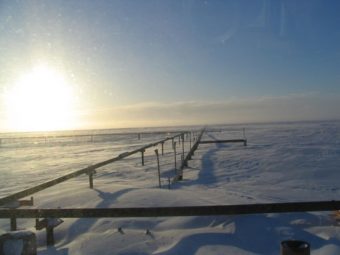
A natural gas line near Barrow
A natural gas line near Barrow. (Photo by Daniel Cornwall/Flickr Creative Commons)

This month, Gov. Mike Dunleavy’s energy security task force released a draft of its statewide energy plan. The draft breaks down strategies to upgrade energy for three major regions in Alaska — rural communities, the coasts, and the Railbelt.

The plan takes a broad approach. There are mentions of fossil fuels — especially natural gas — and renewables like wind, solar and hydropower. It even calls for developing technologies like micronuclear plants.

“It was kind of a large collection of every energy idea anyone’s ever heard for the past 10 years in one document,” said Ben Boetteger, a policy analyst with Cook Inletkeeper. 

But the only specific projects are proposals that have long been criticized by renewable energy advocates.

The document calls for revisiting long-discussed megaprojects like the Susitna Dam and the Alaska Liquid Natural Gas pipeline, also known as the AKLNG projectan 800-mile pipeline that would run from the North Slope to Cook Inlet. 

Activist Arleigh Hitchcock with the Fairbanks Climate Action Coalition said it would be a “carbon bomb,” emitting a massive amount of greenhouse gas that causes climate change.

“We need to move away from natural gas,” Hitchcock said. “It’s still a fossil fuel, and a limited resource. And unreliable.”

The draft plan says that bringing the pipeline to fruition would be good for Railbelt utilities, which rely almost entirely on natural gas from the Cook Inlet. Cook Inlet supplies could run short before the end of the decade. 

But the project also has a $40 billion price tag. And to build it, Alaska would have to sell some gas leases to buyers outside of the state, mostly in Asia. No buyers have come forward yet. 

Critics say the project is not financially feasible, and it’s not clear how much of the hypothetical gas supply from the AKLNG would be sold to Alaskans. 

Hitchcock said the draft plan’s focus on the AKLNG and other natural gas prospects was disappointing.

“It would’ve been nice to see the taskforce come out with some real solutions, some renewable energy solutions, that are the future for Alaska,” they said. “Instead of continuing the same extractive model for the state that isn’t working.”

The draft plan does lay out broad intentions to promote renewable energy projects — things like workforce development and recruitment, new financing options for renewable energy projects, and more money towards the state’s existing renewable energy fund. 

The plan also calls for the adoption of a state clean energy standard. Early on, the taskforce considered a renewable energy standard instead. That would have set enforceable targets and deadlines for utilities to incorporate more sustainable energy like solar and wind power. A clean energy standard — which the task force endorsed — is incentive-based and has looser terms. 

It’s too early to tell if these suggestions will do much to increase the amount of renewable energy in the state. But Boetteger, with Cook Inlet Keeper, said the draft plan’s could motivate lawmakers. 

“I expect this is going to be influential in the legislature, so it will definitely help elevate these issues,” Boetteger said. “But as for solving them, it is definitely not a solution in itself.”

None of the draft plan’s proposals are hard commitments yet. And notably, in nearly 150 pages of proposed renewable energy strategies, the report only mentions climate change once. 

Later frosts could make new crops possible in Alaska, but climate change brings challenges, too

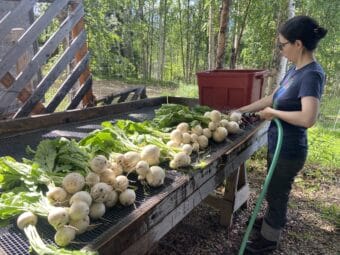
Farmhand Jeanetta Carroll washes turnips at Calypso Farm in Fairbanks, Alaska in summer 2023 (Photo Courtesy of Susan Willsrud/Calypso Farm)

In October, fall gives way to winter for much of Alaska. But each year, the first frost is arriving later and later. That could be a boon for Alaska farmers.

University of Alaska Fairbanks professor Glenna Gannon says the longer growing season is making some types of crops possible for the first time. 

“We’re successfully able to grow things like artichokes and field-grown tomatoes, peppers and corn here in Fairbanks,” Gannon said. “I don’t think, you know, 30 or even 10 years ago, that would have been successful.”

Fields at Calypso Farm, summer of 2023 (Photo Courtesy of Susan Willsrud/Calypso Farm)

Gannon runs crop trials at the university’s experiment farm, where nine out of the 10 latest first frosts on record have occurred since 2001. For many places, especially in the Interior, that shift is allowing farmers to keep their crops in the field through mid-September. 

In a state that’s struggled with food security, shifting seasons and hotter temperatures brought on by human-caused climate change could allow Alaska farmers to grow more abundant and diverse produce. But climate change can also bring drought, pests and permafrost thaw. 
And it can make weather more erratic too. Tom Zimmer of Calypso Farm, just outside of Fairbanks, said that’s what he worries about most.

“Yes, frost-free days are increasing,” Zimmer said. “But the instability of the climate is making it probably more difficult to farm.”

Zimmer and his wife have run their small organic farm since 2000. This year, snow and frost lingered late into the spring, which delayed planting. Then a hot, dry summer came on quickly. Some plants thrived. 

“This year, we had excellent green beans, amazing cauliflower,” Zimmer said. “But other crops bolted. It was too hot.” 

Hot summers will become more and more common for many regions across the state, according to climate researcher Nancy Fresco with the university’s International Arctic Research Center. Fresco develops climate models to predict Alaska’s agricultural future. 

“We’re anticipating continued increases in both the length of the growing season — how many frost-free days — but also in the cumulative heat across the growing seasons,” she said. 

Summer heat gives some crops a boost

As the climate warms over the coming decades, the frost-free season will likely get longer by weeks or even months. And summers will continue to get hotter. 

Every plant has its own baseline temperature where it begins to sprout and grow. To mature for harvest, it needs a certain number of days with temperatures above that threshold. Hotter summer days that linger later in the year can increase the number of good growing days to give certain crops a boost. 

Warm-weather species, like tomatoes, corn and peppers, need temperatures of at least around 50 degrees to start growing. To ripen, they need a lot of days that fall above that threshold. So historically, those crops have been hard to grow in Alaska without a greenhouse.

But even cold-tolerant species, like brussels sprouts, have been a challenge because they take a relatively long time to mature. Farmers and gardeners who have tried to grow them in Alaska have risked losing their crops to frost and snow before the harvest.

Theoretically, climate change could help both types of crops. But Fresco said existing climate models also neglect a lot of important factors that shape farming.

“We were really just looking at air temperature, which is of course, a big deal in growing crops,” Fresco said. “But there are some really important factors about what can grow, — that are particular to Alaska, that are challenging in Alaska — that we haven’t yet had a chance to model.”

Glenna Gannon harvesting peppers at the University of Alaska Fairbanks experiment farm in summer 2023 (Photo courtesy of Glenna Gannon)

Permafrost — a layer of soil that remains frozen throughout the year — is one of the most pressing factors in the Interior. It can affect soil temperature and moisture, which can inhibit plant growth regardless of air temperatures. But as it thaws, it will likely destabilize seemingly viable farmland in the sub-Arctic. 

And even as atmospheric conditions become more favorable, farmers will still have to contend with the long hours of sunlight — up to 22 hours for some farms in the Interior. Some crops just can’t tolerate that much light. 

Farmers proceed with caution

Zimmer, from Calypso Farm, says there’s a disadvantage for every advantage that climate change brings. Some of Alaska’s more cold-tolerant crops, like cabbage or broccoli, may actually fare worse as temperatures warm. And many regions in the state are also facing a higher threat of summer drought.

Winters are also becoming more mild overall. While that can be great for certain perennial crops, like fruit trees, Zimmer said it’s brought more aphids and root maggots to his crops.

“In our 20 year experiment, one of the things that’s most noticeable to me is the insect life cycle,” Zimmer said. “One of the beauties of growing in Alaska is a harsh winter that kills a lot of our pests. And that’s starting to go away.”

Climate change will increase the breadth of crop varieties and the amount of land that’s viable for farming in Alaska. In some ways, Zimmer said, that’s a great opportunity to improve food security and access to locally grown food.

“We really want to focus on growing more farmers in Alaska,” he said. “But it’s not like Alaska is warming, everything’s great. We have to proceed slowly, carefully and work with the natural cycles.”

Both Zimmer and Gannon say that planting a diversity of crops is the best way for farmers to prepare for climate change. Though warm weather crops are becoming more possible, they might not be reliable.

“We have the ability to have a much greater breadth of what we grow here,” Gannon said. “But I still want to plant the seed of caution for anyone who’s going out to grow their garden or plant their farm. You know, they’re still in Alaska.”

Flood watch canceled for Juneau

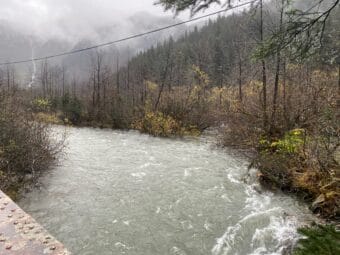
Waters rose in Gold Creek on the morning of Thursday, Oct. 19, 2023. (Photo courtesy of Claire Stremple)

Update — Oct. 19, 2:20 p.m.

A flood watch for the Juneau area has been canceled. In an update Thursday afternoon, the National Weather Service said Jordan and Montana Creeks had crested, and the threat of flooding had passed.

Original story

A flood watch is in effect for the Juneau area after the remnants of a tropical typhoon passed over Southeast Alaska this week. National Weather Service meteorologist Pete Boyd said forecasters are monitoring flood-prone areas, especially around Jordan Creek and Montana Creek.

“We started to see spikes in the creeks,” Boyd said. “But right now we’re already starting to see them crest.”

Rain is expected to diminish through Thursday morning, but flooding is still possible in the Juneau area. A flood watch is issued when there’s a possible threat of flooding, with rivers rising. But under a flood watch, flooding is not imminent. 

Boyd said the possibility of flooding will decrease as rain continues to lighten up heading into Thursday afternoon. 

“Precipitation rates and amounts are already diminishing rapidly,” Boyd said. “In fact, we’re already starting to see breaks in the clouds in some places.” 

This week’s heavy rainfall broke daily rainfall records in Juneau, Ketchikan and Sitka. Juneau saw just under two inches on Wednesday, breaking the previous record of 1.51 inches for that date from 1964.
Despite the record setting, Boyd says that amount of rain is pretty typical for October in Southeast Alaska. 

Lighter showers will persist through the weekend before a period of drier, colder weather beginning next week. 

Juneau condo owners take on $1 million in flood repairs without help from state or federal aid

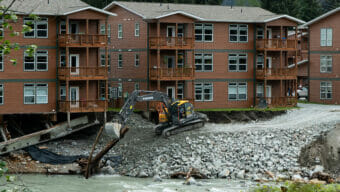
Workers removed debris and added rock fill along the bank at Riverside Condominiums on Aug. 8, 2023. (Andres Javier Camacho/KTOO)

Juneau’s record-breaking glacial outburst flood in August nearly sent a condo building on Riverside Drive into the Mendenhall River.

The morning after the disaster, Riverside Condominium Homeowners Association treasurer John Dittrich saw the building hanging over the edge of the riverbank. He called a meeting of the HOA board.  

“It seemed very precarious, where it was sitting. So we acted immediately,” Dittrich said. “We authorized emergency use of our reserves. Which were never intended for something like this.”

Money collected from residents for routine maintenance like trash pickup or the occasional paint job became a disaster relief fund instead. There was enough money to stabilize the precarious Building D, but that was just a fraction of the necessary repair work. Building D needs a new foundation, and the erosion left three more buildings vulnerable to future floods. 

The cost to fix those things is estimated at more than $1 million. 

The state disaster declaration freed up some recovery money — up to $20,500 per homeowner. But the way Alaska law treats HOAs — and the way state disaster aid is doled out — makes the Riverside Condo residents ineligible for state aid. 

“You’re stuck paying, but you can’t put your hat out for some more money,” Dittrich said. “So it’s frustrating for a lot of people.”

Recovery aid falls short 

Condo residents say recovery aid from familiar safety nets like insurance and federal and state disaster aid has fallen short of their expectations. In the weeks since the flood, insurance has denied most of their claims. Then, in late September, the Federal Emergency Management Agency denied requests for disaster aid. 
Brenna Heintz still hasn’t been able to get into her unit on the top floor of Building D. She applied for individual disaster assistance from the state, which can hypothetically cover repairs for property that’s damaged in a natural disaster. But she was denied.

The state told her that repairs for her damaged building were not her responsibility. 

“It’s the HOAs responsibility. But in order for them to fix that they need money, and that comes from us,” Heintz said. “I am not eligible for homeowners aid, even though the money is coming out of my pocket.”

That’s because Alaska state law requires that homeowner’s associations share responsibility for “common elements.” In this case, all of the Riverside Condo buildings count as a common element, and all 51 homeowners in nine HOA condo buildings are on the hook for repair costs, even though most of the buildings were untouched by the flood.

Each individual condo owner will have to pay between $21,000 and $26,000 for the repair work, depending on the size of their unit. But under those same state laws, the HOA is treated like a nonprofit business, not a group of individuals. Which means people like Heintz can’t access most forms of individual state disaster aid. 

“I was naive about the scope of this when it first happened. And I was naive about the actual amount of money it would take,” Heitz said. 

Donations, private loans fill the funding gap

Heintz and some of her neighbors are relying on donations from family, friends and the community at large. One of Heintz’s friends set up a GoFundMe that raised almost $28,000 — just enough money to cover Heintz’s share of repairs. 

She said that without those donations, she’d have to take out a loan. And that’s what many residents in the undamaged buildings are doing. A local lender, True North Federal Credit Union, offered loans with below-market interest rates for up to 20 residents. Dittrich says most of those loans have been claimed. 

Loans from the federal Small Business Administration recently became available. Unlike aid from FEMA, homeowner’s associations are eligible. But Dittrich said that option came too late. Individual condo owners might pursue it, but the HOA won’t. 

Other condo owners, like Joanna Forst, took money out of their savings. Forst owns a unit in the undamaged Building A along the riverbank, which she rents out. She said her obligation to pay for the cost of repairs came as a shock at first. 

“That’s a lot of money out of everybody’s pocket. Yet, that’s what I signed into,” Forst said. “And that was a hard pill to swallow.”

Forst was able to make her payment in full, but as a stay-at-home mom, she said that money had been an important supplement to her husband’s income. 

“My spending has basically been cut to absolutely no spending,” Forst said.

But in the end, she said repair work felt like a worthy investment to protect her unit from future flooding. 

Dittrich says about three-quarters of Riverside Condo residents have made their payments, while the rest navigate different payment options. 

“Our goal is to get much of this work done before winter sets in,” Dittrich said. “And that’s certainly a tall order.” 

Much of the initial work to armor the bank is nearly done.

Remnants of Typhoon Bolaven will bring heavy rain, strong winds to Southeast Alaska

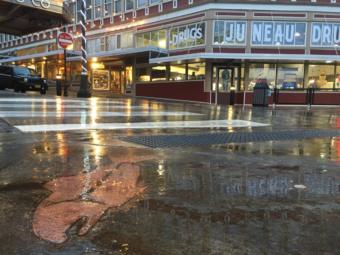
Rain trickles onto the pavement in an intersection in downtown Juneau, Nov. 19, 2019. (Photo by Ryan Cunningham/KTOO)

The remnants of Typhoon Bolaven will reach the Gulf of Alaska this week, bringing moderate to heavy rain and strong winds to Southeast Alaska.

National Weather Service meteorologist Kimberly Vaughan said rain is expected to pick up on Tuesday morning.

“We’re looking for rain to continue through the week,” Vaughan said. “It will somewhat taper off by Friday.” 

A high wind warning is in effect for communities in the Southern panhandle — including Prince of Wales Island, Ketchikan and Metlakatla — with winds between 20 and 30 mph and gusts up to 60 mph as the ex-typhoon makes landfall on Tuesday morning. 

Winds at that speed could blow down trees or power lines, which could cause blackouts in those communities. 

Though rain will be heavy, 24-hour rainfall totals are expected to be between one and two inches. Meteorologists say that’s similar to a typical fall storm.

“It’s still going to be heavy rain, and we’re going to continue to monitor river levels,” Vaughan said. “But it’s not anything that’s likely to be record-breaking.” 

There is still the potential for minor flooding across the entire panhandle. Meteorologists will update forecasts to give more detail on flood potential as rain begins to fall. 

At its peak over the western Pacific Ocean this past weekend, Typhoon Bolaven reached wind speeds of 180 miles per hour, making it the second strongest storm worldwide of 2023. 

Ocean temperatures are warming worldwide due to human-caused climate change, which can lead to more intense storms like Typhoon Bolaven. Warm ocean waters can cause storms to grow stronger, faster. Current water temperatures in the Western Pacific are about 1 to 3 degrees above average.

There are also El Niño conditions this fall, which makes ocean temperatures even warmer. El Niño is a natural climate pattern that brings warmer waters to parts of the south Pacific Ocean, which affects weather in Alaska and across North America.  

When El Niño conditions combine with warming caused by climate change, it can fuel more intense storms.

Typhoon Bolaven weakened significantly as it moved across the open ocean over the weekend. By the time it makes landfall in the Southeast, it will be even less powerful. Still, people across Southeast should expect a week of wet weather.  

Site notifications
Update notification options
Subscribe to notifications