Anna Canny

Local News Reporter

Meteorologists vs. microclimates: Forecasting the weather in Southeast Alaska

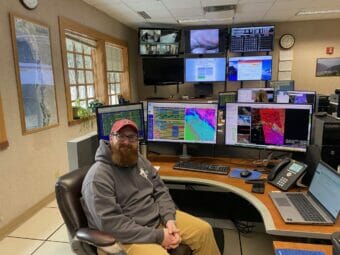
Meteorologist Grant Smith at the National Weather Service office in Juneau. (Photo by Anna Canny/KTOO)

Last week, a blizzard in Juneau forced schools to shut down in the middle of the day, touching off a scramble to pick up kids amid blowing snow and slippery roads.

School officials told parents they chose not to close ahead of time — despite forecasts that had called for up to 8 inches of snow — because “often the weather doesn’t hit as forecasted.”

It’s true. Weather forecasting is notoriously hard to get right, especially in Southeast Alaska. No one knows that better than National Weather Service meteorologist Grant Smith.

“One time I was standing at my house looking outside, just drinking my coffee, and it was 34 and raining. Later that afternoon it was 38 and snowing,” Smith said. “I was just like, ‘I give up.’ It’s a moving target.”

Smith moved to Juneau in 2020 after seven years working as a TV meteorologist in South Dakota. He says forecasting there was a little more straightforward. 

“South Dakota, a lot of it is flat. So you can just take the models and go ‘eh, that sounds right’,” Smith said. “Because it’s flatter, the range of possibilities is much smaller.” 

Models meet microclimates

Weather forecasts start with three basic components: satellites, radar and models. 

Together, radar and satellite imagery show the basics of incoming weather systems. Meteorologists can look at them to see the direction of a storm or the intensity and location of precipitation. 

Weather models are used to bring out the finer details. Smith and his colleagues at the NWS run more than a dozen models to build the forecast each day. They all use the same basic principle: running simple atmospheric data through complex equations that predict things like wind speed, dewpoint and temperature.

But what’s happening in the atmosphere doesn’t always give a clear picture of what’s happening on the ground. That means forecasters have to compare the weather systems to what they know about the terrain. And the mountains and waterways of Southeast Alaska make things complicated. 

For instance, Hoonah and Gustavus are fairly close to each other, but the same wind pattern can cause very different weather in each.

“The north wind for Gustavus is coming off of land — probably going to be cold, probably going to be snow,” Smith said. “But a north wind over Hoonah is coming off the water. Rain, rain-snow mix, or rain.”

Juneau alone has a handful of distinct microclimates. 

Downtown, right on the water, it’s usually rainier. When fronts come off the ocean, clouds hit Douglas Island before dumping rain downtown. Meanwhile, in the Valley — which lies in the shadow of Mendenhall Glacier — it’s often less rainy and colder and snowier in the winter. 

And the area at the edge of the Mendenhall Wetlands is known for dense fog. 

“So naturally, we put an airport there,” Smith said. “That’s what we always joke about.”

Meteorologists can adjust the forecast to account for those differences. Meteorologist Nicole Ferrin says the models predict weather conditions for areas that are three square kilometers. But even in that small grid, Juneau’s terrain can change from land to ocean to high mountain peaks. 

By living and working in Juneau, Ferrin has learned to adjust the model forecast grid by grid to fit community needs. 

“The majority of this box is a mountain, and the models think that that is a mountain point. They don’t know that Home Depot’s right there. Right? But I do,” she said, as she clicked to edit the temperature forecast by hand. “I know that there’s people that live there and might be clicking on that point to get the forecast. So I’m gonna adjust that to match.”

Forecasters in the Juneau office of the National Weather Service work 24 hours a a day to keep tabs on changing weather throughout Southeast Alaska.
Forecasters in the Juneau office of the National Weather Service work 24 hours a a day to keep tabs on changing weather throughout Southeast Alaska. (Photo by Matt Miller/KTOO)

A Florida-sized chunk of Alaska

Southeast’s mountains and waterways are only part of the challenge. It’s also just a huge forecast area.

“Our area is about the size of Florida,” Smith said. “And Florida has six or seven offices. And we have one.”

After twelve years in Juneau, Ferrin has the benefit of local knowledge. But not all meteorologists stick around that long. And many of them haven’t visited all of the small communities they’re called on to forecast for.

So they turn to the people that live there.

The final component of the weather forecast comes from real-time observations, collected at weather stations scattered all over the Panhandle. They measure things like precipitation, wind speed and temperature. 

But a lot of the data that forecasters rely on comes from volunteers. 

“People that are weather nerds like the rest of us here in the building,” Smith said. “They like the weather, so they report on it.”

Spotters are trained on how to collect key pieces of weather data. When storms hit, they send information by email or over the phone from all across Southeast Alaska. 

Sometimes they beat the weather system. If a front passes over Gustavus, for instance, those local observers can help meteorologists predict what’s going to happen in Juneau.

Still, over an area the size of Florida, there are bound to be some gaps. Some places lack weather stations and spotters, which makes forecasts less precise. 

“We have a weather ob[servor] here, Tenakee Springs. We have one in Angoon. And then nothing between there,” Smith said. “So we may not know what’s going on there all the time.”

This satellite animation from the National Weather Service shows a weather system moving across Southeast Alaska on morning and afternoon of Aug. 2, 2022.

An abundance of caution

NWS forecasters often default to the more significant weather possibility, especially when making storm advisories or warnings. So if the conditions for heavy snow are there, they’ll include it in the forecast even if they can’t be sure it will happen everywhere.

“Sometimes when we issue a storm warning, you know, the range can be two to eight inches,” Smith said. “It’s not because we’re not sure. It’s because we think two inches down there and eight inches over there.”

If it does snow, the forecast gives the public time to prepare. If it doesn’t, it might be a pleasant surprise. But because their top priority is safety, they’re likely to over-predict sometimes. 

Despite the challenges, Smith says assembling a forecast in Southeast Alaska is more satisfying than anywhere else he’s worked.

“It makes it kind of more of a challenge,” he said. “And more fun when you can nail it. When you get it right.”

Cleanup crews respond to sewage spill on Douglas Island in Juneau

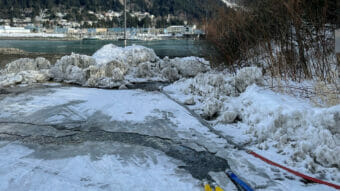
Hoses attached to the wastewater lift station on Douglas Island discharged into Gastineau Channel after a system failure early this morning (Photo courtesy of City and Borough of Juneau)

City cleanup crews are responding to a wastewater spill on Douglas Island, near the base of the Douglas Bridge.

Chad Gubala, a manager for the city’s wastewater utility, said that an equipment malfunction at around 5:30 Thursday morning caused sewage to spill from a city lift station near Sandy Beach into Gastineau Channel. 
Both the main and backup pumps failed at the lift station, which helps transport wastewater from homes on south Douglas Island to the Thane treatment plant. Gubala said crews were called in to stop the flow and pump out the flooded area. 

Gubala said no solids were visible in the initial spill, and much of the initial cleanup on the beach has already wrapped up.

“We’re now entirely stabilized with the situation and fixing our site appropriately,” he said.

The majority of the spill went directly into the channel. Gubala said the state Department of Environmental Conservation was notified by the city. The DEC has a standard procedure for sewage discharge to make sure everything was cleaned up properly. 

The lift station was restored to normal status by early Thursday afternoon, but Gubala says his team will be monitoring it closely.

In the long-term it will likely be replaced altogether. The wastewater utility has submitted plans for a $2.2 million capital improvement project — including lift station replacements — waiting for appropriation and authorization by the Juneau Assembly in the coming months. 

Price Tagish: As Alaska boats age, who bears the cost?

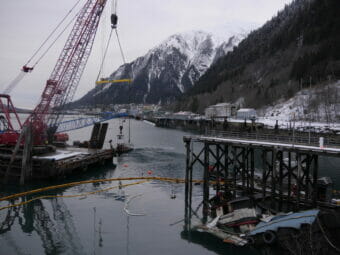
Recovery efforts for the sunken boat Tagish began in early February. It was a multi-agency effort led by the Coast Guard, with help from the Alaska Department of Environmental Conservation and a private salvage company, Melino’s Marine Service. (Photo by Katie Anastas/KTOO)

The Tagish, a 107-foot World War II tugboat, has finally been hauled away after nearly two months underwater.

The uninsured, 81-year-old wooden boat sank just south of Juneau’s cruise ship docks in December last year, following a cold snap that may have cracked its pipes. Its sinking ends a decades-long restoration effort by Juneau local Don Etheridge.

When the Tagish sank with approximately 60 gallons of diesel fuel and 50 gallons of lube oil on board, the U.S. Coast Guard was called in to address the pollution threat.

“The vessel was really contaminated,” said Chief Mike Ryan with the Coast Guard’s Incident Management Division. “It was a very old vessel with a lot of different fuel tanks.”

The cleanup, which wrapped up late last week, took more than two weeks and cost at least $650,000 — a cost that Ethridge, who did not have insurance for the vessel, could not cover up front.

When vessel owners don’t have the means to clean up pollution, the Coast Guard may be called in to take over. Often, that happens when a boat finally sinks.

“We deal with this maybe three or four times a year here in Southeast Alaska. So it’s not something that happens like every week,” Ryan said. “But I’d say in the long run, there’s probably going to be more issues with aging vessels. I think that’s just the nature of having a boating community.”

It’s hard to restore old vessels to their former glory, as Etheridge attempted. At the time of the sinking, he had replaced the interior and half the deck, which cost thousands of dollars.

“It scares me to think about how much I put into it,” Etheridge said.

But in some cases it’s even harder, and more expensive, to get rid of them.

“It costs you a small fortune to get rid of a boat,” said Etheridge, who is also chair of the Juneau Docks and Harbors board. “It’s cheaper to just keep paying your mortgage than it is to get rid of the boat.”

For many years, Etheridge even had the boat insured.

“And then the insurance company notified me that they weren’t going to insure it no more,” he said. “They canceled my insurance. Because of the age of the boat, being as old as it is.”

And just like that, Etheridge’s hobby project also became a huge liability. In Alaska and many other coastal states, the aging of the fleet presents a costly environmental hazard. According to a study from the Alaska-based McKinley Research Group, 54% of vessels in Southeast Alaska were built before 1980, which is beyond the typical lifespan for most boats.

But owners of older vessels are often left with few options.

“The Tagish is a symptom of a bigger problem,” said Juneau Harbormaster Matthew Creswell. “There is not an easy, cost-effective way to dispose of vessels when they reach the end of their useful life.”
Old tug boats, specifically, have caused multiple headaches in Juneau in the last decade. First, there was The Challenger, a 71-year-old wooden tug that sank near the Mendenhall Wetlands State Game Refuge back in 2016. It took six weeks and nearly $2 million to recover.

Excavators demolish the tug Challenger on March 7, 2016 (Photo by Mikko Wilson/KTOO)

Then the Lumberman, which was scuttled and sunk in 2021, after it was abandoned in city and state-owned tidelands for years. Its disposal cost Juneau Docks and Harbors $160,000, with an additional $70,000 from the federal government.

When those vessels were first abandoned, the state of Alaska had weak laws on liability for abandoned or derelict vessels. And in the case of the Challenger and the Lumberman, it was nearly impossible to hold someone accountable.

Vessels were not required to have ownership titles until the passage of SB 92 in 2018. The law requires all boats longer than 24 feet to be registered with the state. And it gives municipalities and the state the opportunity to be proactive in removing derelict vessels before they sink.

The law gives the state and municipal agencies like Juneau Docks and Harbors the authority to remove or impound a vessel that is considered abandoned or derelict. That authority is not often applied, and in most cases, there is no money to help them do that.

The tugboat Lumberman sitting in Gastineau Channel at low tide on June 15, 2018 (Photo by David Purdy/KTOO)

Etheridge moored the Tagish at the city-owned National Guard dock, which is a “non-moving” vessels area. Though Etheridge says the boat was seaworthy, he couldn’t afford to sail it due to the high cost of fuel.

According to Creswell, vessels in other parts of the harbor must demonstrate their seaworthiness three times a year.

“Unfortunately, the Tagish, that wasn’t fitting in any of those regulations.”

Still, he says, the boat was by no means abandoned.

“Mr. Etheridge bought that boat and he had great plans for it,” Creswell said. “He was a very responsible owner, he made daily checks of the boat, by all accounts he did everything right.”

Though SB 92 introduced a framework for dealing with vessel hazards, it leaves some gray area when it comes to long-term, old restoration projects like the Tagish, says Holly Wells, a lawyer with Anchorage-based Birch Horton Bittner & Cherot. Wells helped to write the legislation.

“I think that there’s a strong argument that it still falls under that definition of a derelict vessel. Despite the intentions,” she said.

Ultimately, though, the burden of proof for that designation falls on the state or municipality.

Rachel Lord, former executive secretary of the Alaska Association of Harbormasters and Port Administrators, also contributed to SB 92. She says the state needs to continue to develop plans for the aging fleet.

“These large old boats are liabilities, they’re tremendous. They’re beautiful. They were part of our history,” she said. “But they all have a lifetime, that clock that is ticking, and the maritime environment is not a friendly one. And when that clock runs out, however, it runs out, the cost is enormous. And so the question really becomes who bears that liability? Who bears that cost?”

In this case, it’s still Etheridge. But a bill of more than half a million dollars is a significant burden for many private boat owners. The federal Oil Spill Liability Fund can be deployed to clean up pollution when owners can’t front the cost.

“Theoretically owners are kept accountable,” Lord said. “But also, that is not an unending pool of money that the Coast Guard is just going to be authorized to continue using ad nauseam to deal with all of our vessels.”

Chief Ryan with the Coast Guard says there have been cases where payment plans are established, but in many cases the full funds are not recouped. Costs are just too steep for most boat owners.

At this point, Etheridge says he does not have much clarity on how much he’ll be expected to pay, and when.

“I haven’t heard a word. Haven’t heard nothing from them,” he said.

In some cases, insurance may be the answer. It can cover the cost of sinking and pollution recovery, but the state does not require vessel insurance of any kind, and most municipalities don’t either. Juneau, Skagway, Haines, Sitka, Wrangell, Petersburg and Ketchikan do not have insurance requirements of any kind.

Just last week a smaller, 20-foot uninsured boat sank in Statter Harbor. The owner has no means to remove it either.

In lieu of insurance, Juneau Docks and Harbors charges a “Vessel Disposal Surcharge” of $0.25 cents per foot, which Etheridge was paying. In spite of its name, that money does not go directly to vessel disposal. Rather, it goes into the general Docks and Harbors operating budget.

During last week’s Docks and Harbors meeting, Creswell said he’d like to raise that fee. And he says the board may consider insurance requirements too, though he says insurance will do little for aging boats.

“There are boats that, you know, I won’t call them uninsurable, but are difficult to insure due to age and construction,” he said.

Essentially, Juneau Docks and Harbors does not have a robust funding structure to help with vessel disposal.

In other nearby coastal states, most notably Washington, harbors implement minimum insurance policies for moored vessels. The Docks and Harbors discussed Washington’s approach in the recent meeting, but it is unclear if it will become a model for Juneau. Ultimately, Wells believes that Juneau’s Docks and Harbors team should not have to take the lead.

“The more we can do that on a state level, the better,” she said. “Because when municipalities are bearing the burden of adopting restrictive laws or imposing insurance provisions, that impacts their relationship with their users of their harbor. And that can be really damning.”

And the challenge is statewide. In Washington, the Department of Natural Resources has a pool of money to help with removal and disposal costs, as well as a voluntary vessel turn in program for boat owners. Lord says these options can help to get ahead on the issue.

“You’re dealing with it proactively instead of having to deal with sunken vessels and mitigation and cleanup and all the other things that come when a vessel starts coming apart,” she said.

If it comes to a case of sinking, the federal government may step in. But in Alaska, the Abandoned and Derelict Vessels program lacks teeth, and state funding.

Etheridge, who owns another wooden boat that still floats in Juneau, says he feels like he has limited options.

“I’ve lost sleep many nights over it,” he said.

Blizzard warning in effect for Juneau, avalanche danger is high

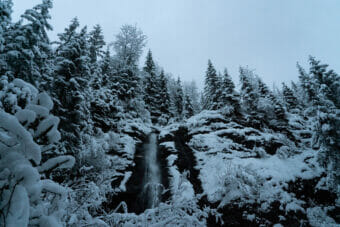
Waterfall near Mendenhall Lake after snowfall on Feb. 13, 2023. (Andrés Javier Camacho/KTOO)

Update Wednesday 12:50 p.m.:

The National Weather Service has issued a blizzard warning for Juneau through 6 p.m. Wednesday.

Snow amounts of 5 to 10 inches have been reported in the region, with 4 to 6 inches more expected.

“Some blowing snow has also been seen with visibilities down to a quarter mile or less at times. The southern panhandle and Sitka have warmed enough to change to rain, but have been seeing gusts to 45 mph,” the warning says.

The city’s current urban avalanche advisory is high.
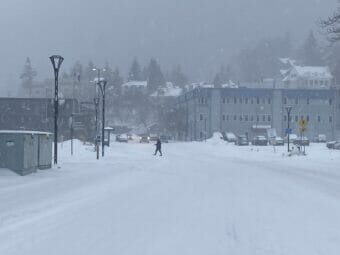
Juneau schools and city offices will close early Wednesday due to conditions.

Original story:

The National Weather Service has issued a winter storm warning in much of northern and central Southeast Alaska starting at midnight Wednesday, with up to 15 inches expected in Juneau.

NWS Meteorologist Edward Liske says snow will start accumulating while many in Juneau are asleep.

“Should have four to possibly six inches of snow already on the ground by the time you get up and get ready to go to work,” he said.

Liske says those who commute to work should make extra time for driving Wednesday morning.

That snowfall will be accompanied by wind gusts between 35 and 40 mph, which could cause blowing snow and reduced visibility.

“Slow down, prepare, be prepared for slippery, possibly snow-covered roads,” he said.

Accumulations of 8 to 15 inches are possible in Juneau, Gustavus, Hoonah and Haines by the end of the day Wednesday. The winter storm warning will expire at midnight on Thursday.

Liske says total accumulations are hard to predict, as they will depend on snow density. He predicts that snow will start out dry and fluffy, but there is a potential for a wintery mix of rain and snow Wednesday as temperatures warm.

Juneau Emergency Programs Manager Tom Mattice says that combination won’t bode well for urban avalanche danger.

“If temperatures are increasing during the storm, and we’re seeing increasing winds during a storm, especially as temperatures increase through the point of freezing, things definitely become unstable a lot quicker,” he said. “The danger will be increasing rapidly.”

Mattice says the snowpack that’s formed this winter has a lot of weak layers, which means a high potential for larger avalanches. He encourages people to pay close attention to the updated urban avalanche advisory on Wednesday morning.

Correction: This story has been updated to reflect that the storm warning expires at midnight on Thursday. 

This post has been updated with new information from the National Weather Service. 

High avalanche danger in Juneau after record snowfall

Freshly fallen snow on Whittier Street in Juneau on Feb. 23, 2023 (Photo by Anna Canny/KTOO)

After a week of clear skies and cool temperatures, people across the panhandle woke up to snow Friday morning. The National Weather Service issued a winter storm warning for Juneau and Gustavus effective through Saturday morning.

Friday brought a white haze of dry snow to Juneau and much of Southeast Alaska. NWS Meteorologist Spencer Fielding said that snowfall would pick up in the evening and through early Saturday morning.

By 12:00 AM on Saturday, more than 14 inches of snow were recorded at Juneau International Airport — a record for that day. The previous record for Feb. 24 was 9 inches, back in 1967.

Overall, snowfall in Juneau has been below normal this winter, with relatively little snowfall in January. But the snow total has been higher for the month of February, with several small snowstorms earlier this month.

Fielding said that snow for this storm would be mostly light and dry with smaller flakes because of the cold, dry weather earlier in the week.

“So what causes snow to be light and dry is the upper air temperatures. If it forms and falls through cold, dry air we’ll see lighter snow,” he said.

The influx of new snow has raised the urban avalanche forecast for Juneau to high. Dry snow can be easily transported, and with high winds predicted for the coming days, there is potential for large avalanches. City officials are encouraging residents to avoid the Flume Trail and the gated area behind the Behrends neighborhood and to be “extremely conservative” in mountain terrain.  

This story has been updated to include snowfall totals from Friday and the avalanche forecast.

Juneau mushroom enthusiast grows community connections through edible fungus business

Alannah Johnson in her “incubation room” where she prepares new batches of fungi to sell through her business, New Earth Fungi. (Photo courtesy of Alannah Johnson)

Alannah Johnson fell in love with the fungi of Juneau’s rainforest nearly a decade ago.

Now, she’s selling delicious mushrooms from her gourmet and medicinal mushroom farm, New Earth Fungi.

On a snowy day at the Brotherhood Bridge Trail, Alannah Johnson recalls the lush green of summertime.

“This whole entire area would just be like, covered with moss. And it kind of reminds me of a little fairyland,” she said.

As her boots crunch along the trail, she stays vigilant, peeking around trees.

“Under a branch or like the space in the bottom of a tree. There’s usually mushrooms in there,” she says.

In the February cold, there are only conks, a woody, bitter shelf mushroom. But Johnson says the forest is abundant with edible mushrooms during the rest of the year. Plump white puff balls as the summer begins, the golden-yellow “chicken of the woods” later in the season, and trumpet-shaped winter chanterelles as summer turns to fall.

Johnson has a passion for microbiology, and a sharp eye for the tiny details of mushroom identification. Subtle differences in colors, shapes and even the spores of fungi help her to tell them apart. And her drive to find them keeps her in tune with the forest.

“I just love the challenge of looking for mushrooms and like paying really close attention to detail,” she said.

Mushroom enthusiast and owner of New Earth Fungi Alannah Johnson uses a device to record the sounds of mushroom “music”. (Photo by Andrés Javier Camacho/KTOO)

She says mushrooms have helped her feel more connected to nature and the food she eats. And those values are the core of her business New Earth Fungi.

Mushrooms have always been a hobby for Johnson. Growing up in California, she started by cultivating shiitakes on logs. But the hobby grew to a full-on passion after she transferred to the University of Alaska Southeast during her sophomore year.

She was taken by the diversity of Southeast’s forests, where she made frequent trips for “mushroom forays,” gathering mushrooms to identify, study and eat. As the founder of the UAS mycology club, she started inviting others to join her.

“I put up some fliers announcing my first foray. And I was really shocked at how many people showed up. I think the first group was about 35 people,” she said. “I didn’t realize that there are other people who were also super passionate about learning about fungi.”

Now, Johnson regularly leads forays for tourists and locals alike. Equipped with wicker baskets and a stack of field guides, she works to demystify fungi as food.

Johnson always knew she wanted to share her passion for mushrooms with others, but she didn’t know how until the pandemic hit. She was doing a post-grad stint as a Peace Corps volunteer in the Caribbean.

“And all Peace Corps from all around the world were evacuated back to the U.S.,” she said. “So I was just like, I don’t know what I’m gonna do. I felt depressed about the whole situation. And then I was like this is the time to start my mushroom business.”

Johnson had no experience as an entrepreneur, but she knew there was a demand for locally-sourced mushrooms. So she started by cultivating them in her home. Her first batch was oyster mushrooms, a popular fluted fungi known for its mild savory flavor.

“They’re pretty easy for me to grow. And a lot of people are familiar with them,” she said. “So I started like, okay, what do people want to eat?”

Soon, she wanted to add new flavors and textures to local palettes with the lion’s mane mushroom, a shaggy white fungus.

“They see it in the grocery store, they’re like, what is that weird thing, and it’s like got little, like, tentacles,” she said. “But then I tell them how to cook it. And now it’s become more popular. And I tell them what the medicinal benefits are. And they’re just in love with it,” she said.

Slowly, Johnson started to introduce new varieties and new mushroom products, like medicinal mushroom tonics. She now cultivates eight varieties. They grow out of large plastic bags that line the white metal shelves of her fruiting room, which she operates out of her home.

A combination of education and cultivation form the foundation of New Earth Fungi. Johnson refined her business plan at the Path to Prosperity three-day business boot camp, an annual business development competition hosted by Spruce Root, a nonprofit focused on community development.

Johnson at the “Path to Prosperity” awards ceremony in January. She stands beside fellow winner Rebecca Kameika of Costa Brava Bakery & Pâtisserie in Haines (Photo courtesy of Alannah Johnson)

She pitched New Earth Fungi, alongside 12 other small business finalists. A team of independent judges selected Johnson as one of two recipients of a $25,000 small business grant.

Johnson said the news came as a great relief.

“When I got off the phone I just broke down,” she said. “I just started crying because I feel like I’ve put so much work, time and energy into all of this and sometimes it can feel like there’s definitely days where I’m like, why am I doing this?”

She says it’s been exciting to see her mushrooms out in the community. They’re sold at grocery stores like Juneau Natural and Rainbow Foods. Some restaurants like Red Spruce, Black Moon Coven and Zerelda’s make dishes centered around them. And individuals who buy them or gather them on mushroom forays will tag her on social media to show off their mushroom dishes.

But she’s been struggling to keep up with growing demand. Cultivating mushrooms at a commercial scale demands sterile conditions to keep mold and undesirable fungi at bay. Johnson says that’s been really hard to do while operating out of her house.

She says she plans to use the prize money to invest in mushroom sterilizing equipment, and maybe a larger commercial space. And plans to hire some help too.

“I think that would be wonderful to hire some people who are really passionate about cultivating mushrooms and participating in mushroom education,” she said.

And most importantly, she believes that improving the cultivation process will free up more time for educational events, where she hopes to forge stronger connections with the land and local food.

“It’s just such a relaxing but healing thing to just be connected and know what things are around you, to have to have a greater appreciation and respect for food, wild food, food that we grow,” she said. “And I feel so connected to this place through mushrooms. It makes me feel warm and fuzzy inside.”

Site notifications
Update notification options
Subscribe to notifications