Anna Canny

Local News Reporter

Juneau’s Basin Road Trestle closed until further notice after rockfall

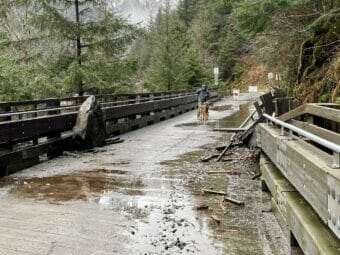
A pedestrian examines damage to the Basin Road Trestle in Juneau on Jan. 25, 2023. The trestle is closed indefinitely after a boulder tumbled down Mount Maria and took out part of the railing. (Photo by Anna Canny/KTOO)

A boulder tumbled down the face of Mount Maria early this morning, damaging one side of the Basin Road Trestle’s wooden railing. The trestle is closed to all traffic at both ends for public safety.

Pedestrians are still crossing it. But Tom Mattice, Emergency Programs Manager for the City and Borough of Juneau, encourages people to stay out of the area for their safety.

“After the rain subsides, and the slope starts to drain, we start to gain a little bit of additional stability,” he said. “But that slope will be unstable for quite some time.”

Mattice says slides are more common in the fall, but warm, wet conditions this winter contributed to the rockfall — especially this weekend’s heavy rains.

“We just had enough rain to deteriorate the hillside, to eat away the bond that was holding a rock in place,” he said. “And as you get that melt and freeze cycle, when it freezes, it expands. And that acts like a jackhammer pushes the rocks away from the hillside.”

Bridge engineers from the Alaska Department of Transportation visited the site Wednesday to look for signs of deeper structural damage. Their findings will help the City and Bureau of Juneau decide how to proceed with clean-up and repair. 

Basin Road will remain closed until further notice. 

Correction: An earlier version of this story stated that the rockfall originated from Mt. Roberts.

The Forest Service wants more input on Mendenhall Glacier area changes

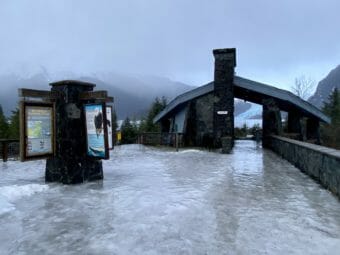
The west pavilion at the Mendenhall Recreation Area.
The pavilion at Mendenhall Glacier Recreation Area on Jan. 19, 2023. The National Forest Service’s Mendenhall Improvement Project proposed seven alternative plans for upgrading visitor accommodations, including replacing the pavilion with a new welcome center (Photo by Anna Canny/KTOO)

The Mendenhall Glacier is one of Alaska’s most-visited tourist attractions in summer. But on a foggy, drizzly day in January, it was quiet except for the sound of Laurie Craig’s ice cleats.

She stood in the pavilion at the edge of the parking lot, pointing past an expanse of hemlock and spruce toward Nugget Falls. Craig saw hundreds of thousands of tourists pass through here when she was the lead naturalist at the visitor’s center. Now, she’s retired.

“That waterfall is awe-inspiring for people. They can go stand in the mist. And they’re thrilled. There’s goats you can see on the mountainside above, there’s bears walking along, tucked into the trees,” Craig said. “How do we preserve that magic? While we’re hosting a million people?”

Laurie Craig poses in front of Mendenhall Glacier.
Laurie Craig was the lead naturalist at the Mendenhall Visitor’s Center for 14 years (Photo by Anna Canny/KTOO).

The U.S. Forest Service is asking people to help them solve that dilemma between now and Feb. 21, during the third public comment period for the Mendenhall Improvement Project.

About 700,000 visitors passed through Mendenhall Glacier Recreation Area in 2017 — more people than the current visitor facilities were designed for. The Forest Service has been working on plans to upgrade the recreation area since 2019.
Ranger Tristan Fluharty says public feedback — more than 400 comments last time around — motivated the release of three new plans earlier this month.

“We’ve really tried to not just request those public comments, but also incorporate them into our alternatives,” he said.

There are also four existing plans, from earlier stages in the planning process. While the new alternatives work to address the public comments in some way, all seven plans remain on the table.

The new alternatives mainly address public concerns around the placement and design of new buildings, the presence of motorized boats on Mendenhall Lake and measures to protect local wildlife habitats.

The new plans offer three different visions for the new welcome center. Previous plans proposed a new welcome center in place of the pavilion on the edge of Mendenhall Lake. That drew concern over blocking the existing panoramic view. New alternatives preserve the view by moving the new welcome center — either by placing it on the hillside, near the existing visitor’s center, or by pulling it back from the lakeshore and making it two separate buildings.

Perhaps most significantly, alternative 6 is the only new plan that ditches motorized boats on Mendenhall Lake. During the last public comment period, the presence of boats raised concerns about visitor safety, emissions, disturbances to wildlife and more general fears about commercialization.

Alternative 6, which has the least environmental impact, also cuts carbon emissions by replacing motorized buses with electric shuttles.

But for all of these plans, Craig worries about the bears. She fears that trail expansion will break up habitats and increase potential encounters with people. Still, she says the new alternatives address many of her previous concerns, and she’s hopeful that people will keep sharing their opinions this time around.

“People get very tired of coming back and doing the same thing over and over. I’ve been there,” she said. “The important thing is when we commented the last time and said we want something different, the Forest Service listened, and is offering something new for us to consider,” she said.

There will be an open house at the Mendenhall Glacier Visitor Center on Jan. 24, 2023 from 4:00 until 7:30 pm, and a webinar Thursday Jan. 26, from 5:30 to 7:30, for the public to learn more.

Comments can be submitted online, by fax, by mail or by hand until Feb. 21.

Tropical front brings heavy rain to Juneau

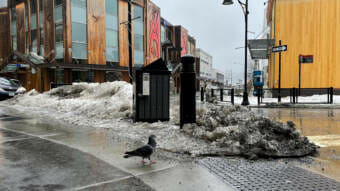
Rainy streets and wet snowbanks in downtown Juneau on Jan. 22, 2022. (Photo by Rashah McChesney/KTOO)

A warm, wet tropical front is bringing heavy rain and high winds to Juneau and much of the Southeast this weekend.

A high wind warning is in effect until midnight, with 60-mile-per-hour gusts and power outages possible.
Meteorologist Nicole Ferrin with the National Weather Service says intense rainfall is not unusual for this time of year.

“But this our first big rain event we’ve had in quite a while. We’re not exactly looking at flooding concerns, but it is a substantial amount of rain,” she said.

Ferrin does expect ponding water in some neighborhoods and roadways. And temperatures will drop as the front passes, which could create dangerous icy patches.

Juneau has had relatively little snow this winter, which might be a good thing. Seasons that switch back and forth between snow and rain can be more hazardous.

Ferrin says this time last year, Juneau had several feet of snow when heavy rains hit, which contributed to roofs collapsing downtown.

“We’re very lucky that we don’t have the snow on the ground,” she said

Tom Mattice, Emergency Programs Manager for the City of Juneau, agrees. He says the bare ground left at lower elevations will slow down potential avalanches, and the sizes of potential slides will be smaller.

Still, he’s raised today’s urban avalanche danger to “High,” and he said small avalanches and mudslides are likely.

“The odds are good with the amount of rain and the warming that we’ll see some activity,” he said.

Though buildings downtown will be relatively safe, Mattice says hikers should avoid the Flume and Perseverance trails for now.

Rain will continue throughout the weekend. But as temperatures drop, snow is possible starting Saturday night. Those cooling temperatures will also bring the avalanche risk back down throughout the day on Saturday.

A warming climate is changing how drought plays out in Southeast Alaska

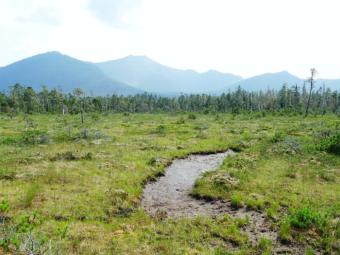
A dried, muddy patch was all that was left of this muskeg pond near Petersburg in the summer of 2019. (Photo by Joe Viechnicki/KFSK)

The fall of 2016 ushered in a historic drought for Southeast Alaska. Hot, dry summers wreaked havoc on subsistence crops like wild berries. Warmer waters disrupted salmon hatcheries in Juneau. And in 2018, about twice as many fires burned in the Tongass as what’s typical. 

By 2019, the U.S. Drought Monitor had declared an extreme drought across the region. Rick Thoman, a climate scientist with the University of Alaska Fairbanks, says dry spells are not abnormal, even in a temperate rainforest. But the drought from 2016 to 2019 was unique. 
“This was a warm, dry drought. And that is very different,” he said. “Droughts from the ’50s, from the ’70s, even into the early ’80s — they were cold, dry droughts. And that matters a lot.”

Though there have been warmer droughts and drier droughts in the past, the region’s longest droughts on record have often been accompanied by below-average temperatures. With 2016, Southeast’s warmest year on record, that changed. 

In a new retrospective report, Thoman and collaborators at the National Oceanic and Atmospheric Association examine the impacts of the 2016-2019 drought in the context of past droughts and future climate projections.

Hotter droughts ahead

Andy Hoell, a NOAA research meteorologist and co-author on the report, said warming temperatures are changing droughts in Southeast.

“Now we’re seeing these droughts that are so much warmer to the tune of like three, four or five degrees,” he said.

According to the report, the lower levels of precipitation during the 2016-2019 drought were not caused by climate change. But the warming was, and scientists say that warming will continue. Climate models predict that Southeast may get up to 6 degrees warmer by 2050. That’s a big deal because higher temperatures cause more evaporation.

When droughts come with higher temperatures, the gap widens between how much water falls from the sky and how much makes it to lakes, streams, plants and soil. Things dry out faster, which threatens ecosystem health and increases the risk of wildfires.

A fire burns through dry vegetation with snow-covered peaks in the background
A wildfire near Juneau in May 2018. Tongass National Forest responded to 32 wildfires in 2018. 15–20 fires/year is normal in the forest. (U.S. Forest Service photo)

Higher temperatures also increase the risk of snow droughts, which happen when less mountain snowpack accumulates. That can decrease supplies of freshwater over time and increase stream temperatures when snow melts in the spring and summer, which harms fisheries.

Many of the plants and animals of Southeast’s temperate rainforest cannot survive long, dry periods. They’re adapted to a stable snowpack and heavy rains. And Southeast’s people are, too.

Preparing for drought in a wetter Southeast

As the 2016-2019 drought stretched on, water levels in lakes and reservoirs reached record lows. Communities across the Southeast had to cut back. Wrangell and Haines placed restrictions on water use, and places that rely on hydropower — like Juneau, Ketchikan and Metlakatla — faced rising energy prices. Some even switched over to diesel generators. 

The drought highlighted that water-related infrastructure may fail during droughts.

“It’s not like there hasn’t been drought in the rainforest before,” Thoman said. “One of the big reasons that this drought was more impactful had nothing to do with how much rain was or wasn’t falling out of the sky, but changes in society.”

Southeast is getting wetter — precipitation could increase as much as 14% by mid-century — but Thoman says that won’t necessarily mean fewer droughts.  Some projections suggest that climate change may create more distinct wet and dry seasons in the Southeast. That means extreme wet periods may be offset by extreme dry periods, especially in the summer.

“You might get 160 inches of rain for the year in Ketchikan,” Thoman said. “But if you only get five inches between June and August, that’s going to be a drought for the Tongass.”

Hoell hopes the report will help communities prepare for future droughts. It highlights the importance of improving water storage, supplementing hydropower and increasing awareness around water conservation. 

He emphasized that the next drought could happen at any time. 

“The rain could shut off and go back to the levels that we had during, say, 2017 or 2018,” he said. “The thing is, you usually don’t care about something unless you’re actually in it.”

Juneau’s first electric bus is a bust, but the city will move forward with electrifying the fleet

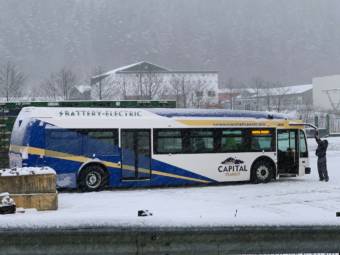
Capital Transit's first electric bus faces persistent problems.
Capital Transit’s first electric bus has faced persistent problems, but the city will electrify the fleet with a new manufacturer. (Photo from the City and Borough of Juneau)

Juneau’s first electric bus hasn’t spent much time on the road since its debut in the spring of 2021 thanks to persistent mechanical problems that have kept it idled again this winter. Still, the city has bought seven more electric buses — from a different vendor.

Capital Transit Superintendent Rich Ross says he remains enthusiastic about electrifying the fleet.

“There’s going to be learning curves along the way,” Ross said. “So while this bus has been a lemon — somewhat of a lemon — we also understand the technology is improving in leaps and bounds as time goes on.”

That lemon, from Southern California manufacturer Proterra, is the only electric bus in Juneau’s fleet of 18. Though other places in Alaska have experimented with electric transit, Juneau was the first city in the state to purchase an electric bus for its fleet.

But there have been ongoing issues with the bus’s wiring harness. When that part fails, it sometimes shuts down one of the bus’s two motors. Though it’s been patched several times, Ross says Proterra has not yet supplied a replacement.

There have also been problems with the bus’s performance in winter weather. Its batteries are supposed to last for 210 miles, enough to cover a 10-hour shift in Juneau.

Ross says that range has not been observed in practice.

“Roughly the best range we were able to accomplish with the bus we have in the summer prime, warm, dry conditions was around 170 miles,” he said.

Even that didn’t hold up in the few weeks the bus ran last winter.

“That range dropped to just below 100 miles because so much more energy is being used to keep the batteries warm and heat the interior cabin and defrost the windows,” he said.

Not only was the battery drained more quickly, it was also slower to charge. In warmer temperatures, electric vehicles rely on quick charging through regenerative braking, which converts kinetic energy to electric. That doesn’t work as well when a battery is cold.

Denise Koch, Juneau’s Deputy Director of Engineering & Public Works, says the nagging problems with the wiring harness have limited the city’s understanding of the bus’s cold weather performance. The bus was out of commission from Thanksgiving through New Year last winter, too.

“That happened to coincide with some of the coldest temperatures of the year, which was frustrating,” Koch said. “We were really looking forward to gathering a long stretch of data about how it performed in that climate.”

In spite of the challenges, the officials with the City and Borough of Juneau and Capital Transit are optimistic about electrifying Juneau’s bus fleet.
“It’s reasonable when you’re an early adopter to expect that there are going to be some kinks and some problems with a newer technology. And that’s what happened,” Koch said.

In October, the city moved forward with purchase of seven new buses using funding from the Federal Transit Administration. But this time they’re switching manufacturers.

They opted for Gillig, the manufacturer that makes Capital Transit’s diesel fleet. Much of the maintenance on the electric buses will be similar to the diesel fleet. Capital Transit hopes that will help prevent future maintenance delays.

The city also hopes that will mean more reliable battery performance. They chose Gillig after consulting with other northern transit agencies — especially Missoula, Montana, which regularly runs Gilligs in cold weather.

Koch says the Federal Transit Administration ranked Gillig as the best performing electric bus in 2022.

Electrification of the fleet will be an important piece of Juneau’s greenhouse gas emission goals. The city has pledged to cut 80% of emissions by 2045, and transportation is one of the highest-emitting sectors.

Koch says the purchase of the new buses shows the city’s dedication to being a leader in sustainability.

“We’re the first ones in Alaska,” she said. “There’s always a balance between, you know, how far you get out ahead? Or do you sit on the sidelines and wait till a technology is completely tried and true.”

Southeast communities Ketchikan and Metlakatla also announced plans to introduce new buses in 2024. And late this summer, the Biden administration announced $1.66 billion in grants tor clean transit. Much of that will go toward electric buses

New bill from Dunleavy aims to help Alaska break into growing carbon markets

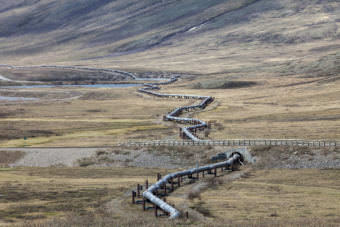
An above-ground section of the Trans-Alaska Pipeline System near the Toolik Lake Research Station in the North Slope Borough. (Photo by Rashah McChesney/Alaska's Energy Desk)
An above-ground section of the Trans-Alaska Pipeline System near the Toolik Lake Research Station in the North Slope Borough. Dunleavy hopes to pursue carbon capture projects in the oil and gas basins of the Cook Inlet and North Slope. (Photo by Rashah McChesney/Alaska’s Energy Desk)

Gov. Mike Dunleavy announced his Carbon Management Bill Package on Thursday.

When introduced to the legislature, the bill will outline new regulations that will help the state break into growing carbon markets. Dunleavy believes it could bring millions or billions in new revenue to the state.

“Alaska is poised, and has a real potential to monetize and capitalize on the discussions regarding carbon,” Dunleavy said in a press conference Thursday. 

Carbon dioxide is the most commonly produced greenhouse gas. The market for storing carbon has been growing, with carbon resources increasingly sold and traded in the form of offsets or credits. Companies and other entities can buy or sell them to comply with regulations on greenhouse gas emissions or to meet voluntary emissions goals.

Dunleavy says there’s a lot of potential to expand the market for carbon in Alaska.

“The question of course is what types, what kind, what amount of money Alaska could realize in this process,” he said.

The legislation would give the Alaska Department of Natural Resources the authority to promote two forms of carbon management and sequestration.

Carbon dioxide in the atmosphere is naturally captured and stored by trees, kelp and soil. 

It’s also possible to compress carbon and pump it underground — a process sometimes called carbon capture, utilization and storage — or CCUS. Dunleavy hopes to pursue that in the oil and gas basins of the Cook Inlet and North Slope. 

Alaska Native regional corporations like Sealaska, Chugach Alaska Corporation, and Ahtna Inc. have been participating in carbon markets for years, by turning sustainably managed forests into carbon credits. Those credits have been bought and sold by companies outside the state, especially in California, where carbon credits are often purchased to comply with the state’s cap-and-trade program.

That’s brought $370 million to Native corporations since 2019, a figure Dunleavy cited as proof of the new bill’s concept.

Dunleavy says the new legislation would not threaten existing industries like oil and gas and logging, which are some of the most significant emitters of greenhouse gasses.

Though the new legislation deals with one of the most important greenhouse gasses, Matthew Jackson, climate program manager with the Southeast Alaska Conservation Council, says it’s not a climate policy.

“It’s more of a financial tool than a climate solution.” Jackson said. “If this is just a new way for the state of Alaska to make money from things that it’s already doing, that’s not necessarily bad, but it has nothing to do with solving the climate crisis.”

The bill will be formally introduced sometime after the legislative session begins on Jan. 17.

Site notifications
Update notification options
Subscribe to notifications