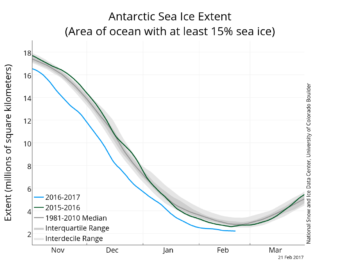
(Graphic courtesy of National Snow and Ice Data Center)
This week, we’re responding to a listener who asked whether it’s true that sea ice in Antarctic waters has been generally increasing, while Arctic sea ice has seen dramatic declines.
“The short answer to the question is ‘yes,'” said climatologist Brian Brettschneider. “There’s been a trend in the last decade or so of increasing sea ice surrounding Antarctica. But from a climate point of view, that’s really far less significant than the decline that we’ve seen in the Arctic. And even if you add the two together, the overall trend is a reduction in global sea ice.”
It’s important to remember that it’s summer right now in the Southern Hemisphere, but still, Antarctica’s record low is for any day of the year since 1979 when they started keeping satellite records.
“So not only do we have record lows in the Arctic, but we’ve just set an all time record low in the Antarctic,” he said “so it’s bad all around.”
The overall trend in the Antarctic has been of increasing sea ice but this year is a different story.
“Remember that climate effects are vastly different,” said Brettschneider. “It’s not a zero sum game. You don’t just add Arctic and Antarctic sea ice and that’s your ice climate equation. Arctic sea ice is far more significant from a global climate perspective.”
Researchers are still trying to understand why there’s been an increase in sea ice in the last 10 to 15 years. Some theorize that glacial melt is flooding the ocean with more fresh water which freezes more easily than sea water.
“There’s also some discussion about the jet stream pattern, the circumpolar jet stream, at about 60 degrees south latitude and how that is preventing, at certain times of year, low pressure areas from generating large swells and kind of breaking up the ice, so it makes it (the sea ice) a little bit more resilient,” he said.
Alaska’s Energy Desk is checking in with climatologist Brian Brettschneider each week as part of the segment, Ask a Climatologist. What do you want to ask?
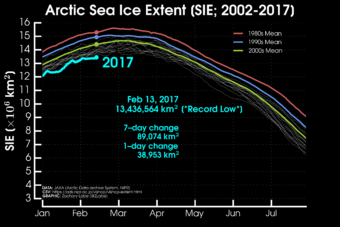
This winter, Arctic sea ice extent is at record lows. (Graphic Courtesy of Zack Labe/UC Irvine)
During a normal winter sea ice grows quickly in the Arctic Ocean, filling up nearly the entire ocean basin. This year though, unusually warm weather and storms are keeping the sea ice extent at record lows.
Climatologist Brian Brettschneider says Arctic sea ice is in pretty sad shape.
“Most of the last 200 days, the sea ice has achieved a daily record low,” he said. “So even though it’s still mid-winter or late winter up there, we should expect a lot of growth and we really haven’t seen nearly what we would expect given the time of year.”
There are a number of reasons why sea ice growth has been particularly slow this winter. Very warm temperatures in the high Arctic is an important culprit.
“There have been times when even at the North Pole it’s hit at or above freezing, which is almost unheard of,” Brettschneider said.
He also says that stormy conditions around Iceland and Scandinavia have promoted increased wave action, which disrupts sea ice formation.
“So just a lot of things have come together to slow and, at times, reverse the sea ice growth in winter, which is pretty unprecedented,” he said.
Winter sea ice growth offsets the summer melt. The more ice that build up in winter, the less ice will melt in the summer.
“It is pretty alarming,” Brettschneider said. “There’s been open water not far off the North Slope of Alaska in January and February, which is really astonishing. Over to the east of Greenland, around Svalbard Islands of Norway, I don’t think they’ve had any sea ice and they’ve been above freezing. These are areas that should be locked into ice and should be below zero, so it’s very concerning about where we could end up in the summer melt season.”
Alaska’s Energy Desk is checking in with climatologist Brian Brettschneider each week as part of the segment, Ask a Climatologist. What do you want to ask?
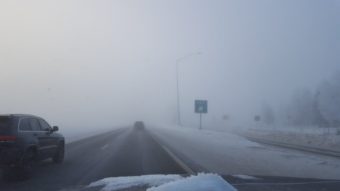
Morning fog in Anchorage on Monday, Feb. 6th, 2017 (photo by Brian Brettschneider)
This week we’re responding to a listener who asked: What the fog? Why has there been so much fog in Anchorage this winter?
Anchorage has had a record amount of dense fog this winter. The main culprit is a dramatic temperature inversion between the mountains and the city. On average, it’s been nine degrees warmer on the upper hillside than in town.
Since Dec. 1 Anchorage has seen 26 days of fog with visibility of a quarter mile or less. Climatologist Brian Brettschneider says you have to go back to 1950 to find a winter that comes even close to the number of days with dense fog.
“Looking back through the records, all the way back to 1925, there’s no other winter that has this many days of dense fog,” he said. “There have been winters with more days of fog that maybe wasn’t as dense, particularly 1950, but no winter has been this close in terms of the number of dense fog days.”
There are a couple of things at play, but Brettschneider attributes the fog to strong temperature inversions, where it’s warmer a few thousand feet in the mountains than it is on the valley floor.
“If you look back at weather balloon soundings, you have to go back to 1950 to find a year that has a bigger temperature inversion than 2017 so far,” he said. “When you have a situation like that, the air doesn’t have any buoyancy, it can’t rise. So if you have moisture trapped at the surface that has nowhere to go. You need the cool air aloft or you need some wind to push it out, and we’ve had neither.”
That trapped moisture comes from Cook Inlet. The snow is contributing too.
“We don’t think about snow evaporating, but when we do get snow, some of it evaporates into the air and we do get moisture. So we have this confluence of moisture sources and then we also have high mountains that really trap the moisture in place,” he said.
So as winter warms up with more sunlight, will the fog start to go away?
“You might have noticed in the daytime now there’s less fog. So with the higher sun angle, the sun’s energy is able to warm the surface up and when you warm the air, it’s able to hold more moisture, then you don’t see the fog,” Brettschneider said. “As it cools back down at night, the ability of the air to hold moisture decreases and it saturates.”
So when the sun gets higher in the sky, there is less fog during the day. In December and January, the short days can make fog stick around all day.
Brian Brettschneider is a climatologist in Anchorage who closely tracks Alaska climate data and trends. Alaska’s Energy Desk is checking in with him regularly as part of the segment, Ask a Climatologist. Do you have a question for Brian? Go ahead! Ask him.
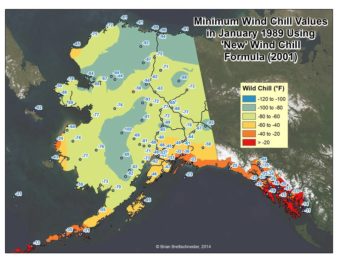
The National Weather Service wind chill formula changed in 2001, altering record breaking wind chills from the 1989 cold snap.
The wind chill dropped to minus 77 in Arctic Village last week. That’s the coldest wind chill recorded this winter in a populated spot in Alaska. Seventy-seven below may sound bitterly cold, but climatologist Brian Brettschneider says its not even close to record territory.
“The record in Alaska, and for any populated place is -100 and that occurred in January 1989, in McGrath” he said.
The National Weather Service calculates wind chill by combining apparent — or actual — air temperature and wind speed. In January 1989 chills as low as minus 120 were registered on the North Slope.
“That’s kind of the low water mark of wind chills,” said Brettschneider, but in 2001 the National Weather Service (NWS) changed the wind chill formula and those temps on the new scale are closer to minus 80 or minus 90.
“So cold,” he said, “but not as cold as what some people might recall if they were around 25 years ago.”
Brettschneider explains that the original wind chill formula was based on experiments at Antarctic research stations, where researchers would see how long it took water to freeze on top of their huts.
“They determined that over the years that really wasn’t the best way to estimate what the apparent temperature is for what people experience,” he said.
The new formula the NWS started to use in 2001 yields a much better representation of the combined effect of the temperature and the wind.
“So the net effect of that is with high wind speed events, there’s a diminishing return on wind chill,” he said. “So a 30-mph wind doesn’t get you much more wind chill than a 20-mph wind. And also at low, low temperatures, even a small wind really jumps the wind chill value up.
In the new system, actual temperatures are more important than wind in calculating wind chill. Previously a 5-mph increase in wind speed would drop the temperature dramatically.
“Now that levels out quite a bit more, with a focus on the first few miles per hour of the wind speed,” he said. “So it’s the temperature that becomes the dominant player in the new wind chill formula.”
Brian Brettschneider is a climatologist in Anchorage who closely tracks Alaska climate data and trends. Alaska’s Energy Desk is checking in with him regularly as part of the segment, Ask a Climatologist.
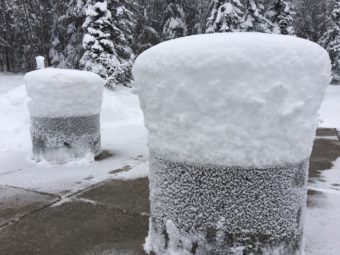
Snow piles up Jan. 23 at Alaska Public Media in Anchorage. (Photo by Annie Feidt/Alaska’s Energy Desk)
The ingredients for picture perfect snowflakes came together in Southcentral Alaska this past weekend. Climatologist Brian Brettschneider says the snowflakes that fell in were especially large and piled up quickly.
“There’s a couple ways you can get big snowflakes,” said Brettschneider. “You can have really wet snow where the flakes clump together, and when that falls, it really compresses. But we had a situation where the whole thermal profile of the lowest, say, 10,000 feet of the atmosphere was right in a sweet spot to promote large snowflake growth. That’s called the dendritic growth zone and it lets the arms, if you will, of the snowflakes get really, really big and it traps lots of air in it. So its light, low density, snow that really piles up quickly.”
He didn’t look at the flakes under a microscope. He didn’t need to: the flakes were that big. And the snow was really dry.
“And when you melt it all out, normally in a typical snowfall about 12 inches of snow would equal one inch of melted water,” he said. “In this case, at the Anchorage National Weather Service office, 25 or 30 inches of snow equaled an inch of water — so very, very dry, light snow that piles up quickly.”
If conditions are right, fluffy snow like this can occur in any part of the state. Anchorage, at least this week, was the sweet spot in the state.
“The farther north you go where its really, really cold, Fairbanks and northward, typically the atmospheric profile is too cold to promote that large growth, so usually you don’t get those big dry snowflake ratios,” he said.
In the Southeast where it’s typically warmer, the wet snow clumps together and doesn’t pile up in the same way.
“I think most people, especially if you have to shovel a driveway, appreciate the lighter, fluffier snow that’s easier to move around and doesn’t cause as many aches and pains,” Brettschneider said.
Brian Brettschneider is a climatologist in Anchorage who closely tracks Alaska climate data and trends. Alaska’s Energy Desk is checking in with him regularly as part of the segment, Ask a Climatologist.
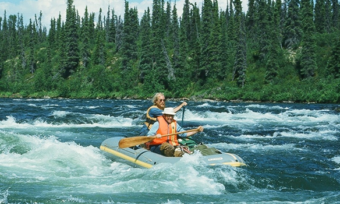
Pat Pourchot rafting an Alaskan river in the 1970s. (Photo courtesy: Pat Pourchot)
John McPhee’s book Coming into the Country starts with a river trip: six men, nine days- floating nearly the entire length of the Salmon river in northwest Alaska. The 26 year old leading the trip was Pat Pourchot, a recent Alaska transplant who had the job of a lifetime with the Interior Department.
As Pourchot tells it, fresh out of college, he lucked into one of the best jobs in the world. In 1972, he was working for the now long gone federal Bureau of Outdoor Recreation in Colorado. His boss needed five people willing to relocate to Alaska. The job? Floating and researching rivers across the state to see if they would qualify for wild and scenic status in the national park system.
“I had wanted to go to Alaska since I was a little kid and I couldn’t raise my hand fast enough and got off the plane here in the spring of 1972 and basically never left,” he said.
The Alaska Native Claims Settlement Act had passed the year before as part of the effort in Congress to make way for the Trans Alaska Pipeline. Besides establishing 12 Alaska Native Regional Corporations, the law called for studying wilderness areas in the state for national designation as refuges and parks.
That’s where Pourchot came in. He had almost no experience in a kayak or canoe. But he was part of the team charged with “inspecting” more than two dozen remote rivers across the state.
“And we were looking for…I think the words were ‘remarkably outstanding values’.”
By 1975, when John McPhee showed up in Alaska, Pourchot was a skilled paddler, with three summers of river running experience behind him. McPhee had a good friend, John Kauffman, who was a colleague of Pourchot’s at the Interior Department and he convinced the writer to come to Alaska for a story. Pourchot had never heard of the New Yorker magazine and didn’t have any idea who John McPhee was.
John McPhee with chum salmon on the Salmon River in Alaska. (Photo courtesy of Pat Pourchot, U.S. Dept. of Interior)
But on the trip, McPhee quickly gained Pourchot’s respect. Pourchot says he asked intricate questions about the landscape and animals and probed the men for their opinions on wilderness and conservation.
Pourchot says McPhee was continually, but not furiously, taking notes on their answers, “Especially in the evening around the campfire he’d be taking notes, lunch breaks he’d be taking notes.”
When The New Yorker article was published in May 1977, Pourchot marveled at the way McPhee unraveled the story of their nine day adventure. The trip started near the headwaters of the Salmon, where the river was barely more than a foot deep.
McPhee writes, “I was not disappointed the Salmon was low. In a lifetime of descending rivers, this was the clearest and the wildest river. Walking it in places made it come slow, and that was a dividend in itself.”
In one especially vivid section, McPhee describes an epic battle between Pourchot and a giant chum salmon. Pourchot says reading the story now brings him back to that day on the river, “I think John McPhee’s accuracy is impeccable. I think he just really captures things so entertainingly and accurately.”
When Coming into the Country was published in December, 1977, it quickly became a bestseller. Pourchot says McPhee’s book doesn’t explicitly make the case for conservation. But it brought the remote wilds of Alaska into focus for readers.
“What it did was raise a nation’s consciousness about Alaska and the stakes,” he said. “And what should the role of conservation be on our public lands in Alaska. I think that’s where undoubtedly it had an effect.”
In 1980, the Salmon River was included in the national wild and scenic river system, along with two dozen other rivers Pourchot’s team floated.
After his brush with McPhee, Pourchot worked as a congressional staffer, state lawmaker and Department of Natural Resources Commissioner, to name a few of his many public service jobs.
He’s now retired, but he hasn’t stopped exploring. Pourchot says he leads a small group of “aging buddies” on river trips in Alaska every summer.
“It’s been kind of a pleasant surprise that most of the places I’ve revisited are largely the same,” he said. “You can go out to Gates of the Arctic or Beaver Creek in Yukon flats Wildlife Refuge and have an experience that’s very similar to the experience we had in the 70s.”
And when he’s off the river he still hears from people who’ve just read Coming into the Country and want to know if he’s the same Pat Pourchot who led John McPhee on the Salmon more than 40 years ago.
Close
Update notification options
Subscribe to notifications
Subscribe
Get notifications about news related to the topics you care about. You can unsubscribe anytime.