Annie Feidt, Alaska’s Energy Desk

Ask a Climatologist: Clear and cold on repeat

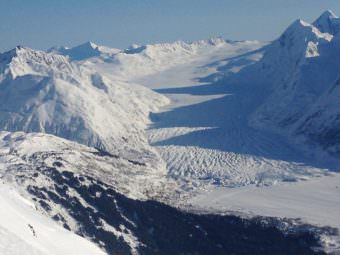
Spencer Glacier on a cloudless day, March 11, 2017 (Photo by Dave Bass)

For most of the state the weather forecast has been pretty simple for the entire month of March: cold and clear. But how unusual is that?

Climatologist Brian Brettschneider says temperatures for the month have been colder than normal for most of the state, and well below normal for Anchorage and Fairbanks.

“It’s been the coldest March since 2007 and the second coldest March since the 1970s,” he said. “Only one March in the last 40 years has been as cold through the first three weeks as 2017.”

In Anchorage, March has been around 10 degrees below normal, while in Fairbanks it’s been more like 17 degrees below normal. In addition, it’s been windy in Anchorage with a wide temperature difference between places like the airport and the rest of the city.

“So in a way,” Brettschneider says, “it’s been a lot colder than the official stats would indicate.”

The majority of the state has had little to no precipitation in March. Anchorage and Kodiak have recorded zero precipitation for the month. Is that related to the cold?

“This is the driest time of year across most of Alaska,” he said. “So it’s not uncommon to be really dry in March, but to go this long without any precipitation at all is not unprecedented, but it is unusual.”

It hasn’t rained or snowed in Anchorage since Feb. 27, 2017. If nothing falls from the sky by Mar. 27, that would tie the record for longest stretch of time without a trace of precipitation.

“We’d have to go another ten or so days to get to a record for measurable precipitation,” Brettschneider says. “These are records that date from the early 50’s, if you go before that, when records were kept in other parts of town, those streaks are a little bit longer, in some cases quite a bit longer.”

Do you have a question for our climatologist? Go ahead, ask him!

Ask a Climatologist: The sun is back and so is winter melt

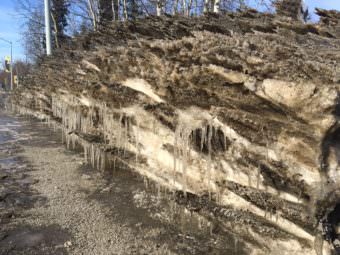
The sun melts snowbanks into icicles in Anchorage on Wednesday, March 15, 2017. (Photo by Annie Feidt/Alaska’s Energy Desk)

March has brought sun to much of the state. But not a lot of warm temperatures. That weather combination prompted a listener to email to ask why some ice and snow is disappearing, even though it’s well below freezing outside.

Climatologist Brian Brettschneider says it’s not the first time he’s fielded this question.

“It’s all about the sun,” he said. “Even when it’s below freezing, direct sunlight works to melt some of the snow.”

Brettschneider says the evidence of this is the presence of icicles.

“Icicles only form when you have melting snow and temperatures below freezing. So the temperature does magnify the effect, but it is the sun directly hitting the snow that’s causing that melting.”

Around Anchorage in mid-March there’s about 100 times more solar energy compared to December, around the winter solstice.

“That energy really works on the snow and melts it,” Brettschneider said. “So even if you have the same temperature in late December, versus the same temperature in mid March, it’s a vastly different melting environment.”

The angle of the sun right now (mid-March) in Alaska is equivalent to the angle of the sun at the winter solstice in northern cities in the lower 48 like Chicago or New York.

“In those big cities, even in the middle of winter, they get melting right away, even if it’s below freezing,” he said. “And this time of year, it will melt really quick. So that explains why we have snow on the ground so much longer than those other cities. We have 100 or so days a year with snow cover and that’s about the sun angle. So the sun is providing this direct melting, even with temperatures below freezing.”

Do you have a question for our climatologist? Go ahead, ask him!

Ask a Climatologist: Record cold at Iditarod start won’t last

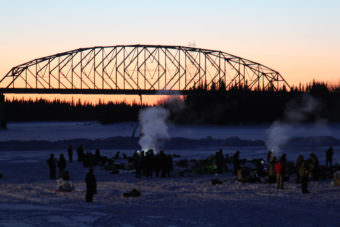
Teams rest at Nenana, on Tuesday, March 7, 2017. (Photo by Zachariah Hughes)

It’s hard to talk about the Iditarod without mentioning weather and climate. And this year is no exception, with mushers and dogs enduring extreme cold in first part of the race.

Climatologist Brian Brettschneider looks into how this year’s cold and snow stacks up to weather records from past races. He says the start Monday in Fairbanks was -19, by far the coldest in Iditarod history.

“If you look at the low for the day, it was -38, but it had warmed up — using the term “warm” loosely — to -19,” he said

Since the Iditarod started in 1973 that was the coldest start by a wide margin. The cold is only supposed to last for a couple of days, then rise into the 20s or even 30s, with lows in the single digits and teens.

“So the extreme cold going on right now is a short term phenomenon,” he said.

As for snow, there’s plenty on the route already, but “none of the checkpoints along the way are forecasting even a flake of snow,” Brettschneider said. “That’s subject to change, potentially, but to have no snow for that long a period for the entire route is really uncommon.”

Even though March is the driest month of the year in much of Alaska, there have been very few years when the week of the Iditarod recorded no snow.

The extreme cold seems notable now, but “when you average the beginning to the end, it’s going to go down as probably a pretty typical race period, temperature-wise,” according to Brettschneider.

Alaska’s Energy Desk is checking in with climatologist Brian Brettschneider each week as part of the segment, Ask a Climatologist. What do you want to ask?

State reduces Hilcorp fine for 2015 worker safety incident

The state is fining oil and gas company Hilcorp $200,000 dollars for a 2015 incident that nearly killed three workers on the North Slope.

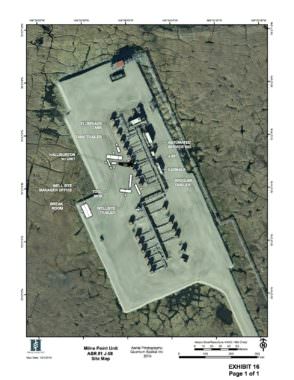
In September 2015 three men nearly died at Hilcorp's Milne Point Unit on the North Slope, after the trailer they were working in filled with nitrogen. (Image courtesy of AOGCC)
In September 2015 three men nearly died at Hilcorp’s Milne Point Unit on the North Slope, after the trailer they were working in filled with nitrogen. (Image courtesy of AOGCC)

The final order amount, which was released March 3, is a significant reduction from the $720,000 penalty the Alaska Oil and Gas Conservation Commission, or AOGCC, proposed last year.

In Sept. 2015, three Hilcorp contractors were knocked unconscious when nitrogen filled their trailer while they were working at the Milne Point Unit.

After investigating the incident, the commission took the highly unusual step of shutting down all four of Hilcorp’s rigs operating on existing wells in the state for nearly a month.
The agency said that had a big financial impact on the company and that’s partly why it’s reducing the fine. In the order, AOGCC also notes Hilcorp has a “significant history of noncompliance” but in the past year has improved overall compliance.

In a statement, Hilcorp said it doesn’t plan to appeal the order. The company said it’s taken steps to avoid a similar incident in the future.

Hilcorp is responsible for a natural gas leak from a pipeline in Cook Inlet that is releasing between 210,000 and 310,000 cubic feet of gas per day.

The company says it won’t be able to begin repairs on the line until mid- to late March.

Ask a Climatologist: Models hint at El Niño resurgence

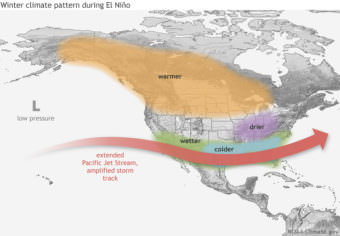
(Graphic courtesy of NOAA)

The weather phenomenon El Niño may be on its way back. That’s after a weak La Niña system faded out a few months ago. Climatologist Brian Brettschneider says computer models are hinting at El Niño returning in the second half of this year.
“The models right now are predicting a 50 percent chance of an El Niño by this fall,” said Brettschneider.

But that doesn’t mean it’s a done deal, he says, but it’s something to keep a close eye on.

Brettschneider offers a primer for those who may have forgotten exactly what El Niño is and what causes it:

“There’s a lot of complicated interactions, but basically you have a warm pool of water that’s semi-permanent in the western Pacific and you have easterly trade winds that push that water and keep it over there. Those easterly trade winds weaken in an El Niño event and that warm water is able to slosh back into the central and eastern Pacific and that really affects a lot of the global circulation pattern because it facilitates thunderstorm development and the movement of air up, creating low pressure and then where that air has to settle back down, creating high pressure, so these large scale wind and pressure patterns that drive much of the climate of the globe.”

In Alaska, the effects of El Niño are most noticeable (and strong) in the winter, making conditions warmer than normal and usually a little wetter than normal.

The usual interval between El Niño years is around five years, but can range from over two to seven years. So, having another El Niño year after just a weak La Niña in between is not unheard of.

“There has been some research that shows in a warming world that El Niños and super El Niños will become more common,” Brettschneider said. “And the impacts of that will be felt more acutely, particularly in places like Alaska.”

Alaska’s Energy Desk is checking in with climatologist Brian Brettschneider each week as part of the segment, Ask a Climatologist. What do you want to ask?

State demands Hilcorp monitor environmental impact of Cook Inlet gas leak

Still from footage taken by a helicopter of a gas leak in Cook Inlet, obtained by the environmental group Cook Inletkeeper. (Image courtesy Cook Inletkeeper)

The state is asking oil and gas company Hilcorp to dramatically step up environmental monitoring near a natural gas leak in Cook Inlet.

The Department of Environmental Conservation, or DEC, says the company needs to be prepared to “evacuate the line,” which could include shutting down wells, by March 13, depending on monitoring results.

The gas leak, discovered Feb. 7, is releasing natural gas at a rate of 210,000 to 310,000 cubic feet per day, according to Hilcorp.

The company has said ice conditions in Cook Inlet won’t allow for beginning repairs on the pipeline until mid- to late March.

DEC sent a letter Feb. 27 to the company, which said it’s “imperative” Hilcorp begin monitoring for potential fish and wildlife impacts and perform regular air and water quality sampling.

The state is asking the company to use trained observers to look for dead fish, birds and marine mammals in the area.

Cook Inlet is critical habitat for an endangered population of beluga whales. DEC also wants acoustic monitoring near the site to determine how far the sound of the leaking gas extends under water.

In a brief statement, Hilcorp spokesperson Lori Nelson says the company is working on developing a monitoring and sampling plan. Hilcorp has until March 8 to submit one to the state.

Correction: An earlier version of this story stated the leak estimate is from the state. The estimate is from Hilcorp.

Site notifications
Update notification options
Subscribe to notifications