Casey Kelly

Juneau Assembly pledges to support Housing First project

Housing First
This concept drawing by MRV Architects shows the proposed Housing First project in Juneau. The facility would be built in Lemon Creek on land donated by Tlingit-Haida Regional Housing Authority.

The Juneau Assembly last night unofficially committed $1.5 million to help fund a Housing First project in the capital city.

Supporters hope the project – which would be the third of its kind in Alaska – will provide a stable place to live for about 30 chronically homeless people. They also hope it eventually will house nonprofits and social service agencies to help individuals out of homelessness.

Housing First proponents say if you give a homeless person a permanent, stable place to live, it’s easier to address what’s causing them to be on the streets in the first place. Whether it’s lack of income, drug or alcohol addiction, mental health issues, or something else, studies have shown the approach reduces the amount of time and money spent on expensive emergency services for the homeless.

But Mandy O’Neal-Cole with the Juneau Homeless Coalition says that’s not the best reason to support it.

“There are a lot of economic reasons to make this happen, but there are more human reasons to make this happen,” O’Neal-Cole told the Juneau Assembly Committee of the Whole.

The homeless coalition is one of several groups that have been working on a Housing First project in Juneau for the better part of two years. O’Neal-Cole works for AWARE, Juneau’s domestic violence and sexual assault prevention nonprofit.

“It’s a lot of people with a lot of different agendas. And the fact is that we all came together with this similar agenda to recognize that this is bigger than any one of us,” she said. “It’s more about all of us and what our responsibilities are to the people who need the most help.”

The Glory Hole emergency homeless shelter recently agreed to be the lead agency for the project, and Tlingit-Haida Regional Housing Authority agreed to donate land next to its offices in Lemon Creek where the facility could be built.

“We know this model works in other cities and we’re absolutely certain it’s going to work here in Juneau,” said housing authority president and CEO Ricardo Worl.

Members of the Juneau Housing First working group ask the Juneau Assembly to support their project. From right to left: Paul Voelckers of MRV Architects, Mandy O'Neal-Cole from the Juneau Homeless Coalition and AWARE, Glory Hole Executive Director Mariya Lovishchuk, Tlingit-Haida Regional Housing Authority president and CEO Ricardo Worl, Bruce Denton with the Glory Hole board of directors, Scott Ciambor with the Alaska Coalition on Housing and Homelessness, and Norton Gregory with the Juneau Affordable Housing Commission and THRHA. (Photo by Casey Kelly/KTOO)
Members of the Juneau Housing First working group ask the Juneau Assembly to support their project. From right to left: Paul Voelckers of MRV Architects, Mandy O’Neal-Cole from the Juneau Homeless Coalition and AWARE, Glory Hole Executive Director Mariya Lovishchuk, Tlingit-Haida Regional Housing Authority president and CEO Ricardo Worl, Bruce Denton with the Glory Hole board of directors, Scott Ciambor with the Alaska Coalition on Housing and Homelessness, and Norton Gregory with the Juneau Affordable Housing Commission and THRHA. (Photo by Casey Kelly/KTOO)

The proposed building would be constructed in two phases, with 32 efficiency apartments, a commercial kitchen and clinic space built in the first phase. Another 22 apartments as well as office space for social service nonprofits would be part of phase two.

The group estimates it needs $6.6 million to build phase one and $9.1 million to do both phases.

Glory Hole Executive Director Mariya Lovishchuk says they hope to get the project started with a $3.5 million Special Needs Housing Grant from the Alaska Housing Finance Corp. That money is in this year’s state budget, but Lovishchuk says it’s unlikely to be available again for the foreseeable future, given the state’s projected deficit of more than $3 billion.

“The time for this project is really now,” Lovishchuk said.

Anchorage and Fairbanks already have Housing First projects, which Lovishchuk says also bodes well for this being Juneau’s year to receive funding.

The Special Needs Housing Grant application is due Feb. 20.

The Assembly Committee of the Whole last night asked the City Manager’s office to prepare a resolution pledging $1.5 million for the project. While the Assembly still needs to vote to approve the resolution at its first regular meeting of 2015, members left little doubt that the vote would be just a formality.

“You have your commitment,” said Assemblywoman Karen Crane.

The Housing First group is also hoping to get funding for the project from the Rasmuson Foundation and other charitable organizations.

The facility is expected to cost about $870,000 a year to operate. More than half of the projected operating costs would come from AHFC vouchers, rental income and the Juneau Community Foundation.

Another electric vehicle charging station to go online in Juneau

electric vehicle
An electric vehicle owned by Juneau Hydropower owner Keith Comstock powers up at Eagle Beach. (Photo by Casey Kelly/KTOO)

Another electric vehicle charging station will go online in Juneau the day after Christmas.

The station at the Marine Parking Garage is the fourth public EV charging station on the Juneau road system. The others are at Eagle Beach State Recreation Area, Alaska Electric Light and Power, and the Ted Stevens Marine Research Institute.

More are planned at Eaglecrest Ski Area, University of Alaska Southeast and the new Mendenhall Valley Library under construction at Dimond Park.

Electric vehicle drivers will need to pay 75 cents an hour to park at the Marine Parking Garage. But use of the charging station is free.

The Juneau Economic Development Council secured a $25,000 grant to expand the number of EV charging stations on the road system.

Glory Hole likely closed through mid-January, still needs Christmas donations

the Glory Hole, McPhetres Hall
The door to Holy Trinity Church’s McPhetres Hall, where the Glory Hole’s soup kitchen is temporarily operating while the shelter is closed for repairs following a flood last month. (Photo by Casey Kelly/KTOO)

About 30 patrons of the Glory Hole homeless shelter in Juneau will spend a little longer than originally expected in temporary emergency housing.
The facility closed after a busted water pipe caused a major flood on Nov. 30. The initial estimate for repairs was about a month, but executive director Mariya Lovishchuk now says it could take until mid-January.

“Most of the ceilings and most of the floors, everywhere except for on the first floor, were damaged and need to be completely replaced. A lot of the sheetrock on the walls needs to be replaced, and things have to be painted,” Lovishchuk says. “The electrical and plumbing is mostly done, and then a bunch of fixtures still have to be replaced.”

Lovishchuk says there are other challenges besides building repairs that need to be dealt with before the shelter reopens.

“For instance, a lot of our bunk beds were destroyed and so now we are trying to find industrial grade bunk beds,” she says. “And it’s actually not as easy as originally anticipated.”

the Glory Hole, McPhetres Hall
Glory Hole patrons eat lunch at McPhetres Hall on Tuesday. (Photo by Casey Kelly/KTOO)

Most of the Glory Hole’s regular clients are currently housed at Juneau International Hostel. Meals are being served at Holy Trinity Church, which is also providing office space for staff. Lovishchuk says the soup kitchen will need to find another location in January, when the church has a conflict. But she’s hopeful the hostel will continue to provide housing until the shelter resumes operations.

She was initially worried the closure would affect cash donations during the holiday giving season, but she says that’s no longer a concern. Due to the closure, the Glory Hole is not accepting as many donations of food and clothing as usual, but Lovishchuk says Christmas gifts are still needed for patrons on Thursday.

“Presents that could be given to anybody, like especially things like warm gloves and warm hats would be, I think, very helpful,” Lovishchuk says.

She says those types of donations can be dropped off at Holy Trinity’s McPhetres Hall or at the hostel during normal business hours.

Juneau Assembly honors JPD’s “Rock Star”

Merrill Sanford, Blaine Hatch
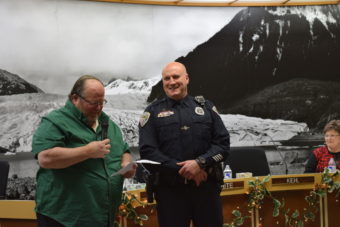
Mayor Merrill Sanford reads a speech recognizing JPD Officer Blaine Hatch for his recent award as Alaska Municipal League Employee of the Year. (Photo by Casey Kelly/KTOO)

The Juneau Assembly last night honored a city police officer who recently received a statewide award as the top local government employee in Alaska.

Then for good measure, the Assembly recognized the entire Juneau Police Department.

Officer Blaine Hatch is JPD’s school resource officer. He runs the D.A.R.E. program, which stands for Drug Abuse Resistance Education. He’s also often the first officer to respond to incidents in Juneau schools.

“Officer Hatch is somewhere between a rock star and a substitute parent for so many of Juneau’s kids,” said Mayor Merrill Sanford.

Hatch received this year’s Alaska Municipal League Municipal Employee of the Year award. AML is a nonprofit interest group for local governments in Alaska. Its board of directors bestowed the honor on Hatch last month after city officials nominated him.

Sanford listed some of the reasons Hatch deserves the recognition.

“He single-handedly teaches D.A.R.E. in six schools, runs the Junior Police Academy, responds to police calls in the schools and assists patrol in his spare time,” Sanford said.

When a student brought a handgun to Thunder Mountain High School earlier this year, Hatch detained him and assisted school officials with a lockdown. He’s also credited with helping save the life of a man who collapsed at a downtown bar this past summer.

JPD Thanks
The Juneau Assembly and city staff thank members of the Juneau Police Department and JPD families. (Photo by Casey Kelly/KTOO)

But Sanford said it’s the little things that earned Hatch his award.

“Officer Hatch assisted with security at the prom celebrations during the spring of 2013. A school employee wrote JPD a thank you letter after seeing him vacuuming the entryway of the venue in his uniform just before the doors opened,” Sanford said.

After Hatch was recognized, Assemblyman Jerry Nankervis – himself a former Juneau cop – said a few words of thanks to the men and women of JPD.

“I know there’s been stuff in the press lately that has not been favorable toward police officers,” Nankervis said. “I am a homer. Hands down, even in spite of that, this is the best police department in the state of Alaska.”

After Nankervis’ remarks the dozen or so police officers and JPD family members at the meeting stood in a line as Assembly members and city staff offered personal thanks with a handshake or a hug.

Tulsequah mine study outlines Taku River barging

Taku River
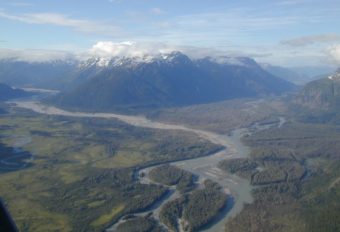
The Taku River. (Photo courtesy Rivers Without Borders)

Chieftain Metals Corp. has released new details on its plan to barge supplies and minerals to and from the Tulsequah Chief Mine, up the Taku River south of Juneau.

Chieftain is trying to re-open the long closed zinc, copper and gold mine in British Columbia. The company filed an updated feasibility study with Canadian financial regulators earlier this month. It says the Taku is likely to be impassable about 23 percent of the time during the proposed barging season from May to September. Another 23 percent of the time, barges will need a tug to help navigate the river.

Chris Zimmer with the environmental organization Rivers Without Borders says the report is light on other details about the company’s barging plan.

“When you look at this, you just think, ‘Boy, how are they going to make this work?'” Zimmer says. “Because they’ve got to get concentrate out on schedule to get it on a barge and to get it down to a freighter in Seattle. And given the conditions in the river, I just can’t see how they’re going to be able to make this work.”

According to the feasibility report, Chieftain would need four custom-built tugs and barges to make the nearly 40-mile run from the mouth of the Taku to the Tulsequah.

The company expects to ship more than 867,000 wet metric tons of concentrate to market over the proposed 11-year life of the mine. At its operational peak that would be more than 93,000 tons per year. About 17,000 tons of supplies and fuel would be shipped up the river every year as well.

Zimmer worries what will happen if Chieftain misses a few barge runs and tries to make them up when river conditions improve.

“They’re probably going to try to run a lot of barges in a very short time to make up for that shortfall,” he says. “And I think they’ll probably push the envelope for what’s safe in the river there.”

Chieftain officials previously have said the mine would not be built unless there was a road leading to it from Atlin, B.C. In October, the company announced the road is no longer being considered. The Taku River Tlingit First Nation has sued to stop the project, saying B.C. officials failed to consult them about an environmental permit.

Ron Maas is the former owner of Taku Glacier Lodge, and still owns about 150 acres up the river. He’s disappointed in Chieftain’s plan to barge.

“I just hate to see them tear up the whole damn country for a few bucks,” Maas says.

He remembers when former Tulsequah owner Redfern Resources tried barging on the Taku, and how the vessels would pass right by his property overlooking the glacier.

“It’s a gorgeous, gorgeous place, and it is just a shame to have that barge coming by,” he says. “You can hear it, you know, five miles away.”

Lynden Logistics — one of the largest freight companies operating in Alaska — last month announced it had signed a non-binding letter of intent with Chieftain to provide barging services for the Tulsequah project. Officials with both companies have declined multiple requests for comment.

Chieftain is still seeking financing to reopen the Tulsequah. Cominco last operated the mine in 1957.

Juneau state lawmakers formed the Taku River Fact-Finding Task Force in 2011 to address local concern over renewed interest in the mine. Rep. Cathy Muñoz says the city’s legislative delegation is still reviewing the updated feasibility study, and will talk about getting the task force back together early next year.

“It’s a high priority,” Muñoz says.

Juneau lawmakers hopeful city can weather pared-down state capital budget

April 3, 2014
The Legislative Council has been funding renovations and seismic upgrades to the Alaska Capitol outside the state capital budget. (Photo by Skip Gray/Gavel Alaska)

The proposed state capital budget submitted by Gov. Bill Walker on Monday includes just four projects for Juneau.

Three of them are federally funded street improvements. The fourth – a little more than $3 million for wastewater treatment upgrades – is the only project in either of Juneau’s two House districts to receive state general fund money.

The budget reflects Alaska’s new reality, with lower-than-expected oil prices leading to an estimated $3.5 billion deficit next fiscal year. Oil and gas taxes make up about 90 percent of Alaska’s unrestricted general fund revenue.

Juneau projects in the proposed capital budget

House District 33 (Downtown Juneau, Douglas, Haines, Skagway, Gustavus):

  • Alaska Marine Highway System, Gustavus Ferry Terminal Modifications – $3.5 million
  • Gustavus – Repair or Replace Rink Creek Bridge – $400,000

Juneau Areawide projects:

  • Water Treatment Improvements, Phase II – $3.1 million
  • Egan Drive/Riverside Drive Intersection Improvements – $1 million
  • Glacier Highway Rehabilitation and Reconstruction – $4 million
  • Industrial Boulevard Widening and Sidewalks – $3 million
“God, you know, it’s in the toilet,” Juneau Sen. Dennis Egan says of low oil prices.

Juneau Rep. Cathy Muñoz – who’s a member of the House Finance Committee – says this will be a difficult financial year for the state.

“The price for oil today is below $60 a barrel,” Muñoz says. “So we can expect some real tightening of not only the capital budget, but the operating budget.”

But Muñoz says things could be worse. A number of projects are underway in the capital city after being funded in recent years. That includes construction of the new State Libraries, Archives and Museum building downtown and renovations to the Douglas Island Building, where about 200 state employees work.

“So we’re looking at just, in the projects that have already been approved, we’re looking at work for the next three to five years,” she says.

Egan says that’s not to mention work being funded outside the state capital budget. He sits on the Legislative Council, a joint House-Senate committee that manages the legislature’s internal budget and support staff, which has been funding ongoing repairs to the state Capitol.

“I just got another $27 million to finish a renovation and seismic retrofit,” Egan says.

Gov. Walker submitted the capital budget Monday, along with former Gov. Sean Parnell’s operating budget, which the new governor has not endorsed.

The Walker administration plans to submit revised versions of both budgets during the upcoming legislative session. Budget Director Pat Pitney says any add-ons will be closely scrutinized.

The Associated Press contributed to this report.

Site notifications
Update notification options
Subscribe to notifications