Casey Kelly

Early study shows surprising optimism among homeless Alaska Natives

Grand Entrance to Celebration. (Photo by Heather Bryant/KTOO)
A University of Washington researcher says a strong desire to pass down traditional knowledge may be related to high levels of optimism that he’s found among homeless Alaska Native elders. (Photo by Heather Bryant/KTOO)

A University of Washington professor has found high levels of optimism among homeless Alaska Native elders living in Seattle, and he’s connected the finding to a strong desire to pass on knowledge and experiences to future generations.

As an Aleut who grew up in Naknek, Jordan Lewis knows a little something about Alaska Native culture. Whenever he’s back home, Lewis says he likes to talk to elders and soak up traditional knowledge.

“They tell stories about how Naknek used to be when they were kids, because it’s changing so much now,” he says. “And I think just the fact that they talk to you and share their experiences, and pass on recipes, or how they used to make things, or where they used to pick berries, is this idea that they are hopeful that you’ll take that knowledge and use it to benefit your own life, but then pass it on again.”

Lewis is an assistant professor at the University of Washington’s School of Social Work. His research focuses on Alaska Native communities and generativity, a concept developed by psychologist Erik Erikson. It says that as we grow older, humans tend to want to pass on their experiences and knowledge to future generations.

“The first generative act most people have in their lives is having kids,” Lewis says. “That’s going to secure your future. But as you grow older there’s this need to pass on your legacy, write your memoirs, storytelling for elders, and passing down stories you heard to your grand kids.”

Lewis has studied how generativity helps Alaska Natives age well and become role models, as well as overcome addictions.

He says he became interested in the homeless because it’s an underserved and often overlooked population. Years ago, he says, his family had a relative involved with the Chief Seattle Club, a nonprofit that provides meals, housing assistance and other services to low-income and homeless Alaska Natives and American Indians. That’s where he and a student interviewed 14 Alaska Native elders last year. He says the results surprised even him.

“All of the elders talked about the importance of giving back and teaching others,” he says. “Whether it’s through sharing a sandwich, giving extra change if they had extra change to someone who wasn’t doing as well as they were. Volunteering at the Chief Seattle Club was almost everybody’s response. That’s what made them happy, that’s what got them up every day. And they all said that they did that because it’s going to come back to them in a positive way.”

He says other themes of the interviews included the importance of laughter and religion.

In addition, each of the elders – ages 45 to 70 – filled out surveys to measure generativity and optimism. Lewis says 12 of the 14 individuals scored very high in both.

“That kind of complimented the qualitative interviews. So I could say, you know, 85 percent of the people I interviewed are very optimistic and like to give back and teach the young people, and then here we have specific examples of what they do to do that,” Lewis says.

While he’s excited about the early results, Lewis admits more research is needed to confirm his findings. He’d like to do more than 100 interviews, and has considered expanding to include American Indians.

He’s planning to present his research at the Chief Seattle Club, and ask officials there for ideas on how to do a broader study of Native homelessness.

“How could we either help the people who are homeless, or how do we prevent homelessness, or how do we make their lives more enjoyable from these experiences of what these elders are doing for themselves,” he says.

Lewis also hopes to publish his findings in a peer-reviewed journal. The initial study was part of an online Stanford University program on successful aging that he participated in last year.

Update: JPD makes arrests in stabbing, assault incidents

Update | 4:25 p.m. Jan. 4, 2015

Juneau Police have made an arrest in last night’s stabbing incident. Lt. Kris Sell says Joshua Paul Feak, 26, has been arrested for felony 2nd degree assault. He’s being held at Lemon Creek Correctional Center.

Original post:

It was a busy weekend for Juneau Police.

One man was arrested early Saturday for allegedly assaulting officers who were responding to a report that he was trying to fight with a cab driver downtown. JPD also is investigating an early morning stabbing Sunday in the Mendenhall Valley.

Officers had to use a taser on Jackson Lee Benedict Buchanan, 28, who allegedly picked a fight with a cab driver and a bystander on Front Street at about 1 a.m. Saturday. Police say Buchanan spat on officers, assaulted them and was warned before being tased. A press release says he continued to fight and thrash after being put into a patrol car before being strapped to a gurney and transported by ambulance to Bartlett Regional Hospital.

Buchanan was later lodged at Lemon Creek Correctional Center and charged with five misdemeanors, including assault, assault on a police officer, criminal mischief, harassment and disorderly conduct.

About 3 a.m. Sunday police received a call from Bartlett’s emergency room that a 17-year-old boy was there with two stab wounds. The boy is expected to recover, but one of the wounds collapsed a lung.

Police say in a release that the victim and another teenage boy were walking on Tongass Boulevard after leaving a nearby house party when two older men approached them and asked for marijuana. After the teens said they didn’t have any pot, a fight allegedly broke out between the two parties during which the 17-year-old was stabbed.

Police say a suspect has been identified and an investigation is continuing.

Juneau’s first baby of 2015!

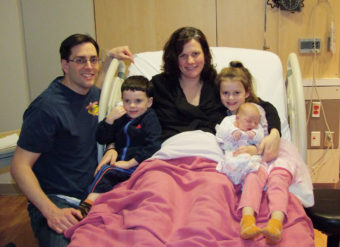
Fanning Family
The Fanning Family, left to right: Luke, Logan, Christine, Adele and Baby Fanning. (Photo courtesy Bartlett Regional Hospital)

Update | Sunday Jan. 4, 2015

The boy’s name is Elliot Michael Fanning, according to Bartlett Regional Hospital.

Original post:

It’s a boy!

The first baby born at Juneau’s Bartlett Regional Hospital in 2015 arrived just after noon today. The little baby boy is the third child for Luke and Christine Fanning, joining older brother Logan and older sister Adele.

The little guy still didn’t have a name as of late this afternoon. He weighed in at 8 pounds, 12 ounces, and was 21 inches tall.

Draft Juneau Economic Plan released

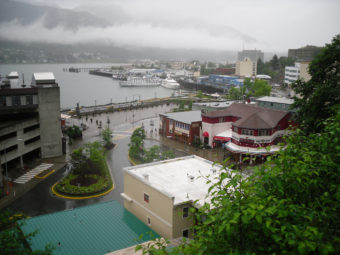
Downtown Juneau
Downtown Juneau. (Creative Commons photo by Lena LeRay)

Does this list sound familiar?

  • Enhance Essential Infrastructure
  • Build the Senior Economy
  • Attract and Prepare the Next Generation Workforce
  • Recognize and Expand Juneau’s Position as a Research Center
  • Build on Our Strengths
  • Protect and Enhance Juneau’s Role as Capital City
  • Revitalize Downtown
  • Promote Housing Affordability and Availability

Those are the eight broad initiatives discussed in the draft Juneau Economic Plan, developed by the McDowell Group and Sheinberg Associates for the Juneau Assembly. The plan is intended to guide the capital city’s financial future for the next decade. Most of the initiatives and specific goals discussed in the plan have been city priorities for years.

“We are in pretty good shape as community economically,” says Jim Calvin with the McDowell Group.

“(We have) relatively high per capita and household incomes, and strong visitor industry, strong mining industry. We have a lot of great assets to build on,” Calvin says. “So I think we’re coming at this from a position of strength as a community, which is certainly better than venturing into economic development when you’re in recession or otherwise struggling.”

Each initiative discussed in the plan includes specific goals or objectives for city officials to work on. Some of those are long-discussed city priorities as well: A second bridge to Douglas Island, expanding the availability of childcare and increasing the number of starter homes to name a few.

Juneau Economic Plan
Juneau Economic Plan fact sheet. (Click to enlarge)

Calvin says these issues have long been barriers to economic growth in Juneau.

“Housing is a case in point,” he says. “It’s really a fundamental, underlying foundation for Juneau’s economy, and we at the moment have a housing market that’s acting as a constraint on economic development.”

The draft economic plan was released Wednesday on the web. Calvin will present details to the Juneau Assembly on Monday.

The specifics shouldn’t come as a shock to the Assembly members, who’ve been receiving periodic updates on the project for almost a year. Mayor Merrill Sanford says the next step is to adopt the plan and implement its recommendations.

“There’s a lot of good goals and a lot of good objectives,” Sanford says. “We’re going to have to prioritize them and figure out which ones we need to do first.”

Sanford thinks the $100,000 the city spent on the plan was worth it.

“It just puts everything into perspective and says, ‘Assembly members, here are the things, some of the things that you’ve been working on diligently, trying to get accomplished.’ It backs those up and supports them. And then it’s given us a couple of other avenues to go down to get to an end result,” Sanford says.

The mayor says the Assembly hopes to adopt the plan by the end of February.

Steedle: New timeline for Capital Transit plan update

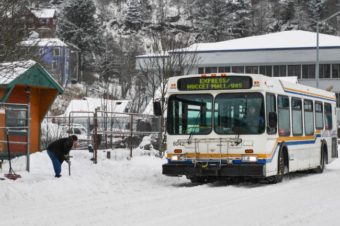
(Photo by Kelli Burkinshaw/KTOO)

Deputy City Manager Rob Steedle says officials have hit the reset button in the ongoing effort to update Juneau’s Capital Transit bus plan.
After delaying changes last month, Steedle told the Juneau Assembly on Monday that the process needs more input from drivers.

“The extent that the drivers were excluded from the process early on has caused us to really suffer and there’s a lot of negative feelings right now with that workforce,” he said.

The city has been working with consultants Nelson\Nygaard on the bus plan update for more than a year. Drivers and riders roundly criticized earlier versions of the proposed changes.

One of the goals was to expand service to Riverside Drive in the Mendenhall Valley. But that’s been complicated by budget cuts and the fact that expanding service in one area would likely mean reducing it elsewhere.

Some Assembly members have suggested restoring funding to the bus system, but Mayor Merrill Sanford questions where the money would come from.

“That’s where we are with our dollars right now,” Sanford said. “So, every time we juggle dollars, and if we say ‘We want to put a million more dollars into the transit system,’ that has to come from somewhere.”

Steedle said the number one goal in his mind is for the city’s bus system to run on time.

“When you have buses running as infrequently as 30 or 60 minutes having timed transfers, I think, is essential,” Steedle said.

The new timeline for implementing route changes calls for getting input from drivers in January and February, before putting the plan out for public comment in March. The plan would come back to the Assembly in April, with implementation tentatively set for early July.

Juneau’s biggest stories of 2014

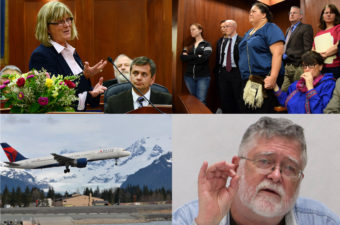
Beth Kerttula, Alaska Native languages, Richard Dauenhauer, Delta
Top left: Former Juneau Rep. Beth Kerttula. Top right: Alaska Native language advocates stage a sit-in at the Capitol. Bottom right: Tlingit scholar Richard Dauenhauer. Bottom left: A Delta plane lands at Juneau International Airport.

A longtime state lawmaker resigned, Alaska Native languages were recognized as official state languages, and a little competition sparked a price war for airline tickets to and from Juneau. Those were just a few of the top stories of 2014 in the capital city.

The year started with the unexpected resignation of one of the state’s longest tenured politicians. After 15 years representing Juneau in the State House, Democratic Minority Leader Beth Kerttula stepped down in the first week of this year’s session. She’d been chosen for an ocean policy fellowship at Stanford University. Kerttula acknowledged the timing was tough, but said it was an opportunity she couldn’t pass up.

“Oceans have been part of my life for a long time and I’ve always had a special place in my heart for these issues,” she said.

The Stanford fellowship led to Kerttula’s current position as director of the National Ocean Council Office for the Obama administration. Sam Kito III was appointed to her old seat and elected in his own right this past November.

During the legislative session, Juneau residents were at the forefront as lawmakers officially recognized Alaska’s indigenous languages. Supporters staged a sit-in protest at the Capitol on Easter. After the bill passed, University of Alaska Southeast Professor Lance Twitchell summed up the feeling in Tlingit.

“We succeeded, we attained,” he said.

As inevitably happens every year, a handful of prominent Juneauites passed away in 2014, including Tlingit scholar and linguist Richard Dauenhauer and journalist Bob Tkacz. Hiker Sharon Buis went missing on Mt. Roberts and was never found, despite weeks of searching.

As befitting the capital city, Juneau residents figured prominently in this year’s elections. Former mayor and Sealaska official Byron Mallott started out as the Democratic nominee for governor, before joining the eventual winning ticket as candidate for lieutenant governor alongside Republican-turned-Independent Bill Walker.

Facing a multimillion dollar budget shortfall, city officials sought to cut spending, but faced backlash over a proposal to close the Augustus Brown Swimming Pool. The pool stayed open, but for the first time in recent memory the Juneau Assembly opted not to fund the Juneau School District to the maximum amount allowed under state law.

There was a change at the top of the school district, with Mark Miller replacing Glenn Gelbrich as superintendent in July. In his first six months, Miller has dealt with the fallout from a high school hazing scandal and made the decision to replace four controversial elementary school texts that some found offensive to Alaska Natives and Native Americans.

A group of concerned residents formed Juneau Votes to increase turnout in the capital city. Voter participation in this year’s municipal election was up 10 points over 2013.

The Assembly is majority female for the first time in city history, after Debbie White and Maria Gladziszewski were elected in October. However, for the first time in more than a decade there’s no Alaska Native representation, as White and Gladziszewski replaced Randy Wanamaker and Carlton Smith.

This summer marked the first time in nearly 20 years that a major air carrier other than Alaska Airlines served Juneau International Airport. Delta provided daily service to the city from the end of May through August. The competition is good for consumers, says Alaska travel analyst Scott McMurren.

“The moment Delta’s rubber hits the tarmac in Juneau, fares will be at historic lows,” McMurren said.

Delta plans to return to Juneau in 2015.

Also this past summer, more than 100 volunteers helped clean up downtown Juneau. The event was organized by the Downtown Improvement Group, a coalition that formed this year to address some of the seedier elements of Juneau and make the city a more attractive place to be. The group plans to continue its efforts in 2015.

Site notifications
Update notification options
Subscribe to notifications