Casey Kelly

Juneau employment down in 2013 as government sector shed jobs

Juneau Federal Building
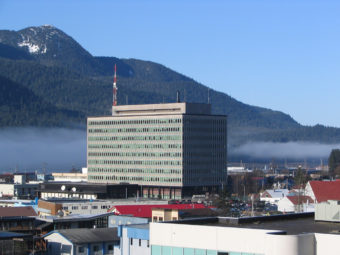
Juneau’s federal building in February 2010. The federal government shed nearly 70 civilian jobs in Juneau in 2013. (Creative Commons photo by Daniel Cornwall)

For the first time in three years, Juneau’s economy failed to add jobs in 2013. That’s according to the annual Juneau and Southeast Alaska Economic Indicators and Outlook report released Tuesday.

The Juneau Economic Development Council’s report says the capital city lost about 240 jobs last year, led by a 2.7 percent dip in government employment. Local and federal jobs accounted for most of the losses in the public sector. The City and Borough of Juneau, the Juneau School District and local tribal government job losses totaled more than 100 positions. Federal government civilian employment was down in the city by nearly 70 jobs.

Juneau’s private sector lost about 40 jobs last year. While the health care, natural resources and mining, transportation and warehousing, and social services industries were all down, those sectors saw increases in total payroll. According to the report, that indicates most of the job losses were lower paying or part-time positions.

Looking forward, JEDC projects no major disruptions to the Juneau or Southeast Alaska economies. Population growth is expected to be slow and the tourism industry will continue to rebound from the recent low year of 2010.

Juneau marks 13th anniversary of 9/11

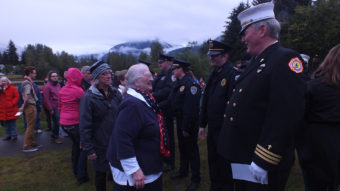
Juneau residents marked the 13th anniversary of the 9/11 attacks on Thursday with a ceremony at Riverside Rotary Park in the Mendenhall Valley.

About 100 people gathered around the park’s Sept. 11 monument to honor those who died and those who were called to serve as a result of the worst act of terrorism ever on American soil.

Speakers included Charity MacKinnon, president of the Juneau-Glacier Valley Rotary Club, Capital City Fire/Rescue Chaplain Dan Wiese, Eagle Scout candidate Konnor Mueller and volunteer firefighter Carl Bottorf. Alyssa Fischer sang the national anthem, while the Juneau Police Department Color Guard raised the United States flag to half-staff. Retired JPD Captain and Juneau Assembly member Jerry Nankervis laid a wreath on the 9/11 memorial.

Many of those who attended the ceremony were veterans or Juneau’s first responders.

Milliron declares write-in candidacy, creating three-way contest for school board

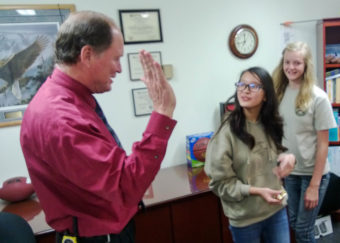
Principal Tom Milliron high fives some Floyd Dryden Middle School students in his office on Sept. 19, 2013. (Photo by Jeremy Hsieh/KTOO)
Then-principal Tom Milliron high fives students in his office at Floyd Dryden Middle School on Sept. 19, 2013. Milliron retired at the end of the school year. (Photo by Jeremy Hsieh/KTOO)

Former Floyd Dryden Middle School Principal Tom Milliron has thrown his name in the hat as a write-in candidate for Juneau School Board.

Milliron says he wants to give voters more of a choice at the Oct. 7 municipal election. While his name won’t appear on the ballot, his entry into the race means there are now three candidates vying for two open seats on the board. The others are school board vice president Sean O’Brien and Brian Holst, who’s seeking his first term on the board.

Milliron says the overall message of his campaign will be to improve student achievement. One way he thinks that can be done is by improving relations between the district administration and employee unions.

“Embrace really a more maybe one-team approach to the bargaining process,” Milliron says. “Because when we see the process deteriorate to what it did with JEA over the last couple years, it really has a direct impact on our kids in the classroom, and just I think doesn’t feel that good at the individual school level.”

In January, the district and its teachers’ union, the Juneau Education Association, reached a two-year contract agreement that goes through June of next year. Prior to that teachers had been working without a contract since July 2013, and the previous contract was a one-year deal.

Milliron also weighed-in against a middle school sports travel ban passed by the school board last year. The issue raised the ire of many in the community, and Milliron says it showed how important it is for the board to communicate clearly to the public.

Milliron retired at the end of last school year after 13 years as principal of Floyd Dryden. He’d previously been the school’s assistant principal and a math teacher at Juneau-Douglas High School.

He turned in his official write-in paperwork to the city clerk’s office on Friday. Clerk Laurie Sica says the paperwork simply ensures that ballots cast for Milliron will be counted. Voters will cast two votes for school board. The top two vote-getters will be elected.

Hart drops out of Juneau Assembly race, endorses Warren

CBJ Assembly Districts
Candidates for Juneau Assembly run for either District 1, District 2 or Areawide seats. Voters cast ballots for all Assembly seats, regardless of where the voter lives. (Image courtesy City and Borough of Juneau)

Karla Hart is dropping her bid for Juneau Assembly.

Hart was going to be one of five candidates for Assembly District 2 on the Oct. 7 municipal election ballot. But she withdrew from the race Tuesday, saying she’ll support Joshua Warren for the seat.

Hart says she and Warren share a common vision for Juneau’s future. She also thinks the 31-year-old can be a voice for millennials on the Assembly.

“I run into millennials who are doing amazing things, and who are approaching problems in new ways,” says Hart, who’s 54. “And I think that they are going to be the ones who are going to bear the fruit or the burden of the decisions that are made by the Assembly now.”

With Hart leaving the race, the candidates for Assembly District 2 are Warren, Debbie White, Kory Hunt and David Fox. The seat is currently held by Assemblyman Randy Wannamaker, who’s not seeking re-election.

Juneau’s municipal election also features a three-way race for areawide Assembly between Norton Gregory, Maria Gladziszewski and Tony Yorba. That seat’s currently held by Carlton Smith, who’s stepping down after serving one term.

Jesse Kiehl is unopposed in his bid for re-election to an Assembly District 1 seat.

Juneau voters cast ballots for all assembly seats, regardless of where the voter lives. District 1 includes downtown, Douglas Island, Lemon Creek and the Juneau Airport area. District 2 encompasses the Mendenhall Valley and out the road.

State ferry union averts strike

ferry LeConte
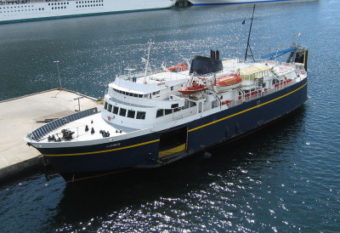
Alaska Marine Highway ferry LeConte docked in Skagway, 2009. (Photo by JWebber/Wikimedia Commons

Alaska Marine Highway System captains and deck officers have avoided a strike that could have shut down ferry service across the state this weekend.
Instead, the International Organization of Master, Mates and Pilots will return to the bargaining table with state officials. Earlier this month, the union rejected a tentative contract agreement that included no pay increase this year, a 1 percent raise next year and a 2 percent increase in 2016. MMP asked the state to reopen negotiations, or members would go on strike this Saturday.

Union representative Ron Bressette says the proposed wage increase does not go far enough, and will force members to continue working overtime.

“They have to man the ships and they just don’t have adequate personnel to do that anymore,” Bressette says. “So one of the concerns is that they have to look at paying the deck officers enough and paying them an industry standard wage in order to recruit and retain new deck officers as well as keep the deck officers that they currently have.”

Administration Commissioner Curtis Thayer says Alaska Marine Highway workers are already well compensated, and the state needs to shrink the agency’s growing budget.

“They’re in line with what has been accepted with the other bargaining units across the state. The wages are the same,” Thayer says. “The state is in a fiscal situation where we don’t have a lot of money to give.”

Both sides have signed an agreement to reopen negotiations as soon as possible with a federal mediator. If mediation fails, language in the agreement says either party could declare an impasse, setting up binding arbitration.

Masters, Mates and Pilots represents about 100 licensed captains and deck officers.

The largest union for state ferry workers agreed this week to a contract similar to the one rejected by MMP. The Inlandboatmen’s Union of the Pacific represents about 650 Alaska Marine Highway employees. A third ferry workers’ union – the Marine Engineers’ Beneficial Association – has yet to vote on its tentative contract agreement.

Juneau police reach community one cup of coffee at a time

Coffee with a Cop
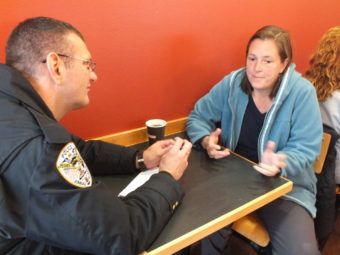
Downtown resident Noelle Derse talks with Juneau Police Chief Bryce Johnson at Coffee with a Cop. JPD started the program this week to improve outreach to the public. (Photo by Casey Kelly/KTOO)

With the recent unrest in Ferguson, Mo., police departments across the country are under a lot of scrutiny. Questions are being raised about use of force, police militarization and racial profiling.

Against that backdrop, the Juneau Police Department this week launched a new outreach program.

Coffee with a Cop

It’s a busy Wednesday morning at the Heritage Coffee shop on 2nd Street in downtown Juneau. A mix of tourists and locals are sipping lattes and eating fresh-baked treats.

Police Chief Bryce Johnson sits at a table near the front door, talking with Noelle Derse. The young mother of three lives downtown and says she loves it. But she feels like the area is kind of sketchy.

“A couple of years ago it was really bad, broken windows all the time,” Derse says. “Every Saturday morning when we took our walk, just filth and vomit and feces and everything all over the streets.”

Derse says she came to Coffee with a Cop to talk to police about increasing patrols in her neighborhood. Overall, she thinks the Juneau Police Department does a good job.

“They work really well one-on-one with people,” she says. “I just want more. I want to see them more. I want to know they’re out here.”

Larri Spengler is with the Thane Neighborhood Association, a community watch group for residents who live a few miles outside downtown. She calls JPD officers helpful and approachable, and says events like this foster good relations between the police department and the community.

“Especially with recent publicity in the nation about police troubles, I mean, I don’t think we have that sense of that here,” Spengler says. “And this kind of thing would help even make it less likely that people would think of the police as other.”

Juneau Police Department Information

Online:
www.juneaupolice.com
www.juneaucrimeline.com

Phone numbers:
Emergency – 911
Non-emergency – 586-0600

Not a police state

At a recent interview in his office, Chief Johnson says he’s followed the events in Ferguson through the media. He’s thought a lot about how he would handle a similar situation, and says it’s important for people to remember that there are a lot of unknowns. But he says one lesson is “we (police) need to learn how to better communicate with the public in general and with the media.”

Since coming to Juneau a little more than a year ago, Johnson has consistently talked about wanting police to be an open and trusted part of the community.

“We don’t live in police states. They call it a thin blue line for a reason,” he says.

Johnson brought the Coffee with a Cop idea with him from Salt Lake City Police Department, where he worked for 20 years. He says trust is important because cops are only part of the crime prevention puzzle.

“When you look at what causes crime it has a lot to do with economic opportunity, it has to do with family status, it has to do with drugs and alcohol,” Johnson says. “These are all problems that the police department cannot fix. So what we have to do is we have to partner with other community agencies, other community entities, other people, and be part of a solution.”

Police militarization

One of the biggest criticisms leveled at police in Ferguson has dealt with the militarization of law enforcement. Johnson thinks that’s an unfair characterization. He says the Juneau Police Department has received some surplus military gear from the federal government. But he says it’s only used under special circumstances and always to ensure the safety of officers and the public.

“I don’t think it is a bad thing the police department is getting this type of protective equipment,” Johnson says. “I think a better conversation would be when do you use it, when do you deploy it?”

Coffee time

Back at the coffee shop, downtown patrol officer Jim Quinto says he doesn’t feel much negativity or hostility toward Juneau police. Quinto grew up here and has been on the force for 17 years. He says efforts like Coffee with a Cop will only improve communication between the department and residents.

“Like when I walk around, I’m constantly going into stores and saying hi to people,” Quinto says. “Just so they know that we’re out there.”

JPD hopes to make Coffee with a Cop an ongoing program with events every month or two in different neighborhoods. Johnson says it doesn’t cost anything, and hopefully it’ll make the department more accessible.

*Editor’s note: This story originally said Larri Spengler was president of the Thane Neighborhood Association. In fact, she’s secretary.

Site notifications
Update notification options
Subscribe to notifications